PART 1
My father carried the same faded red thermos for thirty-two years. It went with him to the gravel quarry where he worked, sat on the workbench in his garage, and rode on the passenger floorboard of his pickup truck. When Dad died of congestive heart failure at seventy-four, my older brother, Greg, took charge of clearing the house. Greg rented an eight-yard dumpster for the driveway and three cardboard donation boxes for the porch. By Sunday afternoon, Dad’s closet was stripped bare.
I walked out to the porch while Greg was loading trash bags into his trunk and saw the thermos sitting in a box marked kitchen junk. The red paint had chipped down to gray steel around the neck, and the plastic handle had been cracked and glued with epoxy back in 1994.
“You’re giving this away?” I asked.
Greg barely glanced up from his trunk. “It’s an old dented bottle, Claire. Nobody uses those anymore. Just let the truck take it.”
I pulled it out of the box and put it in my front seat. Greg rolled his eyes, but he did not argue. He was already talking about listing Dad’s two-bedroom ranch house on the county line, calculating how fast an estate sale company could liquidate the tools. Greg had always been in a hurry whenever Dad’s money was within reach.
For four months, the thermos sat on the open shelf above my washing machine. I used it as a simple reminder, nothing more. Then, on a Tuesday morning in October, I knocked it over while reaching for a bottle of laundry detergent. When it hit the linoleum, something clicked hard against the bottom metal casing. It sounded like a loose bolt.
I picked it up and shook it. The glass vacuum liner inside was intact, but something heavy shifted in the hollow base. I turned it upside down. The steel bottom plate had two tiny notches Dad had worn smooth over decades. I worked my thumbs into the grooves, pressed down hard against the spring tension, and turned it counterclockwise.
The plate gave way with a dry rasp. Inside the hollow space beneath the glass cylinder sat a tight cylinder of yellowed paper secured by a red rubber band that snapped the moment I touched it.
There were two sheets torn from Dad’s pocket ledger. On the first page, Dad had drawn a line down the center in blue ballpoint ink. On the left side were years and reasons. On the right side were exact dollar amounts written in his stiff, neat handwriting.
1998 – Greg court fine and impound: $2,400.
2003 – Greg first clinic stay: $6,500.
2007 – Greg shop lease bail-out: $11,200.
2012 – Greg second clinic: $8,000.
2016 – Greg back rent and lawyer: $14,500.
The numbers ran down the page, total after total, adding up to $78,600 across twenty-four years. Every time Greg had hit a wall, he had come to Dad’s kitchen table with excuses and promises. Dad had paid every cent from his wages and later from his modest pension, never saying a word to me.
At the very bottom of the page, Dad had drawn a solid double line. Beneath it, he wrote my name.
Beside it, in ink that looked fresher, he wrote: “She never asked.”
My hands shook as I unfolded the second sheet of paper. It was not another list. It was a handwritten letter addressed to the branch manager at First State Bank in town, dated three weeks before Dad went into hospice. The first line was underlined twice: “Under no circumstance is Gregory to be present or notified when Claire opens box 114.”
Stapled to the back of the note was a small brass key.
PART 2
I stood by my washer for twenty minutes just reading those three words: “She never asked.”
It was true. When my husband, Mark, was laid off during the housing slowdown in 2009, we cut our grocery bill to seventy dollars a week and took on night shifts cleaning office suites. Dad had offered fifty dollars once for gas, and I had handed it right back to him, telling him we had things covered. I thought I was protecting him. All along, Greg had been draining Dad’s savings with both hands, leaving Dad to balance the ledger in secret inside the only object he never let out of his sight.
I wanted to call Greg right then. I wanted to read every line off that ledger into the phone and ask him how he slept at night knowing Dad had spent his retirement bailing out grown-man mistakes. But Dad’s note was specific. It gave instructions, not permissions.
The next morning, I took Dad’s note, the brass key, and his certified death certificate to First State Bank on Elm Street. The bank had been bought out twice over the years, but the vault in the basement remained the same heavy steel safe from 1968.
A loan officer named Mrs. Gable looked at the paper, checked my driver’s license against Dad’s signature card, and walked me down into the safe deposit viewing room. The room was narrow, furnished with a single vinyl chair and a laminate desk under fluorescent lights. Mrs. Gable brought out a long, narrow metal box, set it on the desk, handed me the second bank key, and stepped outside to close the door.
My fingers were cold when I turned the key.
Inside box 114, there was no stack of hundred-dollar bills. There was no secret insurance policy. What sat in the bottom of the steel tray was an unsealed manila envelope labeled “For Claire Only,” a small velvet jewelry box, and a signed deed from 2004.
I opened the deed first. It was for sixty-two acres of wooded timberland in northern Mercer County, ground Dad had inherited from his grandfather. Greg and I had visited the cabin on that property twice as children, but Dad had told both of us twenty years ago that he had sold the parcel to pay off property taxes.
Attached to the deed was a county property tax receipt marked paid through current year, along with a certified quitclaim deed naming me as the sole owner upon Dad’s death.
Inside the envelope was a letter in Dad’s familiar block print.
“Claire,” it read. “Greg thinks this land was sold to keep him out of county jail in ’04. I told him that lie so he would stop asking for pieces of it. The quarry paid me a buyout when they modernized the crusher, and I used that money to save the parcel instead. I knew if Greg knew the land existed, he would find a way to mortgage it away. You took care of yourself, you took care of your family, and you never looked at my wallet like it was an open tab. This ground is yours. Do not give him an inch of it.”
Inside the small velvet box was my mother’s engagement ring. Greg had spent the last six months claiming Dad had sold Mom’s diamond during her final hospital stay.
I sat alone in that small bank room and wept, not out of sadness, but from the sudden, sharp weight of knowing how long Dad had stayed silent just to keep peace in a family that was already broken.
PART 3
Two days later, Greg called while I was looking over the surveyor map of the Mercer County property.
“The listing agent called,” Greg said, his voice brisk and impatient. “The house in town will clear probate next week. After the cleanup fees and the mortgage balance, we should split about thirty thousand each. I need you to sign the listing authorization tonight. I have a buyer lined up for a cash close.”
“I am not signing anything tonight, Greg,” I said quietly.
“What are you talking about?” he snapped. “We need the cash. I’ve got bills coming due on my truck and the shop.”
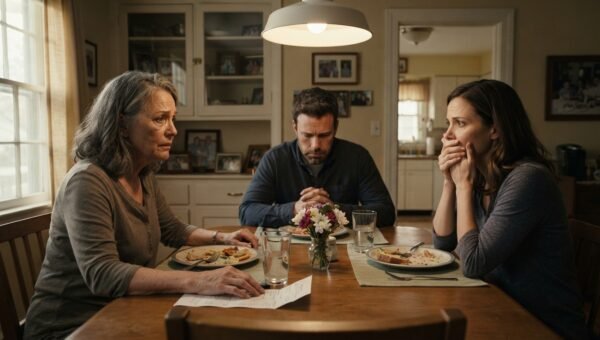
“You always have bills coming due,” I replied. “Come over to my kitchen table. We need to talk.”
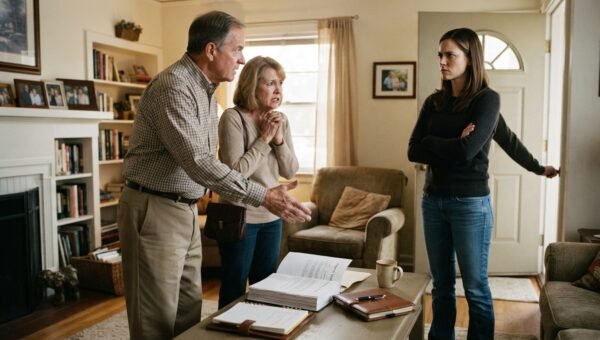
He arrived forty minutes later in a sour mood, slamming the screen door and dropping his keys on my counter. “I don’t have time for a sit-down, Claire. Just sign the paperwork so the broker can put the sign in the yard.”
I did not say a word. I simply slid the two pieces of ledger paper across the table toward him.
Greg picked up the first sheet. His eyes flicked across the dates and amounts. I watched his jaw tighten when he hit the line from 2007, then the line from 2016. His face lost its color, but his expression turned defensive almost immediately.
“Where did you get this?” he asked, his voice low and sharp.
“Out of the thermos you threw in the donation box,” I said. “Seventy-eight thousand, six hundred dollars, Greg. That was Dad’s entire pension cushion. You bled him dry every time you made a mess, and then you had the nerve to tell me he died broke because of the hospital.”
“He was my father,” Greg said, leaning over the table with his hands flat on the wood. “A father helps his son. I had bad luck. He understood that. What does this matter now anyway? He’s gone.”
“It matters because of the rest of it,” I said.
I laid the copy of the Mercer County deed on top of the ledger.
Greg looked down at the header. He read the county parcel number, and then he froze. “He sold this. He told me the lawyer took this in 2004.”
“He lied to you, Greg,” I told him plainly. “He kept it in his name, he paid the taxes every November in cash, and he transferred it directly to me through a transfer-on-death deed. It was never part of his estate. It doesn’t go through probate. It doesn’t get split.”
Greg’s face went red. “That land is worth over two hundred thousand dollars in timber alone! That belongs to both of us. He was losing his mind at the end, Claire. You coerced him. I’ll contest it.”
“Read the bottom of the bank note,” I said, pointing to the carbon copy. “Dad had his attorney, Sam Miller, notarize his capacity evaluation three weeks before he went into hospice. Sam has the original affidavit on file. Dad explicitly stated that every dollar he gave you over thirty years was considered an advancement against your inheritance. If you contest this deed, Sam files the full accounting against your half of the house in town. You won’t get thirty thousand, Greg. You will owe the estate forty-eight thousand.”
The kitchen went dead quiet. Greg stared at the paper, then at me. For the first time in my life, he had nothing clever to say. There was no excuse to offer, no promise to turn things around, and no old man in a flannel shirt to write him another check.
ENDING
Greg did not contest the deed. He signed the final closing papers on Dad’s small town house through an email link from his phone, never showing up to the attorney’s office in person. When the estate account settled, Greg received his fifteen thousand dollars, paid his truck arrears, and stopped answering my phone calls. We have not spoken since Thanksgiving.
In late spring, Mark and I drove three hours north to the Mercer County parcel. The dirt road was overgrown with sweetgum saplings and wild blackberry briars, but the small cedar cabin near the creek was still solid. The tin roof had kept the interior dry.
Inside on the pine mantel, Dad had left an old pair of leather work gloves and a tin of matchsticks.
I took the red thermos out of my coat pocket and set it right in the center of the mantel. The chipped paint and the cracked handle did not look like junk anymore. It looked like twenty-four years of quiet patience, kept safe by a man who knew how to wait out the truth.
I left the thermos there on the shelf, locked the front door behind us, and walked down toward the creek with my husband in the quiet woods that Dad had saved for me.