PART 1
My husband, David, spent thirty years rolling his eyes whenever Anne called our house.
If she came over for Sunday coffee, he found an excuse to work in the garage. If she stayed for dinner, he ate fast and carried his plate to the sink without saying five words to her. He always told me she took up too much of my time. He called her dramatic. When she called me in tears over a bad muffler or a broken furnace, David would just shake his head and mutter that Anne never learned how to stand on her own two feet.
So when Anne died in her sleep three weeks ago from heart failure at sixty-two, I did not expect David to grieve. He came to the funeral in his dark suit, stood behind me at the cemetery, and held my elbow. He was quiet, but David was always quiet.
The shock hit me four days later.
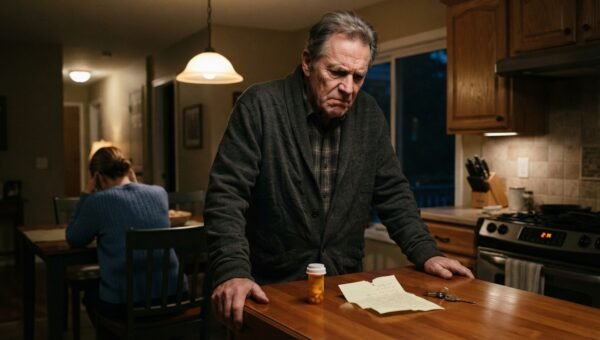
I was sitting at our kitchen table going through our joint checking account statements to do our monthly bills. I noticed an automatic recurring withdrawal of $164 to the county electric cooperative. We pay our electric bill through a different city utility, so the account number caught my eye.
I logged into our bank portal and searched the payee history.
Every single month, on the seventeenth, David had transferred money to that rural electric account. The amounts varied between $130 and $210. It went back twenty-two months.
I called the cooperative directly. The woman on the line told me the service address before I could even explain myself.
It was the brick four-plex on Maple Street. It was Anne’s apartment.
My hands started shaking. I dropped the pen on the table. For nearly two years, while Anne struggled with her health and David complained about her coming over, he had been paying her power bill out of our joint retirement checking.
I felt sick to my stomach. You hear stories about men who pretend to dislike a woman just to cover up what is really happening. I thought about the late evenings he stayed late at his brother’s shop. I thought about the way he never looked at her across the dining table. The secrecy felt like grease on my skin.
When David walked in from the yard with grass clippings on his work boots, I did not yell. I just turned the laptop screen toward him.
“Why have you been paying Anne’s electric bill for two years?” I asked.
My voice sounded thin and dry. “Why would you hide that from me, David?”
David stopped in the doorway. He looked at the screen, then looked down at his boots. He did not get angry. He did not make an excuse. His face just looked tired, the skin around his eyes sagging in a way I had not seen before.
“It is not what you are thinking, Sarah,” he said quietly.
“Then tell me what it is,” I said. “Because right now it looks like my husband was keeping secrets with my best friend behind my back.”
David took a slow breath. He reached into his pocket, pulled out a small brass key, and set it on the laminate counter between us.
“Her nephew is not coming until Saturday to clear the place out,” David said. His voice was thick. “Go to her apartment before the landlord clears it. Look in the kitchen drawer by the refrigerator.”
“David, answer me,” I said.
“Just go, Sarah,” he said, and for the first time in our forty-year marriage, he walked out of the house while I was still speaking to him.
I drove across town with my stomach in knots. Anne’s apartment building smelled like old carpeting and lemon floor wax. When I unlocked her door, the living room was still and dim. Her knitting basket sat beside the armchair. Her reading glasses were on the end table next to a half-empty box of peppermint tea.
I walked straight to the small kitchen. The second drawer beside the refrigerator was full of take-out menus, rubber bands, and coupons. Pushed all the way to the back was a thick manila folder.
Across the front, in Anne’s neat, looping handwriting, was my name: *Sarah.*
I pulled it out and set it on the counter. Inside were copies of hospital bills, receipts, short handwritten notes on yellow legal pad in David’s handwriting, and one sealed white envelope.
My name was on the envelope too.
I tore the flap open with an unsteady thumb. Anne’s handwriting covered two pages of lined notebook paper.
The first sentence read:
*Please don’t blame him. I made him promise not to tell you what your test results really showed.*
The air went completely out of my lungs.
I stopped reading. I did not look at the second sentence. I reached for my phone with trembling fingers and dialed Dr. Reynolds at the regional kidney center.
PART 2
The clinic receptionist tried to give me the standard runaround about appointments and doctor availability.
“My name is Sarah Evans,” I said into the phone, leaning against Anne’s kitchen counter so hard the edge pressed into my ribs. “Two years ago, in October, I went through living donor screening for Anne Miller. I have her medical folder in front of me right now. I need to speak with Dr. Reynolds or the transplant coordinator immediately.”
Something in my voice made the woman stop. She put me on hold. For four long minutes, the only sound was the hum of Anne’s refrigerator and the ticking of the plastic clock on the wall.
Two years ago, Anne went into end-stage renal disease. Her kidneys were failing fast, and she had started dialysis three mornings a week. I had gone to the transplant center in the city without telling David at first. I wanted to give her one of mine. We had been friends since seventh grade. We had shared apartments in our twenties, held each other’s babies, and buried our parents. Giving her a kidney felt like the most natural thing in the world.
David had been furious when he found out. We had our worst fight in thirty years in our kitchen. He told me I was sixty years old, that major surgery could kill me, and that Anne always expected the world to carry her burdens. I went through the testing anyway.
Three weeks later, the nurse coordinator called me with the results. She told me I was disqualified, that my tissue type was not an acceptable match, and that the evaluation was closed. I had cried in Anne’s living room for two hours, apologizing over and over for having useless blood. Anne had just hugged me, stroked my hair, and told me it was okay.
On the phone, a click came through the line.
“Mrs. Evans?” It was Dr. Reynolds. His voice was calm, measured, the way specialists always sound. “I pulled your archive file. What is your question?”
“My best friend died three weeks ago,” I said. “I just found a letter she wrote before she passed. She said my husband promised not to tell me what my donor tests really showed. Dr. Reynolds, what did those tests show?”
There was a long silence on the other end. Paper rustled.
“Mrs. Evans, you remember that when a living donor is evaluated, the donor and recipient have separate advocate teams to protect both parties,” he said.
“I remember,” I whispered.
“Your antibody screen and HLA typing were actually an exceptional match,” Dr. Reynolds said quietly. “You were six for six. You were as close to an identical donor as an unrelated person could possibly be.”
My knees gave out. I caught myself on the edge of the sink.
“Then why did you turn me down?” I asked. “You told me we weren’t a match.”
“We told you the match could not proceed,” Dr. Reynolds corrected gently. “During your cardiac clearance, your stress echocardiogram picked up a severe asymptomatic ascending aortic aneurysm. It was nearly five centimeters. You had no symptoms, but putting you under general anesthesia for a major nephrectomy would have carried a catastrophic risk of arterial rupture. You would have likely died on the table.”
I could barely hear him over the pounding in my ears.
“I was going to sit you down that Friday to refer you to a vascular surgeon,” Dr. Reynolds continued. “Anne found out through her advocate that your evaluation had been halted due to a life-threatening donor finding. She went into our coordinator’s office in tears. She demanded that we withdraw her as a recipient for you before you ever found out.”
“Why?” I choked out.
“Because she knew you,” the doctor said. “She told us that if you found out you were a perfect match, you would spend months trying to find a surgeon reckless enough to clear you. She said you would refuse to fix your own aorta until you found a way to save her first. She withdrew herself so the decision was out of your hands. And your husband came in that afternoon to sign the privacy release for your vascular consult.”
I thanked him somehow and hung up.
I sat down on the linoleum floor of Anne’s kitchen, pulled her letter from my lap, and read the rest.
PART 3
*Please don’t blame him,* Anne wrote. *I made him promise not to tell you what your test results really showed.*
*David came to the clinic that day looking ready to take my head off. He thought I was pressuring you. He thought I was going to let you cut yourself open for me. But when he sat in that little consultation room and the doctor told him about the bulge in your heart artery, David didn’t yell. He broke down right in front of me.*
*He sat in that plastic chair with his head in his hands and cried like a child. He kept saying, ‘She thinks she is saving you, and she is walking around with a bomb in her chest.’*
*I told him right then that I was withdrawing my name. I told him we had to let you believe you just weren’t a match. You have spent your whole life trying to fix everything for everybody, Sarah. If you knew your kidney could save me, you would have fought every doctor in the state, and you would have died. I couldn’t live with that. Even if it gave me ten more years, I would have died of grief anyway.*
*David hated me for a long time because he thought you loved me more than your own safety. But that day, he looked at me and said, ‘You just saved my wife’s life.’*
*When I had to drop down to part-time at the library because the dialysis wiped me out, I couldn’t keep up with the rent and the utilities. David found out from the social worker. He came over here on a Tuesday, mad as hell, with a checkbook in his hand. He told me that as long as I kept my mouth shut so you wouldn’t worry, he would make sure my heat and lights never got turned off. He said it was the only debt he had ever owed in his life that he couldn’t pay back.*
*Don’t be mad at him, Sarah. And don’t be mad at me. You got to live. You got your heart surgery, you got to see your grandson start kindergarten, and you are here. That is all I ever wanted.*
*Take care of him. He loves you so much it scares him.*
The notes from David in the folder were short, scrawled on scrap paper over two years:
*Paid the July power bill. $158.*
*Brought two bags of groceries. Put them in the freezer.*
*Sarah had her six-month heart scan today. Doctor says the graft looks clean. Thank you, Anne.*
I sat in that quiet apartment for an hour. Every ugly, petty thought I had carried over the last four days washed out of me, leaving an ache so deep I could hardly stand up.
I folded the letter, put it in my pocket, and drove home.
The house was dead silent when I walked in. David was sitting in the dark of our living room, his hands clasped between his knees, staring at the braided rug. He looked up when the screen door clicked shut. His eyes were red-rimmed and hollow.
“Did you read it?” he asked. His voice cracked.
I walked across the room, pulled up the ottoman, and sat directly in front of him. I reached out and took his rough, work-calloused hands in mine.
“You knew for two years,” I said.
“I wanted to tell you every single day,” David whispered, his shoulders shaking. “Every time you complained that she looked tired, every time you took her soup, I wanted to tell you. But Anne made me swear on our children. She said if you found out, you would carry the guilt of her dying for the rest of your life. She said the only way you could be happy was if you believed it was just bad luck.”
“You paid her bills,” I said softly.
“I couldn’t let her sit in the cold,” he sobbed. He didn’t try to hide his face. “She gave me you, Sarah. The doctors said if you hadn’t gone for that donor screen, that aneurysm would have taken you in your sleep within six months. Anne gave you back to me. How could I let her struggle alone?”
I pulled him into my arms. We sat together on the floor of our living room and wept for the woman who had loved us both enough to carry the heaviest secret of our lives.
ENDING
We went back to Anne’s apartment the next morning, before her nephew arrived from Denver.
We didn’t take much. Her nephew wanted her furniture and her television, which was fine. I took her recipe tin, the framed photograph of the two of us at the state fair in 1984, and the ceramic blue teapot she used every time I visited.
David walked into her small kitchen, took down her utility bills from the corkboard by the phone, and folded them into his breast pocket. He settled the final account with the electric cooperative that afternoon, paying the remaining thirty-eight dollars out of his own wallet.
That night, for the first time in forty years, David and I didn’t turn on the television after supper.
I set Anne’s blue teapot on our stove and filled two mugs with peppermint tea. We sat at the kitchen table by the back window, watching the sun drop down behind the willow trees, listening to the crickets in the grass.
David reached across the table and covered my hand with his.
“She was a good friend, Sarah,” he said quietly.
“She was the best,” I said.
And for the first time in my life, my husband didn’t roll his eyes. He just squeezed my fingers, looked at the empty chair beside us, and nodded.