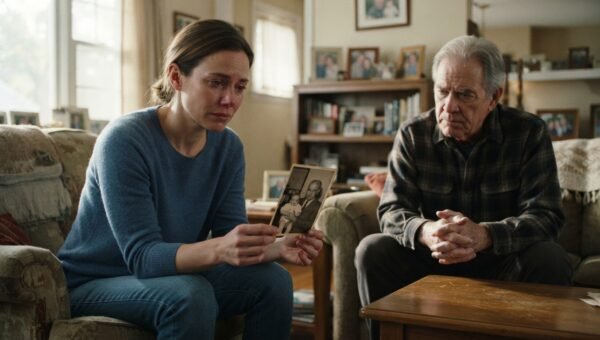
PART 1
Evelyn did not lower her voice when she blocked the aisle. She stood at the end of the front pew in her black wool coat, both hands resting on the varnished wood, and looked right past my shoulder.
“This row is for blood family, Martha,” she said. “The nieces came in from Ohio, and Greg is here with his boys. You can take a seat in the fourth row with the neighbors.”
I had been married to her son David for twenty-six years. I had washed his clothes, managed his insulin, paid the mortgage on our house on Elm Street, and spent the last nine months sleeping in an armchair next to his hospice bed while Evelyn visited twice a month to criticize the dust on the baseboards.
David’s younger brother Greg would not look at me. He just stared down at his funeral program, rolling the paper into a tight cylinder.
People were already sitting behind us. I could hear the organ humming softly from the loft, and the quiet murmurs of our friends from the hardware store David ran for three decades. My knees felt weak. I had not slept more than three hours a night since Tuesday, and the thought of arguing over a church bench in front of two hundred people made my stomach turn sick.
“Evelyn,” I said, keeping my voice down so only she could hear. “I am his wife.”
“Blood is blood,” she answered. She did not blink. Her jaw was set in that same stubborn angle she used whenever she wanted David to write a check for her roof or pay off her delinquent property taxes. “Don’t cause a scene today of all days. Just sit back there.”
I stepped back. My hand touched the edge of the fifth row. Before I could slide into the empty space between our mailman and our former Sunday school teacher, Pastor Miller walked out from the side door near the pulpit.
He was holding a thick, legal-sized manila envelope. He did not go to the lectern. Instead, he walked down the center aisle, his dress shoes clicking against the stone floor, until he stopped right beside me.
“Martha,” he said gently, loud enough to carry across the first five pews. “David came to my study four months ago. He asked me to hold this for you, and he gave me very clear instructions.”
Evelyn turned around, her eyebrows pulled together. “Pastor, this is David’s service. We are ready to begin.”
Pastor Miller looked at her with a steady, quiet gaze. “I know, Evelyn. David told me to hand this envelope to Martha right here at the start of the service, but only if anyone tried to push her out of her rightful place.”
He placed the envelope in my hands. The paper was heavy. David’s handwriting was on the front, neat and deliberate in blue ballpoint ink: *For my wife, Martha. Open only if my mother forgets who carried me.*
My fingers shook as I pulled the brass clasp open.
The first page was a handwritten letter from David. I recognized the blue stationery from his desk drawer.
The second page was folded twice. When I smoothed it against my black purse, Evelyn leaned forward from the front row, squinting through her bifocals.
She saw the county clerk’s gold seal first. Then her eyes locked onto the legal address typed across the top line: 412 Meadowbrook Lane.
It was not our home on Elm Street.
It was her house. The one she had lived in for forty years, the one she constantly bragged had been in her family for three generations.
Evelyn reached out a gloved hand as if to snatch the paper, her voice turning sharp. “Where did you get that? That has nothing to do with this service!”
Pastor Miller put one hand gently on my shoulder and spoke softly, loud enough for the first three rows to hear every word.
“There’s a third page, Martha. You should read it before anyone leaves this sanctuary.”
PART 2
The sanctuary went completely still. Even the organist stopped playing, leaving only the hum of the heater blowing through the floor vents.
Evelyn’s hand stayed frozen in midair, inches from the deed. Her face was flushed dark red above her lace collar.
“This is private family business,” she hissed, looking around as the neighbors in the rows behind us leaned in. “David was confused at the end. The medicine made him confused.”
“David was entirely clear,” Pastor Miller said. “He signed these papers in my presence and in front of an attorney from the county seat on the fourteenth of October. That was two weeks before he ever went into hospice care.”
I unfolded the third page.
It was a standard real estate lease agreement, printed on firm legal bond, backed by an affidavit signed by both David and Evelyn three years earlier. Below it was a notarized revocable occupancy agreement.
The memory hit me with sudden, sharp clarity.
Three years ago, Evelyn had shown up at our kitchen table in tears. Her late husband’s pension had shrunk, the local utility district had placed a lien on Meadowbrook Lane, and the bank was three weeks away from issuing a formal foreclosure notice. She had fallen behind by $48,200 on an adjustable-rate mortgage she took out without telling anyone.
David had spent two weeks reviewing our savings. We had $62,000 put aside for our own retirement. He sat me down on the back porch with our bank book and asked for my blessing to save his mother from losing her roof.
“I can’t let her go to a shelter, Martha,” he told me that night. “She’s difficult, but she’s my mother.”
I had agreed. I signed the withdrawal slip. We paid off the entire mortgage balance of $48,200 and covered the back taxes with county penalties totaling another $7,400.
What David never told me, until this moment, was what he had demanded from Evelyn in exchange.
The deed in my hand was a recorded warranty deed. To protect our family’s life savings, David had required Evelyn to deed 412 Meadowbrook Lane entirely into his name. She had signed the deed over to him in exchange for the payoff, while David granted her a revocable life estate.
The terms of that life estate were spelled out on the third page, in crisp black type.
The occupancy agreement stated that Evelyn could live in the Meadowbrook house rent-free for the rest of her natural life, on two non-negotiable conditions. First, she was responsible for routine maintenance and property insurance. Second, the agreement stated that upon David’s death, sole ownership and full executive control of the property transferred automatically to his surviving spouse, Martha.
Then came David’s personal rider, typed at the bottom and initialed by Evelyn herself:
*If at any point following my death, the designated life tenant refuses to recognize Martha as my legal heir, attempts to contest my estate, or takes public action to exclude or humiliate her, the life estate shall terminate immediately, and full possession shall revert to Martha without cure period.*
Evelyn was staring at the bottom of the page. She recognized her own signature, looped and shaky, next to the notary’s circular stamp.
“He promised me he’d burn that,” she whispered, her voice cracking for the first time. “He promised me nobody would ever see that agreement.”
“He told me he would leave it in my safe deposit box,” Pastor Miller said quietly. “And he told me that if you treated his wife with dignity, she would never even have to know it existed. You could have lived out your days in that house, and Martha would have simply inherited the deed when your time came. But he told me you wouldn’t be able to help yourself.”
PART 3
Greg finally stood up from the front pew. His face was gray. He looked at his mother, then at the deed in my hands.
“Mom,” Greg muttered, his voice tight. “Did you sign the house over to Dave?”
“He forced me!” she spat out, turning on her younger son. “I had nowhere else to go! He took advantage of his own mother!”
“No, Evelyn,” I said. My voice was surprisingly steady. All the exhaustion that had been weighing down my shoulders seemed to settle into cold, clean resolve. “David didn’t take advantage of you. You took $55,600 from our joint retirement account. You told the whole town that David was a good son who helped you with paperwork, while you spent the last three years telling his cousins that I was an outsider who married him for his shop.”
She glared at me, but her fingers were trembling against her coat. “You can’t throw me out. That is my home. You wouldn’t dare.”
I looked down at the letter David had written to me on the blue paper.
*Martha,* his handwriting read. *If you are reading this, it means she tried to put you in the back. It means she made you feel like you didn’t belong to me. You gave me twenty-six years of patience, and you gave her our retirement money without a single complaint. The Meadowbrook house is yours. Not someday. Today. What you do with it is entirely up to you. You do not owe her my memory, and you do not owe her your silence. Sit where you belong.*
I folded the letter and placed it into my black purse with the deed and the agreement.
“Pastor,” I said.
“Yes, Martha?”
“I would like to sit down now.”
Pastor Miller nodded. He stepped past me, walked down the aisle, and stood directly in front of the front pew.
“Greg,” the pastor said firmly. “Please take your family and your mother and move to the fourth row. The front pew is reserved for David’s wife.”
Greg didn’t argue. He took his mother by the elbow. Evelyn pulled away from his grip, her mouth opening to speak, but she looked back at the faces in the congregation. Our neighbors, the men David worked with, the women from the auxiliary who had known her for forty years, they were all watching. There was no sympathy left in the room.
She gathered her black purse and shuffled down the aisle, her head ducked low, her heels dragging against the floor. Greg followed with his sons, his eyes fixed on the floor.
I walked to the front row. I sat down in the center of the pew, directly in front of David’s casket, right where the morning light came through the tall amber windows.
The organist began to play again, a quiet, steady version of the hymn David had whistled every morning while shaving.
Pastor Miller walked up the three steps to the pulpit, opened his Bible, and began the service.
ENDING
After the burial at Oakridge Cemetery, the family gathered in the church fellowship hall for the luncheon. Evelyn did not come. Greg told someone she had gone straight home to Meadowbrook Lane, locked the deadbolt, and pulled the front curtains shut.
Two days later, on Thursday morning, Greg drove out to our house on Elm Street. He knocked on the back door and stood on the porch with his hands in his jacket pockets, looking uncomfortable.
“Martha,” he said when I answered. “I didn’t know about the $55,000. I swear I didn’t. She told me Dave helped her refinance through the bank.”
“David didn’t want you to carry the burden, Greg,” I told him. “He carried it himself.”
Greg looked down at his boots. “Is she going to have to leave?”
I invited him inside and set a cup of coffee in front of him. I pulled the legal papers from my sideboard and laid them flat between us.
“I am not going to put an eighty-one-year-old woman on the street,” I said. “David didn’t want that, and I don’t want that on my conscience. But the house is not hers, Greg. It belongs to me. She will sign a standard tenant lease by the end of this month. She will pay the taxes and the insurance every year on time, through your office. And she will never speak a disrespectful word about David or our marriage again.”
Greg exhaled, a long breath that sounded like he had been holding it since the funeral. “She’ll sign it. I will make sure she signs it.”
The lease was drawn up by David’s attorney on Friday and returned to me on Tuesday, signed in Evelyn’s thin, uneven hand. She did not call me. She did not send a card. But every month since then, the tax escrow payment arrives in my mailbox on the first day of the month, signed by Greg as her power of attorney.
Yesterday afternoon, I went through David’s desk in the den.
In the bottom drawer, tucked beneath his old receipt ledgers and extra checkbooks, was an old brass key with a piece of faded masking tape stuck to the ring. In David’s handwriting, the tape said: *Meadowbrook Front Door.*
I held the cold metal in my palm for a moment, then set it down inside the small wooden box on his desk where he kept his watch and his wedding ring.
He had protected me even when he knew his own body was failing. I sat down in his armchair, looked out at the garden we had planted together that spring, and for the first time in nine months, I felt completely at rest.