PART 1
My father stopped calling the afternoon we brought Maya home from the county agency. He didn’t yell, and he didn’t slam the phone down. He just leaned into the receiver with that dry, stubborn rasp of his and said, “Blood matters more than people admit.” Then he hung up.
For seven years, he kept his word like a man guarding a fence line. Every August, a birthday card arrived in our mailbox for my biological son, Leo.
Inside would be a crisp twenty-dollar bill and Dad’s neat, slanted cursive wishing Leo another good year on the baseball field. For Maya, whose birthday was in October, there was never an envelope. Not a postcard, not a ten-cent sticker, not a single word.
When Maya was six, she asked me why Grandpa Thomas only had one stamp a year. I told her some grown-ups had bad eyesight and couldn’t see the whole family at once. It was a clumsy lie, but it was the best shield I could build out of thin air. By the time she turned nine, she stopped asking altogether. She simply handed Leo his card from the porch steps, walked back inside, and went up to her bedroom to practice her flute.
Then, three weeks ago, Dad died in his sleep in the small brick house where he had lived alone since my mother passed.
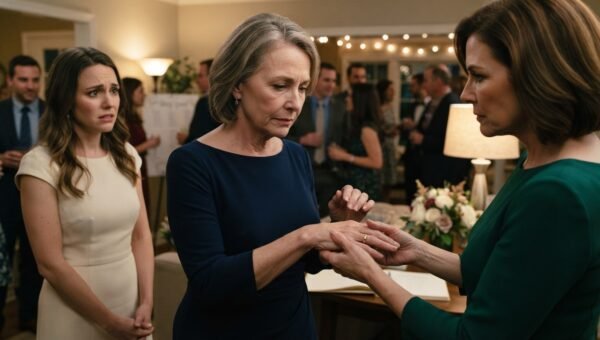
The funeral was small, quiet, and gray. We sat in the third row: my husband David, Leo, Maya, and me.
I hadn’t expected to feel much beyond an old, familiar knot of resentment. But when the service ended and the church hall cleared, Dad’s lifelong friend, Walter Vance, walked over to us. Walter was seventy-four, a retired postal clerk who walked with an aluminum cane and wore a suit that smelled like cedar closets.
He didn’t offer me a handshake. Instead, he stopped directly in front of Maya, rested his weight on his cane, and reached into his coat pocket.
“Your grandfather wanted you to have this,” Walter said quietly.
He handed her a plain white letter envelope. It had no stamp and no address.
Maya looked up at me with wide, hesitant brown eyes. I nodded, though my stomach tightened with sudden anger. I wondered if my father had used his final days to deliver one last bitter reminder from the grave.
Maya slipped her finger under the flap and pulled out a single photograph.
It was a glossy 4×6 print taken from across the street from Lincoln Elementary. In the center of the frame stood my father, wearing his faded brown canvas barn jacket and wool cap, leaning against the chain-link fence near the crosswalk. The timestamp in the corner showed it had been taken six months earlier, in the chilly gray of late October.
Maya turned the print over. On the back, written in black ballpoint pen with unmistakable steadiness, were four words:
*Maya Elizabeth – my girl.*
Beside her middle name, exactly right, he had drawn a small, shaded heart. He had never once spelled her name right in the family group texts my sister used to run, always adding an extra ‘h’ or writing ‘Mia’ until we finally stopped replying.
“He came every Thursday,” Walter said, looking straight at me now. “Rain or shine, Arthur. He sat in my Buick on the corner by the library and watched for the yellow bus.”
My voice came out harsh, cracked with seven years of accumulated grief. “Why? Why would he do that after seven years of pretending she didn’t exist?”
Walter didn’t answer with words right away. His jaw worked silently for a second, his old fingers trembling slightly as he reached deep into the left breast pocket of his coat. He pulled out a thicker, manila envelope, sealed tight with yellowing tape.
“Because he was too cowardly to mail this to your house,” Walter said. “He asked me to give it to you if he didn’t make it to spring.”
Before I could reach across and take it, Maya’s small hands were already tearing through the tape.
PART 2
“Maya, honey, wait,” David said, reaching out to catch her wrist, but the tape had already given way with a dry rip.
Inside the envelope was not a letter. It was a faded, stapled legal document dated October 14, 1954, and beneath it, a small brown leather ledger with worn edges.
Maya pulled out the legal document, but her eyes couldn’t make sense of the dense, typed legal jargon. She looked at me, confused, and held it out. “Dad? What is this?”
I took the paper from her hands. The header across the top was from the Wayne County Probate Court. It was an interlocutory decree of adoption for a four-year-old boy named Arthur Thomas Miller.
My father’s name.
My hands went completely still on the paper. I read the date three times. October 1954. The names of the adoptive parents listed on the decree were Harold and Evelyn Miller, the two people I had grown up calling Grandma and Grandpa Miller. They were farmers outside of Canton. They had buried Harold in 1982 and Evelyn in 1991. Not once in my forty-two years had either of them, or my father, ever breathed a syllable about an adoption.
“He never told you, did he?” Walter said quietly, watching my face.
“No,” I whispered. “He never said a word.”
Walter leaned closer, his voice dropping so the few stragglers leaving the chapel couldn’t hear. “Arthur was four when they took him in. Harold was a hard man. An old-school German farmer who believed blood was the only thing that tied a man to the dirt. Every time Arthur dropped a tool or didn’t move fast enough in the barn, Harold would remind him that he didn’t have Miller blood in his veins, that he was charity from the county home.”
The sanctuary had gone completely cold around us. David stood behind Maya, his hands resting gently on her shoulders, while Leo leaned in from the aisle, staring at the aged yellow paper in my hand.
“Harold told him every single year of his childhood that blood would always win out,” Walter continued, his knuckles white against the grip of his cane. “He told Arthur that an adopted child would always turn away eventually, because you can’t plant an apple tree and expect peach fruit. Arthur spent seventy years trying to outrun that sentence. When you brought Maya home, it didn’t make him angry at you, son. It terrified him. He thought you were setting yourself up for the exact same cruelty he took every day of his youth.”
“So he punished her instead?” I asked, and the anger came back into my throat, hot and sharp. “He made an eight-year-old girl feel invisible because his father was a tyrant?”
“He didn’t know how to look at her without seeing the scared little boy in Harold’s barn,” Walter said. “He told himself he was keeping his distance to protect everyone. But then last winter, his kidneys started failing. The doctor told him he had six months, maybe eight if he went on the machine. He refused the machine. And the very next week, he called me up and said, ‘Walt, drive me to Lincoln Elementary. I need to see if she smiles like Arthur’s mother.'”
Maya looked down at the ledger she was still holding. “Dad,” she said softly, “look at this.”
PART 3
She opened the small brown leather notebook. The pages weren’t filled with a diary. They were filled with bank transaction slips, carefully taped onto the lines in chronological order.
The first slip was dated November 3, 2017, just three weeks after the day we brought Maya home from the social worker’s office. It showed a deposit of $150 into an account under the name *Maya E. Miller, Arthur Miller Custodian*.
Every month for seven years, there was an entry.
December 2017: $150.
January 2018: $150.
March 2020: $200.
August 2022: $150.
Alongside each deposit, my father had written small, tight notes in pencil.
*Saw the photo Arthur’s sister posted. The girl has good, strong shoulders. Needs a real winter coat.*
*Walt says the middle school band needs instruments next fall. Make sure she gets the good silver one, not the rental junk.*
*May 2023: Watched her run the relay at field day. She doesn’t quit when she drops the stick. She picked it right back up. Good girl.*
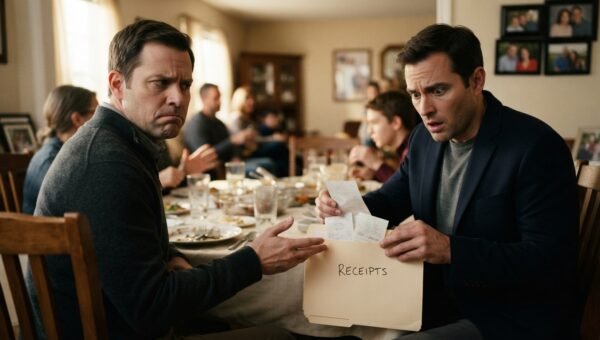
Page after page. Seven solid years of silent deposits, documented month by month, right beside the receipts for the checks he sent to Leo. The total at the bottom of the final page, dated two weeks before he died, was stamped with a certified bank balance: $18,450.
Tucked into the very back pocket of the ledger was a final note, written on the back of an unused birthday card. A card with a cartoon badger wearing a party hat, the exact kind of card he always bought for Leo.
Inside, his handwriting was shaky, the lines wavering from the weakness in his hands during those last weeks.
*Artie,* it read. *I was a coward. Harold told me for twenty years that love without blood was just borrowed time, and I let a dead man’s poison keep me on the other side of your door. I sat by that schoolyard every Thursday because looking at your daughter made me realize Harold was wrong about everything. She didn’t look like an outsider. She looked like my family. She looked like yours. I wanted to walk up to the car and tell you, but every time I reached for the door handle, I felt the shame of seven lost years sitting on my chest like an anvil. If you hate me, you have every right. But don’t let her think she wasn’t wanted. She was the best thing you ever did, and I was too small a man to say it to her face.*
Maya was reading over my arm. She didn’t cry. Her fingers just traced the edge of the certified bank draft for eighteen thousand dollars, then moved to the badger card, touching the wobbly ink where he had written her name.
“He saw me drop the baton,” she whispered. “I remember that day. I cried behind the bleachers because our team got fourth.”
“He was sitting in the blue Buick by the fence,” Walter said softly. “He told me he almost got out that afternoon to buy you an ice cream cone from the truck. He sat there with five dollars in his hand until the parking lot was empty.”
ENDING
We didn’t go to the reception at the funeral home. Instead, David drove us out to the old brick house on Elm Street so Walter could let us in with his spare key.
The house was clean, smelling faintly of lemon wax and stale black coffee. On the small kitchen table where Dad had eaten dinner by himself for fifteen years, there was only one thing sitting beside the salt shaker: a pair of small brass opera glasses, the ones my mother used to keep in her purse for high school choir concerts. Next to them was a yellow legal pad with the school bus schedule printed from the district website, with the 3:15 PM route circled twice in red ink.
Maya picked up the opera glasses. She put them to her eyes and looked out the kitchen window toward the small, overgrown backyard.
“He really came every week?” she asked Walter.
“Never missed one,” Walter said. “Even in January when the snow was halfway up the Buick’s hubcaps.”
We used the money in the account to pay for Maya’s flute lessons and set the rest aside in a college fund under her name, exactly the way Dad had structured the custodial agreement.
The photograph from the school fence now sits on the small bookshelf in Maya’s room, right next to her band medals. It is framed in simple dark wood. Sometimes, when I walk past her door in the late afternoon, I see her sitting on the edge of the bed with that badger card resting on her knee, turning it over to look at the little shaded heart.
My father spent seven years trying to prove his own father right, and in the end, he spent his last six months praying he was completely wrong. He never found the courage to knock on my front door, and there are parts of those seven years that I will never get back, no matter how many pages were in that ledger.
But yesterday was Thursday. Around three in the afternoon, I found myself pulling my car over to the curb across from Lincoln Elementary, right by the public library. I sat there with the motor running, watching the yellow buses line up along the sidewalk, waiting for the bell to ring.