PART 1
My mother told the same story at every Sunday dinner, every graduation, and every time money got tight when I was growing up. She said my biological father, Raymond, walked out on us when I was six years old and never looked back. She said Frank, the quiet man she married four years later, stepped into the wreckage and saved us from losing the roof over our heads.
For forty-four years, I believed every word of it. Frank was the one who checked my oil, bought my winter coats, and paid for my braces. Whenever Raymond came up in conversation, which was rare, Frank would just look down at his hands and say, “Some men aren’t cut out to carry a family, Nora. You just have to be grateful for what’s in front of you.”
I turned fifty last month. Two weeks after my birthday, Frank took a bad fall off a step stool in the garage and broke his hip. While he was in rehab, Mom asked me to go through his metal filing cabinet in the back of the linen closet. She needed the deed to their cemetery plots and the policy paperwork for his supplemental insurance.
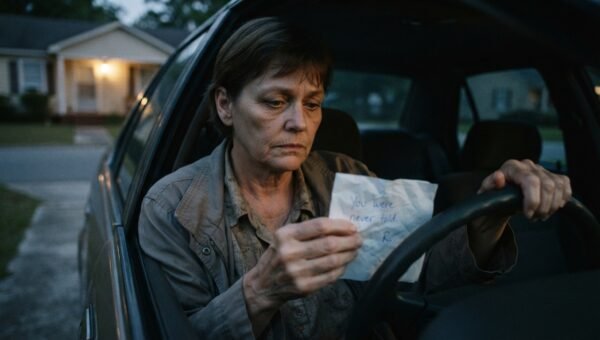
The cabinet smelled like old cedar and rusting brass. Down at the bottom of the second drawer, behind a stack of tax returns from 1994, I found a manila folder with my name penciled in faded graphite across the tab.
Inside was a formal loan agreement dated September 12, 1982.
It was typed on standard legal paper, bearing the seal of a county notary. It stated that Raymond Vance agreed to pay Frank Miller $350 on the first day of every month, designated specifically for my school tuition, books, clothing, and extracurricular fees. Stapled right behind the contract were dozens of carbon copies of bank money orders, each signed by Raymond Vance and made out directly to Frank Miller. There was also a handwritten ledger. It tracked eleven straight years of payments, right up until the month I graduated from high school.
The total came out to a little over $46,000.
I took the folder straight to my mother’s house. She was sitting at the kitchen table, slicing apples into a plastic bowl. When I dropped the open folder on the table between us, her hand stopped moving.
“You told me he never sent a dime,” I said. “You told me Frank carried every single cent on his own back.”
Mom set the paring knife down on the cutting board. Her jaw tightened, the way it always did whenever she felt cornered. “Nora, you don’t know the whole picture. It’s complicated.”
“Complicated?” I pointed at Raymond’s signature on a carbon receipt from my eighth-grade year. “He paid Frank every month. Frank took his money and let me believe my real father forgot I existed.”
The front door clicked open. Frank was supposed to be in physical therapy for another hour, but my brother-in-law had brought him home early. He came shuffling into the kitchen with his aluminum walker, his tennis shoes dragging slightly on the linoleum.
He took one look at the open file, looked at Mom, and stopped. Then he slowly lowered himself into the wooden chair at the head of the table. He didn’t make an excuse. He didn’t ask how I found it.
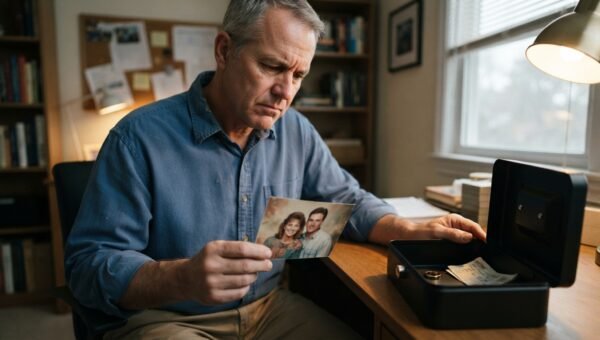
Instead, Frank reached into his back pocket, took out his worn brown leather wallet, and flipped open the center flap. Behind his driver’s license was a small, creased color photograph. He slid it across the wood until it rested against the loan papers.
I picked it up. It was taken outside my high school gymnasium on a muggy June afternoon in 1994. There was Frank in his blue Sunday suit, and standing right beside him by the heavy double service doors was a tall, thin man with graying hair and my exact nose. They were tucked behind the brick column where the crowd couldn’t see them.
“He was there,” Frank said, his voice scratchy and quiet. “He was at more than one thing, Nora. Track meets. Band concerts. He watched from the top row of the bleachers.”
My hands started to shake. “If he loved me enough to pay for me, and he loved me enough to show up, why did you let me hate him my whole life?”
Mom didn’t look at the photo. She stared straight at the salt shaker, her face tight, and whispered, “Tell her why he wasn’t allowed to come inside, Frank. Tell her what that money actually was.”
PART 2
Frank looked down at his knuckles. The silence in the kitchen went on so long that the hum of the refrigerator sounded like a drill.
“The agreement wasn’t a gift, Nora,” Frank said. “And it wasn’t child support. Raymond didn’t pay that money because he had to. He paid it because he wanted to keep a promise he broke years before.”
“What promise?” I asked.
Frank reached out and tapped the manila folder. “When your mother and I got married, Raymond didn’t just walk away. He tried to take you. He had a good job at the limestone quarry back then, and he hired an attorney out of Fort Wayne to file for full custody. He told the judge your mother was unstable because she went to the county clinic for depression after her brother died.”
I turned to Mom. Her hands were pressed flat against her apron. She refused to meet my eyes.
“He almost won,” Frank continued. “Your mother didn’t have a dime of her own, and my income at the transmission shop barely covered the rent on our two-bedroom house. The court appointed an investigator. Raymond had money, he had family in the county, and he had a lawyer who knew how to make your mother look unfit.”
“So you bought him off?” I asked, my voice rising. “You let him pay you to stay away from me?”
“No,” Frank said firmly. “Look at the first page again. Look at the date.”
I pulled the first sheet closer. September 12, 1982. I was eight years old.
“That wasn’t when we settled custody,” Frank said. “Custody was settled in 1980. The judge gave full custody to your mother, but gave Raymond visitation every other weekend and four weeks in the summer. For two years, he picked you up on Friday nights and brought you back Sunday afternoon.”
My mind raced back to being seven or eight. I remembered a blue pickup truck. I remembered a small yellow house with a porch swing, and a man who smelled like sweet tobacco and sawdust. But those memories had always felt like dreams because Mom spent decades telling me Raymond vanished right after the divorce.
“He didn’t vanish,” I said slowly. “I remember the yellow porch. Why did the visits stop?”
Frank looked at Mom. “Helen, you want to tell her, or do you want me to read the third page?”
“The file had two pages,” I said, flipping the contract over. “Just the terms and the signature page with the notary stamp.”
Frank shook his head. He pulled his walker closer, leaned his weight onto his forearms, and stood up. He walked slowly down the hallway toward the master bedroom. Mom didn’t move. She kept her eyes fixed on the cutting board.
“Mom,” I said. “What was on the third page?”
“He was dangerous, Nora,” she said, her voice dropping to a harsh hiss. “You only remember the swing. You don’t remember him coming to my porch at midnight pounding on the storm door. You don’t remember him threatening to put you in his truck and drive across state lines so I’d never see you again.”
“If he did that, why didn’t you call the police? Why did you sign a contract to take his money every single month?”
“Ask Frank,” she snapped, her eyes shining with sudden anger. “Ask your precious stepfather who came up with the idea.”
Frank shuffled back into the kitchen. In his left hand, he held a single sheet of faded blue-lined legal paper, folded into quarters. The edges were worn soft, like it had been folded and unfolded a hundred times.
He laid it flat on the table in front of me.
“This is the page your mother made me take out of the folder when we filed our papers in ’94,” Frank said. “She told me to burn it. I couldn’t do it.”
PART 3
I smoothed the blue page with my palm. The handwriting was sharp and uneven, written in blue ballpoint ink that had faded to purple.
It was an addendum, signed by both Frank Miller and Raymond Vance, dated the exact same afternoon as the loan agreement.
The text didn’t talk about custody. It talked about a debt.
In the spring of 1982, my biological father had caused a three-car wreck on Route 14 while driving under the influence. He had missed his turn coming off the shift, crossed the center line, and struck a station wagon carrying a young couple and their infant daughter. Nobody died, but the medical bills were enormous, and Raymond’s insurance had lapsed two months prior. The civil judgment against him was for $38,000, and criminal charges were pending in county court.
Raymond had gone to Frank, not to Mom.
According to the handwritten notes at the bottom of the page, Raymond had begged Frank for help. If Raymond went to prison, he would lose his house, his job at the quarry, and any chance of keeping his visitation rights. But Frank didn’t have $38,000.
What Frank did have was the deed to his transmission shop, which his father had left him free and clear.
“You mortgaged your shop?” I asked, looking up at Frank.
“I took out an equity loan against the building,” Frank said. His voice was steady, completely without self-pity. “I paid the settlement directly to the clerk of courts so the civil suit was cleared and Raymond got three years of probation instead of three years in state prison.”
“Why would you do that for the man who tried to take your wife’s daughter?”
Frank looked across the table at Mom, then back at me. “Because your father made a deal with me that day. He said, ‘If you keep me out of prison, I will never let Nora know her father is a convicted drunk who almost killed a baby. I will pay you back every dime through a private school fund so she has a college account, and I will step back until I have five years of clean sobriety.’ That was the deal.”
The room felt completely hollow.
“He kept the payments going,” I whispered, staring at the thirty-six carbon slips. “He paid back every dime.”
“He did,” Frank said. “Every month. He worked double shifts at the quarry. He never missed a date. When you needed braces in seventh grade, he sent an extra five hundred dollars cash in a plain envelope. When you made the varsity track team, he bought your running shoes through the school coach so you wouldn’t know where they came from.”
“Then why didn’t he come back?” I cried out, the anger breaking through my chest. “Five years of sobriety would have been 1987. I was thirteen! Why did you tell me he abandoned me? Why was he hiding behind the gym doors at graduation?”
Frank looked at Mom. He didn’t speak. He just sat back in his chair and folded his hands over his stomach.
The answer wasn’t with Frank. It was with my mother.
I turned to her. Her face was bright red now, the skin around her mouth pale and pinched.
“Mom?”
“He was an embarrassment, Nora,” she said, her voice shaking with forty years of buried spite. “Look at what he did! He was a drunk who almost killed people. Frank had a clean name in this town. Frank went to church. Frank had a business. If Raymond came back into your life, everybody would remember the wreck. Everybody would talk about how I married a failure who almost went to prison.”
“So you lied to me,” I said. “You told me he didn’t care about me.”
“I protected you!” she yelled, slamming her palm onto the table. The teacups rattled in the saucers. “I gave you a father who didn’t carry shame. I made Frank your father. Raymond agreed to it! When his five years were up, he came to the house, and I told him if he tried to enforce his visitation, I would tell the whole county that he paid Frank off to keep his record clean. I told him I’d make sure you hated him anyway.”
“And what did Raymond say?” I asked, my heart pounding against my ribs.
Frank reached out and touched my arm. “Raymond cried, Nora. He stood on that gravel driveway and told her that if staying away was the only way you could grow up proud and peaceful, he would stay on the other side of the fence. He told me, ‘Just make sure she gets to college, Frank.’ And then he kept sending the checks.”
ENDING
My biological father died nine years ago in an apartment in South Bend. I remember when Mom got the phone call from a county coroner. She had hung up the phone, walked into the living room where I was visiting with my own two daughters, and said, “Well, Raymond passed away. At least he can’t cause any more trouble.”
I didn’t go to his service because I thought he was a stranger who threw me away for forty years.
Sitting in that kitchen, looking at the forty-six thousand dollars in carbon receipts and the picture of Raymond standing by the gym doors, I realized I had mourned a lie my entire adult life. Frank hadn’t lied out of cruelty; he had kept a quiet man’s terrible bargain to keep peace in a house ruled by my mother’s terror of what the neighbors thought.
“Where is he buried, Frank?” I asked.
Mom stood up from the table. “Don’t you go digging up old dirt, Nora. It’s done. It’s over.”
“Sit down, Helen,” Frank said. It was the only time in my fifty years that I ever heard him speak to her with steel in his voice.
Mom stared at him, stunned, then sank back into her chair and pulled her sweater tightly around her shoulders. She looked small, bitter, and completely stripped of the righteous story she had told for half a century.
Frank reached into his shirt pocket, pulled out a small slip of paper, and handed it to me. On it was written the name of a small cemetery two miles north of the quarry, along with a section number.
“He asked me to keep that for you,” Frank said softly. “He told me, ‘When she’s old enough to understand that people make awful mistakes and spend their lives trying to pay for them, give her that.'”
The next morning, I drove out to the cemetery alone. It was an overgrown plot surrounded by silver maples, just off the state highway. The headstone was simple granite, paid for by the quarry union, with his name and his dates: Raymond Vance, 1948 to 2017.
I sat on the edge of the grass and pulled the small graduation photograph from my purse. In the picture, Frank and Raymond were standing shoulder to shoulder in the shadows behind the gym, both of them wearing dark suits, both of them looking toward the stage where I had walked up to take my diploma.
Neither of them had been a perfect man. One of them had made a terrible wreck of his early life, and the other had helped bury the truth to keep a family together. But as I set the photograph against the gray stone, I knew Raymond had never abandoned me. He had stood in the back of the room for thirty years, paying for my life while letting another man take the credit, just so I would never have to carry his shame.
I stayed until the sun went down behind the trees, listening to the traffic on the highway, and for the first time in fifty years, I said goodbye to my father.