PART 1
The hospital discharge planner asked where I was going, and neither of my adult children would look me in the eye.
My son, David, had his arms crossed by the window of the recovery room. He is forty-two, an estimator for a roofing contractor, and he keeps three separate clipboards in the back seat of his truck. He had spent twenty minutes explaining why his split-level house was a liability for someone with sixteen fresh surgical staples in her right hip.
Too many steps up from the garage, he said. A narrow hall. A dog that jumps.
My daughter, Megan, sat in the vinyl armchair with her work laptop open on her knees. She is thirty-eight, manages customer accounts for a regional logistics firm, and lives forty minutes south in a one-story townhouse with zero steps.
“Mom could have the guest room,” Megan had told the nurse earlier, her eyes fixed on an email chain. “Except Greg’s mother is staying until the fourteenth, and the master bath is the only one with a walk-in shower. I would have to bathe her before seven every morning or take unpaid leave.”
“I did not ask either of you to take me in,” I said. My throat was still dry from the anesthesia. “I have lived in my apartment for twelve years. I have a walker with rubber wheels and a pantry full of canned soup. I will manage alone.”
David made a sharp noise through his teeth. “You can’t even stand up to use the commode by yourself, Mom. Be realistic.”
“Then I will sit until I can,” I told him.
They signed the release forms together because the transport van would not move without a family signature. David drove behind the van in his truck. Megan followed behind him in her crossover. When the driver wheeled me through the front door of my ground-floor apartment, my children carried in my plastic hospital bags, set a box of disposable bed pads on the coffee table, and stood in my kitchen arguing about who was going to take the Saturday shift to check on me.
It was not a loving argument. It was the tired, bitter calculation two busy adults do when an aging parent suddenly turns into an unscheduled bill.
“I have youth soccer all Saturday,” David said, leaning against my refrigerator. “You take Saturday. I will come Sunday afternoon.”
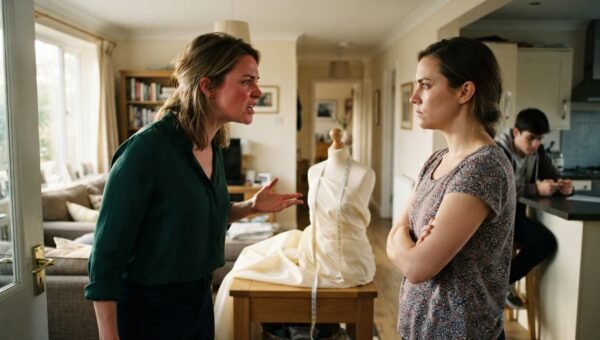
“I did Thanksgiving,” Megan snapped. “And I took off two half-days last week for her pre-op scans. You take Saturday.”
I gripped the armrests of my recliner. The surgical site was a deep, throbbing ache that made my stomach turn.
“Both of you leave,” I said.
Megan stopped. David turned around.
“Mom,” David began.
“Leave the keys on the counter and go,” I said. “I mean it. If I fall, I will press the pendant around my neck. But I am not going to sit in my own living room and listen to you bid on me like bad debt.”
They left within ten minutes. Neither of them hugged me. David tapped my shoulder twice, the way he does with his bowling partners, and Megan promised to text me before bed.
I spent that first night awake, timing my pain medication with a digital kitchen timer, dreading the morning because I knew I could not lift my right leg high enough to clear the shower ledge.
At seven-thirty the next morning, someone knocked twice on my front door, unlocked it with a deadbolt key, and walked in.
Her name was Rosa. She wore maroon scrubs, rubber-soled clogs, and carried a canvas tote bag smelling faintly of fresh rosemary.
“Mrs. Miller?” she called out, setting the tote on my dining table. “I’m with Comfort First Home Services. Let’s get you sitting up before your stiffness sets in.”
I gripped my walker, confused. “I didn’t call Comfort First. I told the hospital social worker I had family helping.”
Rosa did not even blink. She checked my chart on a small tablet, pulled clean nitrile gloves from her pocket, and guided me into the bathroom with hands so steady and practiced I did not feel a single jolt in my hip joint.
“The family contracted us directly,” Rosa said, adjusting the plastic shower bench. “Seven days a week. Three hours every morning. Personal hygiene, wound inspection, light meal preparation, and guided range of motion. Everything is handled.”
Every single day for three weeks, Rosa arrived at seven-thirty sharp.
She stripped my sheets and washed them with unscented detergent. She checked my incision, measuring the redness with a disposable paper tape and writing the numbers in her spiral notebook. When the staples came out at day ten, she massaged the tight scar tissue with vitamin E oil. She peeled carrots, boiled chicken thighs, and left four glass Pyrex bowls of soup lined up in my refrigerator with blue painter’s tape on the lids, each marked with a day of the week.
Whenever I asked her about the bill, or offered to write a check for her mileage, she smiled and shook her head.
“Agency policy, Mrs. Miller,” she told me on a Tuesday morning while helping me practice walking without the cane. “Private client contracts are paid on automatic draw. The family took care of everything.”
David called me twice a week during those twenty-one days. His calls were short, five minutes between job sites, asking if my walker felt sturdy and whether I needed bread. Megan texted every evening at eight: *Hope today was good. Drink your water.* Neither of them mentioned an aide. Neither of them complained about the cost. I assumed they had split the agency fee down the middle, too ashamed of their hospital argument to bring it up to my face.
On a Friday morning, exactly three weeks after surgery, Rosa helped me walk down the carpeted hallway of my building to the mailbox and back. I did not use the cane once. My hip moved clean and solid, without the bone-on-bone grind that had stolen my sleep for four years.
“That’s twenty-one days,” Rosa said, smiling as she packed her blood pressure cuff into her tote. “You have your six-week follow-up on Wednesday, but you’re clearing thresholds ahead of schedule. Today is my last day.”
I felt a sudden tightness in my chest. “You’ve been an angel, Rosa. Truly.”
“You did the hard work,” she said.
After she clicked the door shut behind her, I sat at my kitchen table. I wanted to send a formal note of commendation to her supervisor. I looked up Comfort First Home Services on my phone, found the local branch office in North Olmsted, and dialed the number.
A woman named Brenda answered.
“I’m calling to commend one of your home health aides,” I said, holding a pen over a blank notepad. “Rosa Delgado. She just finished three weeks of post-op care for me, and she was exceptional.”
There was a pause, followed by the rapid clatter of computer keys.
“What is your name, ma’am?”
“Evelyn Miller. On Elmwood Avenue.”
More typing. Then a longer silence.
“Mrs. Miller, I’m showing your initial referral from MetroHealth on the twelfth, but that intake was marked canceled the same afternoon. We never dispatched an aide to Elmwood Avenue.”
I gripped the phone tighter. “That’s impossible. She wore your agency badge. She came every morning at seven-thirty.”
“Rosa Delgado hasn’t worked for Comfort First since last November,” Brenda said, her voice dropping into a careful, formal tone. “She moved into private independent contracting. If someone used our letterhead or badge, ma’am, that didn’t come through our office.”
My hand began to shake against the Formica table.
I hung up, found the small paper appointment card Rosa had taped to my refrigerator three weeks ago, and dialed the cell number written in blue ink.
The phone rang three times.
It clicked open.
“Mom?”
The voice was not Rosa.
It was David.
The background noise was unmistakable: the whine of circular saws and the low rumble of a diesel engine idling.
“David?” I asked, my voice barely above a whisper. “Why are you answering Rosa’s phone?”
There was a heavy intake of breath over the line.
“Please don’t be mad,” he said. “She forwarded her work line to my truck after she clocked out this morning. She wasn’t supposed to tell you who hired her until you could walk again.”
Before I could form another word, the brass lock on my apartment door clicked.
The door swung open. Megan stepped into my entryway, her work bag over her shoulder, holding a manila folder and a white business envelope with a printed invoice sticking halfway out of the flap.
PART 2
Megan kicked the door shut with the heel of her flat shoe. She looked up, saw me standing by the kitchen counter with my phone pressed to my ear, and stopped.
“Who are you talking to?” she asked, dropping her purse onto the entryway bench.
I did not answer her. In my ear, David was still speaking.
“Mom? Are you there? Listen to me, I know how you get about your pride. But after that scene at the hospital, I couldn’t sleep. You couldn’t even reach your own toes to put on socks. If you stayed alone, you were going to fall, break the other side, and end up in a state nursing bed. I had to do something.”
“David,” I said, keeping my eyes fixed on my daughter. “Your sister just walked through the door.”
The line went dead silent.
“What is she doing there?” David asked. His voice lost its defensive warmth instantly.
Megan narrowed her eyes at me. “Is that David? Put him on speaker.”
I pressed the button on my screen and laid the phone flat on the counter between us. “David is on speaker, Megan. What is in your hand?”
Megan did not hesitate. She set the white envelope on the counter right next to my phone.
“It’s the final billing statement for your home recovery,” Megan said, pulling out a typed sheet of paper with a clean accounting header. “I paid the deposit out of my emergency savings three weeks ago, but the remaining balance is due by five o’clock today. It’s two thousand four hundred dollars. I came to ask how you wanted to handle it, or if David was finally going to write his half of the check.”
Through the phone speaker, David let out a harsh, disbelieving laugh.
“What invoice, Megan?” David said, his voice crackling through the tiny speaker. “What the hell are you talking about?”
Megan crossed her arms, glaring down at the phone. “I’m talking about the aide who has been bathing our mother for twenty-one days, David. The one you were too busy to help with. I didn’t want to bring Mom into the middle of it, but since you’re on the line, you owe me twelve hundred dollars.”
“Megan,” I said. My voice was very calm, but the skin across my knuckles was white where I held the edge of the counter. “Who did you hire?”
“Rosa Delgado,” Megan said immediately. “I hired her through an independent caregiver registry the night we brought you home. I gave her our garage code, I set the schedule for seven-thirty to ten-thirty, and I agreed to pay four thousand eight hundred dollars for the three weeks. Twenty-four hundred upfront, twenty-four hundred upon completion.”
She tapped the invoice with her manicured fingernail.
“I’ve got the agency contract right here in the folder,” Megan added, her chin lifted. “Signed by me on May twenty-fourth.”
“May twenty-fourth?” David’s voice roared through the phone. “I met Rosa Delgado in the lobby of her apartment building on May twenty-second! Two days before surgery! I gave her twenty-five hundred dollars in cash from my personal checking account, and I paid her another twenty-five hundred this morning at six-thirty at the Sunoco on 130th Street!”
The kitchen went completely quiet.
The hum of the refrigerator seemed to double in volume. A car passed outside on Elmwood Avenue, its tires hissing against the damp pavement.
Megan stared at the phone. Her face did not soften, but her lips pressed into a thin, bloodless seam. “You’re lying. You didn’t pay her. You never pay for anything upfront. You make excuses until I handle it.”
“I have the withdrawal receipts in my center console, Megan,” David snapped. “Five thousand dollars flat. Rosa told me she had an independent rate of thirty dollars an hour plus mileage. She told me she had an open slot starting the morning of the twenty-third. She took my cash, she signed my receipt on the hood of my truck, and she promised me she would never bring up money to Mom.”
I reached out and pulled Megan’s white envelope toward me.
The header did not say Comfort First. It said *Delgado Care Management LLC*.
The total fee listed was $4,800.
Deposit paid: $2,400 by Visa on May 24.
Balance remaining: $2,400.
Due date: June 14. Today.
I looked down at the paper. Then I looked at the little spiral notebook sitting by my telephone, where Rosa had written down my blood pressure, my pulse, and my surgical measurements every single morning for three weeks.
Rosa had not been sent by an agency.
She had not chosen between my children.
She had taken five thousand dollars in cash from my son in a gas station parking lot, taken twenty-four hundred dollars off my daughter’s credit card, and was now expecting another twenty-four hundred from my daughter before the banks closed today.
She had charged both of my children for the exact same twenty-one days of care, collecting nearly ten thousand dollars for three weeks of morning visits.
“David,” I said into the phone. “Where are you right now?”
“Brookpark Road,” he said, breathing hard. “Heading toward the warehouse.”
“Turn the truck around,” I said. “Come to my apartment. And call Rosa’s personal number from your job phone. Tell her you forgot to have her sign the final tax release for your medical deduction, and tell her to meet you here in thirty minutes.”
“Mom,” Megan whispered, her eyes fixed on the paper in my hands. “Did he really pay her?”
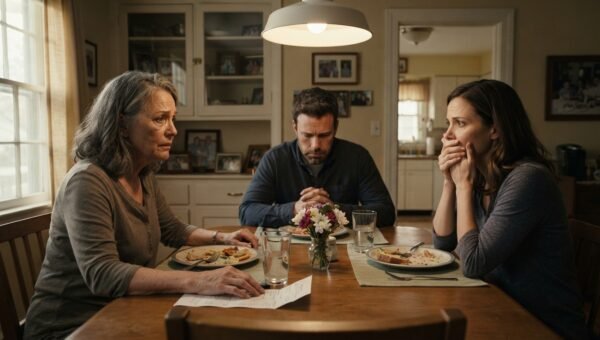
“Both of you did,” I said. “And neither of you had the decency to speak to each other for three weeks to find out.”
PART 3
David arrived twenty minutes later. His work boots left faint dust rings on the linoleum. He didn’t take off his cap. He slammed a green bank envelope onto the counter next to Megan’s invoice.
Inside were two carbon copies of cashier’s checks and two handwritten receipts, signed in looping blue ink: *Rosa Delgado, RN Independent.*
Megan was sitting at the table, her laptop open, staring at her online banking portal.
“She processed the first charge through a Square reader,” Megan said, her voice shaking slightly. “The merchant name is Delgado Services. I thought… I thought David was just doing what he always does. Letting me carry the mental load while he showed up for twenty minutes on Sundays.”
“I showed up on Tuesdays and Thursdays after work, Megan,” David shouted, pointing a thick finger at her. “You wouldn’t know because you never called to check. You just assumed I was useless!”
“Stop it,” I said.
I did not raise my voice, but both of them shut their mouths.
I walked over to the table without my cane. I pulled out my kitchen chair and sat down between them.
“You both sat in that hospital room and treated me like an eviction notice,” I told them, looking from David’s reddened face to Megan’s tight jaw. “You were so terrified that the other one was going to get out of doing their fair share that you couldn’t even look at me. You didn’t hire Rosa out of love. You hired her out of guilt, and you hired her out of spite so you could prove the other one was selfish.”
David looked down at his boots.
Megan blinked, her throat working as she swallowed.
“She knew it,” I continued, pointing at the two documents lying side by side. “She deals with families like us every month. She saw an old woman with two adult children who couldn’t stand being in the same room long enough to coordinate a schedule. She knew you wouldn’t talk to each other. She knew David would hide his cash payments to look like the noble, quiet son, and she knew Megan would file an invoice to hold over his head later.”
A light knock sounded on the front door.
David moved toward the hall, but I stood up and held up one hand.
“Sit down, David,” I said. “I am seventy-one years old. I am not an invalid. I will open my own door.”
I walked to the door, unlocked the deadbolt, and pulled it open.
Rosa stood on the welcome mat. She was no longer wearing her maroon scrubs. She had on a beige trench coat and small gold hoop earrings, holding a leather planner under her arm. When she saw me standing tall without support, she smiled her warm, professional smile.
“Mrs. Miller! Look at you, standing without the cane. David called and said he needed a signature on the deduction paperwork before I closed my files.”
She looked past my shoulder, and her smile vanished.
David was standing by the counter, arms crossed. Megan was standing next to him, holding the printout of the credit card charge.
Rosa did not run. She did not gasp. She simply tightened her grip on her planner, her shoulders dropping about an inch.
“Come inside, Rosa,” I said gently. “Shut the door behind you.”
She stepped into the small entryway. The apartment smelled of the chicken broth she had simmered only yesterday morning.
“You took five thousand dollars in cash from my son,” I said, keeping my voice level. “And you charged my daughter twenty-four hundred dollars on her card, with an invoice for twenty-four hundred more.”
Rosa looked at the counter, then at David, then at Megan.
“I provide specialized private duty nursing,” Rosa said. Her voice was steady, but her eyes darted to the deadbolt behind her. “My standard agency-free rate is seventy-five dollars an hour for post-operative orthopedic recovery. That includes on-call access, dressing changes, and physical rehabilitation.”
“Your standard rate is thirty dollars an hour,” David said, taking a step forward. “You told me that yourself at the Sunoco.”
“And your Square merchant account lists your business as general domestic assistance,” Megan added, her voice cold and sharp. “Not registered nursing. You don’t have an active RN license in Ohio, Rosa. I just checked the state registry on my laptop while we were waiting for you. It lapsed in 2024.”
That was the first time Rosa’s composure cracked. Her jaw tightened, and a red flush crept up the side of her neck.
“I took care of your mother,” Rosa said, her voice dropping into a low, defensive hiss. “I was here every morning at seven-thirty. I cleaned her body when she was crying from the pain of that hip. I cooked her meals. Neither of you were here. You paid for a service, and I delivered it.”
“You delivered twenty-one days of care,” I said, stepping between Rosa and my children. “You were kind to me, Rosa. You were gentle with my hip, and you made good soup. But you stole from my family because you saw our dysfunction and decided it had a dollar value.”
I reached over to the table and picked up the white invoice Megan had brought. I tore it in half, then tore it again, and dropped the pieces into the small wastebasket by the door.
“You will not collect the remaining twenty-four hundred dollars from my daughter,” I told her. “And you will refund the twenty-four hundred dollars you charged to her Visa card right now, using your phone, while we watch.”
Rosa looked at David. “We had an agreement.”
“Refund the card, Rosa,” David said, his voice deadly quiet. “Or my sister calls the Ohio Board of Nursing about your lapsed license, and I take these cash receipts down to the county prosecutor’s office. You took cash under the table for medical care without reporting it. How do you think that looks on a police report?”
Rosa stood motionless for five seconds.
Then she unzipped her purse, pulled out her phone, and opened her merchant application. Her fingers moved quickly across the glass screen.
Megan’s phone chimed three seconds later. Megan looked down, verified the notification, and nodded once.
“It’s refunded,” Megan said.
“Now leave,” I told Rosa. “Leave the keys on the table.”
Rosa took my apartment key off her brass ring, set it on the entryway table without looking at any of us, turned around, and walked out the door. The latch clicked shut behind her.
ENDING
David and Megan stayed in my kitchen for two hours after Rosa left.
For the first hour, they tried to defend themselves. David insisted he had only used cash because he thought it would save time and keep the agency from turning me down. Megan argued that she had used a registered service because she wanted a paper trail for tax season.
I let them talk until their voices ran out of steam.
When the apartment went quiet again, I pointed to the five thousand dollars in cash receipts sitting on the counter.
“David paid five thousand,” I said. “Megan paid twenty-four hundred, which has now been returned. That means David paid for my care entirely out of his own pocket.”
Megan looked down at her hands. Her shoulders were sloped forward, the sharp, defensive posture gone. “I’ll write David a check for twenty-five hundred right now. We split it down the middle.”
David didn’t reach for his pen. He rubbed his face with both hands, leaving a smudge of roofing dust across his forehead.
“Keep your check, Megan,” David said quietly. “I took the money out of my truck fund. I can wait another year for a new transmission.”
“No,” Megan said, her voice cracking. “We split it. I was horrible at the hospital, David. I was thinking about my work reviews and Greg’s mother, and I just… I wanted it off my plate. That wasn’t fair to you. And it wasn’t fair to Mom.”
“Neither of you were fair to me,” I said.
They both looked up at me.
“I spent thirty years raising you to be competent people,” I told them. “I did not raise you to treat me like a logistics problem to be passed back and forth. You spent nearly ten thousand dollars trying to avoid talking to each other for three weeks.”
David looked down at the floor. Megan reached across the table and pushed her checkbook toward her brother.
This time, David didn’t push it back. He took it, tore out the blank check, and handed it to her.
“Write it for twelve hundred,” David said softly. “The five thousand was too much anyway. If we’d talked, we could have hired a licensed daytime girl from the parish for twelve hundred total.”
Megan wrote the check. Her handwriting was shaky, but she signed her name, tore it off, and laid it neatly on David’s green bank envelope.
They left together around four in the afternoon. They didn’t take separate vehicles; David left his truck parked in my visitor slot and rode with Megan in her crossover so they could pick up his kids from soccer practice together.
After they were gone, I walked into my small kitchen.
The silence in the apartment was different this time. It wasn’t the lonely, heavy silence of the night after my surgery, when I had sat by the timer terrified of moving my leg. It was just the ordinary quiet of a Friday afternoon.
I opened the refrigerator.
Sitting on the second shelf was the last glass Pyrex bowl of chicken soup Rosa had made, with the blue painter’s tape marked *Friday* on the lid.
I picked it up, carried it over to the sink, and pulled off the tape.
I dumped the soup down the drain, turned on the hot water, and let the faucet run until the sink was clean. Then I washed the bowl with soap, dried it with a clean dish towel, and put it away in the cupboard.
My hip didn’t hurt at all.