PART 1
I was twelve years old the winter the factory gates locked for good, and my dad came home before the streetlights were even on. He sat at the kitchen table with his coat still buttoned, staring straight ahead at the salt shaker like he had never seen it before. My mother was standing by the stove stirring a pot of thin cabbage broth. Nobody said a word, but the silence had weight.
It settled down over the floorboards and never really left our house again.
Within two months, the pantry was down to plain rolled oats and generic yellow cornmeal. The envelopes from the electric company had red print stamped across the front, stacked beneath a cracked coffee mug by the phone. In the seventh-grade cafeteria at Oak Ridge Middle School, the line for hot lunch smelled like buttered yeast rolls and roasted meat. The other kids carried trays piled with sloppy joes and tater tots, tossing quarters onto the silver metal counter.
I did not have quarters. My mother packed my brown paper sack every morning with half a boiled potato or two dry slices of white bread. By November, there was nothing to put in the sack at all. When the bell rang for lunch, I walked straight past the double doors and headed down the back hallway toward the water fountain near the gym.
I leaned down and drank until my ribs hurt. The cold municipal tap water filled my stomach for twenty minutes, just enough to stop the sharp, hollow ache from twisting up into my throat during fifth-period geography. I stood by the locker bank, wiping my chin with the sleeve of my faded sweater, terrified someone would notice I had not set foot in the cafeteria.
Then came a rainy Tuesday in early December. The last bell rang, and I went back to my homeroom desk to gather my binder. When I unzipped the nylon front pouch of my backpack, a wave of heat hit my face.
Tucked neatly beneath my three-ring notebook was a golden, flaky turnover wrapped in wax paper. It was still warm against my palms. I peeled back the greasy paper with trembling fingers. It was packed with ground beef, diced potatoes, and soft, sweet onions. I looked around the empty classroom, my pulse hammering in my ears.
Nobody was there except Mrs. Gable erasing the chalkboard with her back turned.
There was no note. No card. No folded piece of loose-leaf paper. I stood behind the library bookshelf on my walk home and ate it so fast my eyes watered.
The next morning, when I sat down after the morning pledge, I reached into the pouch just to check. Sitting on top of my pencil case was a crisp, perfect Honeycrisp apple. It was polished until the skin shone, cold to the touch. The day after that, it was a thick sandwich made from crusty homemade bread with shaved ham, sharp white cheddar, and mustard spread evenly all the way to the edges.
It kept happening. Every single week, three or four days out of five, my backpack held real food. Sometimes it was two hard-boiled eggs with a pinch of kosher salt folded into a tiny paper twist.
Sometimes it was a foil packet of leftover fried chicken, seasoned with cracked pepper that tasted like a restaurant meal.
I never caught anyone slipping it in. But by late January, I started watching the room during morning recess.
There was a quiet girl named Joy who sat two rows over and one desk ahead of me. She had soft brown hair pulled back with plain metal barrettes, and she never spoke unless Mr. Henderson called her name directly. Joy always wore clean, neat sweaters that looked hand-knit, and she kept her head down over her sketchpad during free period.
One Thursday morning before the first bell, I dropped my eraser on purpose and knelt down beneath my desk. I watched through the forest of chrome chair legs. Joy walked in carrying her coat, paused beside my desk while pretending to look at the bulletin board, and with a swift, practiced motion of her wrist, slid a wrapped blueberry muffin straight into my unzipped side pocket.
She did not glance back. She did not smile. She just walked to her seat, hung her coat over the back of her chair, and opened her history book.
My chest went tight. I wanted to say thank you, but the shame of needing it kept my jaws locked shut. A boy whose family is falling apart learns early that charity feels heavy, even when it saves you. So I stayed silent, eating what she gave me behind the football bleachers, carrying a debt I knew I had no way to repay.
By mid-March, the spring mud was thawing out. Joy lingered by the locker bank after the dismissal bell. She walked up to me, her knuckles white around her canvas shoulder bag.
“My mom said you should come over for supper tonight,” she said. Her voice was barely above a whisper. “We have pot roast. There’s plenty.”
My first instinct was to say no. I was wearing sneakers with worn-through soles and corduroy pants that were two inches too short. But my stomach had been growling since noon, and the thought of warm beef and gravy was more than my twelve-year-old willpower could fight.
“Okay,” I muttered, looking down at my shoes. “I can stay for an hour.”
Joy lived six blocks away in an older part of town, in a small, painted brick cottage with a white porch railing and blooming yellow crocuses lining the stone walk. The path was swept clean.
I wiped my dirty sneakers thoroughly on the coir doormat. Joy turned the brass knob, pushed the heavy oak door open, and stepped inside.
“Mom,” Joy called out softly toward the kitchen. “He’s here.”
The house smelled like roasted garlic, bay leaves, and warm yeast. I followed Joy through the narrow front hall and stepped onto the polished linoleum of the bright, yellow-walled kitchen.
Standing over the porcelain stove, holding a wooden spoon with a blue-checked apron tied tight around her waist, was a tall woman with graying blonde hair pinned up in a neat bun.
She turned around to greet us, wiping her hands on a dishtowel, and my breath caught so hard in my throat that I nearly stumbled backward into the doorframe.
The woman standing at the stove was Mrs. Margaret Vance.
She was the chief loan officer at the First National Bank on Main Street. And three weeks earlier, I had sat on a hard vinyl chair in the bank lobby while my father begged her across a mahogany desk not to foreclose on our family home.
PART 2
I had sat in that cold marble bank lobby for two hours while my father twisted his work cap between his calloused hands. Through the glass partition of the corner office, I had watched Mrs. Vance look down at our file through wire-rimmed glasses. She had not raised her voice. She had not slammed any papers. She had simply pressed her lips into a thin, straight line, slid a typed notice across the dark mahogany wood, and shaken her head.
My father had walked out of that office looking ten years older, his shoulders hunched, carrying a white envelope that meant we had ninety days before our front porch was posted for auction. He had wept quietly that night in the dark laundry room so my mother would not hear.
And now here she was, standing five feet away from me in wool socks, holding a wooden spoon dripping with brown beef gravy.
Mrs. Vance did not flinch when she saw my face. Her expression was calm, but her eyes softened in a way I had never seen at the bank.
“Sit down, Arthur,” she said gently, pulling out a heavy pine chair from the kitchen table. “Wash your hands at the sink first. The roast just came out of the oven.”
I could barely move my legs. Joy was already setting three ceramic bowls on the table, along with a plate of sliced sourdough bread. The warmth of the kitchen felt suffocating. My throat was so dry I could hardly swallow.
“Did you tell her?” I whispered to Joy as I reached the sink. My hands were shaking under the warm water. “Did you tell her who I was?”
Joy looked at me, her brown eyes completely clear. “My mom told me to watch you, Arthur. Back in November. Before you even knew my name.”
I dried my hands and turned around. Mrs. Vance set a large platter of tender beef, carrots, and roasted potatoes in the center of the table. She ladled thick gravy over my plate until it spilled over the edges, then placed two buttered slices of bread right beside my fork.
“Eat first,” Mrs. Vance said, pulling her apron over her head and sitting down opposite me. “We talk after the food is done. Nobody leaves my table hungry.”
I wanted to stand up, throw my hands in the air, and walk out. I wanted to defend my dad. But the smell of that meat was overwhelming, and when I took the first bite, hot tears burned the corners of my eyes. I kept my head down, chewing slowly, fighting to keep my dignity intact while Mrs. Vance and Joy talked quietly about the middle school spring pageant and the neighbor’s cat.
Whenever my plate was empty, Mrs. Vance reached over with the carving fork and added another slice of roast. She did not bring up the bank. She did not ask about my parents. She just watched me eat, making sure I finished every last bite on the plate.
When dinner was over, Joy began clearing the plates and running water in the sink.
Mrs. Vance folded her hands on the table and looked directly at me.
“Your father came to my desk three weeks ago,” she said, her voice quiet and even. “I know you were sitting in the waiting area. I saw your coat.”
“You told him no,” I said. The anger finally broke through the fear, raw and hot. “He worked twenty years at the mill. He never missed a payment until the plant shut down. You gave him a piece of paper and told him we had to leave.”
Mrs. Vance took a slow breath. She reached down beside her chair and lifted a heavy leather briefcase onto the table.
“At the bank, Arthur, I work under state banking regulations,” she said, clicking open the brass latches. “If an account is ninety days delinquent on a commercial mortgage guarantee, the software flags it. If I sign an illegal extension at my desk, the auditors flag it the next morning, the board revokes the branch license, and your family gets foreclosed on anyway within two weeks by a court-appointed receiver. The rules don’t have ears, and they don’t have a heart.”
She pulled out a blue manila folder and laid it flat between us.
“That day your father sat across from me, I couldn’t grant an unsecured extension under First National’s charter,” she continued. “If I had lied on that application, it would have been dismissed in county court. So I rejected the commercial waiver. That was my job as a loan officer.”
She turned the folder toward me and tapped the front label.
“What I didn’t tell him in that office was what I was doing as Margaret Vance.”
PART 3
I stared down at the blue folder. Written across the tab in black permanent marker was our address on Maple Street, followed by my father’s full name: Thomas J. Miller.
“I grew up in an iron-worker family in Ohio,” Mrs. Vance said softly, leaning forward. “When the foundries closed in seventy-two, my mother boiled soup from potato skins and lard. My brother and I took turns going to school because we only had one pair of winter boots between us. I remember what it looks like when a child’s collarbones start pressing hard against their shirt.”
She tapped the folder again.
“Joy came home in October and mentioned a boy in her class who stayed by the gym water fountain during lunch. I asked for your name. When Joy said Arthur Miller, I checked our branch files that very evening. Your father’s employer had just declared bankruptcy, and his final payroll check had bounced. I already knew your kitchen was empty.”
“The food,” I whispered. “The turnovers… the sandwiches…”
“I baked them every night,” she said. “I gave them to Joy every morning. I told her not to say a word to anyone, especially you. A young boy’s pride is a fragile thing, Arthur. If you thought it was pity from a lady at the bank, you would have thrown it in the trash can behind the school.”
She opened the blue folder. Inside was a stack of legal documents stamped with green notary seals, along with an official application form from the State Rural Housing Assistance Fund.
“Your father didn’t know about this program,” Mrs. Vance explained, pointing her finger down a row of typed numbers. “Most people don’t. It’s an agricultural bridge grant designed for displaced manufacturing workers whose properties fall within designated municipal transition zones. It covers mortgage principal for up to twelve months while an applicant retrains.”
“Why didn’t you give it to him at the desk?” I asked, my voice cracking.
“Because the bank isn’t allowed to broker state welfare applications on commercial premises,” she said firmly. “It’s considered an administrative conflict of interest under our state charter. I would have been fired, and the paperwork would have been thrown out. But there is nothing in the banking code that stops a private citizen from preparing the application on her own kitchen table.”
She reached inside the folder and pulled out a cashier’s check made out to First National Bank. The amount typed in black ink was $1,420.00.
Attached to the check was a signed personal guarantee form.
“This is my own money,” Mrs. Vance said, looking me dead in the eye. “It covers your family’s delinquent balance through the end of next month. That stops the county auction cold. It buys us thirty days for the state assistance board to approve this grant.”
She closed the folder and slid it across the wood, right in front of my hands.
“I need your father to sign pages four, seven, and twelve,” she said. “And I need him to bring them back to this house tomorrow night at seven o’clock. Not to the bank. Here.”
I looked at the folder, then at the check, then up at Mrs. Vance. My throat felt like it was closing up.
“Why would you do this for us?” I asked, the words barely audible. “We don’t have anything to give you back.”
Mrs. Vance reached across the table and placed her warm, calloused hand over my trembling knuckles.
“Because a town where children go hungry while banks take their houses isn’t a town worth living in,” she said quietly. “Now take that folder, walk home before dark, and tell your father to put on a clean shirt tomorrow evening.”
ENDING
I carried that blue folder against my ribs the whole six blocks home, holding it tight against the cold wind like it was made of thin glass.
When I walked through our front door, my dad was sitting at the kitchen table in the dim light, staring at a pad of yellow legal paper covered in crossed-out numbers. The room smelled of cold cabbage and burnt coffee. He looked up, his eyes dull with exhaustion, and started to tell me it was too late for me to be out walking alone.
I didn’t let him finish. I walked straight up to the table and laid Mrs. Vance’s folder on top of his yellow pad.
“What is this, Artie?” he asked, his voice flat.
“Open it, Dad,” I said. “Please.”
He opened the flap with heavy, slow fingers. I stood there and watched as his eyes scanned the typed state grant application, then the cashier’s check with Margaret Vance’s name printed on the payer line, and finally the handwritten cover note explaining every single step he needed to take.
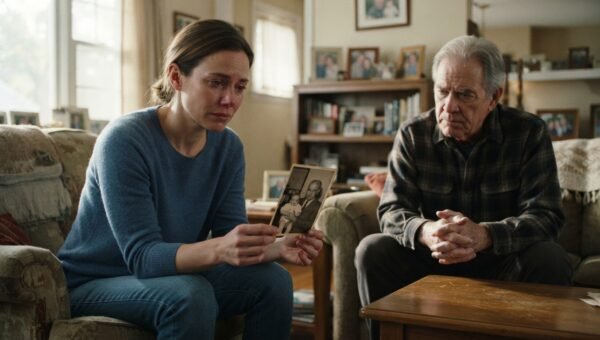
My dad went completely still. His face drained of color, and then, for the first time in my life, I watched my father put his head down on his folded arms and sob until his shoulders shook violently against the table. My mother came running out of the hallway, her hands wiping her apron, and when she read the papers, she dropped down beside his chair and held him.
The next evening at seven o’clock, my father put on his only Sunday suit, combed his hair with water, and walked up the front steps of the little brick cottage on Elm Street. He stayed in Mrs. Vance’s living room for two hours.
The state grant went through five weeks later. It paid our mortgage payments for seven months while my dad took evening classes at the technical vocational school thirty miles south. By late summer, he had earned his commercial boiler certification and was hired as the chief facilities maintenance tech for the county hospital system.
Our house was never put up for auction.
Joy and I graduated eighth grade that June, and we walked home together from the ceremony carrying our diplomas rolled up with blue ribbons. We never talked about the backpack lunches again. We didn’t need to. Every morning until the last day of school, a sandwich or a piece of fruit had been sitting in my side pocket, and every morning I ate it knowing our family was still under our own roof.
Years later, after Joy had moved to Chicago and I had finished college on a work-study scholarship, Mrs. Vance retired from the bank. She was seventy-two years old and lived alone with a rescue terrier.
Every single Tuesday afternoon, an insulated metal delivery box showed up on her front porch railing. Inside was fresh sourdough bread, carved roast beef, and a warm fruit turnover wrapped in greaseproof wax paper from the town bakery I opened on Main Street.
There was never any bill. There was never any note. Just good food, warm enough to hold against the cold, delivered by someone who remembered what it was like to be saved.