PART 1
I found the phone on a Tuesday afternoon while looking for the lug wrench in David’s trunk. It was wrapped in an old wool sock down in the spare tire well, tucked beside the jack.
It was an old black flip phone, cold to the touch and completely dead. I stood there in the driveway with grease on my knuckles and my stomach twisting into knots. David and I had been married for twenty-eight years.
We shared a bank account, a grocery list, and a quiet house that had been too quiet for five years. There was no reason on earth for him to own a phone I did not know about.
I took it into the garage, dug through the plastic bin where we kept spare cords, and found a micro-USB cable that fit. I plugged it into the wall outlet over the workbench and waited. My hands were shaking. I told myself to put it back and wait for him to get home from the hardware store, but fear does not listen to reason. I expected a password. I expected deleted call logs.
The screen lit up with a cheap blue glow. There was no passcode.
The inbox held thirty-two messages, all from the same ten-digit number. There was no name attached to it. The first text on the screen was from three weeks ago: “He asked about you today. Wants to know if you’re bringing the tackle box again.”
Two weeks before that: “We got the test results back. Doctor says everything looks clear. Stable.”
I scrolled down as fast as my thumb would move. The dates kept rolling backward, month by month, year by year. They did not stop at last winter or the summer before. The very first message was dated October 19, five years ago.
That was exactly six days after our nineteen-year-old son, Jesse, was killed by an oncoming truck on Route 9.
Six days after Jesse died, while I was still lying in bed unable to swallow water, my husband was exchanging messages with a strange woman.
I did not stop to think. I pressed the call button and held the plastic against my ear. It rang twice. A woman answered on the third ring, her voice calm and slightly breathless, like she had just walked in from the yard.
“David?” she asked.
My voice sounded small and dry. “Who is this?”
There was a pause on the line. The background noise on her end went quiet, like she had stepped into another room. When she spoke again, her tone was careful.
“Is this Martha?”
Hearing my own name from a voice I had never heard before made my knees go weak. I leaned against the workbench, knocking over a can of WD-40.
“How do you know who I am?” I asked. “Who are you?”
“Your husband said you might find the phone someday,” she said softly. She sounded neither defensive nor scared. She sounded sad. “Martha, my name is Laura Campbell. I’m the mother of the boy who received your son’s heart.”
The breath went out of me all at once.
“What?” I whispered.
“David has been visiting him,” she said. “Every year on your son’s birthday.”
PART 2
I stood by the workbench with the phone pressed to my ear, listening to the hum of Laura Campbell’s kitchen refrigerator hundreds of miles away.
“Every year?” I could barely get the words past my teeth.
“Every June,” Laura said. Her voice was steady, gentle, and terribly real. “He drives out here to Missouri.
He brings a small wooden toy or a fishing lure. He sits on our porch for an hour, he talks to Lucas, and then he drives home.”
Jesse’s birthday was June 14. For five years, David had told me the same story every June. He told me he needed to go up to the cabin by Lake George alone for a long weekend to clear his head. He told me he couldn’t be in our house on Jesse’s birthday because looking at the empty bedroom broke him in half. And every single year, I had kissed his cheek, packed him a cooler of sandwiches, and spent that weekend crying by myself on our sofa so he would have the space he needed to grieve.
He had not gone to Lake George once.
“Why didn’t he tell me?” I asked, my voice cracking. “Why would he keep this from me?”
Laura was silent for a long moment. When she spoke, she chose her words with great care. “When the transplant coordinator reached out to us five years ago, she told us the donor’s family had declined all contact. She said the mother was too fragile, and that writing letters would only cause unnecessary pain. A month later, David sent a private letter to the hospital network with his number. He asked them to forward it to me only if my son was stable. He told me you were barely holding on. He said if you knew he was looking for pieces of Jesse out in the world, you would never be able to rest.”
“That wasn’t his choice to make,” I said.
“I know,” Laura said. “I asked him that three years ago. I told him he should bring you. He said he was terrified that seeing Lucas alive would make you hate the fact that your boy wasn’t.”
I ended the call without saying goodbye. I set the little flip phone on the kitchen counter, sat down at the table, and waited.
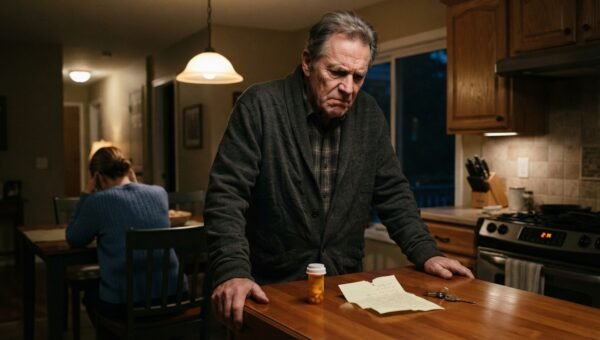
David’s truck pulled into the driveway at twenty past five. I heard the driver door slam, heard his heavy work boots scrape on the back mat, and heard the familiar rustle of brown paper bags as he set down groceries. He was sixty-one, with graying hair at his temples and the stooped shoulders of a man who worked forty hours a week on his feet.
He walked into the kitchen with a jug of whole milk and stopped.
The black phone sat right between the salt and pepper shakers. The charging cord was coiled beside it.
David did not jump. He did not make an excuse. He just looked at the phone, then looked up at my face. The color slowly drained out of his cheeks, leaving him looking older than I had ever seen him.
“You went through the trunk,” he said quietly.
“I called Laura,” I told him. My hands were flat on the tabletop. “Tell me why you spent five years lying to my face.”
PART 3
David did not sit down. He rested both hands on the back of the opposite chair, gripping the wood until his knuckles turned white.
“Because you were dying, Martha,” he said. His voice was raw. “You don’t remember what you were like that first year, but I do.”
“Do not blame this on me,” I said.
“I’m not blaming you,” he replied, shaking his head. “I’m telling you what happened. When the doctor came out of the ICU and asked about donation, you threw up on the floor. You screamed at them not to cut him up. You made me sign the papers while you sat in the waiting room with your eyes shut. Do you remember what you said in the car on the way home?”
The memory hit me with sudden, sharp clarity. I had looked at the empty back seat and said that if I ever saw someone walking around with Jesse’s parts, I would want to tear them out with my bare hands. I had said it out of pure, wild agony. I was thirty pounds lighter back then, living on toast and black coffee, sleeping sixteen hours a day with the curtains drawn.
“I was out of my mind,” I whispered.
“I know you were,” David said. A tear slipped down his cheek, catching in the stubble along his jaw. “And I was losing my mind, too. But I had to keep going to work. I had to pay the mortgage and the ambulance bills. The day they told me Jesse was gone, part of me stopped working. The only thing that made sense to me was knowing where that heartbeat went.”
He pulled out the chair and sat down heavily.
“I didn’t plan on visiting,” David said. “Laura wrote back through the coordinator, just a short note saying the boy had survived the surgery. His name was Lucas. He was twelve. He had been in heart failure since he was nine. I bought that cheap phone at the gas station because I didn’t want the number showing up on our home bill. I thought I would just get one text, know he made it, and throw the phone away.”
“Then why didn’t you?”
“Because on Jesse’s first birthday without him, Laura sent a picture,” David said. “The boy was standing by a lake, holding a sunfish. He had color in his cheeks. I got in the truck to go to the cabin, Martha, I swear to God I did. But I hit the highway interchange and I just kept driving west. I drove fourteen hours straight. I sat in a diner across from their subdivision for three hours before I worked up the courage to knock on her door.”
“And you went back every year,” I said. “While I sat here alone.”
“I was a coward,” David said simply. “Every June, I told myself I would tell you before I left. And then I would look at you, finally starting to plant flowers in the garden again, finally laughing at something on the television, and I thought, if I bring this up, I’ll drag her right back into the dark. I thought I was protecting you. But really, I was just selfish. I wanted to see him, and I didn’t know how to carry your anger along with my own grief.”
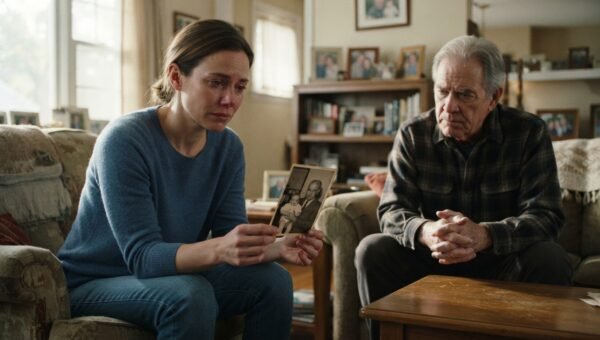
He reached into his pocket, pulled out his wallet, and laid a photograph on the table.
It was school portrait of a teenage boy with dark hair and bright, cautious eyes. He was wearing a navy blue polo shirt. He did not look like Jesse at all. Jesse had been tall, broad-shouldered, and loud, with a mop of unruly curls. This boy was thin, with a quiet, careful smile.
“He’s seventeen now,” David said, his voice breaking completely. “He wants to be an engineer. He asks about you every time I visit, Martha. He knows who gave him his life.”
ENDING
We did not sleep that night. We sat at the kitchen table until the sun came up, talking through five years of silence.
I was furious with David. The anger did not vanish just because his intentions were rooted in love. He had shut me out of a truth that belonged to both of us. He had treated me like glass that would shatter at the slightest tap, forgetting that I had carried Jesse inside my body before he ever held him in his arms.
We spent two weeks barely speaking, moving around each other in the house like strangers sharing a hallway. But every morning, the photograph stayed on the refrigerator, held up by an old plastic magnet Jesse had made in third grade.
On the second Sunday in July, I picked up the little black flip phone from the counter. I dialed Laura’s number myself.
We talked for two hours. She told me about the night the helicopter landed at the regional hospital with the cooler. She told me how Lucas used to get winded climbing the three steps up to their porch, and how last fall he had joined the high school cross-country team, not to win races, but just because his chest didn’t hurt when he ran. She didn’t offer excuses for David, but she told me that the first time David sat on her sofa, he had cried so hard he couldn’t speak for twenty minutes.
“You should come,” Laura told me. “Not for his birthday. Just come.”
Two weeks later, David and I drove west together.
The drive was long, hot, and mostly silent, but it was not an angry silence. It was the quiet of two people bracing themselves for an open door they had kept locked for five years.
When Laura opened the screen door of her small brick ranch in Missouri, she didn’t say much. She just stepped out onto the porch and pulled me into an embrace that smelled of laundry detergent and summer heat.
Then Lucas walked out from the kitchen.
He was shy. He held his hands in his pockets and looked down at his sneakers before looking at me. “Hello, Mrs. Miller,” he said.
I looked at his chest under his gray t-shirt. I had thought for years that seeing the person who got Jesse’s heart would feel like theft. I had thought it would feel like someone was wearing my dead child’s clothes. But standing on that sunlit porch, looking at a skinny kid who had a whole life ahead of him, the knot that had lived under my ribs for half a decade finally loosened.
“Hello, Lucas,” I said.
He stepped forward, hesitated, and then put his arms around me.
I leaned my ear against the center of his chest. Through the thin cotton of his shirt, steady and strong, I heard the rhythm. It wasn’t Jesse, and it never would be. Jesse was gone, and nothing on this earth was ever going to change that.
But the rhythm was there. It was beating thirty times a minute faster than it had in the hospital bed, stubborn and alive, keeping this boy on his feet.
We stayed for dinner. We ate pot roast and talked about Lucas’s college applications. When we left that evening, David put the old flip phone on Laura’s kitchen counter and left it there.
We didn’t need a secret line anymore. We had the boy’s number saved in both of our regular phones, right between the dentist and the oil change place, where it belonged.