PART 1
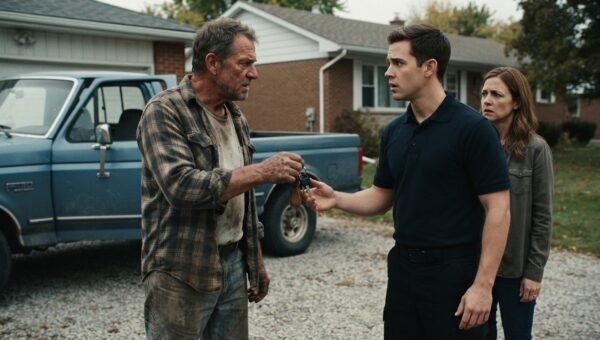
My father drove that dark blue 2014 Ford F-150 for ten years. It wasn’t fancy, but Dad kept the maintenance records in a clear plastic pouch in the glove compartment and never missed an oil change by so much as fifty miles. When he passed away in mid-October, the truck was sitting parked in his gravel driveway, washed and clean, just like he always kept it.
Two days after the funeral, my younger brother Tommy showed up at Dad’s small ranch house while I was packing up the kitchen pantry.
Tommy had red eyes and looked exhausted. He stood by the kitchen counter, fiddling with his car keys, and asked if he could borrow the truck for a few days. He told me his own sedan was making a terrible rattling noise in the front end, and he needed something reliable to haul a few leftover items from Dad’s garage and run some personal errands before going back to work.
I didn’t think twice about it. Dad was gone, we were both grieving, and Tommy was my little brother. I handed him the keys from the hook by the back door. Tommy promised he would bring it right back to Dad’s driveway by the end of the following week.
One week turned into three weeks, and then Thanksgiving came and went. Whenever I called Tommy to ask about the truck, he had a new excuse lined up. First, he claimed he was waiting on a replacement part for his car.
Then he said he had caught a bad cold. By Christmas, he stopped answering my calls altogether, only sending back short text messages saying the truck was safe in his carport and that I was stressing over nothing.
By late January, three months had slipped by. I was handling the final paperwork for Dad’s modest estate as the executor. Dad had not left a complicated life behind. His will clearly stated that his remaining assets, including his vehicle and bank accounts, were to be divided equally between Tommy and me once all medical bills and probate fees were settled. Because Dad’s health had been declining for over a year, I was already listed as a secondary driver on the truck’s auto insurance policy to run his errands, and I was the one paying the monthly premiums out of the estate account.
On a Tuesday afternoon, a family friend sent me a link to an online marketplace listing.
She asked me if Tommy was selling Dad’s truck for the estate. My stomach dropped the moment I clicked the link.
There on my phone screen was Dad’s blue F-150, parked in the lot behind a local diner, polished up for sale. The listing was asking $18,500 cash. Under the vehicle description, written in all capital letters, was Tommy’s personal cell phone number with the words: “Clean title in hand, serious cash buyers only.”
My hands shook as I dialed Tommy’s number. When he finally answered on the fourth ring, he sounded annoyed. I asked him straight out why our father’s truck was listed online for nearly twenty thousand dollars.
Tommy didn’t even try to deny it. Instead, his voice went cold and defensive. He told me that Dad had always verbally promised the truck to him before he died, even if it wasn’t spelled out in the legal papers.
He said he had taken care of Dad during the final months just as much as I had, which was not true at all, and that I was being heartless and greedy over a piece of old metal. Before I could say another word, Tommy yelled that I had always tried to control everything, and then he slammed the phone down.
I sat at my kitchen table for an hour, sick to my stomach. I hated confrontation. A part of me thought about just letting it go and deducting the value of the truck from Tommy’s share of the estate payout later on, just to keep peace in what was left of our family.
Then, around eight o’clock that evening, an unfamiliar number sent a message to my phone.
The text was from a man named Marcus. He explained that he had met Tommy behind the diner an hour earlier with cash in an envelope, ready to buy the truck. But when Marcus asked to see the paperwork, Tommy produced an old registration slip and tried to brush off the title paperwork, claiming the title transfer could be done through a third-party service the next day.
Marcus was a retired county inspector and knew better. While Tommy was pacing on the phone near the highway, Marcus opened the glove box to look for the current registration. Right on top of the stack, he saw the active insurance card with my name and phone number printed boldly across the bottom.
Marcus sensed something was deeply wrong with the transaction and backed out on the spot, telling Tommy he had to think about it. Before leaving, Marcus snapped a quick picture of the glove box compartment and the paperwork to confirm whether I was actually the owner.
When I opened the photo Marcus sent, I saw the insurance card sitting on top of the original manual. But tucked directly behind the card was a folded piece of lined yellow legal paper. Marcus’s camera had caught the paper at an angle, where the glove box light hit it.
I enlarged the image on my screen, zooming in as far as the pixels would allow. Right across the top fold was Dad’s unmistakable, sharp handwriting in dark blue ink.
The first sentence was plainly visible:
“If Tommy ever tries to sell this truck, give the envelope under the seat to…”
PART 2
The rest of the sentence was cut off by the shadow of the glove box door. My heart pounded so hard against my ribs that I could barely steady my fingers to reply to Marcus.
I called Marcus immediately. I thanked him for his honesty, explained that our father had recently passed, and told him that Tommy had no legal authority to sell the vehicle without probate approval. Marcus listened quietly, took a long breath, and apologized for getting caught in the middle of a family mess. He told me Tommy had seemed frantic and eager to take cash on the spot, even offering to drop the price by a thousand dollars if Marcus paid right then.
Marcus told me the truck was still parked at the 24-hour car wash near the interstate exit where Tommy had pulled over to vacuum it before meeting him. He said Tommy had parked it under the far floodlight, visibly angry after the deal fell through, and had walked into the adjoining convenience store to buy coffee.
I didn’t wait. I grabbed Dad’s spare key from my desk drawer, slipped my purse over my shoulder, and drove twenty minutes across town in the dark.
When I pulled into the car wash lot, Dad’s blue truck was sitting right where Marcus had described. Tommy was nowhere in sight. Through the glass storefront of the convenience store across the lot, I could see Tommy leaning against the counter, talking to the clerk and nursing a styrofoam cup.
I parked my car out of sight behind the vacuum stalls and walked quickly to the passenger side of the truck. My hands were trembling as I unlocked the door with the spare remote. The familiar scent of Dad’s old peppermint candies and cedar shavings hit me immediately.
I opened the glove compartment, pulled out the folded sheet of yellow legal paper, and opened it under the interior cabin light.
The note was dated eight months earlier, during the week Dad was first admitted to the hospital for his heart condition. In steady, deliberate lines, Dad had written:
“If Tommy ever tries to sell this truck, give the envelope under the seat to the county sheriff. Tommy knows what is inside it. I forgave the debt between a father and son, but I will not let him steal from his sister when I am in the ground. Everything left belongs to both of you equally. No tricks.”
Beneath the note was a small brass key taped to the bottom of the page.
I dropped to my knees on the gravel and reached underneath the driver’s side seat. My fingers brushed against the metal frame until I hit a heavy, magnetic key box clamped to the underside of the floorboard. I pulled it free and opened the slide. Inside was another key, along with a flat metal lockbox tucked far back against the carpet behind the heating vent.
Using the small brass key from the note, I unlocked the box right there on the passenger floor.
Inside was a signed, notarized promissory note from three years prior, along with six certified cashier’s check receipts totaling $42,000. Tommy had borrowed that money from Dad’s retirement savings to start a supposed home renovation business that never materialized. Written across the bottom of the agreement in Tommy’s own handwriting was a pledge stating that if the loan was not repaid before Dad’s passing, the entire sum was to be deducted directly from Tommy’s half of any inheritance, and the truck was to remain in my possession as collateral.
Next to the receipts was the original, unencumbered vehicle title, made out solely to Dad, with a handwritten transfer form signed by Dad naming me as the sole inheritor of the vehicle.
Tommy hadn’t just borrowed the truck to run errands. He had deliberately hidden the truck, searched the house for the title, and was attempting to liquidate an asset that was legally designated to protect me from the very money he had already taken.
PART 3
Before I could lock the box back up, the driver’s side door flew open.
Tommy stood there in the harsh yellow wash of the overhead floodlights, his jacket unzipped, staring down at me with wide, panicked eyes. His face went instantly pale when he looked past my shoulder and saw the metal box sitting open on the passenger seat.
“What are you doing in my truck?” Tommy shouted, stepping toward me. His voice echoed off the concrete car wash bay.
I stood up straight, stepped out onto the asphalt, and held the notarized papers firmly against my chest.
“It was never your truck, Tommy,” I said, keeping my voice as steady as I could manage. “Dad left a note in the glove box. And he left this box under the seat.”
Tommy lunged forward to grab the papers, but I stepped back toward my car. His temper flared, his face turning dark red. He started yelling that Dad wasn’t in his right mind when he wrote those papers, that Dad had promised to forgive the $42,000 as a gift, and that I was ruining his life over an old debt. He told me he was behind on his rent, that collection agencies were calling him every week, and that the $18,500 from the truck sale was the only thing that could keep him from going under.
“You have a paid-off house and a pension,” Tommy spat, stepping into my space. “You don’t need this money. I’m taking the truck, and you’re going to hand over those keys right now, or I’m calling the police and telling them you stole Dad’s vehicle from me.”
“Go ahead and call them,” I replied. I held up Dad’s note and the signed vehicle title. “Dad wrote right here that if you tried to sell this truck, these papers go straight to the county sheriff. The registration is in Dad’s name. The insurance is under my name. The title names me. You have no bill of sale, no title, and you just tried to sell a vehicle from an open probate estate to a cash buyer using a false listing.”
Tommy froze. He looked from the papers in my hand to the phone in his pocket. He knew exactly what the local sheriff would do if an executor presented proof of an unauthorized vehicle sale alongside a documented history of undisclosed financial debts.
For two full minutes, neither of us said a word. The hum of the highway traffic in the distance was the only sound between us.
Finally, Tommy’s shoulders slumped. The anger drained out of him, replaced by the same sullen, defeated look he had carried whenever Dad caught him in a corner as a teenager.
“I don’t have the forty-two thousand,” Tommy whispered, looking down at the wet concrete. “I spent it years ago. There’s nothing left in my bank account. If you take this out of my half of the estate, I won’t get a single dime from the house sale.”
“That was your choice when you signed this agreement with Dad,” I said. “Dad loved you enough to protect you while he was alive, but he wasn’t going to let you rob me blind after he was gone.”
I reached into the truck, took the original set of keys out of the center console, and dropped them into my purse alongside the spare.
ENDING
Tommy didn’t try to stop me as I locked the truck doors. He stood under the flickering neon sign of the car wash, looking smaller than I had ever seen him, watching me walk to my car. I told him he could walk home or call a friend, but that the truck was coming with me.
The next morning, I delivered the entire metal box, the promissory note, and the vehicle title directly to the probate attorney handling Dad’s estate. The lawyer reviewed the documents, shook his head in quiet disbelief, and immediately filed the amended inventory with the county court.
Because of the documented $42,000 loan, Tommy’s final distribution from the sale of Dad’s modest house was reduced to satisfy the debt he owed the estate. After legal fees and closing costs were accounted for, Tommy received less than three thousand dollars from the final settlement.
He didn’t speak to me at the final court hearing. He signed the probate closing paperwork in silence, took his check from the attorney’s assistant, and walked out of the building without looking back. We haven’t exchanged a single word since that morning in court.
I took the truck to Dad’s regular mechanic the following week. We put on four new tires, flushed the fluids, and had the interior detailed.
The truck sits in my driveway now. Every time I turn the key and see Dad’s handwritten maintenance mileage written on the little sticker in the corner of the windshield, I feel a quiet sense of relief. Dad wasn’t a man of many words, and he hated family arguments more than anything in the world. But he knew his children, he knew the truth, and even after he was gone, he made sure things were made right.