PART 1
The basement in my house was never meant to be an apartment. It was a finished walkout space with nice daylight, an open sitting area where my teenagers used to watch movies, a small guest bedroom, and my home office tucked off to the side. Most importantly, it held the laundry room. To wash a load of towels or run the linens, I had to walk down the carpeted stairs from the kitchen, turn the corner past the furnace closet, and step through the double doors.
That layout worked fine for twenty years. It worked fine because the house belonged to me.
I bought the place four years before I ever went on a first date with Tom. My father had passed away when I was thirty-two, leaving me a small inheritance from the sale of his machine shop. I took that money, combined it with every dollar I had saved working as a paralegal, and bought the three-bedroom split-level at the end of a quiet cul-de-sac. When Tom and I married six years later, we signed a clear agreement, kept the deed solely in my name, and split the household utilities and maintenance down the middle. Tom never had a problem with it. He had his own retirement savings, I had my house, and we built a comfortable life together raising our two children.
Then Tom’s sister, Brenda, lost her husband.
Carl had been sick for two years, and the medical bills had taken a heavy toll on their finances.
When he passed away in late autumn, Brenda sold their small townhouse to settle the debts. She called Tom in tears three nights a week, talking about how lonely she was and how she needed a temporary landing pad while she looked for a small senior apartment near town.
“Just four weeks, Karen,” Tom told me at the kitchen table one Sunday evening, holding both of my hands across the placemats. “Thirty days at most. Just until she gets her deposit together and looks at the garden apartments on Maple Street. She’s my sister. If we turn her away right now, I’ll never forgive myself.”
I looked at Tom’s tired face and felt for him. Family is family, or at least that was what I told myself. I spent that entire weekend cleaning out the downstairs guest room, putting fresh sheets on the bed, and clearing space in the downstairs closet.
Brenda arrived on a Tuesday in early November with four giant rolling suitcases and a trunk full of plastic storage totes. Tom carried them down the stairs while Brenda stood in the foyer, complaining about the draft near my front door.
“You really should have that weatherstripping replaced,” she told me, not even taking her coat off yet. “A cold foyer drives up the heating bill terrible.”
I let it roll off my back. She was grieving, I thought. People say thoughtless things when their world has been turned upside down.
Four weeks passed in a blink. December came, bringing snow and the holidays. When I gently asked Tom if Brenda had scheduled any tours at the Maple Street complex, he waved his hand and told me it was cruel to push a widow out right before Christmas. So I kept quiet.
By February, Brenda’s presence was no longer confined to the guest bedroom.
She started by stacking four plastic storage totes in the hallway between the stairs and the laundry room.
Then six more appeared against the wall of my office. When I asked her if she could consolidate them inside her bedroom closet, she sighed loudly, pressed a hand to her chest, and said, “Carl’s photo albums are in those boxes, Karen. I can’t just shove my late husband into a dark closet.”
By April, she had completely taken over the laundry area. She bought three separate plastic sorting hampers and set them directly in front of my washer and dryer. If I brought a basket of darks down on a Saturday morning, she would come out of her room in her quilted robe, crossing her arms.
“I have a delicate cycle running in twenty minutes,” she would announce. “You should really check with me first so our cycles don’t overlap. It ruins the water pressure.”
I reminded her, as politely as my temper allowed, that the laundry room was shared space and that I had been doing laundry on Saturday mornings for two decades. Brenda merely sniffed, shook her head, and muttered something under her breath about people who lacked basic consideration.
The real trouble started during the summer, when our children, Chloe and Mark, came home from college.
Chloe came down to the basement one afternoon to grab an extra set of twin sheets from the linen closet. She left her sneakers by the bottom step. Ten minutes later, Brenda was standing in my kitchen upstairs, holding Chloe’s running shoes by the laces between two fingers like they were toxic waste.
“I almost broke my neck on these,” Brenda said, dropping them onto my clean kitchen rug in front of Tom and the kids. “Chloe, you are twenty years old. Living under a roof requires respecting the common areas. Your mother might let you drop your belongings wherever you please, but an adult household has standards.”
Chloe’s face burned bright red. She looked at me, then at her father. Tom just cleared his throat and looked down at his phone, pretending he hadn’t heard the tone his sister used.
“Brenda,” I said, setting my dish towel down on the counter. “Do not speak to my daughter that way in this house. If you have an issue with shoes, you speak to me.”
“I am simply trying to maintain order,” Brenda replied smoothly, smoothing the front of her cardigan. “When multiple adults share a home, rules are necessary. Otherwise, it turns into chaos.”
She turned and walked down the stairs before I could answer.
By September, eleven full months had passed since Brenda carried her bags into my basement. There had been no apartment viewings. There had been no applications submitted. She had unpacked all her knickknacks and set them along the shelves of my office. She had placed a decorative runner across the hallway table where I kept my printer paper. When I brought it up to Tom in our bedroom at night, he would get defensive.
“She has nowhere else to go, Karen! The rental market is insane right now. What do you want me to do, throw my widowed sister out on the street?”
“She has twenty-two thousand dollars sitting in a savings account from Carl’s life insurance, Tom,” I replied, keeping my voice low so the kids wouldn’t hear. “She told me that herself back in January. She isn’t broke. She just has free room, free utilities, free cable, and a maid service she doesn’t pay a dime for.”
“She’s family,” Tom insisted, turning his back to me and pulling the blanket over his shoulder. “Give her a little grace.”
I had given her grace for three hundred and thirty days.
The final breaking point came on a cool Thursday evening in early October. I had worked a long, exhausting nine-hour day at the firm, dealing with back-to-back probate filings. I came home carrying a bag of groceries, my feet aching, wanting nothing more than to brew a cup of tea and sit in my quiet living room.
Brenda was waiting for me at the island.
She had a cup of coffee resting on a paper napkin and a lined yellow legal pad lying open next to it. As soon as I set the grocery bag down, she slid the yellow paper across the granite counter toward me.
“We need to talk,” she said, her voice completely calm, completely self-assured. “I spent the afternoon putting this together. With the holidays approaching again, things are getting too loose around here. We need clear boundaries.”
I looked down at the pad. Across the top, written in her neat, looping cursive, was the heading: *HOUSEHOLD STANDARDS AND RULES FOR RESIDENTS AND GUESTS.*
Underneath were six numbered items.
Rule number one dictated that no one could run the washer or dryer before 10:00 AM or after 6:00 PM, to avoid disturbing her sleep schedule.
Rule number two stated that all personal mail delivered to the front box must be brought downstairs immediately so she wouldn’t miss her medical statements.
Rule number three prohibited anyone from using the basement sitting area after 8:00 PM on weeknights.
And then I read rule number four.
*4. Family members and guests must ask permission before using the downstairs walkout patio entrance, as this entryway now serves as a private threshold.*
I stared at the paper. My name was on the deed. My money had paid every property tax bill for twenty-four years. My father’s labor had helped secure the roof over her head.
“Guests should follow family standards,” Brenda said, taking a deliberate sip of her coffee. “You and Tom let the children treat this place like a hotel. If we are going to make this work long-term, you need to sign off on these so we have mutual accountability.”
I did not yell. I did not throw the yellow pad across the kitchen. I did not call for Tom.
I looked up from the paper, met Brenda’s smug, expectant eyes, and let out a very slow breath.
“I see,” I said quietly.
I folded the yellow sheet in half, slid it into the pocket of my work slacks, and picked up my groceries.
The next morning, an unmarked white van pulled into my driveway at exactly 8:15 AM.
PART 2
The white van had a discreet logo on the side panel: *MERCER COUNTY LOCK & SECURITY.*
A tall man in navy blue work pants stepped out, carrying an aluminum tool case and a clipboard. His name was Dave. I had called his shop at 6:30 that morning, leaving an urgent voicemail explaining that I owned a residential property and required immediate lock modifications on three exterior and interior doors.
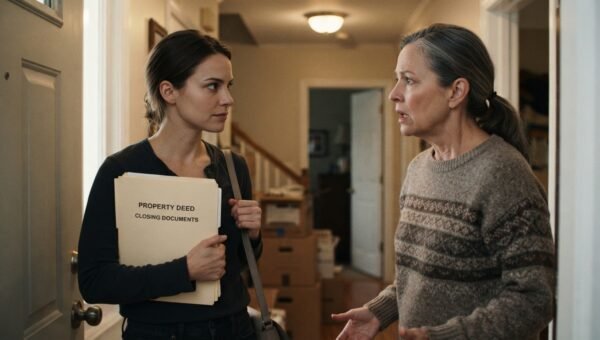
I met him at the garage door with a fresh travel mug of black coffee and a manila folder under my arm. Inside that folder was my original property deed, my driver’s license, and the county tax assessment showing sole ownership under my maiden name. Dave glanced at the paperwork, nodded once with the professional disinterest of someone who had seen every variety of domestic dispute, and pulled a key-cutting kit from his van.
“We’ll start with the interior door at the top of the basement stairs,” I told him, keeping my voice level and calm. “I want a heavy-duty deadbolt installed. Keyed from the top side. No lock or release mechanism on the basement side.”
“Understood,” Dave said, following me into the kitchen.
Tom was already gone for the day, having left at seven for his shift at the regional water authority. But the sound of Dave’s drill boring through the solid oak door at the top of the basement stairs did not take long to wake my sister-in-law.
Within three minutes, the door at the bottom swung open. Brenda came bustling up the steps in her floral housecoat, her hair in pink foam rollers, her face twisted in absolute disbelief.
“What on earth is that noise?” she snapped, stopping two steps from the top landing. Then she saw Dave kneeling on my kitchen floor with a hole saw and wood shavings scattered around his boots. She let out a sharp, mocking laugh. “Karen, what is this ridiculous nonsense? What is a locksmith doing to our basement door?”
Dave didn’t look up from his work. He kept the drill steady, blew away a small cloud of sawdust, and reached into his tool box for a brass strike plate.
“He’s securing the upper residence,” I said, leaning against the counter with my arms crossed.
Brenda’s laugh died instantly, replaced by a tight, thin scowl. “Securing it from what? Your own family? Have you lost your mind because of the list I gave you? Tom will have this taken off the minute he gets home from work.”
“Tom doesn’t own this door, Brenda,” I answered. “And neither do you.”
Dave stood up, packed his drill into its molded plastic case, and looked at me with his clipboard in hand.
“All right, ma’am,” Dave said, checking his work order. “You requested three total points of service. We’ve got the interior separation deadbolt done. Which exterior doors belong to the rental unit you’re legally creating downstairs?”
Brenda froze on the stairs. The color drained from her cheeks so fast it was almost comical. Her fingers tightened around the banister until her knuckles turned waxy white.
“Rental unit?” Brenda’s voice pitched up an octave, trembling with sudden outrage. “What rental unit? What are you talking about?”
I walked over to the landing, looked down at her from the top step, and handed her a crisp, white legal envelope.
“Last night, you handed me house rules for my own home,” I told her, looking her directly in the eyes. “You told me that guests must follow family standards, and that your space was a private threshold. You were right about one thing, Brenda. We do need clear boundaries. So I am treating you exactly like the independent adult you claim to be.”
Inside the envelope was a standard thirty-day notice to quit, drafted on the firm letterhead where I worked, signed by one of our senior real estate partners. Behind it was a commercial lease agreement.
“You have thirty days to vacate my property,” I said. “If you wish to remain beyond the first of next month, the basement will be converted into a fully separate, private unit. The rent is eighteen hundred dollars a month, plus thirty percent of the electric and water bills. You will have exclusive use of the patio entrance, which Dave is re-keying right now. But you will have zero access to the upper level of this home.”
“Eighteen hundred dollars?” Brenda shrieked, clutching the envelope against her chest like a shield. “You’re insane! I don’t have eighteen hundred dollars a month! Tom will never let you do this! Tom is my brother!”
“Tom doesn’t pay the property taxes on this parcel,” I said. “And Dave needs you to step down so he can complete the work on the patio lock.”
PART 3
Brenda retreated down the stairs, slamming the lower door so hard the framed pictures in my hallway rattled.
By noon, the locksmith was gone, having handed me two sets of keys for the new patio deadbolt and the only key to the upper separation door. By 12:15, my phone lit up on the kitchen counter. It was Tom.
He didn’t even say hello.
“Karen, what the hell are you doing?” he shouted into the receiver, his voice echoing from what sounded like his truck cab. “Brenda just called me hysterical! She’s having chest pains! She says you hired a man to lock her in the basement and you’re demanding eighteen hundred dollars a month? Have you completely lost your mind?”
“I haven’t locked anyone in, Tom,” I said, keeping my tone perfectly measured. “She has full, unobstructed egress through the sliding patio doors. The locksmith gave her a brand-new brass key for it ten minutes ago. She can come and go as she pleases.”
“You locked the stairs!” Tom roared. “You locked my sister out of our kitchen! She can’t even get a glass of water!”
“She has running water in the downstairs bathroom, Tom. And there’s a mini-fridge in her room. But she cannot enter my living space anymore. Not after last night.”
“Because of a piece of paper?” Tom’s voice cracked with frustration. “She was trying to help! She was trying to keep the house tidy! She’s grieving Carl, for God’s sake, Karen! She has nobody! I told you she just needed a little time!”
“She’s had eleven months, Tom,” I said. “And last night she didn’t try to help. She tried to claim authority over my house. She told my daughter what doors she could use. She told me when I could wash my clothes. You sat on the sofa and let her do it because you were too cowardly to tell your sister no. So I told her no for you.”
“I am coming home right now,” Tom snapped. “And I’m taking that deadbolt off that door with a crowbar.”
“If you touch that door with a crowbar, Tom, you will be vandalizing a property deeded solely to me,” I said, my voice dropping an octave, deadly quiet. “And the next call I make won’t be to a locksmith. It will be to the township police to report an illegal trespass, followed immediately by a call to my divorce attorney. Do not test me on this.”
The line went dead.
Tom arrived at the house forty minutes later. I heard his truck tires skid slightly on the gravel driveway. The front door banged open, and he stormed into the kitchen, his face mottled red, his jacket unzipped. He marched straight toward the basement door, his hand reaching for the knob.
The brass deadbolt was locked solid.
He grabbed the knob, rattled it violently, and then spun around to face me. I was sitting at the kitchen table, an open folder in front of me, a cup of tea in my hand.
“Unlock this door,” Tom demanded.
“No,” I said. “Sit down, Tom.”
“Karen, I swear to God—”
“Sit down,” I repeated, pointing to the chair opposite me. “Or pack your bags and go downstairs with her. Those are your only two options today.”
Tom stared at me. In twenty-four years of marriage, he had never heard that steel in my voice. He looked at the locked door, looked at the papers spread across the table, and slowly sank into the wooden chair.
I pulled out the yellow legal pad from my pocket and laid it flat between us.
“Read it,” I said.
Tom glanced at his sister’s handwriting. He read the first three rules, his brow furrowing. When his eyes hit rule number four, the line about asking permission before using the walkout entrance, his shoulders dropped an inch.
“She… she was just frustrated,” Tom muttered, though the anger had drained from his voice. “She didn’t mean it like that.”
“She meant every single word,” I told him. “And she meant it because you spent eleven months teaching her that she could treat me like a roommate in my own home. You let her take over my laundry. You let her humiliate our daughter in front of us. You let her treat my hospitality as her birthright. I am done.”
I slid the thirty-day notice across the table.
“She has thirty days,” I said. “You have twenty-four hours to decide whose side you’re on. If you want to pay her eighteen hundred dollars a month out of your personal account so she can live down there under a strict landlord-tenant lease, you can write the check. If not, you can help her find an apartment this weekend. But she will never step foot in this kitchen again. And if you ever choose her entitlement over my dignity in this house again, our marriage ends on the thirty-first day.”
Tom sat in silence for two full minutes. The only sound was the hum of the refrigerator.
Downstairs, we could hear Brenda pacing across the laminate floor, slamming cabinet doors, waiting for her brother to come rescue her.
Tom buried his face in his hands. He let out a long, shuddering breath, looked up at the locked oak door, and finally spoke.
“I’ll help her find an apartment on Saturday.”
ENDING
The next three weeks were the quietest weeks my home had seen in almost a year.
Tom kept his word. That Saturday morning, he walked down the exterior gravel path around the side of the house, unlocked Brenda’s patio door with his own key, and sat with her for four hours. I didn’t ask what was said. I didn’t care to know. All I knew was that Brenda did not scream, she did not knock on the interior stairs, and by Sunday evening, Tom had submitted an application for a one-bedroom garden apartment at the Oakridge complex three miles down the road.
Because she had twenty-two thousand dollars in the bank, her application was approved by Wednesday.
The move-out took place on the last Saturday of October. Tom rented a small moving truck and hired two young men from his department at the water authority to help carry the heavy furniture.
Brenda did not speak to me once the entire day. She stood on the back patio in her heavy winter coat, directing the men as they hauled her storage totes, her late husband’s photo albums, and her three plastic laundry hampers out through the sliding glass doors.
Whenever I looked out the kitchen window, she intentionally turned her back to the glass, making a grand show of adjusting her scarf or looking down at her phone. She wanted me to feel the weight of her silence. She wanted me to feel like a monster who had cast a grieving widow into the cold.
I felt nothing of the sort. I felt the crisp autumn air moving through my house, clean and unburdened.
When the last box was loaded, Tom drove the truck out of the driveway, following Brenda’s silver sedan toward her new apartment. The street returned to absolute stillness.
I walked down the kitchen stairs, unlocked the heavy deadbolt Dave had installed, and opened the door.
The basement was empty. The carpet had dent marks where her furniture had pressed into the pile, and a few stray strips of packing tape lay near the baseboards, but the space was mine again.
I spent the rest of the afternoon opening every window on the lower level, letting the cool breeze sweep out the scent of her lavender room sprays and stale coffee. I wiped down the washer and dryer with bleach, threw away the junk mail she had left on the hallway table, and moved my desk back toward the center of the office.
Chloe came home from campus that evening to help me put the room back together. We carried a basket of freshly washed towels down the stairs together, laughing without having to lower our voices, stepping freely across the floor without checking anyone’s schedule.
Tom came home late that night. He looked beaten down, his shoulders slouched from carrying boxes up two flights of stairs at Brenda’s new building. He set his keys on the counter, walked into the kitchen, and sat quietly at the table while I poured him a cup of coffee.
“She’s settled,” he said quietly, not looking up. “She’s mad as hell at both of us. Mostly at you. But she’s in.”
“Good,” I said, setting the mug in front of him.
He looked at the deadbolt on the basement door, then looked at me. “Are you going to leave that lock on there?”
“Yes,” I replied, sitting down across from him. “It stays.”
Tom nodded slowly, took a sip of his coffee, and didn’t argue. He knew that lock wasn’t just a piece of brass hardware on a wooden door. It was a line drawn in the sand of our marriage, a permanent reminder that kindness without boundaries isn’t love; it’s surrender.
I had given Brenda grace for eleven months. But in the end, I reclaimed my home, my peace, and my self-respect with a single turn of a key.