PART 1
My husband and I had one strict rule from the day we combined our bank accounts: no secret debt. We had watched my sister lose her home after her husband hid credit cards, and we swore we would never do that to each other.
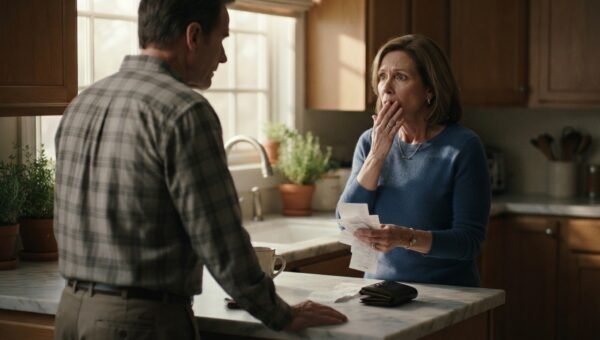
Then, on a Saturday morning while checking the air in his spare tire, I pulled up the trunk mat and saw a folded manila envelope wedged into the metal rim.
Inside was a final collection notice demanding $61,000. It listed an account opened twenty-four years earlier, showing our old rental address and the last four digits of his Social Security number. The emergency contact named on the original loan was his mother, Evelyn.
David walked into the garage holding two mugs of coffee. When he saw the yellow paper in my hand, he dropped the mugs. One shattered against the concrete.
“Where did you get that?” he asked. His voice was completely flat.
“Under your spare tire, David. What is sixty-one thousand dollars doing under your tire?”
He did not yell. He did not make an excuse. He just looked at the floor and said, “Call the number on the paper. Put it on speaker. Right now.”
We stood by the workbench while the phone rang. When the representative answered, David gave the reference number. The agent confirmed the balance was accurate: $61,000 on a consolidated private student loan that had defaulted decades ago.
“Who signed for this?” I asked.
“The primary borrower on file is David Miller,” the representative said. “Co-signed by Evelyn Miller in October of 2002.”
David stared at the phone. “I went to community college on a local grant,” he told the agent. “I never took out private loans.”
“Sir, the payments were made steadily from a joint account in your mother’s name until six months ago,” the agent replied. “When the payments stopped, the collection letters went to the last registered address, then forwarded to your current vehicle registration.”
We hung up. The garage was so quiet I could hear the refrigerator humming inside the house.
“Evelyn,” I said.
David’s mother lived in an assisted living facility twenty minutes away. She had moved there two years ago after her arthritis made living alone impossible. David had visited her every Tuesday, always bringing her butterscotch hard candies and the local paper.
“We go now,” David said.
We drove in silence. He kept both hands locked at ten and two on the steering wheel, his knuckles white against the dark plastic. When we walked into Room 114, Evelyn was sitting by the window in her floral armchair, watching birds on the feeder outside.
Before David even took the folded notice out of his jacket pocket, she turned her head. She looked at his face, then looked down at his empty hands.
“I wondered how long it would take you to find your brother’s name,” she said.
David stopped two feet from her chair. “What are you talking about? I don’t have a brother.”
“His name was Thomas,” Evelyn said softly, smoothing the wool blanket over her knees. “And you didn’t just share a house with him. You gave him your life.”
PART 2
David didn’t move. He stood over his mother’s chair with his coat half-unbuttoned, the paper still in his hand.
“Thomas died when he was three,” David said. “You told me that when I was seven. You showed me the tiny headstone out past the county line.”
“That headstone has no body under it,” Evelyn said. She didn’t look nervous. She looked like a woman setting down a bag of wet laundry she had carried up two flights of stairs. “Your father bought that plot before he left us. Thomas was sixteen when you were twelve, David. But Thomas got into trouble with the law in the county over. A girl died in a car he was driving, and he ran.”
“Stop,” David said. His voice cracked. “Stop lying to me.”
“I am seventy-eight years old, David,” she said. “I am done lying. When your brother ran, he had nothing. No credit, no record that wasn’t flagged by state troopers, no future. When you turned eighteen, Thomas needed to start over in Arizona. He wanted to go to technical school. I told him he couldn’t use his name. So I took your high school transcripts, your birth certificate, and your Social Security card from the metal lockbox under my bed.”
I felt the room tilt. I stepped forward and grabbed David’s elbow. His arm was rigid as iron.
“You gave his brother his identity?” I asked her. “You let another grown man live as David?”
“He didn’t live as David for everything,” Evelyn said, her eyes finally shifting to me. “Just the loans. Just the schooling. I promised Thomas I would pay every cent. And I did. For twenty-four years, I took cleaning jobs after my shift at the laundry ended. I paid four hundred dollars every month like clockwork. But my pension dried up when the plant closed its fund, and my hands stopped working last winter. The money ran out. I knew the letters would come.”
“Why was this in David’s trunk?” I demanded, tapping the envelope against the arm of her chair. “He found this under his spare tire this morning.”
Evelyn looked up at her son. A small, painful look crossed her face. “I didn’t put it in your trunk, David.”
David took a step back. The color in his neck drained away.
“Who did?” I asked.
“Someone called me two weeks ago,” Evelyn whispered. “A man. He asked which room was mine. He asked if David still drove the silver sedan. I thought it was an old neighbor from the county. But he said one thing before he hung up. He said, ‘Tell Ma the debt is coming home.'”
David turned on his heel and walked straight out of the room. I hurried after him down the tiled hallway, past the nurse’s desk and out the double sliding doors into the parking lot.
“David, wait!” I caught his jacket near the rear bumper of our car. “You knew. You knew something before we came here.”
“I didn’t know about a loan,” David said, his breathing rough and shallow. “I swear to you on our marriage, Sarah, I didn’t know about any sixty-one thousand dollars.”
“Then why didn’t you look surprised when she said someone put it in your trunk?”
David pulled his keys from his pocket. He clicked the trunk release. The lid popped open. He lifted the heavy black mat again, exposing the hollow well where the spare tire sat bolted to the frame.
“Look at the rim,” David said quietly.
I bent down. In the dim light of the trunk, next to where the collection notice had been, someone had used a silver paint pen to write eight numbers directly onto the black steel rim. It was a phone number with an Arizona area code. Below it were four words written in crooked block letters:
*CALL ME LITTLE BROTHER.*
PART 3
We didn’t go back into the nursing home. We sat in the front seat of our sedan with the engine idling, the air conditioner blowing cold across our faces.
“Do we call the police?” I asked.
“If we call the police,” David said, staring at the radio screen, “they pull the original loan application from 2002. They see my name, my Social Security number, and my mother’s signature. My mother will be charged with identity theft and bank fraud. At seventy-eight, in a wheelchair.”
“And if we don’t?” I said. “Our credit gets ruined. They put a lien on our house. We spent fifteen years paying off our mortgage, David! We gave up vacations. We drove beaters. I will not lose our home because your mother broke the law twenty-four years ago for a phantom.”
David pulled his phone out. He dialed the Arizona number on speaker.
It rang four times. Then a man picked up. He sounded older, his breath raspy like he smoked heavily.
“Took you long enough,” the voice said.
David looked at me, then back at the phone. “Who is this?”
“You know who it is. Ma told you.”
“Thomas is dead,” David said, his voice dropping an octave. “My brother died forty years ago.”
The man on the other end let out a short, wet laugh. “Thomas Miller died on paper so the county sheriff would stop looking for him. You got the clean name, David. You got the house in town, the normal high school diploma, the wedding in the paper. Ma sent me across the country with a duffel bag and told me I was nobody. Then she used your credit to get me three years of aircraft mechanics school.”
“You defaulted,” I spoke up, unable to keep quiet. “You left sixty-one thousand dollars in debt hanging over a man who didn’t even know you existed.”
There was a silence on the line. Then the man spoke again, his tone hardening.
“I paid Ma six hundred dollars cash every month until two years ago,” Thomas said. “Every single month by Western Union to her personal account. She wasn’t paying that loan off with laundry money. I was paying it. But two years ago, she called me and said the loan was completely paid off. She told me the bank sent a clearance letter. She told me to stop sending money so I could buy my own trailer.”
I froze. I looked at David.
“She lied to you?” David asked.
“She kept the cash, David,” Thomas said. “When the collection company tracked me down at the hangar last month because my address was linked to the old Arizona schooling, they told me the loan hadn’t had a principal payment in three years. She was taking my money and using it to pay for that private room in her assisted living center.”
The puzzle snapped together with brutal clarity. Evelyn had not been protecting Thomas out of pure sacrifice. When her own pension fell short, she had pitted her two sons against each other from hundreds of miles apart. She told Thomas the debt was cleared, took his money for her facility deposits, and let the unpaid balance silently roll toward David’s credit file, knowing David would never let his mother go to jail.
“Where are you?” David asked.
“I’m at a motel six miles from your house,” Thomas replied. “I came here to look you in the face and find out if you were in on it with her. I slipped that notice into your car at the grocery store three days ago. If you want this fixed, meet me at the diner on Route 4.”
David turned the car around.
We met Thomas twenty minutes later in a corner booth of the roadside diner. He looked remarkably like David: same wide jaw, same graying hair at the temples, but his hands were heavily calloused and his skin was weathered by western sun. He didn’t look like a criminal or a ghost. He looked like an exhausted, aging mechanic.
Thomas pulled a battered leather binder from under the table and dropped it between our coffee cups. Inside were twenty-four years of Western Union receipts, every single one addressed to Evelyn Miller, stamped and dated.
“I have every record of what I sent,” Thomas said. “I never meant to hurt you, David. But I won’t go to prison for her greed, and I won’t let you pay for it either.”
David looked at the receipts. His hands were steady now. The confusion had burned off, replaced by a cold, clear resolve.
“We aren’t paying it,” David said. “And neither are you.”
ENDING
We didn’t file a police report against Evelyn, but we didn’t protect her lies anymore either.
The next morning, David, Thomas, and I went to an attorney’s office in town with the entire paper trail: the original loan documents, the forged signatures from 2002, and the decades of Western Union receipts proving Thomas had provided repayment funds directly to Evelyn.
The lawyer was blunt. Evelyn was legally culpable for fraud, but given her age, medical state, and lack of assets, criminal prosecution was unlikely to result in anything beyond restitution orders she could never satisfy. The lender, however, faced an entirely fraudulent loan contract signed without the primary borrower’s legal knowledge or true signature.
David signed an affidavit of identity theft and forgery. It was the hardest thing I had ever seen him do. His signature on that legal document officially notified the credit bureau and the lender that his own mother had forged his identity.
Within ninety days, the collection agency removed the $61,000 balance from David’s credit report. The debt was charged off as uncollectible fraud by the originating lender.
Evelyn was not sent to jail, but the state intervened regarding her finances. Her private room at the facility was downgraded to a shared ward funded entirely by basic Medicaid. When we went to pack up her personal belongings, she tried to justify it one last time, claiming a mother had the right to balance the scales between her children.
David didn’t argue with her. He set her small wooden jewelry box on the nightstand, kissed her forehead, and stepped back.
“I loved you, Ma,” he said simply. “That was enough. You didn’t need to steal the rest.”
He stopped visiting on Tuesdays.
Thomas stayed in town for a week before driving his truck back to Arizona. He and David are not close; you cannot build forty lost years of brotherhood over coffee in a single afternoon. But they text each other on Sunday evenings. Short messages about car repairs, the weather, and work.
Yesterday, David cleaned out the trunk of our car. He scrubbed the silver marker off the spare tire rim with steel wool until the black metal was clean and smooth again. Then he put the trunk mat back down, closed the lid, and walked into the house to help me start dinner.
There are no more secrets in our house. We keep our debts in the open, and the ghosts where they belong.