PART 1
The flowers came to our house by mistake on Mother’s Day morning.
It was just past nine o’clock on a Sunday, cool and gray outside. The front doorbell rang while I was wiping down the kitchen counter, listening to the radio softly in the background. When I opened the door, a teenager in a green polo shirt shoved a heavy glass vase wrapped in cellophane toward my chest.
It was a massive spring arrangement filled with pale pink peonies, white roses, and trailing ivy. Taped to the side was a clear receipt sleeve showing an eighty-dollar charge.
“Happy Mother’s Day, ma’am,” he said, already turning back toward his idling van at the curb.
I stood in the doorway holding the vase. I don’t have children. Wilford and I had tried for nearly seven years when we were younger, going through three rounds of fertility treatments that drained our savings and broke my heart before we finally closed that door for good. I made my peace with childlessness thirty years ago, or at least the kind of peace where you stop crying in church on the second Sunday of May.
I carried the heavy vase to the small table by the foyer mirror and slipped the small card from its white envelope.
Inside, in neat printed type, it said: “To Mom, from Daddy and the twins.”
My hands went completely cold.
Out in the garage, I could hear the steady scrape of Wilford’s hand plane against cedar.
He had retired from the county road department two years earlier and spent almost every Sunday morning out by his workbench, building porch planters or fixing lawn equipment. Thirty-one years we had lived in this house on Sycamore Street. We shared coffee every morning, split the utility bills from our joint checking account, and sat in the same pew on Sundays.
I took the envelope and walked out to the front porch, lowering myself slowly onto the top wooden step. My knees were stiff, but my stomach felt hollowed out, like someone had scooped the air right out of me.
I pulled my reading glasses from my sweater pocket and examined the cellophane wrap. Taped beneath the price tag was the delivery slip from Bloomingfield Florist, a little local shop on the corner of Elm and Fifth, right across from the county courthouse. The address printed across the bottom was our own: 412 Sycamore Street.
I dialled the shop’s phone number on my cell. An answering machine clicked on first, warning about holiday volume, but then a woman’s voice picked up, slightly harried and breathless.
“Bloomingfield Florist, how can I help you?”
“Good morning,” I said, trying to keep my voice from shaking. “A driver just dropped off an arrangement at 412 Sycamore Street. I believe there has been an error. The card says it is for a mother from her twins, but no children live here.”
“Oh, goodness,” the girl said, paper rustling loudly over the receiver. “Let me check the run sheet for Route 3. What name was on the invoice?”
“The receipt says Sowards,” I replied. “Wilford Sowards.”
There was a quick pause, followed by the clatter of keyboard keys.
“Oh! No, ma’am, that’s Mr. Sowards’s standing order,” she said, her voice instantly turning cheerful and familiar. “He sets it up every year on his card so he doesn’t have to call in.
He has sent that exact arrangement every Mother’s Day since 2014. The driver must have seen his billing address on the top line instead of the delivery line. We had two new temp drivers start this weekend for the holiday. I am so sorry about that!”
A loud buzzing started behind my ears.
“Since 2014?” I asked.
“Yes, ma’am, ten years running. He’s one of our regulars.”
“I see,” I said. My voice was barely a whisper. I gripped the wooden rail of the porch until the splinters bit into my palm. “Could you read me the delivery address on file, please? Just so I know where it was supposed to go.”
“Sure thing,” she said without hesitating. “It’s listed for 118 Ridgeview Court. Over in the Briarwood subdivision.”
Briarwood was an older, quiet neighborhood four miles west of our church.
“And who is the recipient?” I asked.
“Corinne Vance,” the girl answered smoothly. “And underneath ‘Daddy and the twins,’ his note says ‘All our love, Liam and Chloe.’ Should I send a driver back out to pick it up from you and take it over to Ridgeview?”
“No,” I told her, my voice turning dead flat. “No, thank you. I’ll make sure it gets to where it belongs.”
PART 2
I hung up the phone. The sun was trying to push through the clouds, casting a dull glare across the yard. In the garage, the radio was murmuring country music, accompanied by the familiar rhythm of Wilford’s hammer.
For ten years, my husband had sent eighty-dollar bouquets to a woman named Corinne and two children named Liam and Chloe.
Ten years meant they were born in 2014. That was the year Wilford took on the county road inspection route across the southern district. He had claimed the job required overnight stays in neighboring counties twice a month, sometimes three. He had complained about the motel mattresses and the bad diner food, and every time he came home, I washed his work shirts, pressed his jeans, and had a pot of beef stew waiting on the stove.
I didn’t storm into the garage. I didn’t scream or throw the glass vase into the driveway. When you have lived sixty-two years on this earth, you learn that anger without proof gives a liar room to talk his way out of a corner. If I confronted Wilford right now, he would tell me it was a mistake, an old friend’s widow, a charity donation through his lodge, or a mix-up with another Sowards in the county.
I carried the flowers into the kitchen, set them on the counter, and walked into our home office.
Our finances had always been simple. We had a joint checking account at Farmers & Merchants where Wilford’s pension and my part-time bookkeeping pay from the hardware store were deposited. We had our house deed in both names, clear and paid off since 2018. But Wilford also kept a locked gray metal filing box on the bottom shelf of his desk. He always said it held his road department union paperwork and tax returns from the years before we married.
The key was on his spare ring in the junk drawer by the refrigerator.
I opened the box. Inside were stacks of old tax files, car titles, and insurance folders. Behind the 2016 receipts, tucked inside a plain manila folder, I found what I was looking for.
A secondary checking account at First National Bank, registered solely under Wilford Sowards.
I pulled out the statements from the last eighteen months. Every month, Wilford had been making a cash deposit of twelve hundred dollars, drawn from an account he never mentioned, followed by an automatic transfer of eight hundred and fifty dollars labeled “Ridgeview Pmt.” There were utility drafts for gas and electric at 118 Ridgeview Court. There were charges for local pediatric clinics, youth soccer leagues, and shoe stores.
And in the very back of the folder was a folded hospital document dated June 14, 2014.
Birth certificates. Twin boy and girl: Liam Sowards and Chloe Sowards. Father: Wilford Sowards, age 54. Mother: Corinne Vance, age 36.
I sat in his desk chair with the papers in my lap. My hands weren’t shaking anymore. They were cold and steady. Wilford had built an entire second family forty blocks from the kitchen where I made his oatmeal every morning. He had watched me wrap Christmas presents for our nieces and nephews, watched me look at other women’s grandchildren with an ache I could never quite bury, and all the while he had two ten-year-old children playing in a yard across town.
I took my cell phone and photographed every single document: the birth records, the bank account numbers, the mortgage transfers, and the utility bills. Then I placed every folder back exactly as I had found it, locked the gray box, and returned the key to the junk drawer.
I walked out to the kitchen, lifted the heavy bouquet, carried it out to my sedan in the driveway, and set it carefully on the passenger floorboard.
Wilford poked his head out of the garage door, wiping grease off his thick fingers with a red rag.
“Where you headed, Clara?” he asked, squinting against the gray light. “Thought we were going to the buffet after service.”
“I have to run an errand for church,” I said evenly. “Mrs. Gable needs some help setting up the fellowship hall.”
“Alright,” he said, nodding easily. “Don’t be long. Rain’s coming in this afternoon.”
“I won’t be long, Wilford,” I told him, and backed the car down the drive.
PART 3
The drive to Ridgeview Court took less than ten minutes.
Briarwood was a quiet, tree-lined circle of small brick ranches built in the late seventies. Number 118 had a basketball hoop mounted above the garage and two bicycles leaning against the porch rail. A small plastic flowerbed border lined the walkway, neat and weeded.
I parked at the curb, got out, and lifted the heavy bouquet.
As I walked up the concrete path, the front door opened before I could even ring the bell. A woman stood behind the screen door, drying her hands on a yellow dish towel. She had dark hair pulled back into a clip, wearing jeans and an oversized cardigan. She looked about forty-five, tired around the eyes, but pretty in a quiet, everyday way.
Behind her, in the living room, I could hear cartoons blaring from a television and a young girl laughing.
She pushed open the screen, looking puzzled at the flowers.
“Can I help you?” she asked.
“Corinne Vance?” I asked.
“Yes?”
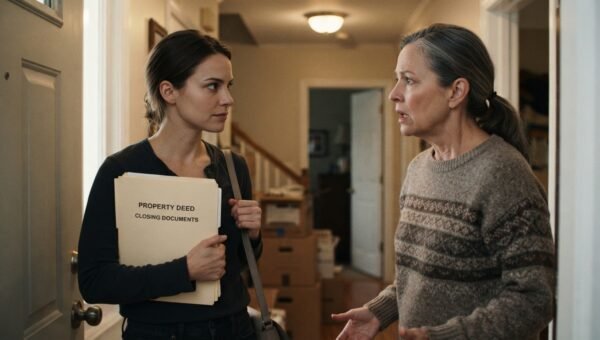
“The florist delivered these to my house by mistake this morning,” I said, holding out the heavy glass vase. “They belong to you.”
She looked down at the pale pink peonies and the white roses, then looked up at my face. “Oh… Wilford must have put the wrong street down. He’s always mixing up the auto-fill on his phone. Thank you so much for bringing them over. You didn’t have to do that.”
She reached out to take the vase, but as her fingers touched the glass, she stopped. Her eyes caught mine, and something in my posture or my face must have registered.
“Wait,” she said, her voice dropping. “Who are you?”
“I’m Clara,” I said. “Wilford’s wife.”
The color drained from her face so completely that her lips turned gray. The vase slipped slightly in her hands, and I tightened my grip so eighty dollars worth of flowers wouldn’t shatter on her concrete porch.
“His… what?” she whispered.
“His wife,” I repeated, keeping my tone measured. “For thirty-one years. We live over on Sycamore.”
She stood frozen on the threshold. From inside the house, a boy’s voice yelled, “Mom, Chloe took the remote again!”
Corinne didn’t answer him. She swallowed hard, staring at me like I was a ghost that had walked up from the road.
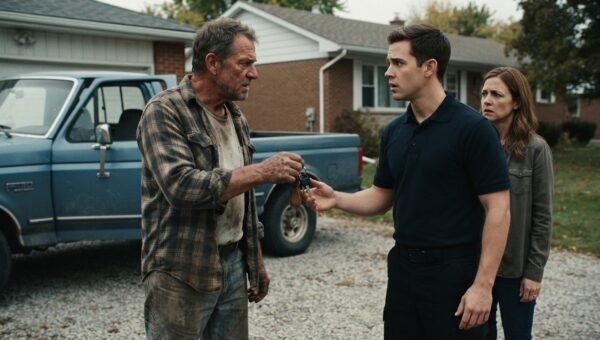
“He told me he was divorced,” she said, her voice trembling. “He told me he had an ex-wife in Shelbyville who took everything in 2011. He said you guys hadn’t spoken in fifteen years.”
“There is no ex-wife in Shelbyville,” I said. “He sleeps in my bed every night he isn’t on the road. We paid our house off together five years ago.”
She pulled back into the entryway, leaning her shoulder against the doorframe as if her legs were giving out. Tears sprang into her eyes, but not the theatrical kind. It was the shock of a woman realizing the ground beneath her had never been solid.
“He’s the father of my children,” she stammered, pointing a shaking hand toward the hallway. “He pays half the mortgage here. He comes by on Tuesdays and Thursdays after work. He told me he couldn’t marry me legally because of a tax lien from his old business.”
“Wilford never had a business,” I said. “He worked for the county road commission for thirty years. He has a pension and three savings bonds.”
She pulled the door almost shut, leaving just a narrow opening so the children wouldn’t see. “What are you going to do?” she asked, her voice cracking.
“I’m going to protect myself,” I told her plainly. “And if you have any sense, you will do the same. Because everything he gave you here came out of money he hid from our home.”
I set the vase down on the porch mat between us.
“Happy Mother’s Day, Corinne,” I said, and walked back down the path to my car.
ENDING
When I pulled into the driveway on Sycamore Street forty minutes later, Wilford was sitting on the front porch swing, drinking an iced tea. His tools were put away, and he had changed into a clean collared shirt, ready for our Sunday dinner.
I didn’t take off my coat. I walked right up the steps and dropped a thick manila envelope onto his lap.
Inside was the printout of the florist receipt, the copies of Liam and Chloe’s birth certificates, and the eighteen months of bank statements showing the eight-hundred-and-fifty-dollar transfers to Ridgeview Court.
Wilford picked up the envelope, frowning. “What’s this, Clara?”
“Read it,” I said.
He opened the flap and pulled out the top sheet. As his eyes hit the names on the birth certificates, his jaw slacked. The easy, comfortable expression he had worn for three decades melted off his face, replaced by a gray, panicked sweat that broke out across his forehead.
“Clara… now, just hold on,” he started, his voice instantly dropping into that placating, reasonable tone he used whenever an argument threatened to start. “You don’t understand the situation. Corinne was in a bad spot years ago. It was a mistake, but I had an obligation to do the right thing by those kids…”
“You had an obligation to your marriage vows,” I said, standing over him. My voice didn’t rise. It was cold as stone. “You let me cry over an empty nursery for ten years while you were setting up a second household across town. You took county pay and diverted our retirement into a house in Briarwood.”
“I never stopped loving you, Clara,” he pleaded, reaching for my arm.
I stepped back out of his reach. “Don’t touch me, Wilford.”
I gave him three hours. I told him if his truck and his clothes weren’t out of the house by five o’clock, I would walk down to the courthouse on Monday morning with every document in that folder and hand them directly to the county ethics board to audit every mileage check he claimed on those ‘overnight inspections.’
He didn’t fight me. Men who live double lives are cowards when the curtain is pulled; they don’t fight because they know how much dirt is under the floorboards. He packed three suitcases, his tool chest, and his hunting rifles into the back of his pickup and drove away before four-thirty.
On Monday morning, I met with Martha Jenkins, a family law attorney who had handled estates in our town for twenty-five years. We filed for divorce on grounds of adultery and financial concealment. Because Wilford had used marital assets to fund the down payment and monthly mortgage on the Ridgeview property without my knowledge or consent, Martha filed a claim against his share of our equity.
We settled six months later.
I kept the house on Sycamore Street free and clear, along with sixty percent of his county pension benefits for the rest of my life. Wilford had to sign over his remaining retirement accounts to cover the fraudulent withdrawals he had made over the preceding decade.
He moved into a small, rented duplex on the north side of town. Corinne didn’t take him in. She hired her own lawyer, filed for formal child support, and put the Ridgeview house up for sale to get out from under the debt he had tied to her name. The last I heard, Wilford was working part-time delivering auto parts to make his court-ordered payments to her and keep his head above water.
Yesterday, I spent the afternoon in my garden, planting yellow daylilies along the front walkway where the porch boards used to creak.
Mother’s Day still comes every May. The church still hands out carnations at the door, and the local shops still put up their pink ribbons and banners. But the ache I carried for thirty years doesn’t feel the same anymore. It isn’t grief over what I missed. It is just relief that the truth finally arrived at my door, even if it had to come wrapped in cellophane and addressed to somebody else.