PART 1
My husband, David, never had much patience for my best friend, Anne. Whenever she came over to our house on Sunday afternoons, he would find an errand that needed doing out in the garage or take our golden retriever on a walk that lasted two hours. He always said Anne was too loud, too scattered, and carried too much drama through our front door. For twenty-six years of marriage, I accepted that.
Some spouses just do not click with childhood friends, and I stopped trying to force them into the same room.
Then Anne died two weeks ago, on a rainy Thursday morning, after a sudden stroke in her hallway. She was sixty-one. I was the one who went with her sister to make the arrangements, pick out the floral spray, and choose the soft blue dress she loved. David attended the service, sat quietly beside me in the third row, and held my hand during the eulogy, but he did not shed a tear. I figured he was just being his usual steady, detached self.
The trouble started on Monday when I was sitting at the kitchen table going through our joint checking account statements to balance our monthly bills. I was looking for an annual insurance payment when a recurring auto-draft caught my attention. It was labeled “Consolidated Power,” but we pay our electricity through the county cooperative.
The draft was for an average of $142 a month, sometimes creeping up past $190 in the middle of summer.
I traced it back through the digital bank records on my laptop screen. It had been drafting every single month on the seventeenth for nearly two years.
I grabbed the phone and called the power company directly, giving them our account information and asking for the service address linked to that specific billing ID. The customer service representative hesitated for a second before confirming the service location: 412 Maple Street, Apartment 3B.
That was Anne’s apartment.
My husband had been paying my best friend’s electric bill for almost two years, behind my back, out of our joint household funds.
The heat rushed straight to the back of my neck. Thoughts started tumbling over each other, ugly and fast. Why would a man pay another woman’s utilities in secret? Why Anne, the very woman he claimed annoyed him?
Had their coldness in front of me been an act? Had they been meeting during those long walks with the dog? The thought of betrayal from the two people who anchored my daily life made my hands shake so badly I could barely hold the paper statement.
When David walked in the back door that evening, hanging his windbreaker on the hook by the pantry, I did not wait. I slapped the printed bank statement onto the kitchen island right in front of him.
“Explain this, David,” I said, my voice tight. “You’ve been paying Anne’s electric bill for twenty-two months. Every single month. Why were you hiding that from me?”
David looked down at the paper. He did not yell, and he did not make an excuse. He just closed his eyes for several seconds, looking far older than his sixty-three years. When he opened them, his voice was flat and quiet.
“I can’t tell you here, Sarah,” he said softly. “You need to go over to her apartment before her sister clears it out tomorrow. In the kitchen, the top drawer next to the refrigerator. There’s a yellow folder with your name on it. Go look at it yourself.”
PART 2
The drive across town to Maple Street took twenty minutes, but it felt like hours. My mind raced through every interaction the three of us had shared over the last two years. I remembered Anne complaining about her pension being tight. I remembered David offering to pick up takeout on nights Anne stayed late, and how he would occasionally stay in his truck in her driveway for five minutes before coming inside. At the time, I thought he was listening to the baseball game. Now, every small memory felt dirty and suspicious.
Anne’s apartment building was quiet. Her sister, Carol, had given me a spare key two days earlier so I could choose a few pieces of Anne’s costume jewelry and her recipe boxes before the estate sale company came on Wednesday.
The apartment smelled faintly of Anne’s lavender hand lotion and stale air. Walking into that quiet kitchen without her sitting at the round wooden table felt like stepping into an abandoned world.
I walked straight to the counter beside the refrigerator. The top drawer held a jumble of ordinary things: rubber bands, takeout menus, birthday candles, and a yellow plastic-tabbed folder. In thick black marker across the front tab, Anne had written: SARAH.
I pulled it out and set it on the laminate counter under the fluorescent light.
My fingers were trembling as I opened the tab. I expected to find personal letters, maybe old hotel stubs, or some proof of a secret life that would shatter my entire marriage. But the top papers were medical invoices from St. Jude Regional Hospital and our local diagnostic imaging clinic. Stamped across them in red ink were payment receipts, paired with carbon copies of cashier’s checks drawn from a local savings branch.
Beneath the receipts were three short, handwritten notes on yellow legal pad paper in David’s unmistakable cramped handwriting.
One of them, dated fourteen months ago, said: “Anne, the balance on the scan is cleared. Keep the lights on. Let me know if the specialty pharmacy pushes back on the co-pay. Do not let her see you struggle.”
And clipped to the very bottom was a sealed white envelope. Written across the front in Anne’s looping script was one sentence: “Sarah, only if I go first.”
I pulled the flap open. The single sheet of stationery unfolded in my hands.
The first sentence hit me like a physical blow: “Please don’t blame him. I made him promise not to tell you what your test results really showed.”
My breath caught in my throat. Two years ago, I had gone in for an intensive series of biopsies and scans following a severe bout of anemia and abdominal pain. The clinic had called me a week later, saying the tests were clean, that it was a ruptured cyst and an iron deficiency, and that I was completely clear.
I stopped reading the letter. The room seemed to spin. I grabbed my cell phone from my purse, dialed the direct line to my family physician’s office, and demanded to speak with Dr. Miller immediately.
PART 3
The receptionist tried to put me through to a scheduling nurse, but something in my voice made her transfer me to Dr. Miller’s personal triage line. When he picked up, I did not bother with pleasantries.
“Dr. Miller, this is Sarah Vance,” I said, leaning against Anne’s counter to keep my balance. “I am standing in Anne Albright’s apartment looking at hospital receipts and diagnostic codes from October two years ago. I need you to open my electronic chart right now and tell me what was sent to this office.”
There was a long pause on the other end of the line, followed by the sound of rapid typing.
“Sarah,” Dr. Miller said, his tone shifting from clinical to cautious. “Your pathology report from October two years ago came back with a severe mislabeling from the regional lab. They initially flagged malignant cells in the peritoneal wash. But two days later, the lab director issued a corrected addendum. It was a cross-contamination error at their central facility. Your tissue was benign.”
“Then why did Anne have these bills?” I asked, looking at the invoices totaling nearly $18,000. “Why was David paying for specialty imaging and oncology reviews?”
“Because,” Dr. Miller said gently, “when that first preliminary result came through, the hospital called your home emergency contact. You were asleep after the sedation. David answered. The preliminary report looked catastrophic. He called Anne because he knew she had worked thirty years as an administrator for the regional oncology network. He was terrified. He went to her to help him understand what you were facing.”
The rest of the story lay waiting in Anne’s letter. I hung up the phone and forced myself to read every word she had written.
Anne wrote that the morning David showed up on her porch with that preliminary paper, he was in pieces. He was ready to sell his carpentry shop and liquidate his retirement to get me into an experimental clinic in Boston. Anne had used her industry contacts to pull in two top specialists for an immediate, private second-opinion review and an expedited re-staining of the original tissue samples before telling me, hoping to spare me the terror until they were certain.
Those private, rushed specialist consultations and emergency panel reviews had cost thousands out of pocket, money Anne had put on her own personal credit cards because she could get the doctors to move faster as professional favors. Three days later, the lab admitted its clerical mistake and sent the corrected report to Dr. Miller, who then called me with the clean bill of health I remembered.
I had celebrated with a quiet dinner at home, never knowing what had happened behind the scenes.
But the financial damage to Anne had already been done. Her pension was modest, and the interest on those emergency medical charges had quickly eaten away at her monthly budget. When David found out six months later that Anne was skipping meals and sitting in the dark with the heat turned down to pay off the cards she had used to protect our peace of mind, he tried to write her a lump-sum check.
Anne, stubborn to her bones, tore the check in half in his face. She refused to take a single dollar from our family savings for what she called “looking out for my sister.”
So David made a quiet deal. He took over her monthly electric bill through an automatic draft so she would never have to sit in a freezing apartment, and he secretly paid down the medical balances month by month through cashier’s checks. He endured her sharp tongue, kept his distance in public so I would never suspect the secret they shared, and carried the quiet shame of having almost lost me without ever burdening me with the terror he had lived through.
ENDING
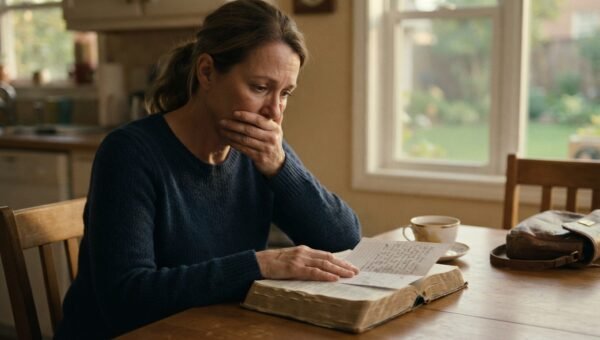
I sat alone at Anne’s kitchen table until the sun went down, reading her letter three times until the paper felt soft in my hands.
She had written at the end: “Your husband doesn’t hate me, Sarah. He just hates that I saw him completely broken, and he’s too proud to ever let you see him that way. Forgive him for keeping the secret. He only did it because he couldn’t bear the thought of a world where you weren’t laughing at his bad jokes.”
I folded the letter, placed it back into the yellow folder with the receipts, and tucked it under my arm.
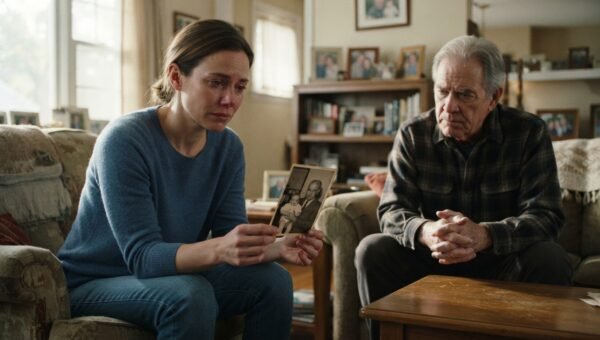
When I unlocked our back door at home, the kitchen was dim. David was sitting in his wooden rocking chair in the corner of the living room, staring out the window into the backyard darkness. His hands were clasped in his lap, resting against his jeans, motionless. He didn’t turn around when the floorboards creaked.
I walked into the living room, pulled the low footstool over to his chair, and sat down in front of him.
I didn’t yell. I didn’t scold him for keeping me in the dark or for handling our money without asking me first. I just reached out, took his rough, work-calloused hands in mine, and laid the yellow folder on his lap.
“I talked to Dr. Miller,” I said softly. “And I read what Anne wrote.”
David looked down at our hands. His shoulders dropped an inch, the stubborn tension he had carried for two years finally draining out of his frame. A single, quiet sob caught in his throat, and he leaned forward until his forehead rested against my shoulder.
“I thought I was going to lose you, Sarah,” he whispered, his voice cracking in the dark room. “I couldn’t let you carry that fear if there was even a chance it wasn’t real.”
I held him there for a long time, listening to the steady hum of our refrigerator and the quiet ticking of the mantel clock.
The next morning, I drove down to the utility company’s local office. I didn’t cancel the draft. Anne’s sister was moving into the apartment for the next three months to settle the estate, and there was still a small remaining balance on the final specialty clinic invoice inside the folder.
I wrote a check from our joint account to clear the medical account in full, signed my own name on the bottom line, and walked out into the crisp autumn air.