PART 1
My sister Karen took over Dad’s checkbook four years before he died, and I let her do it because she lived three streets away from his house while I was two hours north. Whenever I offered to split the paperwork, Karen waved me off. She told me she had a system, that Dad’s memory was slipping, and that it was easier if one person kept the files in order.
When Dad passed away in October, Karen called me from his kitchen table to say the final accounts were nearly empty. After the medical bills and the small burial policy paid out, there was only about eighteen hundred dollars left, which barely covered the gravestone engraving. I accepted it. I grieved, packed up a box of Dad’s old fishing lures and his flannel shirts, and went back home.
Then in late March, a green county tax notice arrived in my mailbox.
It was addressed to Rachel Vance, my legal name, for an annual parcel assessment in Miller County. The delinquent amount was $412.50 for twenty-two acres of undeveloped timberland on Old Creek Road. I had never owned land in Miller County. I had never bought acreage anywhere in my life.
I called the county tax assessor the following morning, thinking someone had made a typo on a parcel ID. The woman who answered looked up the parcel number and paused for a second before telling me the land had been deeded into my name four years ago.
“That has to be an error,” I told her. “I’ve never signed a purchase agreement or a deed in Miller County.”
“Well, ma’am, it was a quitclaim deed,” she said. “Transferred out of a family trust. Your signature and notary seal are on the record. If you want to see the instrument, you’ll have to come pull the physical book or look at the scanned microfiche in the recorder’s office.”
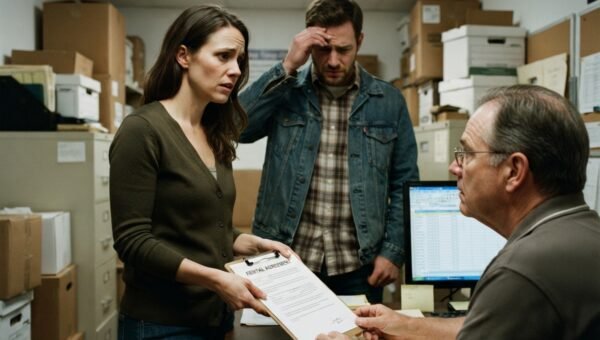
The next morning, I took the morning off work and made the drive down to the Miller County courthouse. The clerk brought up the file on a monitor behind the counter. There was my full name, typed neatly across the grantee line. Below it was a cursive signature that looked like mine at first glance, but the loop of the ‘R’ was slanted too sharply to the left. Karen wrote her uppercase letters with that exact backward lean. She had signed my name, had a mobile notary stamp it, and filed it four years ago, three weeks before Dad had signed over his financial power of attorney.
“Who paid the taxes the first three years?” I asked the clerk.
She checked the ledger. “Cashier’s checks from a regional credit union. They stopped arriving this past November.”
Right after Dad died.
I asked the clerk for the physical plat map and the gate address. The parcel was seven miles outside town, down a rutted gravel lane overgrown with switchgrass. When I pulled my car up to the tree line, there was nothing there but an empty, neglected pasture and one weathered metal equipment shed padlocked with a heavy brass Master lock.
The lock was old, but the hasp was secure. I didn’t want to break it, but the property was legally in my name, and my stomach was turning over. I walked back to my car, got Dad’s old tire iron from my trunk, slipped the flat end behind the latch, and leaned my weight into it until the dry screws tore free from the frame.
Inside, the shed smelled of dry dust, engine grease, and stale cedar. There were a couple of rusty gas cans and a wooden workbench against the back wall.
Hanging right above the bench, tacked directly into the plywood with two roofing nails, was a large wall calendar from four years ago. It was open to the month of May.
One single date, May 14th, was circled in thick red grease pencil. I recognized Dad’s heavy hand instantly. May 14th was the exact date Karen had officially taken over his power of attorney.
Directly beside the red circle, written in the shaky, deliberate handwriting Dad developed after his first mild stroke, were six words:
“If she signs for Rachel, call Martin.”
PART 2
I stood by the workbench with my hand resting on the dry wood, reading those six words three times.
Martin was Martin Cole. He had been Dad’s closest friend since their days working together at the county road commission, but I hadn’t seen Martin in at least five years. The last time I asked Karen about him, right after Dad went into assisted living, she told me Martin had moved south to live near his daughter and didn’t take calls anymore because of his hearing.
I took down the calendar, folded it carefully, and walked back out to my car. My hands were shaking so hard I dropped my keys in the grass before I could get the door open.
I didn’t call Karen. If she had forged my name on a county land deed four years ago, calling her would only give her time to shred whatever paper trail was left in Dad’s house. Instead, I drove straight into town and stopped at the local diner where the retired county road crew used to get coffee on Tuesday mornings.
The woman behind the register knew Martin immediately.
“Martin Cole didn’t move south,” she said, wiping down the laminate counter with a rag. “He’s still living out on Ridge Road in the yellow house with the twin silos. He was in here yesterday morning for oatmeal.”
Ten minutes later, I pulled into Martin’s gravel driveway. A silver pickup sat near the porch. Before I could even turn my engine off, the front screen door pushed open and an older man in denim overalls and a green work cap stepped out onto the porch, squinting against the late morning sun.
He looked at my car, then down at me as I stepped out. He didn’t look confused at all.
“You’re Rachel,” he said, his voice gravelly and flat. “Arthur’s girl.”
“I am,” I said, holding the folded calendar in my hand. “Martin, I just came from the shed out on Old Creek Road.”
Martin looked down at the paper in my grip, then let out a slow breath through his nose. He didn’t ask what I was holding. He turned slightly and held the screen door open with his elbow.
“Come inside,” he told me. “Your father told me this day was coming, but he hoped to God it wouldn’t.”
The front room smelled of pipe tobacco and clean laundry. Martin didn’t offer me tea or small talk. He walked over to a steel two-drawer filing cabinet in the corner of the room, unlocked the top drawer with a small brass key he took off his pocket ring, and pulled out a thick manila folder labeled with my father’s initials.
“Arthur knew what Karen was doing long before his mind started slipping,” Martin said quietly, setting the folder down on the kitchen table. “Karen thought because your dad got tired in the afternoons, he wasn’t watching the mail. But he watched everything.”
“Why didn’t he stop her?” I asked. “Why put the land in my name?”
“Because Karen didn’t want you to have that land,” Martin said. “She wanted to hide it.”
Martin pulled out a chair and sat down heavily. He laid his rough hands flat on the wood.
“Four years ago, Karen got into heavy debt with a private loan company over an online retail venture she never told you about. She was facing a personal judgment for sixty-two thousand dollars. She knew that if Arthur left property directly to her in the will, the creditors would attach a lien to it the minute it went through probate.”
The pieces started shifting in my head, cold and ugly. “So she forged my name to take it out of Dad’s name before probate?”
“She convinced herself she was borrowing your identity for safe storage,” Martin said. “She transferred the parcel to you so it would look like an arms-length gift between your father and his other daughter. Her plan was to force a private sale later, or hold it until her judgment cleared, then have you sign it over without realizing what it was worth. But your dad caught the paperwork in the mail before she could shred the county return receipt.”
“If Dad knew,” I said, my voice rising, “why didn’t he go to the police? Why didn’t he call me?”
“Because Arthur was terrified of losing his home,” Martin said bluntly. “Karen told him that if he made a fuss, she would step down as caregiver, report him as incompetent, and have the county put him in the state ward in Leesburg. She had him backed into a corner, Rachel. He was seventy-eight years old, and he was scared.”
Martin pulled a single sheet of yellow lined paper from the folder and pushed it toward me. It was dated four years ago, written entirely in Dad’s hand, witnessing the forged deed and authorizing Martin to hold Dad’s private journals if Karen ever attempted to sell or liquidate the family assets.
“There’s one more thing,” Martin said, his voice dropping lower. “The day your father passed away, Karen didn’t come to you with the truth. But your father came to me the week before he died. He made me promise that if you showed up with that calendar, I had to show you what she did with the actual cash.”
Martin reached back into the envelope and pulled out a small, folded carbon slip from a local branch bank. Before I could ask what it was, Martin put his thumb beside the date at the top and quietly said, “Read the date first, Rachel. Just look at the date.”
PART 3
The date on the deposit slip was October 18th, two days before Dad died.
It was a teller receipt for a transfer out of Dad’s primary savings account into an individual account in Karen’s name only. The amount printed on the receipt was $48,500.
Below the amount was Karen’s signature as power of attorney, with a handwritten note in the memo line: *Caregiver expense reimbursement.*
My chest felt completely hollow. When Karen called me on October 22nd to tell me Dad was gone, she had cried into the phone and said Dad was down to eighteen hundred dollars, that the cost of his medications had drained everything he worked forty years at the grain elevator to save. I had felt so guilty back then. I had felt terrible that she had shouldered the financial burden while I was living two hours away, so I told her to keep the eighteen hundred for herself to cover her gas and meals.
She hadn’t drained it on medicine. She had emptied his life savings forty-eight hours before his heart gave out, knowing that once he passed, the power of attorney expired and the money would have had to go through probate and be divided equally between the two of us.
“Arthur couldn’t speak clearly those last two days,” Martin said softly. “Karen had him sign a blank withdrawal voucher while he was drifting in and out on morphine at the hospice center. The teller was an old girl from church who didn’t question Karen’s authority because of the paperwork she carried. But the branch manager called me that afternoon because Arthur had put my name on his accounts thirty years ago as an emergency contact, just in case.”
“Did you confront her?” I asked.
“I tried,” Martin said. “She told me if I opened my mouth, she’d tell everyone in town I was harassing a grieving daughter. She threatened to call the sheriff on me if I stepped foot in Arthur’s hospital room. So I waited. Arthur told me, ‘Rachel will get the tax bill. The county never misses a tax bill. When she finds out, she’ll come looking.'”
I sat at Martin’s kitchen table for twenty minutes in total silence. I looked at Dad’s handwriting on the calendar, the forged signature on the county deed, and the $48,500 transfer receipt.
The anger didn’t come like a sudden burst. It came like cold, heavy iron settling into my ribs.
I took the papers, put them inside my purse, and thanked Martin.
“What are you going to do?” he asked from the porch as I walked down the steps.
“I’m going to see my sister,” I said.
Karen lived in a brick ranch on the north side of town. When I pulled into her driveway, her sedan was parked under the carport. She opened the front door wearing an apron, holding a wooden spoon, smiling as if I had just dropped by for a casual lunch.
“Rachel! What on earth are you doing in town? You should have called, I would have put on some soup.”
I didn’t smile. I walked past her into the living room and set my purse down on the coffee table.
“I just came from the county recorder’s office,” I said.
Karen’s smile froze slightly at the corners, but she didn’t flinch. “What recorder’s office?”
I reached into my bag, pulled out the copy of the deed, and laid it on the glass table between us.
“You put twenty-two acres on Old Creek Road into my name four years ago,” I said. “You signed my name on the grantor transfer and paid a mobile notary to stamp it.”
Karen blinked once. Her face tightened, the friendly expression dropping away completely. She crossed her arms.
“I had to protect that property from Dad’s medical bills,” she said, her voice turning sharp and practical. “You don’t understand how the state works, Rachel. If the state thinks an elderly person has assets, they take everything for long-term care before Medicaid kicks in. I saved that land for the family.”
“You didn’t save it for the family,” I said evenly. “You had a sixty-two thousand dollar judgment against you from a bad loan. If the land stayed in Dad’s name, you couldn’t touch it. If it went to you, your creditors would seize it. So you forged my name to hide it under my credit.”
Karen’s mouth opened slightly, but no words came out.
“And that’s not all,” I continued, taking the bank receipt out of my bag. I didn’t raise my voice. “You cleaned out forty-eight thousand five hundred dollars from Dad’s account while he was slipping away in hospice, and then you looked me in the eye and said there was only eighteen hundred left.”
Karen stared at the yellow paper on the table. For a second, I thought she might apologize, or break down and explain how desperate she had been. But she didn’t. Her eyes narrowed.
“I took care of him for four years, Rachel!” she hissed, stepping closer. “You came down on weekends once a month. You brought him pie and went to church with him, while I changed his bedsheets and sorted his pills and listened to him repeat the same three stories every single day! I earned that money! Dad would have wanted me to have it!”
“Dad knew what you were doing,” I said. “He left a calendar in the shed on Old Creek Road. He wrote a note to call Martin if you signed my name.”
Hearing Martin’s name stripped the fight right out of her posture. Her shoulders dropped an inch. She looked down at the carpet, her jaw working silently.
“I’m giving you two choices, Karen,” I said, keeping my voice as level as a carpenter’s rule. “You wire half of that money, twenty-four thousand two hundred and fifty dollars, into my account by five o’clock tomorrow, and we hire a real estate attorney to sell the Old Creek Road parcel legitimately, splitting the proceeds down the middle after back taxes are paid. Or I walk back into the county courthouse and hand these copies to the county prosecutor for forgery and elder financial exploitation.”
“You wouldn’t do that to your own sister,” she whispered.
“Try me,” I said.
ENDING
The wire transfer for $24,250 hit my checking account at two o’clock the following afternoon.
Karen didn’t call or text when she sent it. The notification just appeared on my phone while I was sitting at a rest stop on my drive back home.
Over the next four months, everything went through an estate attorney named Henderson, whose office sat two doors down from the courthouse. Karen never attended a single meeting in person. She signed the listing agreements and the deed corrections by certified mail. The twenty-two acres on Old Creek Road sold in late August to a local timber buyer for $68,000. After the attorney fees, the unpaid county taxes, and the closing costs were settled, another $31,400 was deposited into my account.
Karen got her equal share of the land sale, down to the penny. I didn’t take a dime more than half of what Dad had intended for us to share, because I didn’t want anything she could ever point to and say I stole from her.
We haven’t spoken since that afternoon in her living room.
My cousin told me recently that Karen tells people in town that I forced a land sale out from under her during a vulnerable time, and that I walked away with money she deserved for caregiving. At first, hearing that made my stomach churn with the same old anger. But after a while, the anger faded into something colder and quieter. The people who knew my father knew the truth, and Martin was still having his oatmeal at the diner every Tuesday morning, ready to tell anyone who asked.
Last weekend, I drove back down to Miller County to visit Dad’s grave.
The county cemetery was quiet, surrounded by the same tall pines that grew out on Old Creek Road. The gravestone was clean now, the final dates carved deep into the grey granite just like we had planned.
I stood there for a long time, listening to the wind through the dry grass. I didn’t feel triumph, and I didn’t feel clean. Finding out that someone you shared a childhood bedroom with could look at your dying father and see only a stack of cash leaves a hollow space that money never quite fills.
Before I left, I reached into my coat pocket and pulled out the small brass Master lock I had pried off the shed door four months earlier. It was scratched and heavy in my palm.
I set it down carefully on the flat granite base of Dad’s marker, right next to his name, and left it there.