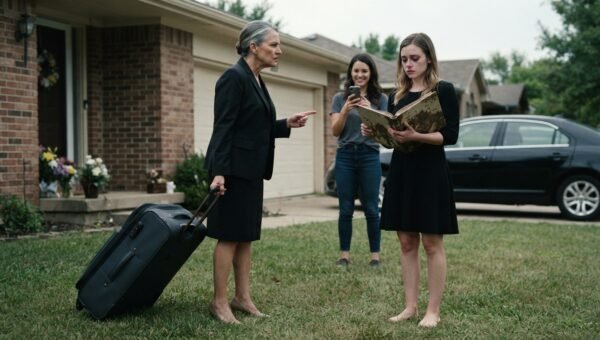
PART 1
My husband, Greg, cleared his throat in the middle of Sunday dinner and told my entire family that I had lost $6,000 from the veterans’ fundraiser account.
He didn’t pull me into the pantry first. He didn’t ask me what happened. He simply set his fork down next to his plate, looked across the table at my daughter, Chloe, and my sister-in-law, Brenda, and said he was worried about my memory.
“Martha has taken on too much,” he said, speaking in that soft, sorrowful tone he uses at funerals. “Her age is catching up with her. The auxiliary books are short six thousand dollars in cash, and she doesn’t know where it went. For her own dignity, she needs to step down publicly this Tuesday before the committee makes it ugly.”
I sat with a warm bowl of green beans in my hands. I am sixty-four years old. I have kept the ledger for the county American Legion Auxiliary for nine years, balancing every single nickel from the bake sales, the fall raffles, and the Memorial Day poppy drives.
“Greg, what are you talking about?” I asked. My voice sounded thin, even to me. “I don’t keep cash in the house. The six thousand from the silent auction went directly into the First National auxiliary escrow account on Thursday afternoon.”
“I checked the ledger at the hall this morning, Martha,” he replied, shaking his head. “Arthur called me before church.
The deposit was reversed or never cleared. The balance is short, and the withdrawal slip has your auxiliary member number on it. You forgot, honey. Just like you forgot to turn the burner off last month.”
The burner had been his fault, but he had insisted I left it on until I doubted myself enough to apologize.
Brenda looked down at her napkin, smoothing the cloth flat with her fingernails. Chloe looked up from her phone, her forehead creased.
“Mom, are you okay?” Chloe asked quietly. “Have you seen Dr. Miller lately?”
That question hurt worse than Greg’s words. My own daughter looked at me like I was disappearing.
Greg reached across the table, putting his warm, heavy hand over mine. “We’ll handle it as a family. I will cover the shortfall from our savings so the veterans don’t suffer. But you have to step down at the Tuesday meeting and admit you’re stepping back due to personal fatigue. We cannot let people think you stole it.”
I didn’t argue anymore at the table. When you argue with a calm man who sounds like he is trying to save you from yourself, you only make yourself look wild.
On Monday morning at eight-thirty, I did not call the auxiliary chairman, Arthur. I didn’t call Greg at his hardware shop either. I drove straight down to the First National branch on Elm Street, carrying my leather purse, my auxiliary checkbook, and my personal driver’s license.
The lobby smelled like clean paper and floor wax. Clara Simmons, a woman who has worked that counter since my children were in elementary school, greeted me from behind the glass.
“Morning, Martha,” she said. “Here to balance the auxiliary books again?”
“Clara,” I said, leaning close to the opening in the glass. “There is a six-thousand-dollar cash withdrawal on our charity account from Thursday. They tell me my name and number are on the slip.”
Clara clicked her mouse a few times, her silver spectacles sliding down her nose. Her eyebrows drew together.
“Yes,” Clara murmured. “Thursday at three-fifteen. In-person counter withdrawal. Cash.”
“Clara, look at me,” I said, pressing both hands against the counter. “Did I walk in here on Thursday at three o’clock and ask you for six thousand dollars in hundred-dollar bills?”
Clara lifted her head. She looked at my face, my eyes, and my short gray hair.
“No, Martha,” she said slowly. “You were not the woman at my counter.”
PART 2
The lobby noise seemed to fade into a dull hum. Clara stared at the computer screen, then looked back at me.
“I was covering teller station three on Thursday,” Clara explained, lowering her voice. “A woman came in wearing your charcoal wool winter coat, the one with the brown velvet collar you always wear to church meetings. She had large sunglasses and a wool scarf pulled up over her chin. She handed over your auxiliary card and your driver’s license. She spoke low, saying she had a terrible head cold and needed the funds for the contractor doing the legion hall roof repairs.”
“My coat,” I whispered.
My charcoal wool coat had been hanging on the hall rack in our entryway all week. It had been a gift from Greg three winters ago.
“The signature looked close enough on the pad,” Clara continued, her lips pressing together in concern. “And she had your actual plastic ID card. But she was nervous, Martha. She kept looking back toward the double doors. I told Mr. Vance, the branch manager, that something felt slightly off, but with the valid ID, the auxiliary signatory authorization, and the matching card, the transaction was completed.”
“I need to see who it was, Clara,” I said. “Greg told our family I have dementia. He told my daughter I lost the money because of my age.”
Clara didn’t hesitate. She stepped away from her station and walked straight into the branch manager’s glass office. Five minutes later, Mr. Vance opened the door and waved me inside.
Because I was a primary authorized signer on the charity account, Mr. Vance pulled up the internal security log on his wide desktop monitor. The timestamp was 3:14 PM on Thursday afternoon.
The camera over the teller counter gave a clear, color view from slightly above. The woman walked up to the counter in my charcoal coat. But when she tilted her head to tuck her scarf under her chin, the overhead light hit her profile.
It was Brenda.
My husband’s sister. The woman who had sat at my Sunday dinner table twelve hours earlier, eating my pot roast and smoothing her napkin while Greg told my daughter I was losing my mind.
She had my purse. Greg must have taken my wallet from my bag while I was out in the garden Thursday morning, handed my driver’s license to his sister, and slipped it back before I ever noticed.
I stared at the screen, my hands trembling against the edge of Mr. Vance’s desk. “Can you save this?”
“The police will need to pull it officially, Martha,” Mr. Vance said gently. “Unless you want to resolve it before filing a formal report.”
“Keep it ready,” I said.
I didn’t go home. I drove to the legion hall. Arthur, the auxiliary chairman, was in the back office going over the monthly statements with his reading glasses on. Arthur served in Vietnam and had known my father for forty years.
When I walked in, he looked up with a pained expression.
“Martha,” he said, taking off his glasses. “Greg came by this morning. He dropped off an envelope with thirty-five hundred dollars in cash. He said it was all you two could pull from savings right now, but he promised the remaining twenty-five hundred next week. He asked me not to file a police report to spare you the public humiliation.”
“Arthur,” I said, sitting down across from him. “Did Greg say anything else?”
“He said you had already agreed to resign tomorrow night. But Martha, something strange happened right before you walked in.”
Arthur turned his laptop toward me. He had the legion’s auxiliary account pulled up on the bank portal.
“Twenty-five hundred dollars hit the account at nine o’clock this morning,” Arthur said, tapping the glass. “A wire transfer. It came from an account belonging to Chloe.”
PART 3
I sat frozen in Arthur’s small office, staring at my daughter’s name on the bank screen.
Chloe had sent twenty-five hundred dollars to cover the exact remaining balance of the missing charity cash. Greg had brought thirty-five hundred in cash this morning. That made the full six thousand.
“Arthur,” I said, my voice shaking with a cold certainty, “give me two hours. Don’t touch these records, and don’t call Greg. If I haven’t explained this by noon, call the sheriff.”
I left the hall and called Chloe immediately. Her voice answered on the second ring, sounding stressed and tight.
“Mom? Are you at home? Are you resting?”
“Chloe,” I said, keeping my words very steady. “Why did you wire twenty-five hundred dollars to the American Legion auxiliary account this morning?”
Silence hung on the line for four long seconds.
“Dad called me at seven this morning, Mom,” Chloe said, her voice breaking. “He said you took the money from the charity account because you were confused, and that you spent it on some online sweepstakes scam you fell for. He said he was putting up thirty-five hundred of his own money, but he was short twenty-five hundred. He told me if I didn’t send the rest, the committee would have you arrested today.”
Tears pricked my eyes, but they were hot with fury, not sadness. “Chloe, did you give your father the money directly?”
“No, he gave me the auxiliary routing and account number. He told me to transfer it straight there so the books would clear before noon. Mom, is it true? Are you having trouble remembering things?”
“I am standing outside the bank right now, Chloe,” I told her. “Meet me at the legion hall in twenty minutes. Do not call your father.”
Then I called Greg.
“Greg,” I said when he picked up at the hardware store. “Arthur wants to see us both in his office before the evening committee meeting. He wants to sign the quiet resignation papers now.”
“Good,” Greg said, breathing a sigh of relief. “I’m glad you’re being reasonable, Martha. It’s for the best. I’ll meet you there in fifteen minutes.”
When Greg walked into Arthur’s office, he had his best sorrowful expression on his face. But the moment he saw Chloe sitting in the corner chair, his smile faltered.
“Chloe? What are you doing here, sweetheart?” he asked.
“She’s here to hear the truth, Greg,” I said.
I nodded to Arthur, who turned his computer screen toward the desk where Greg stood.
Mr. Vance at the bank had sent over the still frames from the security camera file. The image on the screen showed teller station three. Brenda was standing at the counter in my charcoal coat, sliding my driver’s license across the marble.
Greg’s face lost all its color. He opened his mouth, then closed it.
“That’s… that’s Brenda,” he stammered, looking at Arthur, then at me. “Martha, Brenda must have stolen your coat and your ID. She’s been struggling with her credit cards. It’s a complete misunderstanding. I had no idea she would do something so reckless.”
“Is that right?” Arthur asked in a dry, flat voice.
Arthur clicked his mouse once to advance the footage by eight seconds and zoomed in on the wide-angle camera above the lobby entrance.
The screen enlarged.
Standing three feet behind Brenda, watching the doors and leaning against the brochure stand, was Greg. As the teller slid the envelope of cash across the counter, Brenda turned around, handed the envelope to Greg, and the enlarged frame showed him opening the flap, his thumbs counting the stack of hundred-dollar bills.
Chloe stood up from her chair. Her eyes were wide, fixed on her father.
“Dad?” she said, her voice cracked down the middle. “You were there with Aunt Brenda? You took the cash?”
Greg stared at the picture of himself counting the auxiliary’s money. He couldn’t speak. The lie had run completely out of room.
ENDING
Greg didn’t try to defend himself anymore. The quiet in that small office was absolute.
Brenda had run up thousands of dollars in debt on high-interest store cards, and the collectors had threatened to garnish her wages. Greg had wanted to bail his sister out, but he didn’t want to touch his own hardware business accounts or explain our joint savings withdrawals to me.
So he orchestrated a theft that would solve Brenda’s debt, pin the blame on my supposed cognitive decline, and let him play the noble, suffering husband who swept in to cover part of the loss while panicking our daughter into paying the rest. He would replace the money, keep his sister out of collections, and gain total control over our family finances by declaring me unfit.
“Arthur,” I said quietly, never taking my eyes off Greg. “The six thousand dollars is back in the escrow account. Thirty-five hundred from Greg’s pocket, and twenty-five hundred from Chloe.”
Arthur nodded slowly. “The auxiliary has been made whole, Martha. But Greg is barred from this post for life. And if you want to take this footage to the county sheriff, I will walk you across the street myself.”
I looked at the man I had shared a bed with for thirty-two years. I saw a small, selfish stranger who was willing to let our daughter believe her mother’s mind was rotting away, just to save his own pride.
“I won’t send you to jail, Greg,” I said, my voice steady. “Because that would drag the auxiliary and Chloe through months of small-town gossip. But you are going to write Chloe a cashier’s check for twenty-five hundred dollars from your personal shop account before five o’clock today.”
“Martha, please,” he whispered, his hands trembling. “We can talk about this at home.”
“There is nothing to talk about,” I said. “You’re packing your clothes and staying at Brenda’s house tonight.”
We didn’t file a criminal report, but truth has its own way of setting boundaries. Arthur accepted my clean ledger at the Tuesday meeting, and I stood before the auxiliary members with my head up, presenting the balanced books to a round of applause. Greg was nowhere in the room.
The next afternoon, I went to First National alone. I opened an individual checking and savings account in my name only, transferring my share of our joint assets and changing the authorized beneficiaries.
When I got back to the house, Greg had already come and gone, taking his suitcases and his hunting rifles. The house felt strangely open and clean.
I walked into the front hall, took my charcoal wool coat off the rack, and carried it out to the garage trash bin. I didn’t want to look at the collar, and I didn’t want to smell the perfume Brenda had left on the wool.
I walked back into my quiet kitchen, put the kettle on the stove, and turned the burner on myself, watching the clean blue flame catch without a single doubt in my mind.