PART 1
The flowers came to our porch around ten in the morning on Mother’s Day. It was already humid enough in Ohio that the cellophane wrap had a film of sweat over the purple irises and yellow daylilies. There was an eighty-dollar receipt stapled right to the brown paper collar. I stood there holding them with both hands, my slippers half off my heels, because I do not have children and nobody has ever sent me flowers on the second Sunday of May.
I took the envelope out of the plastic fork stuck into the foam. I read the little printed card twice. “To Mom, from Daddy and the twins.”
Out back, the lawnmower shut off. The engine sputtered twice, died down, and left the whole yard quiet except for the sparrows in the hedge. Wilford was in the detached garage, likely wiping off the blades with an old towel like he always did on Sunday mornings before church.
I lowered myself down onto the porch steps. My knees popped, the right one louder than the left. Thirty-one years married to Wilford Sowards. In our thirties, we spent five years driving to clinics in Columbus, taking temperatures, sitting on paper sheets, and praying until my throat was raw. When the doctors told us it was simply never going to take, Wilford held me on the living room rug and told me God made some homes to be just two people caring for each other.
I made my peace with childlessness a long time ago. I buried it deep enough that it did not ache every single day, only on holidays.
I looked down at the receipt. The florist was Country Gardeners on Route 4. The order said “Prepaid Standing Order.”
I took my cordless phone off the kitchen counter and dialed the number on the paper. A young girl answered, her voice loud and cheerful over background music and the rustle of wrapping paper.
“Country Gardeners, Happy Mother’s Day, how can we brighten your day?”
“Hello,” I said. My voice was raspy, like I had been sleeping with my mouth open. “I have a delivery that came to 418 Elm Street. It has an order slip for Wilford Sowards. It must be an error. There are no mothers at this house.”
“Oh, let me pull the ticket,” she said. The keys clacked on an old keyboard. “Oh, no, Mrs. Sowards?
I am so sorry! That is our rookie driver, Tommy. He saw Mr. Sowards on the account profile and grabbed the billing address by mistake instead of the delivery ticket. Mr. Sowards’s standing order? He has sent that exact same arrangement every Mother’s Day since 2014.”
A knot pulled tight in the center of my chest.
“Every year since 2014,” I repeated.
“Yes, ma’am! It is set up on an annual recurring debit. Let me verify the real delivery address so Tommy can run it back out before noon. He has got it down for 114 Whispering Pines Court.”
Whispering Pines was a cul-de-sac four miles out past the Baptist church where Wilford served on the deacon board. It was a subdivision built in the late nineties, all brick ranches and two-story siding homes.
“And who was it addressed to on the delivery ticket?” I asked. I kept my voice flat, like a clerk checking inventory. “Just so I make sure the envelope has not been mixed up.”
“It says Clara Vance,” the girl said, totally innocent. “Under the twins, it says ‘Daddy, Clara, Mason, and Mia.’ Tommy should be back in ten minutes, Mrs. Sowards. Do you want him to pick it up, or should we just remake it fresh?”
“Do not send him back,” I told her. “I will bring it over myself.”
I set the receiver down on the cradle.
Clara Vance was the daughter of Wilford’s second cousin on his mother’s side. She had lost her mother to cancer when she was nineteen. Ten years ago, she moved to our county from down near Portsmouth, and Wilford helped her find an apartment and helped co-sign on a used Honda Civic because he said family looked after family. She had twins in the fall of 2014. At the family Thanksgiving dinner that year, Wilford told everybody Clara had made a foolish mistake with an oil-field contractor who had skipped town before the babies were born. Wilford had set up a small trust through his church discretionary fund to help buy diapers, or so he told the deacon board.
I walked through the back door into the garage.
The garage smelled of two-cycle engine oil, cut grass, and Wilford’s peppermint hard candies. He was sitting on a metal folding chair by his tool chest, taking off his work boots. He had gray hair at his temples, the same thick shoulders he had when we were twenty-two, and a faint smear of grease on his forearm.
“Grass was wet,” he said, not looking up. “Had to stop twice to scrape the deck. Are you ready for service? We ought to leave by ten-thirty.”
I held the bouquet in front of me with both arms.
“These were delivered to our porch, Wilford.”
He glanced at the yellow lilies. He gave a little, puzzled chuckle and leaned back against the tool cabinet. “What in the world? Somebody send you an appreciation bouquet from the choir?”
“The card says, ‘To Mom, from Daddy and the twins.'”
His hands stopped right on the laces of his left boot. His knuckles stayed bent. The casual, easy look on his face drained away so fast it looked like water running down a sink drain.
“They brought it to the billing address,” I said. “Whispering Pines. Mason and Mia. That makes them nine years old, doesn’t it?”
He did not deny it. He did not ask what I was talking about. He just sat on that steel folding chair, staring at the wet cellophane wrap in my hands, and took a long, shaky breath that made his chest heave.
“Norma,” he said, his voice dropping an octave into something thick and ugly. “Let me talk to you inside.”
PART 2
We did not go inside the house. I stayed standing by the open bay door with the morning breeze blowing grass clippings against my ankles, and Wilford stayed on his folding chair with one boot off and one boot on.
“How long?” I asked.
“You know how long,” he said. He looked down at the concrete floor between his socks. “You just said it. Nine years.”
“Since before they were born.”
“Clara was twenty-four. She was working at the feed store office. I was out there three times a week delivering seed from the warehouse. It happened, Norma. It was not planned. It was not some big romantic thing. It was just a mess, and then she was pregnant, and she was not going to get rid of them.”
“And the oil contractor who skipped town?”
“I made him up,” Wilford said. He rubbed his hands over his face, pressing his palms into his eyes until his skin went red. “I had to give the family something to say so they wouldn’t ask questions. Clara agreed to it. She wanted the children to have a clean name in town.”
“A clean name,” I said. My voice did not shake. That was the strangest part of that morning. I felt completely hollow, like someone had taken a melon baller and scooped out everything soft under my ribs. “And you have been their daddy for nine years while I made Sunday dinners and ironed your shirts for church.”
“I took care of them financially,” he said, looking up with that defensive deacon look he used whenever the church budget was tight. “I didn’t take from our household money. I used my overtime bonuses from the supply company and my side hauling jobs. I never let our bills slide, Norma. Not once.”
“Where did the down payment for 114 Whispering Pines come from?”
He shut his mouth.
In 2017, Wilford had told me his mother’s remaining estate had closed out with four thousand dollars after probate and medical debts took the rest. He had handled the paperwork himself through a lawyer in Circleville.
“That was your mother’s house money,” I said. “The sixty thousand from the farm parcel.”
“She needed a yard for the kids,” he whispered. “The apartment had mold in the basement. Mason has asthma. What was I supposed to do, let my own blood live in a dump?”
“They are your blood,” I said. “And what am I?”
He stood up then, limping slightly in his gray work sock, and reached out for my shoulder. “You are my wife. You have always been my wife. I never left you. I was never going to leave you. I made a vow to you thirty-one years ago, and I kept this home solid.”
I stepped back out onto the gravel driveway so his fingers missed my sleeve.
“You did not go to church conferences in Cleveland every September,” I said.
He did not answer.
“You went on family vacations.”
“Just camping,” he muttered, as if the cheapness of the trips made them less real. “Just three days at Salt Fork Lake so they could catch bluegill. Norma, please. Look at me. We are fifty-six years old. What are we going to do, blow up thirty years over something that’s already done?”
“Put your other boot on,” I said.
“Why?”
“Because we are going to Whispering Pines.”
He balked. His whole face tightened up with real terror, not the quiet shame he had shown five minutes earlier. “No. No, Norma, you do not need to do that. Leave Clara out of this. She doesn’t need this on Mother’s Day with the kids right there.”
“You are going to drive your truck, and I am going to follow you in the Buick,” I said. “And if you don’t turn down Elm Street right behind me, I am calling your pastor, your superintendent at the plant, and your sister before you reach the end of the block.”
Wilford stared at me for ten seconds. He had never heard me use that tone in thirty-one years. I was the wife who organized the funeral luncheons and made sure his prescription refills were picked up on Tuesdays. He slowly pulled his boot on, tied the knot, and took his keys off the nail by the side door.
The drive took nine minutes. I followed his silver Silverado past our church, where the parking lot was already filling up with cars, down through the bypass, and into Whispering Pines. The subdivision was quiet. A couple of teenage boys were throwing a football in a yard near the entrance.
Wilford pulled into the concrete driveway of a beige ranch house with maroon shutters. In the yard was a plastic swing set and a pair of small bicycles with training wheels leaning against the porch railing.
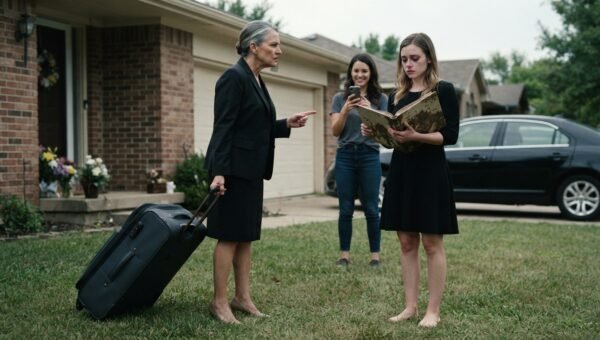
Wilford sat in his truck with the engine idling. I parked behind him, blocking his bumper, got out of the Buick, and took the yellow and purple flowers from the passenger seat.
PART 3
I did not wait for Wilford to climb down from his cab. I walked up the three concrete steps to the front door and pushed the doorbell. It played a two-tone chime inside.
Through the frosted oval glass in the center of the door, I saw a woman’s silhouette move quickly down the hallway. The door opened.
Clara had her hair tied back in a messy clip. She was wearing blue jeans and a yellow cardigan over a white shirt, and she had flour on the side of her thumb like she had been baking. When she saw me standing there with the arrangement from Country Gardeners, the smile on her face froze, slipped, and vanished completely.
Behind her, down the hall, a boy and a girl were sitting at a small kitchen table. I could see the backs of their dark heads. They were coloring on large sheets of construction paper.
“Norma,” Clara whispered. Her hands went straight to the pockets of her cardigan.
“The driver took these to Elm Street by mistake,” I said, holding out the flowers. “Tommy had the billing profile confused with the delivery ticket. He said your standing order has been running since 2014.”
Wilford’s heavy boots hit the front porch behind me. He did not look at Clara, and he did not look at me. He looked at the brass house numbers beside the doorframe.
“Clara,” Wilford said, his voice flat and dead. “She knows.”
Clara took a slow step back into the entryway. She did not cry. She did not scream. She just looked at Wilford with a sudden, bitter tiredness that looked years old.
“I told you not to use your credit card for those,” she said to him. “I told you four years ago to stop sending them through the shop.”
“It was an automatic debit,” he said miserably. “I forgot it was set up.”
“You forgot,” she repeated. She looked back at me. Her eyes were hazel, the same color as Wilford’s mother’s eyes. “Norma, come in out of the front yard. The neighbors don’t need to watch this.”
“I am not coming into your house,” I said. “I brought your flowers. Your children made you cards, I assume. Wilford bought the flowers.”
“Mom?” a small voice called from the kitchen. The little boy poked his head around the corner. He had Wilford’s wide jaw and Wilford’s straight, thick eyebrows. “Is that Daddy?”
“Go back to the table, Mason,” Clara said, not turning around. Her voice was firm, but her chin trembled once. “Stay with your sister. Daddy’s talking to an adult right now.”
The boy lingered for half a second, staring right at Wilford. Wilford didn’t look at him. He kept his eyes on the floor mat by the door. The boy ducked back into the kitchen.
“What do you want, Norma?” Clara asked. She leaned against the doorjamb, crossing her arms over her chest. “Are you going to make a scene in front of nine-year-olds on Mother’s Day?”
“No,” I said. “I am not going to touch those children. But I want the deed to this house.”
Wilford’s head jerked up. “Norma, wait a minute—”
“Shut up, Wilford,” I said. I did not raise my voice. I kept it low so the children would not hear. “The sixty thousand from your mother’s estate belonged to our joint marital assets. You hid it in an individual account and transferred it to the title company for this down payment. I remember the date on the probate closure. June 2017.”
Clara looked at Wilford with sudden sharp anger. “You told me that money was an early inheritance your mother set aside specifically for the twins before she died. You told me she knew about them.”
“She didn’t know,” I told her. “Wilford’s mother died in a nursing home with dementia. She didn’t know her own name the last two years she lived, let alone that Wilford had a family on the side. He stole that money out of our family estate.”
Clara’s face went from pale to gray. She turned on Wilford. “You lied to me about your mother? You swore to God she gave her blessing on that down payment so the kids would have a roof.”
Wilford looked like a man standing under a falling wall. “I had to get the money out where it could do some good. You needed the house, Clara!”
“You told me your wife knew we had an arrangement,” Clara said, her voice dropping into a fierce, harsh hiss. “You told me three years ago that Norma knew I had the children and that she accepted it as long as we stayed on this side of town and didn’t bother her life!”
The hollow feeling in my ribs turned to ice.
“He told you I knew?” I asked Clara.
Clara stared at me, her eyes wide. “He said you were devout. He said you couldn’t have babies, and when this happened, you two had a long prayer session and agreed that you would stay married for his job and your social circle, but that he was going to provide for his children. That’s why I never called your house. He told me it was part of the agreement that we never crossed paths.”
I looked at Wilford.
He was looking down at his boots again, his shoulders slumped, completely broken and pathetic. He had constructed two completely different realities, four miles apart, telling each woman what was required to keep his dinner warm on both sides of town. To Clara, I was the cold, pious wife who traded his fatherhood for social status at church. To me, he was the devoted, grieving husband who shared my quiet, empty house and accepted our barren life with Christian grace.
“Here are your flowers, Clara,” I said.
I set the arrangement down on the porch mat, right between Wilford’s work boots and the front door.
“Keep them,” I said. “Because by tomorrow morning, Wilford’s things will be on the curb, and you two can figure out how you’re going to pay the mortgage on this place when the bank sees the forensic accounting.”
ENDING
I drove back to 418 Elm Street alone. The church bells were ringing down the road, signaling the end of the eleven o’clock service. People were walking out to their sedans in their pastel dresses and dark suits, nodding to neighbors, holding little carnations the ushers had handed out to every mother at the door.
I went into the master bedroom. I pulled Wilford’s two large canvas duffel bags from the top of the closet.
I did not throw things or tear them. I worked steadily. I packed his work shirts, his suits, his Sunday ties, his underwear, his steel-toed boots, and his hunting jackets. I carried the bags out to the garage and piled them on the concrete where his lawnmower sat. Then I went to his desk in the den.
I took the steel lockbox he kept behind the encyclopedias. I had known the combination since 1998—the year his father died. Inside were the titles to both vehicles, our homeowners insurance policies, his mother’s probate settlement papers, and seven years of monthly bank statements from a regional savings bank in Lancaster that never sent mail to our house.
I called my sister, Evelyn, who lived twenty miles north in Delaware.
“Norma?” she answered. “Happy Mother’s Day, honey. Are you two coming out for pie this afternoon?”
“Evelyn,” I said. “I need you to call your son-in-law. The one who does forensic divorce law in Columbus. Tell him I am coming to his office at eight o’clock tomorrow morning, and I have the paper trail.”
Wilford pulled into the driveway twenty minutes later. He came into the kitchen looking thirty years older, his face slack and gray. He tried to speak three times before any sound came out.
“Clara told me to leave,” he whispered. “She locked the deadbolt. She won’t let me back inside until she talks to an attorney.”
“Your bags are in the garage, Wilford,” I said. I was sitting at the kitchen table with a cup of black coffee that had already gone cold. “You have your truck. You have your wallet. Do not sleep in this house tonight.”
“Norma, we have thirty-one years,” he pleaded. Tears were running into the gray stubble around his mouth now. “You can’t just throw away a whole life over a terrible mistake. I sinned. I know I sinned. But God forgives, Norma. We can go to Pastor Miller. We can do counseling.”
“God might forgive you, Wilford,” I told him, looking him right in the center of his red eyes. “He has an infinite capacity for mercy. I am just a woman who spent thirty years believing you were lonely with me. I don’t have that kind of mercy in my kitchen.”
He stood there for two minutes, waiting for me to break, waiting for me to start crying so he could hold my shoulders and tell me how hard he had tried to carry the burden for everyone.
I did not blink. I did not move.
He finally turned around and walked out through the laundry room. A minute later, the garage door rumbled open, his truck started, and the gravel crunched as he backed down the drive and turned onto Elm Street.
The divorce took fourteen months. Wilford’s attorney tried to claim the Whispering Pines property was separate property purchased through inherited family funds. My nephew’s law firm proved that Wilford had commingled our joint savings to cover the estate debts so he could pull the clean cash from the land sale to hand to Clara’s title company.
The judge ordered the Whispering Pines house sold at partition. Clara received forty percent of the equity to protect the minor children’s shelter, but Wilford’s share went straight to me to replace the drained joint accounts and the pension loans he had taken out against our retirement. Wilford had to move into a one-bedroom apartment over an auto repair shop near the fairgrounds. He lost his deacon seat within forty-eight hours of the filing.
Clara moved back down toward Portsmouth to be near her sister. She works at a medical billing office now. She called me once, about six months after the court proceedings finished. It was an awkward, five-minute call on a Tuesday afternoon. She told me she had put child support orders through the state agency so she never had to speak to Wilford directly, and she apologized for what she had believed about me for nine years. I told her the children were innocent, and that was all either of us could say.
I stayed in the house on Elm Street. I paid off the small remaining mortgage balance with my half of Wilford’s liquidated company stock.
Every year now, when the second Sunday of May comes around, the church ushers still try to offer me a carnation at the door because of my age. I always smile, pat their hands, and tell them no thank you. I don’t need a flower to prove what I survived, and I don’t need a card to know exactly who I am in an empty house that belongs entirely to me.