PART 1
The day it started, Leo was four years old and sitting on the linoleum in my kitchen, building crooked garages out of wooden blocks. He dropped one, looked up at me with his round hazel eyes, and said, “Look, Grandma. The blue truck fits.”
I smiled and rubbed the top of his head. “Good job, my boy.”
Karen was standing by the sink, rinsing out a coffee mug. The water stopped running.
She dried her hands on a dish towel, taking her time with each finger, and then turned around. Her face was tight, the way it always got when she felt she had to correct somebody.
“Martha,” she said, keeping her voice low so Leo wouldn’t notice, “please stop calling him that.”
I thought I had misheard her. “Calling him what, honey?”
“My boy.” She folded the towel in half and laid it flat on the counter edge. “You call him ‘my boy’ every time you walk in the door. He isn’t your boy. He’s mine and David’s. It sounds possessive, and I don’t like it.”
A hot sting rushed into my neck. I was sixty-one then, living alone in the three-bedroom ranch house my late husband, Arthur, and I had built outside Harrisburg back in 1989. Arthur had been gone two years. David was my only child, and Leo was my only grandchild.
I had called David “my boy” from the day he was born until the day he moved out for college, and using it for Leo felt as natural to me as breathing.
“I didn’t mean anything disrespectful, Karen,” I said, my voice shaking a little. “It’s just an old habit of speech.”
“Well, break the habit,” she said flatly. “It makes me uncomfortable.”
I looked down at Leo. He had already moved on to stacking red blocks on the roof of the garage. I didn’t want a scene in front of him, so I swallowed the hurt, nodded, and said, “All right. I’m sorry.”
After that morning, the rules multiplied. If I brought Leo a set of pajamas, Karen asked if something was wrong with the clothes she bought him. If I offered to watch him on a Friday evening so she and David could go to dinner, she said they already had plans with her sister.
When I dropped by with homemade banana bread, she stood in the doorway, took the foil-wrapped loaf with a polite thank-you, and never invited me past the foyer.
By the time Leo turned seven, I had learned to keep my distance. I stopped offering. I waited for invitations that rarely came, except for Thanksgiving, Christmas afternoon, and Leo’s birthdays. Even then, Karen hovered. If I sat on the carpet to look at a Lego kit with him, she found an excuse to send him upstairs to wash his hands or put his shoes away.
David noticed, but David had always been like his father when it came to conflict. He looked at the floor, cleared his throat, and stayed quiet. When I asked him once in the driveway if I had done something terrible to offend his wife, he rubbed the back of his neck and said, “Mom, you know Karen gets anxious about boundaries. Just give her space.”
So I gave her space. I spent six years giving her space. I lived in my quiet house, tended my garden, worked two mornings a week at the library desk, and tried not to count the weeks between seeing my grandson. I told myself it was just the way modern families were. I told myself I was being sensitive.
Then came Leo’s tenth birthday party last Saturday.
They held it in their backyard. David had rented a bouncy castle, and a dozen neighborhood kids were running through the sprinkler in the grass. Karen was by the patio table, pouring lemonade into plastic cups. She smiled at me when I handed Leo his card with a fifty-dollar check inside, but it was the same thin, careful smile she had given me for years.
Around four o’clock, the party started winding down. Parents arrived to collect their kids, and David was busy helping someone back their minivan out of the tight driveway. I walked over to the patio chair to pick up my purse, ready to make my usual quiet exit before I overstayed my welcome.
Leo came running up the wooden deck steps, his hair damp from the sprinkler. He had a small brown paper gift bag in his hand, the handles folded down.
“Grandma, wait,” he said, catching his breath. “Mom said I had to give this to you before you drove home.”
I looked across the yard. Karen was standing by the glass sliding door. She wasn’t watching the other parents. She was watching me, her arms crossed over her chest, her expression entirely still.
“What is this, buddy?” I asked.
“Open it,” he said, grinning.
I pulled open the brown paper bag. Inside, resting on a layer of plain white tissue paper, was a navy blue baseball cap. Embroidered across the front in clean white thread were two words: MY GRANDMA.
My chest hitched. “Leo, did you pick this out?”
“Mom ordered it special,” he said, looking proud of himself. “She said you were supposed to look underneath.”
I reached inside the bag again. Tucked under the cap was a folded sheet of lined notepad paper. The handwriting on it was Karen’s neat, slanted script.
I unfolded it, expecting a polite thank-you note for the birthday check.
Instead, the first line read:
*Martha, I owe you the truth about why I pushed you away all these years.*
My eyes dropped to the second sentence:
*Two months before Leo was born, I stood outside the garage and overheard David and your husband talking. Arthur told David that if I ever tried to take the baby or leave, you two already had custody papers drawn up to take his son away from me.*
The yard seemed to go completely silent. The laughter of the kids by the driveway faded into a dull buzz. Arthur had died eight months before Leo was even born. He had spent his final year in and out of the hospital with congestive heart failure.
I folded the paper with fingers that felt like ice, looked up at Karen, and saw her turn her back and walk into the house.
PART 2
I drove the four miles back to my house without the radio on. My hands stayed clamped at ten and two on the steering wheel, my knuckles aching.
Arthur had been dead almost eleven years. He was a strict, practical man who had run an auto parts business for thirty years. He kept every receipt in metal filing cabinets in the basement, paid his bills on the second of every month, and never tolerated disorder. But the idea that Arthur had sat in our garage, planning to take an unborn baby from a young mother, turned my stomach inside out.
I set my purse on the kitchen counter, walked down the basement stairs, and switched on the overhead fluorescent light.
Arthur’s gray filing cabinets were still lined against the cinderblock wall. After his funeral, I had shredded his old tax files from the nineties and cleared out his business ledgers, but I had kept his personal files: the deed to the house, the car titles, our life insurance policies, and our family lockbox.
I opened the bottom drawer of the right cabinet. The folders were labeled in Arthur’s heavy black marker: *House Insurance*, *Property Taxes*, *Cemetery Plots*, *David College*.
Right behind *David College*, there was a manila folder with no label. Just a date stamped in pencil: *March 14, 2014*.
That was roughly three months before Arthur passed away, and four months before Leo was born.
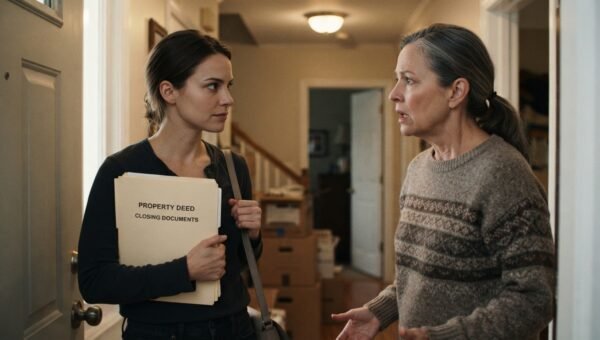
My hands trembled as I pulled it out. Inside were three stapled legal documents prepared by a family law attorney in Camp Hill named Harold Vance. The top page was titled: *Petition for Third-Party Custody and Emergency Guardianship.*
My name was on it. So was Arthur’s.
I stood there under the humming fluorescent tube, reading the words on the page. The petition claimed that Karen was mentally unstable, that she had a documented history of postpartum depression in her immediate family, and that Arthur and I possessed the financial and residential stability required to provide immediate custody of the infant upon delivery.
It was unsigned. There was no court stamp. But Harold Vance’s business card was paperclipped to the corner, along with a yellow sticky note in Arthur’s unmistakable handwriting: *David needs to sign line 4 if she tries to move back to Ohio.*
My breath caught in my throat. In early 2014, David and Karen had been married less than two years. They had fought terribly that winter. I remembered David coming over to the house late on Sunday nights, sitting at the kitchen island while Arthur drank black coffee, complaining that Karen was homesick and threatening to take the baby to her parents in Columbus once he was born.
I had told David back then, “Marriage takes time, son. You two have to work it out.”
I had never seen these papers. Arthur had gone to Harold Vance on his own. He had used my name without my consent, drafted an ugly, threatening weapon, and put it in our basement.
I walked upstairs, took out my cell phone, and called David.
He answered on the third ring. “Hey, Mom. Did you get home okay?”
“David,” I said, my voice shaking so badly I had to lean against the counter. “You need to come over here right now. Alone.”
He paused. “Is everything all right?”
“Come over now.”
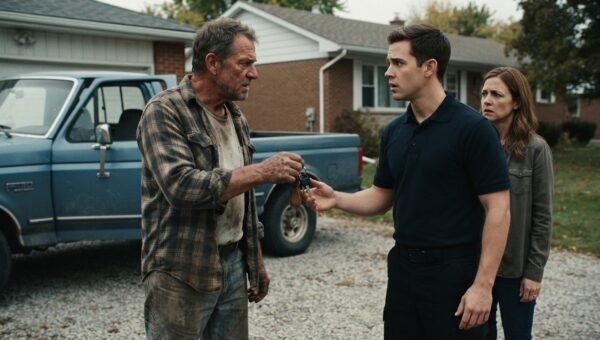
Twenty minutes later, his truck pulled into my driveway. He walked into the kitchen wearing his gray cargo shorts and a faded college t-shirt, his keys dangling from his finger. He took one look at my face, then looked down at the kitchen table.
The manila folder was sitting right in the center, next to the baseball cap and Karen’s note.
David stopped three feet from the table. He didn’t ask what was wrong. He didn’t ask why I called. He just blew out a long breath, rubbed both hands over his face, and asked, “Did she finally tell you what Dad said about the custody papers?”
PART 3
“You knew,” I whispered.
“Mom, sit down,” David said, reaching for a chair.
“Don’t tell me to sit down!” The sound of my own voice surprised me. I had never yelled at David in his adult life. “You let Karen believe for ten years that I was trying to steal her baby? You let her think I was part of this?”
David pulled out a chair and sat down anyway, his shoulders slumped forward. “I didn’t know how to fix it, Mom. Dad handled it.”
“Dad has been in the ground for ten years, David! What did he handle?”
David stared at the yellow legal pad on the table. “Back when Karen was pregnant, we were broke. I had lost the job at the lumber yard, and Karen was working twenty hours a week at the clinic. She was terrified. Her parents offered to give us a down payment on a house if we moved to Ohio. She wanted to pack up and go. Dad found out, and he lost his mind.”
“Arthur went to Harold Vance,” I said, pointing at the folder.
“Dad called Vance the next day,” David said quietly. “He told me he spent twelve hundred dollars to get those papers drawn up. He told me if Karen packed one suitcase, all I had to do was sign the line, and you and him would file for emergency custody before she crossed the state line. He said you had the house, you had the money, and a judge would never let a broke girl take his only grandchild out of Pennsylvania.”
“And you let her hear that?”
“I didn’t know she was listening,” David said, his voice cracking. “We were out by his workbench in the garage. Dad was yelling. He held those papers in my face and told me that blood stays with blood, and that you and him would never let her take his boy.”
*His boy.*
The phrase hit me right between the eyes.
“Dad kept saying, ‘That’s our boy, David. That’s your mother’s boy. She’s not taking our boy to Ohio.'” David looked up at me, his eyes rimmed in red. “Karen was standing by the side door behind the tool rack. She heard every word Dad said. She thought it was your idea, Mom. Dad kept using your name. He said, ‘Your mother and I have this locked down.'”
“Why didn’t you tell her the truth?” I demanded. “Why didn’t you tell her I knew nothing about it?”
David looked down at his shoes. “Because Dad gave me eight thousand dollars to pay off our credit card debt that same afternoon. He told me if I told Karen it was all his doing, she’d divorce me on the spot and take the baby anyway. He said, ‘Let her be scared of your mother. A scared wife doesn’t pack her bags.'”
The room felt cold. The man I had been married to for thirty-four years had bought our son’s silence for eight thousand dollars, using fear to hold a young couple together and using my name as the threat.
“And when Arthur died?” I asked, my chest tight. “When Arthur passed away two months before Leo was born, why didn’t you tell her then?”
“Because she was already terrified of you, Mom,” David said, tears finally leaking down his cheeks. “Every time you offered to help, every time you bought clothes or offered to babysit, she thought you were building a case against her. She thought you were gathering evidence that she was unfit. And every time you called Leo ‘my boy,’ it sounded to her like Dad’s voice in that garage. I was too cowardly to admit that I took Dad’s money and let you take the blame.”
I stood there looking at my forty-year-old son. He wasn’t a monster; he was weak. He had chosen his own comfort and his father’s money over his wife’s peace of mind and his mother’s dignity.
“Get in your truck,” I said.
David blinked. “What?”
“We are going to your house. Right now.”
“Mom, please, don’t blow up our family—”
“You blew it up ten years ago, David,” I said, picking up the folder, the note, and the baseball cap. “Now we’re going to put it on the table.”
ENDING
Karen was sitting on the back patio alone when we arrived. Leo was inside playing video games; the blue light from the television flickered against the living room window.
When she saw me walk through the side gate with David behind me, she stood up quickly, her face pale.
I didn’t raise my voice. I didn’t cry. I walked up to the glass patio table, set the manila folder down in front of her, and laid the note beside it.
“Karen,” I said, “I read your note.”
She swallowed hard, looking between me and David. “Martha, I didn’t want to cause a fight on Leo’s birthday. But I couldn’t keep looking at you anymore. Every time I see you with him, I remember that garage.”
“Look at the papers,” I said gently.
She hesitated, then opened the folder. She saw the date. She saw Harold Vance’s name. Then she saw the signature line at the bottom.
“Arthur went to Vance alone,” I told her, my voice steady. “I never saw these papers until forty-five minutes ago when I dug them out of Arthur’s filing cabinet. I never spoke to Harold Vance. I never agreed to take your child. And if Arthur had ever suggested such a wicked thing in front of me, I would have thrown him out of my house.”
Karen looked up, stunned. Her eyes shifted to David.
David couldn’t look her in the face. He stood on the patio bricks, staring at the seam between two pavers, his hands shoved deep into his pockets.
“David?” she whispered.
“It’s true,” David said, his voice barely audible. “Mom didn’t know. Dad did it all. He gave me eight grand to cover our debt, and he told me to keep my mouth shut so you’d stay.”
Karen didn’t yell. She didn’t throw anything. She just sat down slowly in the patio chair, as if all the strength had been drained from her legs. She covered her mouth with both hands, staring at the man she had been married to for twelve years.
“Ten years,” she whispered into her palms. “I hated her for ten years because of you.”
“I’m sorry,” David choked out. “Karen, I’m so sorry.”
“Go inside, David,” she said. Her voice wasn’t loud, but it had an edge of iron that made David turn around and walk through the sliding glass door without another word.
When the door clicked shut, Karen and I sat in the gathering dusk. The cicadas were buzzing in the maples along the fence line.
“I thought you were waiting for me to fail,” Karen said, her tears finally spilling over. “Every time I had a bad day, every time I got overwhelmed when he was a baby, I thought you were taking notes. When you called him ‘my boy,’ I thought you were telling me he belonged to you.”
I reached across the table. For the first time in ten years, I put my hand over hers. She didn’t pull away. Her fingers were cold, but she held on.
“I called him my boy because my heart was so full of love for him that I didn’t have any other words,” I said softly. “I loved you, too, Karen. I just didn’t know how to reach you.”
She leaned forward, rested her forehead against our joined hands, and cried for a long time. I sat with her until the streetlights came on.
We didn’t fix everything that night. A lie that lives for ten years leaves deep roots, and David spent the next three months sleeping in their guest bedroom while they started marriage counseling. There are still quiet moments between Karen and me, moments where the old awkwardness tries to creep back in. Healing isn’t a straight line.
But last Tuesday, I drove over to their house after school. I didn’t wait on the porch. Karen opened the door, smiled a real, tired smile, and stepped aside to let me in.
Leo was at the kitchen table, doing long division with a stubby pencil. He looked up, saw me, and pointed to the navy blue cap sitting on the counter.
“Hey, Grandma,” he said. “Are you going to wear your hat to my game on Saturday?”
I picked up the cap, adjusted the strap in the back, and pulled it down over my gray hair.
“I sure am,” I told him, looking over at Karen as she poured two cups of coffee. “I sure am.”