Eleven months. That was how long the porch boards had stayed dry on Thursdays before Clara walked up the driveway with the blue spiral notebook tucked under her arm like a church hymnal.
Arthur had been gone nearly a year, buried under six feet of southern Illinois clay after his ticker finally gave out in the recliner while the six o’clock news was still murmuring about a grain elevator fire in Vandalia.
I had spent those eleven months learning how to talk to the walls, how to cook a pork chop for one person without throwing half of it in the grease trap, and how to ignore the way George used to hobble across the gravel every single week with a brown paper sack from the Piggly Wiggly.
George was seventy-eight, with fingers like gnarled oak roots and ears that didn’t catch half of what you said unless you looked him square in the eye. When Arthur died, George had stood by the fresh mound with his hat clutched against his belt, his jaw working like he was chewing on a dry piece of horseshoe tobacco. The next Thursday, my screen door had rattled. I found a quart of buttermilk, a pound of butter, and two cans of creamed corn sitting right on the Welcome mat with a folded napkin tucked under the handle.
I thought it was pity. I thought it was just an old man trying to keep his hands busy now that his lifelong fishing buddy was planted in the cemetery.
“Let me do one useful thing,” George had mumbled whenever I tried to hand the bags back to him through the wire mesh. That was his phrase. He said it whenever he helped me clear an ice dam off the gutter, and he said it when he hauled my old garbage cans back from the curb after a snowstorm.
Then George went to sleep on a Tuesday night and simply didn’t wake up to feed his three Rhode Island reds.
Clara had come down from Peoria to sort out his house, her station wagon stuffed with cardboard wardrobe boxes and rolls of packing tape that smelled like hot glue. She looked tired, her hair pulled back with a yellow pencil she must have found behind George’s kitchen telephone.
She didn’t knock long before she pushed the screen door open an inch and called my name through the gap.
“Linda? You got a minute?”
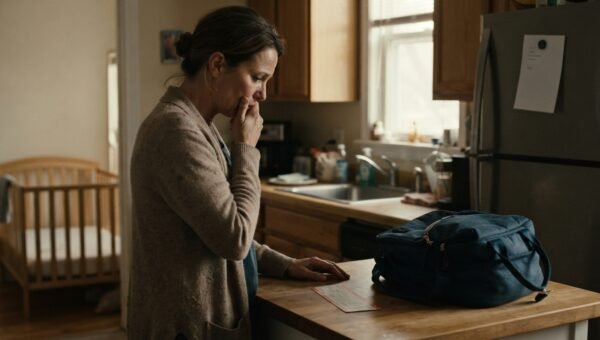
I was sitting at the laminate kitchen table with a cold cup of instant coffee that had formed a skin across the top while I stared at a basket of unmatched socks. I told her to come on in, wiping my palms down the front of my apron even though I hadn’t touched anything greasy all morning. I figured she wanted to ask about borrowing Arthur’s post-hole digger or whether she could leave her trash cans by our fence until the Friday pickup.
Instead, she laid the blue notebook down right between my sugar bowl and the salt shaker.
“Dad kept this in the bottom drawer of his roll-top desk,” Clara said, her voice dropping into that flat, level register people use when they are carrying something heavy they aren’t quite ready to drop. “Under the receipts for his tractor parts and his old Baptist church contribution envelopes.
It’s got your name on the first page, Linda. But the rest of it… well, you better look for yourself.”
I didn’t reach for it right away. My fingers felt stiff, like they’d been dipped in cold well water. The cover was faded cardboard with the blue ink lines bleeding at the corners where George’s sweaty thumbs had held it over the span of twenty winters.
“What is it, Clara?” I asked.
“Just read the third page,” she said, nodding toward the window that looked out over the gravel drive.
I opened the stiff cardboard cover. The paper inside was yellowed at the edges, smelling faintly of the pipe tobacco George used to smoke behind his barn when his daughter wasn’t looking. The handwriting was cramped and spidery, each entry written in that heavy-handed mechanical pencil lead that always smudged if you rubbed your palm across it too fast.
*October 14, 1994.*
*Arthur. Two sacks flour, one bag salt, five pounds red potatoes. Paid: $0.00.*
I turned the page.
*November 3, 1994.*
*Arthur. Side of pork, canned peaches, four pounds sugar. Paid: $0.00.*
It went on like that, page after page, month after month, year after year, stretching backward through the Clinton administration, through the first Gulf War, all the way back to the late eighties. Every single week, right alongside the flour and the potatoes, there were numbers that didn’t make any sense. Sometimes it was grocery tallies. Sometimes it was receipts for truck parts, or bags of feed, or a notation about a cord of seasoned oak delivered cord by cord before a hard freeze. And always, beside every entry, Arthur’s name was written in that heavy, stubborn hand.
My throat felt tight, like I’d swallowed a dry saltine. I kept turning the pages, my thumb catching on the coarse paper, watching the dates climb backward into years when Arthur and I had barely known each other well enough to nod across the property line. Back when Arthur was just the quiet guy who drove the red Dodge flatbed for the county road crew and I was still working three days a week down at the dry goods store in town.
“I don’t understand,” I whispered, looking up at Clara. “Arthur wasn’t a charity case. We had our own money. We paid our bills on time every month. Why was George keeping track of our groceries like we owed him rent?”
Clara crossed her arms over her flannel shirt, her jaw tightening until a little muscle jumped beneath her ear. She didn’t look at me; she looked out the window toward the rusted-out shell of Arthur’s old 1984 Dodge Ram sitting out by the machine shed with two flat tires and a bed full of rotted cedar fence posts.
“Dad didn’t give him groceries because you were poor, Linda,” Clara said quietly. “He gave them to him because of what happened on Route 6.”
The kitchen went dead quiet except for the electric refrigerator clicking on in the corner with a dull, hollow thrum. I could feel the linoleum cool beneath the thin soles of my slippers, and I remember thinking how stupid it was that I hadn’t put on my wool socks that morning.
“Route 6?” I said. The words felt heavy in my mouth, like I was trying to spit out a peach pit. “Arthur didn’t talk much about the road crew days. He said a bridge crew dropped a beam near Morris and he hurt his shoulder, but that was long before we were married.”
“That’s not what happened,” Clara said. She reached down and tapped her fingernail against the very last page of George’s notebook, right where the blue lines ended and the blank margins began.
There was no grocery list on that final page. There was only a single sentence, written so hard the lead had torn clean through the cheap newsprint paper:
*Tell Linda what happened on Route 6 in 1988.*
And right below it, underlined twice with a red grease pencil that George must have dug out of his toolbox, were those five words that made my stomach pitch forward into the dark:
*You really don’t know?*
I sat there with my hands flat on the oilcloth table cover, staring at the torn paper until the blue ink started to blur around the edges. I didn’t know. That was the terrible, hollow truth of it. Thirty-one years of sharing a mattress, thirty-one years of listening to Arthur clear his throat in the dark, thirty-one years of passing the salt and butter across this exact same table, and I didn’t know what happened on a stretch of two-lane blacktop thirty-eight years ago before my wedding ring was even sized.
“Clara,” I said, and my voice sounded thin, like dry corn husks rubbing together in a November wind. “Clara, what did George tell you before he went?”
“He didn’t tell me much at the end, Linda,” she said, her voice softening just a fraction as she pulled out one of the metal folding chairs and sat down across from me. “His mind was going toward the end, you know that. He kept calling me by his sister’s name from fifty years ago. But whenever he woke up in the middle of the night, he’d grab my wrist so hard it left bruises. He’d say the same thing over and over. He’d say, *’The truck was still idling, Clara. The lights were on in the ditch.’* That was all he’d give me before he’d drift off again.”
I shook my head, my hand going automatically to the little silver locket on my collarbone that Arthur had bought me for our tenth anniversary. It felt cold against my skin.
“Arthur never drove a truck into a ditch in eighty-eight,” I said, trying to anchor myself to the facts I’d lived with for half my life. “He had the Ford before the Dodge. He bought the Ford new in Bloomington the year my mother died. He always kept it washed. He was careful.”
“People are careful when they’re running from something,” Clara said gently.
She stood up and walked over to the back door, her boots clicking against the linoleum. She didn’t wait for me; she just unlatched the screen and pushed it open, stepping out onto the back porch where the morning sun was just beginning to hit the top rail of the railing.
“Come on,” she said over her shoulder. “There’s something in the glove box of that old truck of his. Dad told me where the key was hidden behind the rafter in the machine shed three summers ago when we were pouring the new pad for the combine. I didn’t know what he meant then. I know now.”
I didn’t want to get up. I wanted to close the blue notebook, put it back in the bread box, and wait for the mailman to bring the Sears circular and the electric bill. I wanted the world to stay the size of this kitchen, where the worst thing that could happen was a dry pork chop or a leaky hot water heater. But the name *Route 6* sat there on the paper like a stain that wouldn’t scour out, no matter how much lye soap you scrubbed with.
I pushed myself out of the chair, my knees clicking like dry kindling, and followed her out into the cold October air.
The wind had picked up from the north, carrying that sharp, metallic smell of frost that always makes your teeth ache before the corn is even all the way out of the ground. The old Dodge truck sat out by the shed like an abandoned animal, its red paint oxidized to the color of dried brick, the rubber on its tires cracked into a million little dry-rotted veins.
Clara was already standing by the passenger door, reaching up over the rusted drip rail. Her fingers fished around behind the wooden header board where Arthur used to keep a spare set of ignition keys wrapped in an old piece of oily rag.
“Here,” she said, holding up a brass key that was so old the teeth were rounded off like an old spoon.
She slid it into the passenger-side lock. It didn’t want to turn; she had to lean her whole shoulder against the door frame, grunting until the mechanism gave a rusted, metallic snap. The door swung open with a dry groan, releasing a thick, heavy wave of air that smelled of old upholstery, dead mice, and fifty-cent cigars Arthur used to smoke behind the barn when he was pretending he’d quit.
“Look in the manual slot,” Clara said, her chin jutting toward the glove box. “Dad said Arthur kept the green folder in there from the very first week.”
I reached inside, my fingers brushing against a box of stale wooden matches, a roll of electrical tape, and a small, stiff leather folder with gold lettering that had long since rubbed away into nothing. My hand was shaking so badly I dropped the matches into the floorboards. I didn’t pick them up. I pulled the folder out into the gray daylight, my thumb catching on the brass clasp.
Inside wasn’t a receipt. It wasn’t a map of Route 6 or a service record for a Ford transmission.
It was a certified copy of a police accident report from November 14, 1988, issued by the Illinois State Police out of the Pontiac barracks, along with a handwritten affidavit on yellow legal paper that smelled so strongly of George’s pipe tobacco I could almost hear him coughing in the corner of the barn.
I sat down on the running board of the truck, the cold iron biting right through the wool of my trousers, and unfolded the papers with fingers that felt like sticks of stovewood.
The police report was brief, the language dry and official the way those things always are. *Single vehicle rollover. 1984 Ford pickup registered to Arthur Miller. Driver uninjured. Passenger…*
My eyes skipped down to the line for the passenger. There was no name typed in. The space had been left blank by the trooper, but someone, George, in his heavy, looping mechanical pencil, had written a name right across the official seal in block letters:
*LEO MILLER.*
Leo. Arthur’s younger brother. The one who had supposedly gone out west to work the oil fields in Wyoming back when we were still kids, the one whose name was never spoken at our dinner table, the one Arthur’s mother used to cry about into her apron while she washed the supper dishes.
I looked up at Clara, who was standing over me with her hands shoved deep into her coat pockets, her breath puffing out in little white clouds against the gray shed wall.
“Arthur didn’t hurt his shoulder on a bridge crew,” I whispered, the words coming out flat and hard. “Did he?”
“No,” Clara said softly. “Leo was driving that truck, Linda. He was nineteen, and he’d been drinking two-dollar bourbon from a paper bag behind the grain elevator. He took a blind curve on Route 6 at eighty miles an hour and put that Ford right through a farmer’s barbed-wire fence into a dry creek bed. There was a girl in the middle of the road, some girl from up near Dwight whose name wasn’t even mentioned in the local paper because her folks paid to keep it quiet. She wasn’t dead, but she was hurt bad. Real bad.”
I stared down at the yellow legal paper in my lap. George’s handwriting went on, sentence after cramped sentence, detailing a night I had never been told about in thirty-one years of marriage.
*Arthur got there twenty minutes before the state trooper,* George had written in his ledger hand. *He pulled Leo out from behind the wheel and shoved him into the weeds by the culvert. When the cruiser pulled up with the blue lights flashing, Arthur was sitting in the driver’s seat with his hands on the wheel, waiting. He told them he missed the turn because of a deer. He took the ticket. He took the court date. He took the three-year license suspension that cost him his job at the limestone quarry. And Leo was on a Greyhound bus to Cheyenne by four o’clock the next morning with fifty dollars in his pocket that Arthur had borrowed from my dad.*
The wind rattled the dry cornstalks out in the north forty, a thin, dry sound that seemed to come from very far away.
I didn’t cry. When you’re seventy-one years old, the shock doesn’t come out as tears right away; it just settles in the bottom of your ribs like a stone you swallowed in your sleep. I sat there on the rusty running board of Arthur’s truck, holding the papers that George had guarded like a church secret for nearly four decades, and I thought about all those Thursday mornings.
I thought about the way Arthur used to sit at the kitchen table every November fourteenth, staring out the window at the empty road with his coffee cup growing cold between his palms, never saying a word, never explaining why he always walked down to George’s barn alone on that one particular afternoon of the year and stayed out there until the sun went down behind the water tower.
I thought he was just getting old. I thought he was just tired the way men get tired after working thirty years on concrete floors and gravel loaders.
“He never told me,” I said, and my voice sounded like a stranger’s. “In all those years, he never once said a single word about Leo or the truck or why George was always checking up on us.”
“Because Arthur was a proud man, Linda,” Clara said, walking over to put a heavy, warm hand on my shoulder. Her fingers were rough and smelled of old paper and woodsmoke, just like her father’s used to. “And Dad… well, Dad helped them pull the truck out of that ditch with his tractor before the tow truck from town even got the call. Dad knew what Arthur gave up that night so his brother wouldn’t go to the penitentiary for felony hit-and-run. Dad spent the rest of his life making sure the debt stayed paid.”
She reached down and took the blue ledger out of my lap, closing the stiff cardboard cover with a soft, dry thump that sounded like a church door latching in an empty room.
“He told me before he died,” Clara whispered, her face close to mine. “He said, *’Clara, when I’m gone, make sure she knows. Not because it’ll hurt her, but because she needs to know who she was sleeping next to all those years. A man who took the whole world on his shoulders and never once asked for a thank-you note.’*”
We sat there together on the running board for a long time as the sun dipped lower behind the machine shed, turning the stubble in the cornfield the color of old copper. Neither of us said anything else. There wasn’t anything left to say that wouldn’t sound small and foolish compared to the weight of what those two old men had carried between them in the dark while the rest of the county slept.
When we finally stood up, Clara helped me brush the rust flakes and dried grass off the back of my trousers. She didn’t offer to take the papers back. She just left them there in my hands, resting against the blue cover of the grocery ledger like an overdue bill that had finally come due after thirty-eight years on the road.
I walked back up the gravel drive alone, my boots crunching on the small white stones that George had hauled in with his trailer back when Arthur’s knees first started giving out.
Inside the kitchen, the house was warm and smelled faintly of the pot roast I’d put in the cast-iron dutch oven before Clara came over. I didn’t turn on the overhead light. I laid the blue ledger down on the laminate table right beside my cold cup of coffee, right where the afternoon light was stretching a long, thin yellow finger across the oilcloth.
I walked over to the window and looked out past the porch toward the empty road where the school bus used to stop. The Thursday groceries weren’t on the mat anymore, and they never would be again. But for the first time in eleven months, the kitchen didn’t feel quite so empty.