PART 1
For almost forty years, my grandfather’s promise was the bedrock of our family.
Grandpa Arthur set up the education and milestone trust back in 1985. He was a machinist who invested in municipal bonds and small commercial parcels, a quiet man who wore flannel shirts with worn elbows and wrote down every single tank of gas in a little spiral notebook. He had four children, but his true pride was his grandchildren. There were twelve of us in total.
His rule was simple, clear, and written into the legal trust document: every grandchild, upon reaching their eighteenth birthday, received a check for $10,000. It was meant to buy their first reliable car, pay for trade school tools, or cover their first semester of college dorm fees. Over the years, the older cousins got their checks right on schedule. My cousin Mark used his in 1996 for nursing school. My cousin Sarah used hers in 2001 for dental hygienist training. Whenever one of the grandkids turned eighteen, a cashier’s check arrived in a crisp envelope signed by the trustee, alongside a handwritten note from Grandpa reminding us to work hard and keep our heads on straight.
Grandpa passed away in the autumn of 2001. After the funeral, the administration of the trust officially rolled over to his oldest son, my Uncle Richard. Richard was the family’s self-appointed businessman.
He wore pleated linen slacks, drove leased luxury sedans, and always spoke in a booming, patronizing voice about portfolio yields and market diversification. None of us questioned him. Grandpa had named him executor and sole trustee, and the family deferred to him as the financial expert.
At that time, the trust still held principal investments and accrued market interest that should have kept it well over $400,000, even after accounting for the initial payouts and reasonable management. It was designed to easily cover the younger grandchildren, including my own son, Leo, who was only a toddler when Grandpa died.
Fast forward to this past August. Leo turned eighteen.
Leo isn’t a flashy kid. He worked two summers at a local tire and lube shop, saving every dime to put toward an associate degree in mechanical engineering at our local community college. The week after his birthday, he sat at our kitchen table with his enrollment paperwork and his tuition breakdown.
He looked up at me, a little nervous, and asked, “Mom, should I call Uncle Richard about the grandfather check, or do you think he just mails it?”
I smiled and told him I would handle it. I felt proud. It was a rite of passage that tied my boy directly to the great-grandfather he was too young to remember.
I dialed Uncle Richard that Tuesday afternoon. He answered on the second ring from the golf course, the sound of a cart engine idling in the background.
“Richard, hi,” I said cheerfully. “Just calling because Leo had his eighteenth birthday last week. We are finalizing his fall class schedule, and I wanted to check on the payout paperwork for Grandpa’s trust.”
The line went dead silent. The background wind disappeared, as if he had pulled the phone closer to his mouth.
“Richard? You there?”
He let out a heavy, patronizing sigh. “Beth. Look, I was going to bring this up at the next family dinner, but since you’re calling… things have changed. The trust is empty. There is no money.”
I gripped the edge of the kitchen counter, my heart thumping against my ribs. “What do you mean, empty? Grandpa had over three hundred thousand in index funds and municipal paper in 2001, plus the interest. How could it be empty?”
“The market crashed in 2008, Beth. Then again during the pandemic,” he said smoothly, his voice dropping into that slick, dismissive tone he used whenever anyone questioned him. “You don’t understand how institutional management works. Fees, bad cycles, inflation. It eroded. It’s gone. I didn’t want to worry your mother or your aunts, so I just absorbed the bad news myself. Leo will just have to take out a student loan like everyone else. Tell him I’m sorry.”
Before I could get another word out, he hung up.
I stood in my kitchen staring at the phone. Something in my gut turned to ice. My grandfather hadn’t invested in speculative tech stocks or volatile crypto. His trust agreement, which my mother had kept an old carbon copy of in her filing cabinet, strictly mandated conservative, low-risk instruments. A market dip might slow growth, but it could not vaporize over four hundred thousand dollars down to zero.
I didn’t break the news to Leo that night. Instead, I called an estate attorney named Walter Henderson the very next morning. Walter had been practicing probate law in our county for thirty-five years. He listened to the timeline, pulled up the probate docket from 2002, and shook his head.
“As a beneficiary’s parent, and with Leo now of legal age as a named beneficiary, he has an absolute legal right to a formal accounting,” Walter told me. “A trustee cannot simply say ‘it’s gone’ and close the book. If he won’t provide the statements voluntarily, we file an emergency petition to compel.”
We sent Richard a formal demand letter requesting ten years of bank statements and ledger accountings. Richard ignored it completely. Two weeks later, Walter filed the motion in county probate court.
Richard didn’t even show up to the hearing. He sent an excuse through a junior associate claiming he was traveling for business. The judge, visibly annoyed by the trustee’s refusal to answer a legitimate beneficiary request, issued an immediate court order compelling the bank to release all trust records dating back to Grandpa Arthur’s death.
Three weeks later, a heavy box of certified financial records arrived at Walter’s office.
Walter called me in. When I walked into his conference room, several thick binders were laid out on the mahogany table, tabbed with neon yellow stickies. Walter looked tired and deeply angry.
“Beth, sit down,” he said quietly. “The market didn’t touch this money. Your uncle did.”
I opened the top binder. The paper trail was sickening in its simplicity.
Starting in May of 2002, exactly seven months after Grandpa Arthur was buried, a recurring monthly electronic transfer had been set up out of the trust’s main liquid account. The destination was a personal LLC account registered solely under Richard’s name. Every single month, like clockwork, Richard pulled between $1,500 and $2,200. Over twenty-two continuous years, more than two hundred and sixty separate withdrawals had systematically drained the principal, the dividends, and the interest.
Every single red cent.
I turned the page, looking at the mortgage and deed paperwork Walter had cross-referenced. The LLC was created for one single purpose: paying the mortgage, maintenance fees, and private dock assessments on a four-bedroom beachfront property in Destin, Florida.
My stomach dropped into a bottomless pit.
It was the very same Florida beach house that Richard had grandly offered to the family every year. The place where my mother, my aunts, my cousins, and all of our kids had gathered for Thanksgiving dinners for over two decades. Richard had always played the benevolent, wealthy patriarch, smiling while everyone toasted his generosity on the back patio overlooking the Gulf.
He hadn’t paid for that house with his own successful business. He had stolen our children’s futures, month by month, dollar by dollar, to pay for his own private paradise while we washed the dishes and thanked him for his kindness.
PART 2
Looking at the bank ledgers laid out on Walter’s table, I felt a physical sickness rise in my throat. Every Thanksgiving toast Richard had ever made played back in my head like a bad movie.
I remembered Thanksgiving 2011, when the air conditioner in Destin broke down. Richard had stood in the living room, shaking his head, loudly telling my mother and Aunt Clara how much the upkeep on a beachfront property cost him out of his own pocket. My mother had felt so guilty that she organized an envelope of cash from the siblings to help him cover the repair bill. And all the while, the trust checking account was quietly paying the mortgage note on the first of every month.
“What are our options, Walter?” I asked, my voice shaking.
Walter took off his reading glasses and folded his hands over the binder. “From a civil standpoint, it is an open-and-shut breach of fiduciary duty. He commingled funds, engaged in self-dealing, and outright converted trust assets for personal use. But practically speaking, Beth, this is criminal grand larceny. If you take this to the county prosecutor, your uncle is looking at felony indictments and prison time.”
I sat with that weight for three days. My first instinct was to call my mother, but Mom was seventy-one, with high blood pressure and a fragile heart. She idolized Richard. He was her big brother, the one who took care of everything after their father died. If I dropped this bomb on her over the phone, she would either refuse to believe it or collapse from the shock.
Then there was Grandma Evelyn.
Grandma Evelyn was ninety-two years old. She lived in a sunny ground-floor room at an assisted living facility five miles from my house. Since a mild stroke three years earlier, she spent most of her days in a motorized wheelchair. Her mind was still sharp, but she rarely spoke unless she had something vital to say. She had loved Grandpa Arthur for fifty-four years. She knew how hard he had worked at the machine shop, coming home with metal shavings embedded in the skin of his palms and grease stains that never quite washed out of his knuckles. Grandpa had lived frugally his whole life specifically so his grandchildren wouldn’t have to start adulthood empty-handed.
I went to visit Grandma Evelyn on a Sunday afternoon. I brought her a small container of sugar-free lemon drops and sat in the armchair beside her bed.
“Grandma,” I said gently, taking her frail hand. “I need to tell you something about Arthur’s trust. But you have to promise me you’ll stay calm.”
She looked at me through her wire-rimmed glasses, her pale blue eyes steady and clear. “If it’s about Richard, Beth, just say it. I gave birth to him. I know his weaknesses better than anyone.”
I laid the certified bank records in her lap. I explained the monthly transfers starting in 2002. I showed her the LLC name, the property tax payments for Destin, and the final balance sheet showing a zero balance the day Leo turned eighteen.
Grandma Evelyn didn’t cry. She didn’t gasp. She turned the pages slowly, her thin, liver-spotted fingers tracing the column of numbers. When she reached the final summary page showing over $412,000 systematically siphoned out of the account, she closed the folder with a quiet snap.
“He stole from Arthur,” she said. Her voice was barely a whisper, but it was cold as iron. “Arthur gave him that responsibility because he was the eldest. And Richard treated Arthur’s sweat like his own pocket change.”
“Walter says we can go to the police,” I told her. “Or we can file a lawsuit to seize the Florida house.”
Grandma Evelyn looked out the window at the courtyard garden for a long time. Then she turned back to me. “Every year, the entire family gathers at Richard’s house for Christmas Eve. Thirty-five people. My children, my grandchildren, the little great-grandbabies. Richard loves holding court. He loves standing by the fireplace with his eggnog, telling everyone how well the family is doing.”
She patted my hand. “You keep these papers in your bag, Beth. You don’t say a word to your mother, and you don’t say a word to your cousins. Not yet. If Richard wants to play the great man in front of this family, he can answer for this in front of all of them.”
Over the next two months, I carried that secret like a stone in my shoe.
I helped Leo apply for a temporary student loan to cover his fall tuition so he wouldn’t fall behind. Every time my mother called to talk about Christmas plans or asked if I was bringing the pecan pies, my stomach tied itself into knots. Richard sent out his annual mass email in early December, instructing everyone on what side dishes to bring and reminding us to park on the left side of his circular driveway so his new sedan wouldn’t get blocked.
On Christmas Eve, the weather was unseasonably crisp. Richard’s suburban colonial was glowing with warm exterior lights and massive pine wreaths. Inside, the house smelled of roasted prime rib and spiced cider. The living room was packed. My cousins were laughing around the kitchen island, the kids were running up and down the hallway playing tag, and my mother was sitting on the sofa next to Aunt Clara, looking through old photo albums.
Grandma Evelyn sat in her wheelchair near the Christmas tree, wrapped in a dark green wool shawl. She hadn’t said more than five words since we arrived, but her eyes never left Richard.
Around seven o’clock, dinner was finished. Richard tapped the side of his crystal wine glass with a silver butter knife. The room went quiet.
“Family,” Richard began, stepping in front of the stone fireplace. He had his chest puffed out, wearing a tailored navy blazer over an open-collared shirt. “Another year has passed, and looking around this room, I am reminded of how blessed we are. Dad always taught us that family comes first. Through hard work, sound leadership, and sticking together, we have preserved the legacy he built.”
He raised his glass. “To Dad. And to another wonderful year for the Miller family.”
Everyone lifted their glasses, murmuring agreement.
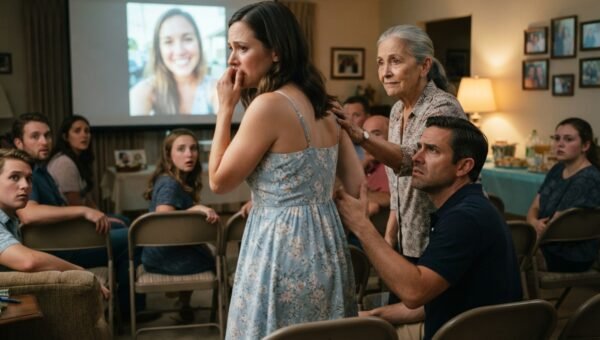
I stood up from the corner of the dining room table. I didn’t raise a glass. Instead, I reached into my leather tote bag and pulled out thirty-five bound, stapled copies of the probate court filing and the certified bank ledgers.
“Before we drink that toast, Richard,” I said, my voice cutting through the festive hum of the room, “I think everyone here needs to see the rest of Grandpa’s legacy.”
PART 3
The room went completely still. My mother looked at me with wide, panicked eyes. “Beth, honey, what are you doing? It’s Christmas Eve.”
“I know what night it is, Mom,” I said calmly. I walked down the center of the living room, handing a packet to my mother, to Aunt Clara, to Uncle David, and to each of my adult cousins. I laid a stack on the coffee table in front of the rest of the family.
Richard’s smile vanished. The jovial host persona stripped away in an instant, replaced by a dark, furious flush that crept up his neck. “Beth, whatever petty issue you have about Leo’s college money, this is entirely inappropriate. Put those away right now.”
“Read page three, Mark,” I said, ignoring Richard and looking directly at my cousin Mark. “Look at the account numbers.”
Mark opened the packet. He had been one of the older cousins who received his check back in the nineties. He looked at the monthly withdrawals, then at the summary table Walter had prepared. His eyes went wide. “Wait. What is ‘Gulf Breeze Holdings LLC’?”
“That is Richard’s personal company,” I announced to the room. “The trust didn’t run out because of the stock market. It didn’t lose money in 2008. From May of 2002 until four months ago, Richard transferred an average of eighteen hundred dollars a month out of Grandpa Arthur’s trust directly into that LLC. He used it to pay the mortgage, the property taxes, and the marina fees on the Destin vacation house.”
A loud gasp came from Aunt Clara. My mother dropped her packet onto her lap, her hands trembling as she stared at her brother. “Richard? Is this… what is this?”
Richard didn’t look at my mother. He glared at me, his eyes burning with pure venom. “You had no right to go digging into trust business! You have no idea what it takes to manage an estate! I gave this family twenty-two years of memories in that house! You took your kids there every single summer! We had Thanksgiving there! I provided that for this family!”
“You didn’t provide anything, Richard,” I shouted back, the anger I had held inside for four months finally tearing out of me. “Grandpa provided that money for his grandchildren! You stole four hundred and twelve thousand dollars! My son Leo worked fifty hours a week this summer changing tires to pay for tuition that his grandfather already paid for twenty years ago! Chloe didn’t get her money! Jason didn’t get his money! You stole from your own blood so you could play the big shot on the beach!”
The room erupted into chaos. My cousins were on their feet, shouting across the room. Uncle David was red-faced, demanding to see the original bank stamps. My mother was sobbing into her hands on the sofa, utterly broken by the sight of her brother’s signature on dozens of monthly transfer authorizations.
Richard backed up against the fireplace mantel, trapped by thirty-five people staring at him with raw disgust. Yet even cornered, his arrogance didn’t crack. He sneered, waved his hand dismissively at the room, and said, “Dad had plenty of money. He would have wanted me to enjoy life. I was the one who took care of him in his final years! I earned every dime of that house!”
Then, the room went dead silent.
Grandma Evelyn was moving.
For three years, none of us had seen Grandma stand without two nurses lifting her by the elbows. But right then, her frail hands gripped the chrome armrests of her wheelchair. Her knuckles turned stark white. Her breath came out in a ragged hiss, and with an agonizing, trembling effort that defied her ninety-two years, she pushed herself up onto her feet.
My mother cried out, reaching forward, but Grandma waved her back with a sharp, violent flick of her wrist.
The entire room held its breath. Nobody moved. Nobody spoke. The only sound was the crackle of the wood in the fireplace and Grandma’s slippers scraping against the hardwood floor.
She took one slow, deliberate step forward. Then another. She stood barely five feet tall, hunched and frail in her wool shawl, but in that moment, she commanded the room like a thunderclap.
She walked right up to Richard. She stopped six inches from his chest.
Richard looked down at his mother, his arrogance suddenly faltering. He swallowed hard. “Mom… look, you don’t understand the legal side of this…”
Grandma Evelyn didn’t let him finish.
With a swiftness that shocked everyone in the room, her right hand came up and struck Richard across the face. The slap echoed against the stone mantel like a gunshot.
Richard recoiled, clutching his cheek, his eyes wide with utter shock.
“Arthur never spent a nickel on himself that he didn’t work for with his own hands,” Grandma said. Her voice wasn’t loud, but it was so sharp and steady it cut through the room like a razor blade. “He died believing his grandchildren would have a start in life. And you turned his grave into your personal vacation.”
She looked him up and down with an expression of profound, unyielding disgust.
“You are no son of Arthur Miller,” she whispered. “Get out of this house. And do not ever call me your mother again.”
ENDING
Richard didn’t say another word. He grabbed his coat from the entryway closet and walked out the front door into the cold night, leaving thirty-four members of his family standing in stunned silence.
The rest of Christmas Eve wasn’t a party. It was a reckoning.
Uncle David and my cousin Mark helped Grandma back into her wheelchair. She was exhausted, her hands trembling from the physical exertion, but her gaze remained clear and completely resolute. My mother sat beside her, holding her hand and weeping quietly. The realization that her beloved brother had deceived the entire family for over two decades had shattered her, but seeing her mother take a stand gave her the strength to face the truth.
The following Monday, Walter Henderson filed a petition in probate court for the immediate removal of Richard as trustee, along with an emergency freeze on all assets associated with Gulf Breeze Holdings LLC.
With the certified banking records and Grandma Evelyn’s sworn affidavit attached to the filing, the judge granted the injunction within forty-eight hours. Uncle David was appointed successor trustee.
Faced with overwhelming documentation and the certainty of criminal prosecution for grand larceny, Richard’s attorney contacted Walter to negotiate a settlement before formal charges were pressed by the district attorney. Richard had no defense. The monthly transfers from the trust account directly into his mortgage servicing company were indisputable proof of conversion.
Under the terms of the court-approved settlement, Richard was forced to put the Destin beach house on the market immediately. The real estate market had appreciated significantly since 2002, and the house sold that spring for $680,000.
After paying off the remaining bank balance and legal expenses, the net proceeds were used to fully restore Grandpa Arthur’s trust.
Every single penny that Richard had stolen over twenty-two years was returned to the fund, along with calculated interest adjustments.
In May, Uncle David hosted a gathering at his house. There were no grand speeches, no crystal glasses, and no arrogant toasts.
Instead, Uncle David sat at his dining room table with a checkbook. He wrote out a cashier’s check for $10,000 for Leo. Then he wrote checks for the other four younger grandchildren who had turned eighteen after the money had mysteriously vanished. Each check was delivered inside a clean white envelope, accompanied by a photocopy of Grandpa Arthur’s original 1985 declaration of trust.
Leo used his check to pay off his freshman student loans in full and buy a reliable used pickup truck so he could drive to his engineering classes without worrying about his transmission dropping out on the highway.
Grandma Evelyn lived to see every one of those checks delivered. She passed away peacefully in her sleep ten months later, in the late autumn of the following year. At her funeral, the entire family filled the chapel pews.
Richard was not there. None of his siblings had spoken to him since that Christmas Eve, and he did not dare show his face.
After the service, Leo and I walked out to the cemetery’s older section, where Grandpa Arthur had been laid to rest twenty-three years earlier. Grandma’s new headstone stood beside his, the fresh earth covered in green sod.
Leo reached into his coat pocket, pulled out his first-semester grade report from engineering school, a solid 3.8 GPA, and placed it gently against Grandpa’s stone, weighting it down with a small piece of polished granite.
“He would be proud of you, Leo,” I said, putting my arm around my son’s shoulders.
“He gave me the start, Mom,” Leo said quietly. “Grandma and you made sure it stayed real.”
We stood together in the quiet afternoon breeze. The family had lost a beach house, and we had lost an uncle who was never truly the man he pretended to be. But standing beside Arthur and Evelyn’s resting place, looking at my boy standing tall and independent, I knew that the real foundation of our family had never been broken. It had just taken an old woman’s courage, and the truth, to set it right.