PART 1
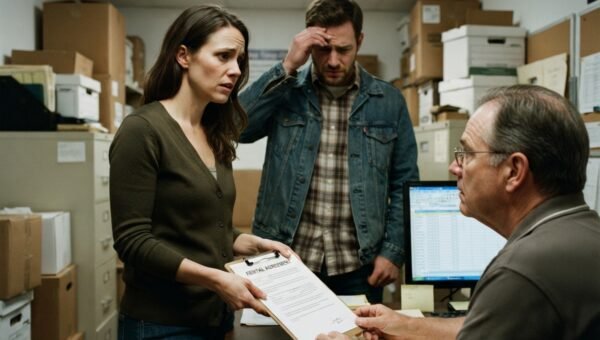
My son pushed a clipboard across the hospital admissions desk twenty minutes before my scheduled knee replacement.
“Sign the bottom two lines, Mom,” Greg said. His coat was still zipped to his chin, and he had not sat down once since walking into the surgical center. “It’s standard paperwork. Consent for anesthesia and hospital admission rules. They won’t take you back until it’s done.”
I had my reading glasses resting on the collar of my sweater, but Greg was already tapping his index finger against the signature line.
He was thirty-four years old, an accountant who kept his tax receipts in plastic sleeves, and I had trusted him with every piece of mail that confused me since my husband passed four years ago. I reached for the plastic pen tethered to the counter with a dirty beaded chain.
The admitting nurse came around the side of the glass partition with my plastic identification bracelet. Her name badge read Teresa, RN. She had gray hair pulled into a clip and the blunt, tired posture of someone who had worked twelve-hour shifts on concrete floors for thirty years.
“Hold on, sweetheart,” Teresa said, reaching over my shoulder to slide the clipboard toward her side of the desk. “Let me check the chart sticker before she signs anything. The registrar printed three packets with wrong account numbers this morning.”
Greg’s hand moved fast. He clamped his fingers over the top edge of the board. “I already checked the account number.
She’s getting nervous. Let her sign so we can get her prepped.”
Teresa didn’t let go. She pulled the board two inches to the right under the fluorescent light, her eyes flicking across the bold header at the top. Her face went completely still.
“This isn’t an admission agreement,” Teresa said. Her voice dropped, flat and even. “This is an out-of-hospital do-not-resuscitate directive. And the patient label on this sheet says Evelyn Vance.”
Greg snatched the page off the clip so hard the paper tore at the metal prong. He folded it twice and shoved it into the inside pocket of his winter coat.
“A nurse down the hall handed it to me by mistake,” he said, stepping back toward the automatic sliding doors. His voice was too loud for a quiet waiting area. “I’ll go find the right counter. Mom, stay in that chair.”
“Sir, you do not leave with hospital documentation,” Teresa said, reaching for the wall phone beside her monitor.
She punched three digits. “Security to admitting station four. Station four right now.”
I sat in the plastic chair with my hands resting on my purse. My heart was thumping in my throat. Evelyn Vance was not a stranger’s name. Evelyn Vance was my mother’s older sister, my aunt who had spent her final three weeks in the palliative wing on the fifth floor of this exact building. She had died forty-one days ago. Greg had handled her funeral arrangements and her small two-bedroom bungalow because my own knees were too swollen for me to manage the stairs.
Teresa hung up the phone, took a deep breath, and looked down at the clip. The corner of the page that had torn off was still trapped under the metal clamp. But underneath it, on the carbon backer that had pressed through, there was a yellow copy of an identification intake sheet.
Teresa turned the board around and slid it across to me.
“Look at the witness line on the intake sheet, Mrs. Miller,” she whispered.
I pulled my reading glasses onto my nose. The ink on the yellow carbon was blue ballpoint, slightly smudged. On the line marked Legal Witness and Alternate Proxy, the signature was written in tight, sloping cursive with high loops on the capital letters.
Constance Miller-Reed.
Connie. My younger sister.
I stared at the looping C until the letters blurred. Connie had walked out of our family eleven years ago over five thousand dollars left in an envelope after our father’s funeral. She had moved three states away, changed her number, and sworn she would never look at my face or Greg’s face again as long as she lived. Greg had always told me Connie hated us both with a bitter, venomous grudge.
Before I could speak, two hospital security guards in dark gray uniforms trotted through the double doors from the lobby. At the exact same second, the pneumatic doors to the pre-op surgical corridor hissed open behind Teresa’s desk.
An orderly in green scrubs backed out of the prep bay, pulling a rolling gurney by its footboard.
“Transfer from pre-op holding bay two,” the orderly called out, checking a plastic clipboard. “Doctor wants her staged in four.”
The woman lying flat under the thin hospital blanket had her head turned toward the wall, an IV line taped to the back of her left hand and a paper surgical cap covering her hair. But as the wheels clattered over the metal floor strip, she turned her head toward the admitting desk.
Her face was gaunt, older than I remembered, and lined with severe pain. But the sharp hazel eyes and the small scar above her left eyebrow were unmistakable.
It was Connie.
She was wearing the exact patient ID wristband that had been printed with my name, Martha Miller, and she was lying on the bed that had been reserved for my knee replacement.
PART 2
Connie saw my face, and her lips parted, but no sound came out. Her eyes were glassy from pre-medication, yet the panic in them was so sharp it cut straight through the hospital fog.
“Martha?” she rasped. Her voice sounded cracked, like she hadn’t had water in hours.
The orderly kept walking, guiding the wheels toward bay four. “Family has to wait in the main lobby, ma’am. She’s already been prepped for anesthesia.”
“Stop that bed,” Teresa said. She didn’t shout, but the command was sharp enough that both security guards immediately moved in front of the gurney. Teresa rounded her desk, walked directly to the head of the bed, and lifted Connie’s left wrist.
She read the plastic band out loud: “Martha Miller. Date of birth, June 14, 1954. Scheduled for right total knee arthroplasty.” Teresa looked up at me, standing by the chair with my purse clutched against my ribs. “You are Martha Miller.”
“I am,” I said. My voice shook so badly I could barely form the words. “That’s my sister. Her name is Constance.”
One of the security officers, an older man with a nametag that read Miller, touched his radio. “Hold surgical prep on team three. We have an identity mismatch in holding.”
Behind us, near the sliding glass exit, there was a sudden thud. Greg had tried to slip through the motion-sensor doors, but the second guard stepped squarely into the frame, blocking the sensor with his shoulder. The heavy glass doors slid shut and locked with an electronic click.
“Greg,” I said, turning around to face my son. “What is your aunt’s name doing on that paper? What is your aunt’s paper doing in your pocket? Why is Connie on my gurney?”
Greg’s jaw was tight. A red flush crept up his neck from inside his zipped coat. “Mom, sit down. You’re making a scene over an administrative screw-up. The admissions clerk mixed up the charts. Aunt Evelyn’s probate papers were in my car because I was dropping them off at the courthouse after your surgery. I grabbed the wrong folder from the backseat.”
“You told me that paper was my consent form,” I said. “You told me to sign the bottom line.”
“I made a mistake,” he snapped, his voice rising. “I was rushing because the surgeon has a strict block time. You’ve been complaining about your knee for two years. I was trying to get you into the room so you wouldn’t get bumped to next month.”
From the bed, Connie let out a dry, ragged cough. She reached her free hand out toward me, her fingers trembling against the blue hospital cotton.
“Martha, don’t let him leave with that coat,” Connie whispered.
Teresa stepped between Greg and the gurney. “Ma’am, do you know what procedure you were brought here for today?”
Connie’s hazel eyes fixed on Greg. The medicine was making her eyelids heavy, but her anger was keeping her awake. “He told me he was bringing me to a private clinic for a pain injection in my lower back. He picked me up at the extended-stay motel on Route 9 at six this morning. He said you were waiting here to make peace with me.”
My stomach dropped through the floor. “The motel on Route 9? Connie, you live in Ohio.”
“I lived in Ohio until two weeks ago,” Connie said. A tear spilled out of the corner of her eye and ran into her graying hair. “Greg called me three days after Evelyn died. He told me you were in hospice at home. He told me you had terminal pancreatic cancer and you refused to call me yourself because of the money from Dad’s estate. He said if I wanted to see you before you slipped away, I had to come now.”
I looked at my son. The boy I had driven to soccer practice three days a week in an old station wagon. The boy who had cried in my lap when his father’s heart stopped in our living room. He stood between two uniformed guards, his hands shoved deep into his pockets, staring at the floor tiles like an annoyed customer waiting for a slow cashier.
“I don’t have cancer,” I said to Connie. “I have arthritis.”
“He told me you had two weeks,” Connie said, her breath hitching. “He said you were living in Aunt Evelyn’s house because the medical bills took your house. When I got to the motel, he came to my room. He brought papers. He said you had four thousand dollars left in a credit union account that Dad set up decades ago, but you needed me to sign as secondary beneficiary because you were too weak to hold a pen.”
Teresa turned to the security officer. “Officer Miller, call the hospital administrator on duty. And call the city police dispatch. Tell them we have a fraudulent admission and suspected medical identity theft in progress.”
“Wait,” Greg said. He finally took his hands out of his coat, holding both palms up. “Wait a minute. Mom, listen to me for one second. Just listen.”
“Don’t call me Mom,” I said. The words came out of me quiet and cold, colder than anything I had ever said to another human being in my seventy-one years. “Take the paper out of your pocket, Greg. Put it on the desk.”
“You don’t understand what happened with Evelyn’s estate,” Greg pleaded, taking half a step toward me before the guard shifted his weight and stopped him. “Evelyn didn’t have any money left. You thought she left two hundred and forty thousand dollars in that municipal bond account. She didn’t. She spent it on private nursing home care three years ago. There was nothing left but seventy thousand dollars in medical debt and a reverse mortgage on the house.”
“And what does that have to do with my surgery?” I asked. “What does that have to do with your aunt’s DNR?”
The double doors at the end of the hall swung wide, and two city police officers walked into the lobby, their duty belts clanking with every stride.
PART 3
The officers separated us immediately. Officer Ramirez, a young woman with a notebook, sat me down in a private consultation room off the main corridor. Teresa came with me, carrying a glass of ice water and the yellow carbon backer that had remained on the clipboard.
Within forty-five minutes, the entire ugly framework of Greg’s plan was laid bare on that small laminate conference table.
Aunt Evelyn had indeed died broke, but she hadn’t died in debt. What Greg hadn’t told me was that three months before she passed, Evelyn had transferred the title of her bungalow directly to me as a survivorship deed, bypassing probate entirely so that her estranged stepchildren couldn’t contest it. The house was appraised at $315,000, free and clear of any mortgage.
Greg had discovered the deed when he went through her safety deposit box in January. But Greg had his own problems. He had taken $140,000 from his accounting firm’s escrow accounts over the previous eighteen months to cover personal sports betting debts. An internal audit at his firm was scheduled for the first week of October. He had three weeks to replace the money or face federal wire fraud charges.
If Evelyn’s house came to me, I would have kept it or rented it out to supplement my modest Social Security check. I would never have agreed to mortgage it or sell it in a fire sale to bail Greg out of a criminal mess.
He needed the property to transfer to him immediately.
If I died before Evelyn’s estate was settled, her will had a standard contingent clause: everything passed to my surviving heir, which was Greg.
“He couldn’t just forge a deed,” Officer Ramirez explained, looking up from the papers they had taken from Greg’s coat pocket. “The county clerk requires notarized identification and living verification for transfers that close to probate. But if you passed away during a routine procedure, he stood to inherit both Evelyn’s property and your life insurance policy of $100,000 without anyone asking questions.”
The DNR wasn’t an administrative error.
Greg had stolen an executed out-of-hospital DNR from Aunt Evelyn’s palliative care file before she died. Evelyn’s legal name on hospital records was Evelyn Vance Miller. He had altered the top line with white correction fluid and run it through a commercial photocopier, superimposing my name and medical record number onto the form.
The paper he had tried to make me sign that morning wasn’t a consent form. It was a revised proxy affirmation that would have authorized Connie to make end-of-life decisions on my behalf if I became incapacitated, based on the forged signature he had tricked Connie into signing at the motel under the guise of an estate release.
Then came the swap.
Greg had known the hospital’s pre-op schedule because he had called the scheduling desk pretending to be my primary physician’s office two days earlier. He knew that during the seven o’clock shift change, patients were moved from the secondary holding bay to the staging room using chart folders rather than electronic barcode scans, which only happened inside the sterile operating suite.
He had checked Connie into the outpatient surgical wing forty minutes before my arrival, using my stolen driver’s license and insurance card, claiming to the intake clerk that “Mom was confused and disoriented from pre-op fasting.” He had left Connie in holding bay two with mild sedatives already administered by a nurse who believed she was prepping an anxious knee patient.
His plan had been monstrously simple: if Connie was wheeled into the operating room under my name, the mismatch would be discovered the moment the surgeon did the final safety timeout. Surgery would be canceled. But in the ensuing chaos, with Connie drugged and confused and the paperwork hopelessly scrambled, Greg intended to produce the altered DNR and proxy papers, claim both women were suffering from severe cognitive decline, and petition for emergency conservatorship over both estates before the end of the business day.
And if I had signed that DNR at the desk before entering the bay?
Teresa leaned forward, her voice low and steady. “If you had gone into that room under that paperwork, Mrs. Miller, and had an adverse reaction to the general anesthesia, the anesthesiologist would have pulled the chart from the door. That DNR would have stopped them from intubating you.”
My hands shook so hard the water in the plastic cup sloshed over my knuckles.
“Where is he now?” I asked Officer Ramirez.
“He’s in the holding cell at the precinct,” she said. “We have the documents, we have the motel surveillance footage showing him picking up your sister, and we have the altered hospital records. The district attorney’s office has already accepted charges for attempted grand larceny, forgery, and reckless endangerment.”
The door to the consultation room opened slowly. Connie was sitting in a wheelchair pushed by a hospital volunteer. Her color had returned, though her eyes were rimmed with red. The IV had been removed from her hand, replaced by a cotton ball taped down with brown paper tape.
The volunteer wheeled her up to the table and stepped out into the hallway, closing the door behind her.
We sat across from each other in that cold, sterile room. Eleven years of silence, eleven years of missed Thanksgivings and birthdays spent believing we were enemies, sat between us like a glass wall that had just been shattered with a hammer.
“He told me you hated me, Martha,” Connie whispered.
“He told me the same thing,” I said.
Connie reached across the table. Her hand was cold, but her grip was firm, the same stubborn grip she had when we were girls sharing a small bedroom under the eaves in Pennsylvania.
“I’m sorry about Dad’s envelope,” she said.
“That wasn’t you, was it?” I asked.
Connie shook her head. “Greg took that cash out of Dad’s suit coat after the viewing. He told me you took it to pay for the flower arrangements. I was too proud to ask you. I just packed my car and drove.”
Eleven years. Stolen by a boy who wanted a down payment on a sports car he crashed two months later.
ENDING
The hospital rescheduled my knee replacement for the following month. Dr. Bennett, the surgeon, came down to the consultation room himself to apologize for the breakdown in their intake protocol, though in truth it was Teresa’s stubborn eye that had saved my life.
I didn’t have the surgery done that morning. I couldn’t bear the smell of the floor wax or the sound of the carts rolling past the door. Instead, Connie and I checked out of the hospital together at noon.
I drove her back to the extended-stay motel on Route 9 in my ten-year-old Buick. She only had one duffel bag and a cardboard box containing photographs from our childhood that she had kept in her closet through all those silent years. We carried the box down the exterior metal stairs of the motel together, resting on the landing when my knee flared up.
“You’re not staying in this place,” I told her.
“Martha, I don’t want to be a burden,” she said, leaning against the railing.
“Evelyn’s house has two bedrooms and a screened-in porch that needs painting,” I said. “And the front steps have a sturdy aluminum railing. I can manage them if you carry the groceries.”
Connie looked at me for a long moment, then picked up the duffel bag and put it in my trunk.
Greg’s trial never happened. In February, his public defender negotiated a plea deal. He pleaded guilty to two counts of forgery and one count of attempted grand theft. The judge sentenced him to four years at the state correctional facility in Albion, with three years of mandatory restitution to his former employer upon release.
I went to the sentencing hearing. I sat in the third row of the gallery with Connie on my right side. Greg was brought in wearing an orange jumpsuit and wrist restraints. When the bailiff turned him to face the bench, he looked back over his shoulder at me. He looked smaller without his tailored wool coat and his leather briefcase, just a tired, desperate man who had gambled away everything that mattered.
He opened his mouth as if to say something to me, but I didn’t lean forward. I didn’t look away, either. I just looked at him with the full, clear knowledge of what he was, and what he had been willing to let happen to the woman who gave him life.
He turned back to the judge and kept his head down.
It took six months of physical therapy after my rescheduled surgery before I could walk without a cane. Every Tuesday and Thursday, Connie drove me to the clinic in Aunt Evelyn’s old sedan, then waited in the lobby with a crossword puzzle until I was finished.
On a warm Saturday in August, Connie and I sat on the screened-in back porch of Evelyn’s house. The lawn was overgrown with dandelions, but the afternoon breeze smelled of cut clover and river water. Between our wicker chairs sat an old metal biscuit tin that Connie had retrieved from her cardboard box.
Inside were four dozen yellowed letters our father had sent to our mother while he was stationed in Korea, tied together with a faded piece of blue yarn.
Connie untied the knot, picked up the top envelope, and handed it to me.
“Read this one first,” she said, resting her chin on her hand. “He talks about the day you were born.”
I adjusted my glasses, smoothed the thin airmail paper flat against my lap, and began to read out loud into the quiet evening air.