PART 1
The scratch was on the left handgrip, right where my wedding ring used to knock against the metal whenever I squeezed the brake.
I noticed it before I even sat up all the way.
Three days earlier, my orthopedic doctor had signed the discharge papers after my knee replacement. The medical supply van had delivered a brand-new, lightweight champagne-gold rollator directly to my front hallway. It had smooth eight-inch wheels, a padded nylon seat with a storage pouch underneath, and zero miles on the rubber.
It cost my supplemental insurance a small fortune, but it was sturdy, and at sixty-eight, living on my own in our modest ranch house after my husband passed, that walker was my ticket to staying out of assisted living.
When I woke up on Tuesday morning, the walker parked beside my bed was not champagne gold.
It was a dull, chipped industrial gray. The right front wheel wobbled when I touched the grip. One of the vinyl brake cables was held together near the bottom fork with electrical tape, and the handgrips smelled faintly of stale bleach and nursing home floor wax.
“Mark?” I called out toward the kitchen.
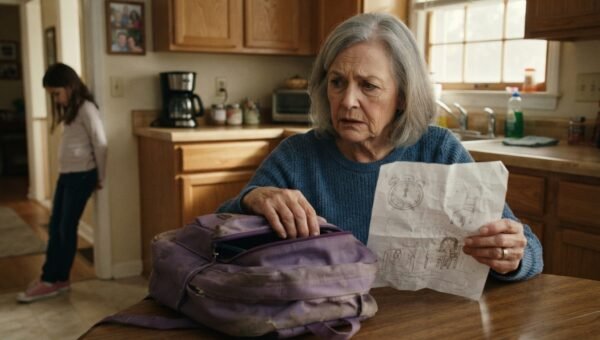
My son, Mark, walked in carrying a mug of black coffee. He was thirty-six, wearing his usual work fleece, his phone tucked into his front pocket. He had offered to sleep on my pull-out couch for the first ten days after surgery to help me get on my feet.
I had been grateful. Lord knows I didn’t like asking for help, but having your joint sawed out and capped with titanium makes you humble fast.
“Morning, Mom,” he said, leaning against my bedroom doorframe. “How’s the knee feeling?”
“What is this?” I pointed down at the gray clunker. “Where is my walker?”
Mark barely looked at it. “Oh, yeah. The supply company sent a driver back late last night while you were out cold from your pain meds. They realized they dropped off the wrong model. That other one was assigned to an outpatient rehab down in the county. This is the one Medicare actually authorized for in-home recovery.”
I gripped the mattress edge and pulled myself up to sit. “They just came into my house while I was sleeping?”
“I was awake watching TV, Mom. I handled it. Don’t worry about it. It works just the same.”
“It doesn’t work just the same,” I said, my voice shaking a little. “The wheels on this one drag, Mark. Look at the tape on this cable.”
“I tested it,” he said, taking a sip of his coffee. “It holds your weight fine. You only need it for three weeks anyway before the physical therapist moves you to a cane. Just don’t make a big production out of it.”
He went back to the kitchen before I could answer.
That was Mark’s way whenever he didn’t want to explain himself. He turned practical questions into an accusation that you were being difficult. For the rest of the morning, I tried using the gray walker to get down the short hall to the bathroom. The right wheel stuck every four feet, making my surgical knee jar with a sharp, sickening ache.
By noon, Mark had left to run errands and check on his own house across town.
I sat in my recliner with an ice pack strapped to my leg, feeling foolish and suspicious at the same time.
Medical supply companies don’t send drivers out at ten at night to swap equipment. They don’t take back a clean, sanitary device and leave a scratched-up relic held together with tape.
I grabbed my iPad from the end table. I intended to look up the customer service number on the medical supply receipt the driver had handed me on Friday. But as I opened the browser, my Facebook feed refreshed.
Under the local Marketplace tab for our county, something caught my eye.
It was a champagne-gold rollator. The exact brand. The exact wide basket. The exact contoured backrest.
The listing had been posted three hours earlier.
The price was $480.
The description was short: *Brand new, never used. Still has plastic wrap on lower frame. Upgraded comfort seat. Cash only. Pick up in Westgate parking lot.*
The seller profile was listed under the name Chloe Miller.
Chloe was my daughter-in-law. She had been married to Mark for five years.
I stared at the screen until the brightness hurt my eyes. The photos weren’t stock pictures from a medical website. They were taken on the dark hardwood floor of my son’s living room. In the bottom corner of the third picture, I could see the edge of the blue patterned rug I had bought them for Christmas two years ago.
My hands began to tremble on the tablet screen. My own son had taken the medical equipment meant to keep his mother safe, replaced it with garbage while I was asleep, and handed it to his wife to flip for four hundred and eighty dollars.
I didn’t yell. I didn’t call him. I sat there in the quiet house, listening to the refrigerator hum, and I felt a cold, clear resolve take over.
I had an old, inactive Facebook account under my maiden name, Evelyn Vance, that I hadn’t used in six years. I logged into it from the browser.
I sent Chloe Miller a direct message: *I saw your listing for the gold rollator. I need one right away for my mother. I have the $480 in cash. Can you meet me at three o’clock by the grocery store in Westgate?*
Seven minutes later, Chloe responded: *Yes. Gray Honda CR-V near the garden center. Cash only, please.*
I set the tablet down on the side table. Then I picked up my phone and called a taxi.
PART 2
Getting into the cab was miserable. Every inch of my right leg throbbed, and dragging myself into the back seat of a stranger’s sedan felt like a bad mistake. I brought the battered gray walker with me, folded awkwardly in the trunk, because I knew I wouldn’t be able to stand on the asphalt without something to lean on.
The driver pulled into the Westgate strip mall parking lot at ten minutes to three. The afternoon heat was already radiating off the pavement.
I spotted Chloe’s gray CR-V parked out near the far edge of the lot, away from the storefronts, backed against a chain-link fence behind the garden center.
I paid the driver, had him set the gray walker on the pavement, and told him to wait five minutes. Leaning heavily on the sticky, worn grips, I hobbled across the empty parking stalls. The stuck wheel dragged with an ugly scraping noise over the yellow lines.
Chloe was sitting in the driver’s seat, scrolling through her phone with the air conditioning running. When she heard the scrape of the metal, she glanced in her side mirror, then snapped her head around.
The window rolled down two inches. She didn’t look flustered or embarrassed. Her eyes narrowed into something tight and defensive.
“Evelyn?” she said. “What are you doing here? Mark said you were resting at home.”
“I came to buy my walker back,” I said. My breathing was ragged from the walk across the blacktop. “Pop the trunk, Chloe.”
She didn’t move for a long second. She looked toward the grocery store entrance, then back at me. “Mark told you to stay off that leg. You’re acting crazy. Get in the car and I’ll take you back to your house.”
“Open the trunk,” I repeated, louder this time. “Or I can call the police right here in front of this grocery store and report my medical equipment stolen.”
Chloe let out a sharp, irritated breath, hit the unlock button, and stepped out of the car. She was dressed in her gym clothes, sunglasses pushed up onto her hair. She walked to the back of the SUV and hauled open the liftgate.
“There,” she said, crossing her arms. “You’re making a scene over nothing. We were going to replace your money.”
I looked into the back of her SUV, expecting to see my gold walker sitting alone on the cargo mat.
It wasn’t alone.
The entire back of the vehicle was packed solid. The rear seats were folded flat, and jammed inside were seven identical rollators, all different colors—burgundy, navy, silver, and my champagne gold wedged right near the center. Six of them still had clear manufacturer plastic clinging to the footrests. They were stacked tight, tires locked against frames.
On the front crossbar of the burgundy one closest to the bumper, a white plastic hospital band was still looped tight around the brake line.
I leaned closer, holding onto the latch of the liftgate so I wouldn’t fall.
The name on the hospital bracelet was printed in clear black thermal ink: *Clara Vance.*
Clara was my older sister.
She had passed away seven weeks ago at seventy-one. She had spent the last three weeks of her life in hospice care at St. Jude’s Memorial after a long battle with pancreatic cancer.
Clara had never used a walker. By the time her hospice began, she had been entirely bedridden. She hadn’t walked across a room since early spring.
I reached out and touched the stiff plastic band. The admission date printed under her name was five days before she died.
“Where did you get this?” I asked, my voice barely a whisper. “Chloe. Why is my sister’s name on this?”
Chloe didn’t answer right away. She looked past my shoulder at the waiting taxi, then down at the pavement. Her defensive sneer had vanished, replaced by an ugly, nervous fidget.
“It’s just surplus,” she muttered. “They write off durable equipment all the time. Everyone does it.”
“Clara never had a walker,” I said, looking right into her eyes. “She couldn’t sit up, let alone walk. Who ordered this in her name?”
The passenger door of a pickup truck slammed shut about thirty yards away.
I looked up. Mark was walking toward us across the parking lot. He had followed her, or she had texted him the second she saw me. His face was flushed red, his jaw clamped shut, his hands shoved deep into his fleece pockets.
“Mom,” he said, his voice hard and sharp as he closed the distance. “Get away from the car.”
PART 3
“You stole from your aunt while she was dying,” I said before he could even reach the bumper.
Mark stopped two paces away. His eyes flicked to the open trunk, then to my face. He didn’t look like my boy then. He looked like an angry stranger caught doing something dirty in broad daylight.
“Keep your voice down,” he said, stepping in close to block the view from the road. “You don’t understand how any of this works.”
“Explain it to me, then,” I said. “Explain why you took my walker while I was sleeping and replaced it with a piece of junk from a basement. Explain why Clara’s name is on this burgundy one.”
“Mark, she has a cab waiting,” Chloe whispered from behind him. “Just take the gold one out and let her go home.”
“Shut up, Chloe,” Mark snapped.
He turned back to me, his chest heaving under his fleece. “Clara had top-tier supplemental coverage through her late husband’s union. You know that. When she went into hospice, the hospital intake coordinator asked if we needed durable mobility equipment ordered before her Medicare benefit period rolled over. Chloe works in patient intake at St. Jude’s, Mom. She knows the billing codes.”
The knot in my stomach turned to pure lead.
Chloe had worked in administrative billing at St. Jude’s for three years.
“She billed her insurance?” I asked. “For things Clara couldn’t even use?”
“The insurance company pays the contracted distributor directly,” Mark said, leaning down so his face was level with mine. His voice was frantic, full of that self-righteous excuse-making that people use when they know they’re entirely wrong. “The hospital writes off whatever is delivered and unused. The distributor doesn’t want them back because restocking fees cost more than the scrap value. They literally sit in supply closets until someone tosses them out. It’s free money, Mom! Nobody gets hurt. Clara didn’t pay a cent out of pocket. Her estate didn’t pay a cent.”
“And mine?” I asked. “Did you bill mine through Chloe too?”
Mark looked away, grinding his teeth. “Your discharge coordinator was behind on paperwork. Chloe flagged your file in the system and had the top-end gold model expedited to your house. We were going to give you that gray one from the beginning. It came out of an estate sale lot I bought two months ago for fifty bucks. It was fine for a couple weeks.”
“You took the equipment I needed to walk after surgery so you could sell it for $480 in cash?”
“We’re behind three months on the mortgage, Mom!” he hissed, his face tightening with raw frustration. “The interest on the credit cards doubled after Christmas. Chloe’s hours got cut at the clinic. We have twelve thousand dollars in unsecured debt and the bank is threatening to pull our line of credit. Four hundred and eighty bucks is a car payment. Five of these pays the mortgage. It wasn’t about hurting you.”
“You left me with a broken wheel, Mark,” I said. “I stumbled twice this morning trying to make it to the toilet.”
He blinked. For half a second, something like real shame flickered across his eyes, but it didn’t last. Shame never lasts long in someone who has already convinced themselves they are the victim.
“You’re fine,” he said, his tone turning cold and dismissive again. “You’re standing right here, aren’t you? Take the gold one if you’re going to make a federal case out of it. We’ll take the loss. Just get in your cab and go home.”
He reached into the trunk to haul my gold walker out from the pile.
“Don’t touch it,” I said.
Mark froze, his hand on the champagne crossbar.
“Leave it right where it is,” I told him.
I reached into my pocket, pulled out my phone, and tapped the camera. I took three clear, steady photographs: one of the whole open trunk showing all seven walkers, one of the license plate on Chloe’s Honda, and one close-up of Clara’s hospital bracelet with the patient ID number and St. Jude’s intake stamp visible.
“What are you doing?” Chloe shrieked, lunging forward to grab my wrist.
“Don’t you lay a finger on me,” I said, stepping back firmly onto my good leg. The pain in my knee was sharp, but my hand didn’t shake. “If you touch me, that cab driver is watching, and I’ll have the police here for assault before you can shut this tailgate.”
Chloe backed off, her face drained of all color.
“Mom, please,” Mark said, his voice dropping into a desperate plea. “If you show that to the hospital, Chloe loses her license. She’ll get fired. We’ll lose the house.”
“You should have thought about your house before you treated your dying aunt like a coupon code,” I said. “And before you treated your mother like a mark.”
I turned around, gripped the gray walker with both hands, and dragged the sticky wheel all the way back to the taxi.
ENDING
I didn’t call the police from the parking lot.
I had the cab driver take me straight to the medical supply distributor listed on my discharge paperwork, an office two miles north on the commercial loop. I sat in a waiting room chair with my leg propped up while the branch manager pulled up the records.
It took him less than ten minutes to see what had happened. The system showed that my gold rollator had been ordered under my primary insurance, marked as delivered, and then within twenty minutes, an amended delivery ticket had been logged using Chloe’s staff credentials to re-route a secondary equipment claim.
I didn’t have to explain the whole ugly mess. The manager took one look at the photos of the trunk, the hospital bracelet with Clara’s name, and the printout of the $480 Marketplace ad I had saved on my iPad.
“This is systematic billing fraud, Mrs. Vance,” he said quietly. His tone was professional, but his jaw was set tight. “We have to report this to our compliance director and the hospital’s integrity hotline immediately.”
“I know,” I said. “Just give me the walker I’m supposed to have.”
By five o’clock that evening, I was back in my own living room. The supply company had delivered another brand-new champagne-gold rollator directly to my door, free of charge, along with a written apology from their regional supervisor.
Mark showed up at my house at seven that night.
He didn’t use his key. He knocked on the front door, standing on the porch under the yellow bug light like a neighbor who didn’t know if he was welcome.
I unlocked the deadbolt and opened the door four inches, keeping the security chain in place.
“Mom,” he said. His voice was cracked, his eyes swollen. “St. Jude’s HR called Chloe an hour ago. They suspended her pending an internal investigation. They told her she can’t return to the building. The hospital’s legal department is involved.”
“I expected they would be,” I said.
“We have a daughter, Mom,” he choked out, leaning his forehead against the doorframe. “Your granddaughter. If Chloe gets charged, if she loses her job, we can’t keep the house. How could you do this to your own family?”
I looked at him through the narrow gap. For thirty-six years, I had made excuses for Mark. When he quit community college, I paid his debts. When he wrecked his first car, I co-signed the next loan. When he complained that life was unfair, I listened and opened my purse. I had taught him, bit by bit, that his mother’s dignity was something he could borrow against whenever he ran short.
“I didn’t do this to your family, Mark,” I said. “You did. When you walked into my bedroom while I was asleep and took the tools I needed to stand up, you decided I wasn’t your mother anymore. You decided I was just another account you could drain.”
“Mom, please—”
“I changed the deadbolt code this afternoon,” I told him. “Your father’s old toolbox is on the back patio. Take it with you. Do not come back here unless I call you.”
I shut the heavy wooden door and turned the deadbolt until it clicked into the brass plate.
I heard his boots scuff down the wooden porch steps, heard his truck engine start, and listened until the sound of his exhaust faded down the street.
The house was completely still.
I took hold of the new gold handgrips. The wheels turned silent and smooth over the hardwood floor, gliding effortlessly without a single rattle or hitch. I walked myself down the hall, turned into the kitchen, and set a pot of tea on the stove.
My knee still ached deep in the bone, but for the first time since they wheeled me out of that hospital, I was standing entirely on my own two feet.