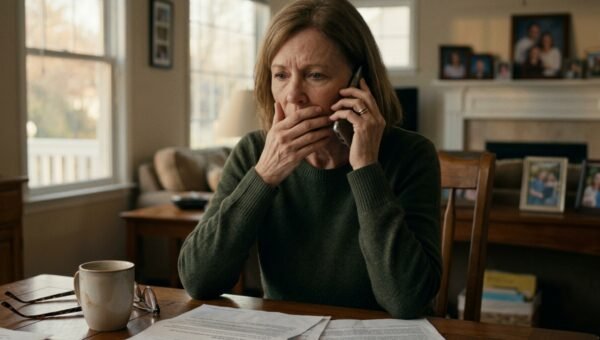
The envelope was sitting on the wooden doormat when I came back from the pharmacy with my blood pressure pills. It was a thick manila thing with the return address of the county medical center stamped in purple ink at the top left corner. I didn’t think much of it at first because my gallbladder surgery had happened two years ago, and usually when hospitals write to you two years later, they want another forty-two dollars for something they forgot to bill.
I unlocked the screen door and set my little brown paper bag on the kitchen counter right next to the sink. The house was quiet in that heavy way it gets when nobody has walked through the front hall for longer than you care to think about. I walked over to the kitchen table, dropped my keys into the wicker basket, and picked up the envelope. My thumb caught the paper edge as I tore it open, pulling out the folded sheets of white computer paper with the green alternating bars.
Then the front screen door creaked.
Before I could even look up, Chloe was standing right there in the kitchen archway. She looked older, or maybe just harder around the edges than she had the last time I saw her at the grocery store parking lot, when she turned her back and got into her station wagon without letting me say a word.
She wasn’t carrying a purse. She was carrying her own copy of that exact same white paper, folded in half with the billing codes turned outward.
“You need to look at this,” Chloe said. Her voice didn’t shake. That scared me more than if she had started crying right then and there.
“Chloe,” I started, taking half a step toward her across the linoleum. “I didn’t know you were, “
“Just look at the date,” she interrupted, holding her paper out toward me so the lines of text hovered right in front of my face. “Page three. The itemized facility charges for the room change. Read who authorized the transfer.”
I looked down at the paper. My eyes aren’t what they used to be, so I had to squint past my bifocals to make out the small print near the bottom margin where the hospital logs administrative updates. There was a timestamp.
4:14 in the afternoon, two days before Chloe went into labor. And next to the signature line for family consent, someone had written down a name and a phone number I had known by heart for thirty years.
“Arthur,” I whispered.
“Yeah,” Chloe said, and her jaw tightened until the skin went white around her mouth. “Dad. He called them from his cell phone while you were still recovering from your first consultation, and he moved your gallbladder operation so it fell squarely on the morning I was admitted. He told them you were confused about the calendar.”
The kitchen seemed to tilt sideways for a second, just enough to make me catch the edge of the laminate table with my palm. Two years of silence. Two years of walking down the cereal aisle and seeing other grandmothers pushing carts with babies babbling in the seats while I looked at the floor because my own daughter thought I chose a routine organ removal over her first child.
Three phone calls while I was under general anesthesia, three unanswered rings that she never let me explain.
“I tried to tell you,” I said, and my voice sounded thin and small in the quiet room. “I woke up in that recovery ward with the nurses telling me the schedule had shifted due to an emergency slot opening up. They told me it was standard procedure. I didn’t know.”
“You always have an excuse,” she had told me back then. Those were the exact words she threw over her shoulder in the hospital corridor while I stood there in my paper-thin gown with the IV tape still pulling at the skin of my wrist. I had let her go because I was proud, and because my side still burned from the incisions, and because part of me thought daughters were just supposed to know their mothers loved them without having to beg for belief.
“He told me you didn’t want to be bothered,” Chloe said now, her voice dropping into a register that made my chest tighten. She took two steps forward and dropped her papers right on top of my stack. “He told everyone at the maternity ward that you took one look at the due date, sighed, and told him you had a bridge club meeting you couldn’t miss. He played the devoted father the whole time I was in labor. He brought flowers. He took pictures with the baby in the hallway and posted them online with captions about how family is everything.”
“A bridge club,” I repeated. I haven’t played cards in ten years. My hands started to shake, not from the blood pressure, but from that cold, rising fury that comes when you realize someone has been rewriting your life behind your back while you were sleeping. “I don’t even own a deck of cards, Chloe.”
“I know,” she said, reaching up with one hand to brush back a stray lock of dark hair that had come loose from her ponytail. “I went through his old desk this morning looking for the title to the lawnmower he promised to fix for me, and I found a folder of hospital receipts from that week. He kept everything. He was proud of it.”
“Where is he now?” I asked.
“Sitting in his living room watching the golf channel probably,” she said. “Drinking his iced tea out of that big insulated mug.”
I looked at the phone sitting on the counter by the bread box. It was an old cordless model with buttons that had worn off the numbers three and seven over the years of calling the hardware store and the pharmacy. I didn’t even stop to think about whether it was the right thing to do or what kind of mess it might start up again. Two years of missing my granddaughter’s first steps, her first teeth, the way her hair curled at the back of her neck just like Chloe’s did when she was small, all of it traded away because Arthur wanted to be the main character in a family drama he invented in his own head.
I picked up the handset and pressed the talk button. The dial tone hummed in my ear, steady and flat.
“What are you doing?” Chloe asked, taking a quick half-step toward me as if she thought I might change my mind.
“We’re going to put him on speaker,” I said, punching the digits of his mobile number from memory the way you dial a combination you’ve known since you were twenty. “Right now. While you’re standing in my kitchen.”
The phone rang three times before it clicked.
“Hello?” Arthur’s voice came through the little plastic speaker, sounding just as thick and comfortable as it always had when he was sitting in his recliner waiting for someone else to fetch him a glass of water. “Marcia? If this is about the gutters, I told you I’m not climbing up there until the weekend.”
“It’s not the gutters, Arthur,” I said, keeping my voice lower than I felt. I hit the speaker button so the sound filled the small space between the refrigerator and the stove.
There was a second of silence on the line, just the sound of a television announcer talking about a putt on the ninth green. Then Arthur cleared his throat.
“Chloe’s there with you, isn’t she?” he asked, and the casual, lazy tone didn’t even leave his voice. He didn’t sound surprised. He sounded like a man who had practiced his lines a hundred times in an empty room. “I figured she’d track down that billing office eventually. Those clerks don’t know how to file anything properly.”
Chloe leaned over the table, her hands flat on the wood, her face only inches from the little black speaker grille. “You told the hospital I didn’t care,” she said, and her voice shook with a dangerous, quiet heat. “You told them I was too busy playing cards to come to the birth.”
“Now, wait a minute, sweetheart,” Arthur said, and you could hear him shifting his weight in the chair. “Your mother was a mess before that surgery. She was nervous about the anesthesia. I just helped the staff straighten out the paperwork so she wouldn’t have the extra stress of driving across town while you were in the middle of all that commotion. I was looking out for her.”
“You changed my surgery date so I’d miss her delivery,” I said, and I could feel the blood rushing into my ears until the room sounded like it was underwater. “You did it because you wanted to be the only one in that waiting room. You wanted to play the hero.”
“Somebody had to be there,” Arthur snapped back, the smooth excuse dropping away to reveal that ugly, thin-skinned temper he used to hide behind closed doors. “The girl was terrified. She needed her father, not someone who acts like every family milestone is an inconvenience. You were too busy with your little routines to care anyway.”
“I was under a general anesthetic, Arthur,” I said, and my hand tightened on the plastic handset until my knuckles went white. “The surgeon had to cut three inches into my side. I didn’t even know what day it was until the nurses woke me up with ice chips.”
“Well, you made your choice,” he said, and I could hear the smug curl in his mouth through the static. “You stayed in that recovery bed instead of walking down the hall. That’s on you.”
Chloe didn’t wait for me to say anything else. She reached down, grabbed the phone right out of my hand, and brought it close to her mouth.
“Pack your things out of the garage,” she said. Her voice was so cold it sounded like winter wind blowing across an empty field. “If you ever come near my house again, or my daughter’s daycare, I’m filing the restraining order before the sun goes down. And don’t bother calling. We know.”
She pressed the red end button before he could answer. The kitchen went back to that heavy, dead silence, except for the hum of the refrigerator starting up its cooling cycle in the corner.
Chloe stood there staring at the blank screen of the phone for a long time. Her shoulders were curved inward, the tension finally draining out of her back in one long, ragged breath. She looked down at her hands, then over at the little brown paper bag with my prescription bottles sitting on the counter.
“I missed two years,” she whispered, and her voice broke right in the middle of the sentence. “She’s two and a half now, Mom. She knows how to use an iPad and she sings these little songs from daycare, and I spent every single one of those days being mad at the wrong person.”
I walked around the table and put my arms around her shoulders. She felt smaller than she used to, or maybe I was just realizing how much weight she had been carrying around by herself while Arthur sat in his house watching golf. We stood there by the laminate table for a long time, neither of us saying anything, just holding onto each other while the afternoon sun moved across the linoleum floor.
“You can come over tomorrow,” I said into her hair, which smelled like the shampoo she used to use when she was in high school. “If you want. We can go pick her up together.”
“Would you?” she asked, pulling back just enough to look into my eyes. Her own eyes were red around the edges, but the hardness was gone, replaced by something open and raw that I hadn’t seen since she was a little girl scraping her knees on the driveway gravel. “Do you think she’d remember me? I mean, she’s seen pictures, but, “
“She’ll know you,” I told her, and my own voice cracked despite myself. “Grandma has a lot of making up to do, and so do you.”
We didn’t talk about Arthur for the rest of the afternoon. We sat at the kitchen table and drank lukewarm instant coffee out of chipped mugs while Chloe told me about how her little girl, my granddaughter, the one I hadn’t been allowed to hold, liked to line up her toy shoes by the back door every night before she went to sleep. It was such a small, ordinary thing, the kind of detail you only know when you’re there in the house, watching the small rhythms of a day unfold.
The next morning, we drove out to the little brick ranch house on the south side of town where Arthur lived by himself. We didn’t go inside. We didn’t even turn off the engine of Chloe’s station wagon. We just watched from the driveway as a couple of plastic lawn chairs he had left out on the grass tipped over in the morning breeze, rolling across the dry Bermuda grass toward the fence line where nobody was watching them anymore.
He didn’t come to the window. He probably saw us through the vertical blinds and decided it was easier to stay in his chair with his television turned up loud. Let him have his quiet house. Let him have his golf tournaments and his empty rooms.
By three o’clock, we were sitting on the rug in Chloe’s living room with a little girl who had her mother’s dark eyes and a smudge of peanut butter on the collar of her yellow shirt. She didn’t know anything about billing statements or hospital schedules or thirty years of living with a man who kept score in a ledger only he could read. She just looked up at me with those wide, clear eyes and handed me a plastic blue block from the middle of the floor.
“Build,” she said.
I took the block from her small, warm fingers, and for the first time in two years, the house didn’t feel quiet at all.