PART 1
My sister-in-law, Brenda, called me in early June with an apology already built into her voice. Her daughter, Chloe, was getting married in September. Chloe had fallen in love with vintage satin, but every boutique in town wanted four thousand dollars for dresses that felt thin and cheap.
“You still have yours in the garment bag, don’t you, Martha?” Brenda asked. “It’s just sitting in your spare closet.
Let Chloe wear it down the aisle. She’ll take such good care of it. We won’t change a single thread. It’ll come back to you untouched.”
I should have said no right then. Brenda and I have never had an easy relationship. For twenty-two years, she has treated whatever belongs to me as community property for her side of the family. But my brother, David, sounded so tired on the phone when he backed her up. He said money was tight with the caterers, and seeing Chloe wear my dress would mean the world to him.
I went up to the spare bedroom closet and unzipped the white canvas bag. The dress had hung there for twenty-eight years. It was heavy ivory silk, cut simple and classic, with fitted lace along the sleeves and a modest four-foot train. But the silk was not why I protected it.
Three days before my mother died of pancreatic cancer in 1996, she sat propped up in an armchair in my living room with a needle between her swollen knuckles.
She had already lost her voice to the weakness, but she insisted on putting her hands on my gown. Using bright blue embroidery floss, she stitched a tiny, crooked row of cross-stitches inside the inner lining of the front hem, right against the ribbon tape. It was her way of giving me something blue, and her way of making sure her hand was on me when I walked down the aisle five months later.
I showed those stitches to Brenda when she came to my front porch to pick up the bag. I turned the silk hem inside out in the sunlight.
“Brenda, look at this,” I told her. “No tailoring that cuts this hem. Chloe can take in the waist with temporary basting, but do not touch the length. And do not touch the sleeves. If it doesn’t fit her height with heels, she can’t wear it.”
“Martha, stop worrying,” Brenda said, waving her hand and taking the bag by the handles. “You have my word.
It will come back exactly the way you gave it to me.”
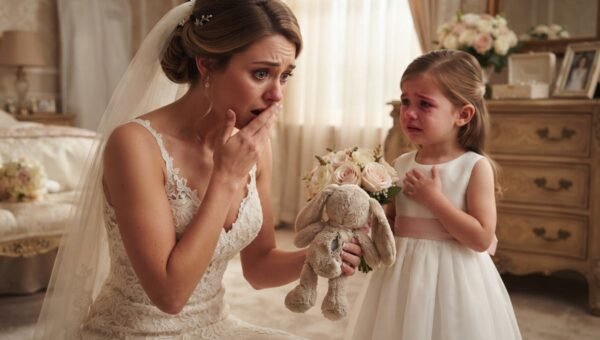
The wedding took place on a Saturday afternoon at an outdoor country club two hours away. When Chloe walked down the aisle, I was sitting four rows back next to my husband, Tom. The moment Chloe stepped onto the grass runner, my breath caught in my throat.
The lace sleeves were gone. Her arms were completely bare, the shoulders recut into a blunt cap sleeve. The long satin train had been sheared off entirely. The skirt hovered three inches above her silver pumps, floating like a tea-length party dress.
I sat through the vows with my hands locked tight in my lap. I did not cause a scene at the reception. I did not confront Chloe, who was twenty-three and smiling at her friends. But the following Tuesday morning, I drove straight to Brenda’s house.
Brenda met me at the screen door holding a black contractor trash bag.
She didn’t invite me in. She handed the heavy plastic over the railing like she was passing out the morning garbage.
“Here,” she said. “We had to make it work for Chloe’s vision. A bride deserves to feel modern on her own day.”
I took the bag, carried it straight to my car, and opened it right there in her driveway. I reached into the bunched-up fabric, hunting for the inner ribbon at the front hem.
The ribbon was gone. The entire lower hem had been hacked away with shears and run through a quick machine stitch with standard white polyester thread. My mother’s blue stitches were completely gone.
I stood there in the driveway, holding that mangled hem, and the tears just spilled over. I couldn’t stop them. I wasn’t crying over the fabric. The fabric was just silk. I was crying because the last physical thing my mother ever made with her own living hands had been chopped off and thrown away for an afternoon party.
Brenda stood on the porch with her arms crossed, watching me break down.
“It’s just fabric, Martha,” she snapped, her voice hard and flat. “Stop acting crazy. The dress is thirty years old anyway. Be happy you helped your niece.”
I didn’t answer her. I threw the plastic bag into my back seat, slammed the door, and drove away. I blocked Brenda’s number that evening. When David called me two days later trying to smooth things over, I told him not to call me again until his wife learned what respect meant.
Two weeks passed. The house stayed quiet, but every time I walked past the spare room door, my stomach burned with regret. I hated myself for trusting her.
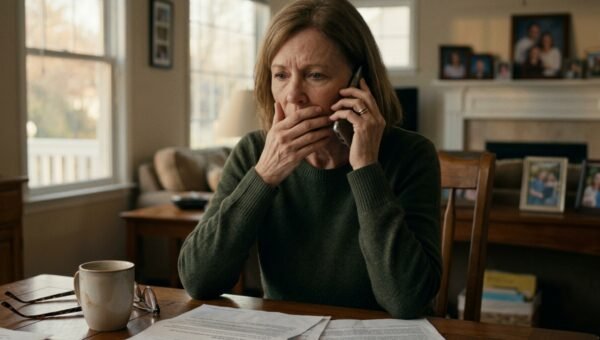
Then, on a rainy Thursday morning, my landline rang.
“Martha?” a woman’s voice asked. The accent was older, crisp and local. “My name is Evelyn Vance. I run Vance Bridal Alterations on Elm Street. Did Brenda Miller bring you an ivory gown recently?”
My chest tightened. “Yes. She did.”
“I thought so,” Evelyn said quietly. “Brenda came into my shop six weeks ago demanding I cut the sleeves and hem that dress to the knee. I told her it was vintage work and shouldn’t be butchered, but she insisted she owned it. When I unpicked the original hem tape to do the cut, I found something. I kept the scrap pieces Brenda told me to throw in the bin.”
I gripped the phone cord. “You kept the hem?”
“I kept the entire bottom border,” Evelyn said. “Because there was a fold of heavy buckram sewn behind your mother’s blue stitches. Inside that fold was a handwritten note wrapped around an old savings deposit receipt. Martha, before you come down here, let me ask you: does the name Eleanor mean anything to your family?”
PART 2
The rain was coming down hard when I pulled up outside Evelyn Vance’s shop on Elm Street. Her store sat between an old dry cleaner and a framing shop, with a single cream-colored mannequin standing in the front window.
When I pushed the front door open, a brass bell chimed overhead. Evelyn came out from behind a pair of velvet curtains. She was a woman in her late sixties, wearing tortoiseshell glasses on a chain and a wrist pin-cushion loaded with yellow-topped pins.
“You look like your mother,” Evelyn said softly before I even introduced myself.
She led me back to her workroom. A massive wooden cutting table dominated the center of the room, surrounded by spools of thread and rows of industrial sewing machines. Laying on a sheet of brown butcher paper was the bottom eight inches of my wedding dress hem, neatly laid out flat.
There they were. The little blue crosses of embroidery thread, uneven and slightly shaky, exactly where Mom had placed them thirty years ago. Just seeing those threads resting on the butcher paper made my throat ache.
“Brenda stood right by that mirror and told me to throw the scraps in the garbage,” Evelyn said, leaning against the edge of the table. “She said nobody cared about old fabric. But I’ve been tailoring for forty years, Martha. When I ran my shears near the front fold, I felt something thick inside the stiffener. A seamstress knows when something has been placed on purpose.”
Evelyn reached into a shallow wooden drawer and pulled out a clean plastic sleeve. Inside was a piece of yellowed, lined notebook paper, folded into a tight square no bigger than a matchbook, along with a carbon-copy deposit slip from First National Bank dated September 14, 1974.
The amount printed in purple bank ink on that slip was $10,000.
“Read it,” Evelyn said gently.
I slid the folded paper out with careful fingers. The paper was crisp and smelled faintly of lavender sachet, the same scent Mom used to keep in her cedar chest. The handwriting was unmistakable: Mom’s small, rounded cursive, written in faded blue ballpoint pen.
“To whoever finds this first,” the note began. “If you are reading this, you are mending or passing down Martha’s dress. In 1974, Eleanor handed me this money to keep our family home out of foreclosure after Arthur lost his job. She made me swear on the Bible that I would never tell Arthur, and that I would pay it back to her family when the time was right. I was never able to return the full amount before she died, but David knows what happened. He knows where the rest went.”
I read the lines three times. My hands were shaking so hard the paper rattled.
Eleanor was David’s mother-in-law. Brenda’s mother.
She had passed away in 2004, but back in the nineteen-seventies, Eleanor had been a quiet widow who lived three streets over from our family. My father, Arthur, had been laid off from the machine plant in 1974. I was only ten years old back then, but I remembered the bitter arguments at the kitchen table, the envelopes marked with red final notices, and then the sudden, unexplained relief when our house was saved from the bank.
My father had always claimed an uncle lent him the cash. But Mom had carried the truth alone in her sewing basket, eventually tucking that receipt and note inside the very dress she knew I would keep forever.
“Look at the back of the deposit slip,” Evelyn pointed out.
I turned the carbon slip over. There was a second set of notes, written in much fresher ink, dated June 12, 1996, just three days before Mom died:
“Paid back $4,000 in 1982. The remaining $6,000 was given to David in cash to deliver to Eleanor before Brenda moved into the house. David took the envelope. He promised me it was settled.”
The room seemed to shrink around me.
David had not just taken Brenda’s side during the wedding dress fight. He had known about this debt for thirty years. My mother had trusted him with six thousand dollars in cash in 1996, money meant to wipe our family slate clean before she passed, and he had looked her in the eye and said it was done.
“Brenda doesn’t know this was in here,” I said, my voice barely a whisper.
“No,” Evelyn replied. “When Brenda brought the dress in, she only cared about making it fit Chloe fast. She wanted it chopped down so Chloe didn’t trip on the lawn. But after you called, I started thinking about the way Brenda spoke about you. She told me you were bitter and jealous of her family. She told me you held grudges over nothing.”
Evelyn folded the butcher paper over the blue stitches and placed the entire package into a neat cardboard box.
“Take your mother’s work home, Martha,” Evelyn said firmly. “And go ask your brother why he let his wife call you crazy over something he helped bury.”
I took the box to my car, sat in the driver’s seat with the engine running, and pulled out my phone. I unblocked David’s number.
I didn’t call him. I took a clear, sharp photograph of the deposit slip and the note lying on Evelyn’s cutting table, and I sent it directly to his phone with a single sentence:
“We need to talk about Eleanor, David. Today.”
Three minutes later, my phone lit up with an incoming call from my brother.
PART 3
David didn’t wait for me to speak when I answered. His breath was coming fast, ragged and thin through the speaker.
“Where did you get that?” he asked. Not a hello. Not a question about the dress. Just panic.
“Mom left it where you couldn’t throw it away,” I told him. “In the hem. The hem your wife demanded Evelyn cut off.”
Silence stretched over the line for five long seconds.
“Martha, please,” he muttered, his voice dropping low. “Don’t bring this up to Brenda. You don’t know what she’s like about money. Just let me come to your house. Alone.”
“No,” I said. “You come to my house, and you bring Brenda with you. If you don’t walk through my front door by five o’clock, I’m driving over to your house, and I’ll lay this carbon slip on your kitchen table right in front of Chloe.”
I hung up before he could argue.
At twenty minutes to five, Tom was sitting at our dining room table, having read the note himself. He didn’t say much; he just kept his hand flat over mine on the polished oak. Outside, tires crunched over the gravel driveway.
David walked in first, his shoulders hunched, his eyes fixed on the floorboards. Brenda followed two steps behind him, her arms already crossed, her jaw set like she was preparing for an unnecessary fight.
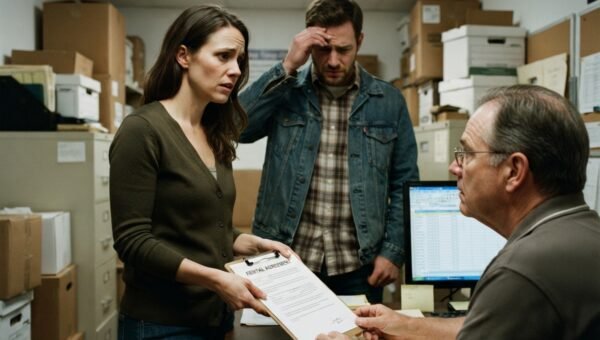
“Martha, this is ridiculous,” Brenda started the second she stepped into the dining room. “David told me you’re throwing around old papers trying to stir up trouble because you’re still upset about a hemline. I told you, we offered to pay for dry cleaning. What else do you want?”
I didn’t answer her with words. I slid the clear plastic sleeve across the table until it tapped against the edge of her purse.
Brenda looked down, irritated, and picked it up. She read the yellowed notebook paper first. I watched her eyes track back and forth across Mom’s handwriting. Then her thumb moved the paper aside and revealed the purple ink on the 1974 deposit slip.
Her hands stopped moving.
“That’s my mother’s name,” Brenda said, her voice losing its sharp edge. “Eleanor Miller. Where did you get this?”
“My mother hid it inside the hem of my wedding dress three days before she died,” I said evenly. “Because your mother loaned my parents ten thousand dollars in 1974 to keep our home from being taken by the county. Mom paid back four thousand herself. And in 1996, she gave the remaining six thousand dollars in cash to your husband to hand directly to Eleanor.”
Brenda turned slowly toward David. Her expression wasn’t angry yet; it was completely bewildered.
“David?” she said. “What is she talking about? My mother never had ten thousand dollars to give away.”
David kept his eyes pinned to the table legs. His face had gone gray. He looked like an old man who had run out of corners to hide in.
“She did,” David finally muttered, his voice cracking. “In seventy-four, Eleanor sold her late husband’s truck and a parcel of timber land out in Wayne County. She gave the cash to Mom to save our house because she liked Mom. She didn’t want Arthur to feel small.”
“And the six thousand dollars?” Brenda asked, taking a step toward him. “The money Martha’s mother gave you in ninety-six? David, look at me.”
David swallowed hard. He couldn’t look his wife in the eye, and he couldn’t look at me either.
“I had credit card debt,” he whispered. “We were trying to close on our first house on Maple Street. The bank told me my debt-to-income ratio was too high. If I didn’t clear the six thousand on the cards, we were going to lose the mortgage approval. Mom gave me the envelope of cash the week she went into hospice. She told me to walk it over to Eleanor.”
“And you kept it,” I said.
“I paid off the credit card,” David sobbed, putting his head in his hands. “I told Mom Eleanor said thank you and that we were square. I thought Eleanor would never ask because she was already slipping with dementia by ninety-eight. She never mentioned it. Nobody ever mentioned it.”
Brenda stared at her husband like he was a total stranger who had walked into her living room uninvited. All the arrogance, all the dismissive cruelty she had used on my porch when she called me crazy, drained out of her face.
For thirty years, Brenda had treated my side of the family like poor relations she had to tolerate. She had bragged about how her mother came from good stock, how David was lucky she married him, how my possessions were disposable cast-offs that Chloe could chop up for a single afternoon.
And the entire time, her own mortgage had been secured with money my dying mother had scraped together to pay an honest debt.
“You let me talk to Martha like that,” Brenda said, her voice trembling with a quiet, terrible fury. “You let me stand on her porch and call her crazy over a trash bag, knowing what you did to her mother.”
David had no answer. He just sat there with his hands over his ears, weeping into the oak table.
ENDING
The dining room stayed silent for a long time after that. Nobody yelled. The truth had landed with such absolute weight that shouting would have sounded cheap.
Brenda set the plastic sleeve back on the wood. She didn’t look at David. She looked straight at me.
“I will write you a cashier’s check for six thousand dollars tomorrow morning,” Brenda said. Her voice was flat, hollowed out by humiliation. “And I will pay Evelyn Vance whatever she charges to restore the lace sleeves and resew the hem.”
“No,” I told her quietly. “You won’t.”
Brenda blinked. “Martha, please. We owe you this.”
“You don’t owe me six thousand dollars,” I said. “That money belonged to your mother, Eleanor. David stole it from her estate, not mine. If you want to balance that ledger, you take that six thousand dollars and put it into a trust fund for your daughter Chloe, and you tell her someday where it came from.”
I reached out and pulled the plastic sleeve back to my side of the table, tucking it against my chest.
“As for the dress,” I added, looking right at David, “Evelyn already saved the only part that mattered. You can’t fix what you broke, David. And you can’t buy your way out of who you are.”
They left my house five minutes later. Brenda walked to the car alone, got into the passenger side, and looked straight ahead through the windshield without waiting for him. David followed her slowly, his shoulders bent, looking smaller than I had ever seen him.
Two weeks later, Brenda mailed a certified bank receipt to my house. She had opened a high-yield savings account in Chloe’s name with six thousand dollars deposited on the first line. Tucked inside the envelope was a short, handwritten note from Brenda. It didn’t make excuses. It simply said: “I am sorry for what I said on your porch. You were not crazy.”
I didn’t call her back. Forgiveness isn’t something that happens because an envelope arrives in the mail, and some boundaries need to stay exactly where they are built. David has called twice since then, leaving hesitant voicemails about Sunday dinners, but I haven’t listened past the first ten seconds.
Yesterday, Evelyn Vance called me back to her shop.
She had taken the scrap of original hem with Mom’s blue cross-stitches and framed it inside a shallow shadow box lined with acid-free ivory linen. Next to the stitches, mounted neatly under museum glass, sat the yellowed note Mom had written in 1974.
The ruined gown is still in the spare closet. It will never be worn down an aisle again, and the sheared lace will never be put back together the way it was. But that little frame hangs right above my sewing desk in the morning light.
Every time I sit down to mend a tear or hem a pair of pants, I run my thumb across the glass right over those crooked blue threads. My mother didn’t leave behind a fortune, and she didn’t leave behind a perfect family. But she left her truth where time couldn’t touch it, and for the first time in twenty-eight years, the debt is finally settled.