PART 1
When my sister Rachel’s husband died suddenly of an aneurysm in his sleep, I didn’t hesitate. She had two boys, six and eight, and an overwhelming pile of debts he had managed to hide until the funeral flowers were barely dry. I own a four-bedroom colonial outside Columbus, completely paid off since my husband passed four years ago. It was just me and my two daughters, Maya, who was nine, and Chloe, who was seven.
I called Rachel the week after the service and told her to pack up her boys and come home to Ohio.
I expected the grief. I expected the crying spells at two in the morning, the sink full of mismatched cereal bowls, and the sneakers kicked off in the front hallway. What I did not expect was the slow, deliberate way Rachel began rearranging my family.
It started with small things I made excuses for. She bought groceries and moved my pantry items to the lower shelves because she said it made more sense. Then she began answering my home phone and telling my church friends that I was resting and couldn’t be disturbed, even when I was standing right in the kitchen folding laundry. I told myself she was grasping for control because her entire life had fallen apart.
Then came the second month.
I came home from my part-time shift at the library and found all four kids sitting around the kitchen island doing their spelling lists. Rachel was standing behind Chloe, smoothing her ponytail with a brush.
“Mom, can I have apple slices?” Chloe asked without looking up.
“Of course you can, sweetie,” Rachel answered before I could take off my coat.
I paused in the doorway. “Rachel, I’m right here. Chloe, ask me next time.”
Rachel offered a tight, apologetic little smile that didn’t reach her eyes. “Oh, Sarah, don’t make it weird. With everything going on, it’s just easier if the kids see us as a team. Two moms under one roof. I told them yesterday they can just call me Mom too if it feels natural. Love isn’t a pie, you know. There’s plenty to go around.”
My stomach tightened. “I am their mother, Rachel. You are their aunt. Let’s keep those lines clear.”
She didn’t argue. She just set the hairbrush down with a soft click and turned to slice the apples, acting like I had made a scene over nothing.
Two weeks later, the real crack appeared.
It was a Tuesday evening. I was tucking Chloe into bed, pulling the lavender quilt up to her chin. She was staring at the glow-in-the-dark stars on her ceiling, twisting the hem of her pajama shirt between her fingers.
“Mom?” she whispered.
“Yes, baby?”
“Where are you going?”
I stopped smoothing her sheets. “What do you mean? I’m not going anywhere. I’m going downstairs to finish the dishes.”
“No,” Chloe said, her voice small and shaky. “Aunt Rachel said you might be going away soon. For a long rest. She told Leo and Sam that we might all have to live together with just her for a while so you can get better.”
A chill went straight through my chest. I had not missed a day of work. I had not been sick. My annual physical three weeks prior had shown nothing worse than mildly elevated cholesterol.
“Chloe, look at me,” I said, keeping my voice as calm and steady as I could. “I am not sick. I am not going anywhere. Did Aunt Rachel say why she thought that?”
“She said you get confused and tired,” Chloe mumbled, looking away. “She said your head hurts from grieving Daddy, and sometimes grown-ups have to go to a special hospital to sleep.”
I kissed Chloe’s forehead, turned on her nightlight, and walked straight downstairs.
Rachel was in the family room, folding a load of towels. I stood in front of the television until she had to look at me.
“Why did you tell my seven-year-old daughter that I might be going away to a hospital?” I demanded.
Rachel didn’t blink. She shook out a bath towel, folded it into neat thirds, and sighed with theatrical patience. “Sarah, you’re twisting things. Chloe was asking why you looked so tired after work. I told her that everyone gets exhausted, and if you ever needed a break, I would be right here to take care of them. You’re hearing monsters in the closet.”
“She said you told her boys that you’d be raising all four of them alone,” I said, my voice shaking with fury.
“You’re being paranoid,” Rachel said, walking past me with the stack of towels. “Honestly, your nerves have been shot lately. Maybe that’s why Chloe is picking up on it. You need to calm down before you scare the children.”
She walked into the guest room and clicked the door shut.
I stood in the dark living room, my hands shaking. Something was completely, terribly wrong.
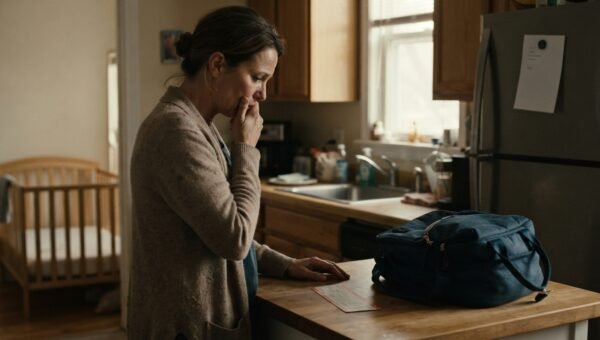
Around ten that night, after the house went silent, I walked into the kitchen to clear the breakfast table. The kids’ shared school tablet, an older Samsung device we kept on the counter for homework apps, was lying next to the fruit bowl. The screen was still lit.
I picked it up to plug it into the charger. Rachel had been using it earlier to look up school bus schedules for her boys. She hadn’t closed the browser.
Her personal email inbox was open on the screen.
Right at the top of the drafts folder was a message dated that afternoon at 3:18 PM. The recipient was an attorney named Mark Vance in downtown Columbus.
The subject line read: *Inquiry regarding standby guardianship and home occupancy in the event of homeowner medical incapacity.*
I tapped the screen. My fingers felt like ice.
The draft read:
*Mr. Vance, following up on our phone consultation. As discussed, my sister Sarah’s mental decline has accelerated following the loss of her spouse, creating an unsafe environment for her minors, Maya (9) and Chloe (7). Attached is the initial medical declaration draft along with her signed authorization granting me temporary standby legal guardianship and power of attorney over the residential property at 1448 Elmwood Drive in the event she requires inpatient placement.*
Below the text was a PDF attachment titled *S_Miller_Authorization_Signed.pdf*.
I opened the file.
It was a standard legal affidavit form. Across the bottom line, above the printed words *Sarah Miller, Legal Guardian and Property Owner*, was a signature.
It was my name. The loops of the *S* and the slant of the *M* were nearly identical to the signature on my driver’s license. But I had never seen that document in my life. She had scanned my real signature from my mortgage refinance papers that I kept in the filing cabinet in my home office.
PART 2
I didn’t scream, and I didn’t wake her up. If my years working the circulation desk at the public library taught me anything, it was that paper and records are quiet, permanent things. Once you make noise, people start destroying the evidence.
I set the tablet down and took pictures of every single screen with my cell phone. I took photos of the drafted email, the lawyer’s email address, the timestamp, and every paragraph of the attached PDF. Then, using the tablet’s browser settings, I forwarded the draft and the attachment directly to my own private work email, deleted the forwarded message from her sent folder, and cleared the trash.
My hands didn’t stop trembling until I walked into my home office and locked the door behind me.
My filing cabinet sat in the corner beneath the window. It had a simple brass push-lock. I kept the small key in a porcelain dish inside my desk drawer. I opened the bottom drawer and pulled out the thick folder labeled *Property & Deed – 1448 Elmwood*.
The documents were out of order.
My husband David and I had kept our closing papers clipped together with heavy black binder clips. The clip on the 2021 mortgage satisfaction letter had been removed. It was lying loose in the folder. Right on top of the deed papers was a stray piece of scrap paper. It was a sheet of ordinary lined notebook paper, filled with repeated attempts at my first initial. A jagged capital *S*, three swooping *S* shapes, and two full attempts at *Sarah Miller*.
She hadn’t just copied it digitally; she had practiced tracing it by hand first.
I sat on the floor with my back against the metal drawers, trying to breathe. My sister had lost her husband, yes. But David had died four years ago. I had grieved him, built a budget, handled my daughters’ tears, paid off the last $14,000 on our mortgage with his modest life insurance payout, and kept our home safe. I was not incapacitated. I was not losing my mind.
Rachel was broke, desperate, and cold-blooded.
The next morning, I acted like nothing had happened. I made scrambled eggs for the kids, packed four lunches, and helped Rachel’s oldest find his missing sneaker. Rachel came into the kitchen around seven-thirty, wearing her floral robe, looking tired and frail.
“Sarah, about last night,” she said softly, pouring herself a cup of coffee. “I’m sorry if I sounded defensive. We’re both just so stressed. Let’s start fresh today, okay?”
“Of course,” I said, handing Chloe her lunchbox without looking Rachel in the eye. “We’re all tired.”
As soon as the kids were dropped off at school and Rachel left in her minivan for an alleged errand, I didn’t go to the library. I drove straight to downtown Columbus, to the county probate court, and then to the office of an estate attorney named Evelyn Reed, whose firm had handled David’s probate four years earlier.
Evelyn saw me at ten o’clock between hearings. She sat across from me in her small, quiet office while I laid my phone on the desk and showed her the screenshots of Rachel’s draft, the forged document, and the practice sheet from my filing cabinet.
Evelyn examined the PDF on my phone screen for a long time. Her expression hardened.
“This is an affidavit of temporary standby guardianship combined with a limited durable power of attorney for residential real estate,” Evelyn said. “If you had suffered an accident or if someone had called adult protective services or emergency services claiming you had a breakdown, and she produced this document with a notary stamp, she could have taken immediate control of your children and your house before a judge ever saw you.”
“Can she get it notarized without me?” I asked, my voice cracking.
“People find unethical mobile notaries every day, Sarah,” Evelyn said bluntly. “Or she could forge the notary stamp entirely. Who is this Mark Vance she was emailing?”
“I don’t know. The name was just on the email draft.”
Evelyn tapped her keyboard, pulling up the state bar directory. “Mark Vance is a real estate and estate planning lawyer. His office is four blocks from here. She hasn’t sent the email yet, which means she was either waiting for another piece of leverage or working up the nerve.”
Evelyn leaned forward. “Here is what we do. We file an immediate notice of revocation of any purported power of attorney with the county recorder, just in case an earlier draft was already signed or filed. Then, we draft a formal, immediate notice to vacate. Your sister is a guest in your home. She has no lease and pays no rent. In Ohio, she has the legal status of a licensee or tenant-at-will depending on how long she’s stayed. But because of the fraud and the danger to your minor children, we will accompany this with a formal cease-and-desist and an emergency trespass warning.”
“I want her out today, Evelyn,” I said. “I cannot sleep under that roof with my girls tonight while she is in the house.”
“Then we do it today,” Evelyn said. “With an officer present.”
PART 3
At two in the afternoon, two Franklin County sheriff’s deputies met me and Evelyn’s paralegal at the curb outside my house.
Rachel’s minivan was parked in the driveway. The living room blinds were cracked open.
I unlocked the front door and walked into the foyer, the two uniformed deputies stepping quietly behind me. The sound of their heavy boots on the hardwood made Rachel step out of the kitchen, holding a mug of tea.
Her face went completely rigid when she saw the uniforms.
“Sarah? What is this?” she asked, her voice instantly high and defensive. “What’s going on?”
“Deputy Higgins is here while you pack your belongings, Rachel,” I said. My voice was surprisingly steady. The trembling from the night before was gone. “You’re leaving my house today.”
“Are you insane?” Rachel shouted, taking a step toward me. “My husband died six weeks ago! My boys are in school! You can’t throw a grieving widow and two children out onto the street! What kind of monster are you?”
Deputy Higgins stepped forward, putting one gloved hand lightly on his belt. “Ma’am, please keep your voice down. The homeowner has revoked your permission to remain on the property.”
“This is my family!” Rachel screamed, looking wildly between the officers. “Sarah is having a breakdown! Look at her! She’s been erratic for weeks, she can’t handle her kids, she asked me to move in to take over the house! I have papers—”
She stopped. The word hung in the air like a dropped plate.
“What papers, Rachel?” I asked quietly.
She clamped her mouth shut. Her chest was heaving.
I pulled two manila folders out of my bag and laid them flat on the kitchen island between us.
The first folder contained printed color copies of her email draft to Mark Vance, the attached guardianship affidavit, and the practice tracing sheet covered in my name. The second folder contained the formal notice to vacate and an official trespass warning prepared by Evelyn Reed.
“I found your draft on the school tablet,” I said. “And I found where you went through my locked filing cabinet to trace my signature from my mortgage deed. You weren’t grieving, Rachel. You were planning.”
Rachel looked at the printed screenshot of her draft. She didn’t cry. The fragile, grieving-sister act vanished in a fraction of a second. Her face set into something ugly and hard.
“You have everything,” she spat at me, her voice dropping to a harsh, venomous whisper. “David left you this house completely free and clear. You have his pension. You work three days a week at a quiet library while my Greg left me with $84,000 in credit card debt and a leased car they were going to repossess! Why should you have a four-bedroom house to yourself when my kids don’t even have their own rooms? You don’t even appreciate it! You just glide through life while I drown!”
“I worked two jobs while David was dying,” I told her, looking directly into her eyes. “I gave up every weekend for three years to keep this house paid off so my daughters would have a roof over their heads. I offered you a safe place to land. I bought your groceries. I washed your boys’ clothes. And you told my seven-year-old child that I was going to be locked in a hospital so you could take my house and my family.”
“You wouldn’t have even known the difference if you had just let me help,” she whispered.
Deputy Higgins stepped between us. “Ma’am, that’s enough. You have one hour to pack your immediate personal belongings, your clothes, and your children’s items. If you are not off the premises by three-thirty, you will be arrested for criminal trespass. Anything you leave behind will have to be retrieved through a scheduled civil standby.”
Rachel stood there for five long seconds, glaring at me with raw, bitter hatred. Then she turned and stormed down the hall toward the guest bedroom.
The next forty minutes were filled with the sound of drawers slamming and hangers scraping against the closet rod. The deputies stood in the hallway, watching her every move. She packed four large suitcases and threw her boys’ backpacks into the back of her minivan.
At ten minutes past three, her phone rang. It was the elementary school letting her know the buses were loading.
“Where am I supposed to go?” she hissed at me from the front door, dragging two heavy duffel bags. “Tell me, Sarah. Where are my boys supposed to sleep tonight?”
“Your mother-in-law has a three-bedroom ranch in Dayton,” I said evenly. “She called me yesterday asking why you hadn’t returned any of her calls about Greg’s estate. I told her you’d be heading her way this afternoon. She is waiting for you.”
Rachel’s face twisted in disgust. Her mother-in-law was the one person who knew Greg’s true financial situation, the one person Rachel couldn’t manipulate with tragic tears.
Without another word, she loaded her bags into the trunk, slammed the hatch, and backed out of my driveway, leaving two dark tire marks on the asphalt.
ENDING
A locksmith arrived at four-fifteen. By five o’clock, every exterior lock on my house had been replaced, including the deadbolts and the garage keypad.
I picked up Maya and Chloe from the after-school program at five-thirty. They noticed the empty guest room the moment we walked through the door.
I sat them down on the living room sofa, pulled them both close to my sides, and told them the simple truth. I told them that Aunt Rachel loved them, but she had made choices that were unsafe for our home, and she had taken Leo and Sam to stay with their grandmother in Dayton.
“Are you going to the hospital, Mom?” Chloe asked, her little hand gripping my sleeve.
“No, sweetheart,” I said, kissing the crown of her head. “I am right here. I will always be right here. Nobody is ever taking me away from you, and nobody is ever taking you away from this house.”
Chloe let out a long, shuddering breath, buried her face in my shoulder, and cried for ten quiet minutes. Maya held my other hand, leaning her weight against my arm.
The next week was heavy, but the air in the house was clean again.
Evelyn Reed contacted attorney Mark Vance’s office. When Vance saw the forged documents and the evidence of the unauthorized access to my records, he immediately withdrew any communication with Rachel and confirmed in writing that he had never represented her and had never accepted any filings. My name and my home deed remained untouched and secure at the county recorder’s office.
Rachel tried calling three times from different numbers over the following month. She left voicemails ranging from hysterical sobbing to accusations that I had ruined her children’s lives. I saved every recording on a flash drive, documented the dates, and kept my phone on block. I never responded.
Last night, I was putting away the laundry in the hallway linen closet. On the top shelf, pushed all the way to the back behind the spare pillows, I found a small spiral notebook with Chloe’s name written on the cover.
I opened it. Inside were three pages of my own handwriting from old grocery lists and school permission slips, carefully glued onto the paper. Below them were dozens of shaky, traced copies of my signature, where Rachel had sat in my quiet house while I was at work, practicing how to become me.
I walked into the kitchen, tore the pages into tiny shreds, and dropped them into the trash can.
Then I walked into the living room, sat on the rug between my two daughters, and helped them finish their fourth-grade puzzle in the quiet, safe warmth of my own home.