PART 1
My son-in-law, Greg, used to lean against my kitchen counter, watch me fold a paper receipt from the grocery store into fourths, and shake his head. “Nobody needs a paper trail for milk and paper towels, Evelyn,” he’d say. He had that small, dismissive grin he always put on when he wanted to tell me I was old-fashioned without coming right out and saying it.
I never argued with him. I was sixty-four, my husband had been gone eight years, and my daughter, Sarah, loved him.
That was enough for me to keep my mouth shut. Whenever I bought anything, from a ten-dollar toaster to a box of nails, the receipt went into an accordion file in the bottom drawer of my oak desk. It was just how my husband and I had lived. We worked hard for what we had, and we kept track of it.
Then six months ago, Sarah got sick. It was sudden, brutal, and fast. Four months after her first doctor’s visit, I was sitting in a cemetery chapel holding a folded program with her picture on the front.
I could barely put one foot in front of the other. For the first five weeks after the funeral, I stayed in my downstairs bedroom in the Craftsman home on Maple Street with the blinds drawn. Sarah and I had bought that house together seven years ago, two full years before she even met Greg.
I sold my old ranch, put $110,000 into the down payment, and we took out a joint mortgage for the rest. When Greg married Sarah four years ago, he moved into the master bedroom upstairs. I kept the downstairs suite, helped with the cooking, and paid half of every utility bill and mortgage payment on the first of each month.
I thought Greg and I were grieving together, even if we did it in different rooms.
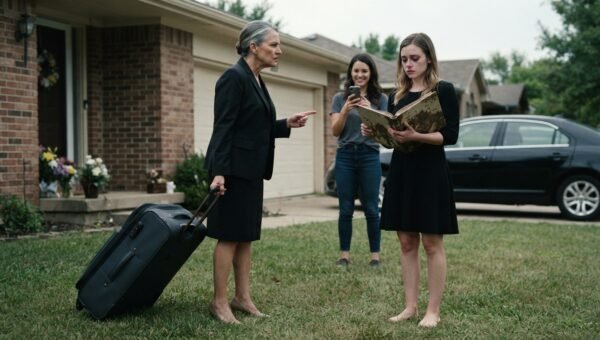
Then came a rainy Tuesday morning. I came up the basement stairs with a basket of laundry and found a white legal envelope sitting flat in the center of the kitchen island. Inside was a formal notice printed from a real estate template. It said I had thirty days to vacate the premises.
Greg was standing by the sink, rinsing his travel mug.
“Greg, what is this?” My voice shook.
He didn’t turn around right away. He dried the mug with a paper towel, set it on the counter, and turned with his arms crossed. “It’s time, Evelyn.
Sarah’s gone. As her surviving spouse, the house passes to me. You can’t stay here forever, and I need a fresh start. You’ve got savings. It makes sense for you to find a quiet senior apartment.”
“This house isn’t just Sarah’s,” I told him, the blood rushing hot into my face. “I paid for more than a third of it in cash. My name is on the mortgage.”
“Your name is on a note,” he said coolly, tapping his finger against the counter. “Sarah was the sole deed holder on record. She took care of the legal side. Everything of hers is mine now. You don’t have an ownership claim, Evelyn. You’re a tenant.”
He picked up his keys, walked out the back door, and left me standing in the kitchen with thirty days ticking down over my head.
I couldn’t afford a high-priced lawyer, and my mind was too clouded with grief to think straight.
That evening, I sat on the floor of my bedroom surrounded by plastic storage bins, trying to figure out how much a moving truck and a deposit on an apartment would cost. I opened the bottom drawer of the desk to dig out receipts from the last two years to calculate moving expenses.
Way in the back, behind the tax folders, my fingers brushed against a thick, heavy cardstock envelope. It was the blue closing packet from the title company from seven years ago, the day Sarah and I sat side by side at a conference table with pens in our hands.
I pulled it into my lap and untied the red string. I flipped past the survey, past the escrow disclosures, past the insurance certificates.
Near the back was a document titled Survivorship Warranty Deed.
Sarah’s signature was on the right. Mine was on the left. The notary seal from the closing officer was stamped in blue ink between our names. Plain as day, the typed text named both of us as joint tenants with full right of survivorship.
According to the date on the stamp, we signed it on October 14. But down in the bottom right corner, where the county recorder’s official bar-coded sticker was supposed to be placed, the white space was completely blank.
It had never been stamped by the county.
The next morning, I confronted Greg before he left for work. I laid the blue paper right on top of his briefcase. “Look at this. Sarah and I signed as joint owners. If she passed, the whole house belongs to me.”
Greg barely glanced at it. He let out a dry, short laugh and pushed the paper aside with his thumb. “Evelyn, you can find whatever unfiled scrap of paper you want in those dusty boxes. It doesn’t mean a damn thing. The county recorder’s database lists Sarah as sole owner under a quitclaim deed. That’s the public record. My lawyer checked it yesterday. You’re trespassing after the thirty-first.”
He grabbed his bag and shut the door behind him.
At nine o’clock, I took the bus downtown to the County Clerk and Recorder’s Office. I took a numbered ticket and waited on a hard wooden bench until number 42 was called.
I walked up to Window 3. A woman with silver-framed glasses and a name tag that said “Marta” looked up. “How can I help you today?”
“I need to check the title history on my home,” I said, sliding the original blue-backed document under the glass partition. “My son-in-law says I don’t own it. But I have this.”
Marta adjusted her glasses, pulled the document toward her, and turned the pages. When she saw the blank corner on the warranty deed, her brow furrowed. “That’s strange. The title company should have delivered this for recording immediately after closing.”
She turned to her computer terminal and began typing. For three minutes, the only sound was the clatter of her keyboard.
Then she stopped. Her fingers stayed frozen over the keys. She leaned in closer to the monitor, tilted her head, and pulled up another document on her screen.
“Ma’am,” Marta said, her voice dropping very quiet. “Did you sign a quitclaim deed on this property three years ago?”
“No,” I said. “Never.”
Marta didn’t answer. She picked up her desk phone, dialed three digits, and looked straight at me through the partition. “Sheryl? Can you step out to Station 3 right now? I have an active title conflict, and you need to see this signature.”
PART 2
The supervisor, a tall woman named Sheryl with a navy blazer and tired eyes, walked up behind Marta’s chair. Marta pointed to the split screen on her computer monitor, tapping her fingernail against the glass.
“Look at the recording date on the quitclaim,” Marta murmured. “June of three years ago. Then look at the original unrecorded warranty deed this woman just brought in.”
Sheryl leaned down, her hand resting on the back of Marta’s chair. She didn’t say a word for nearly two full minutes. She looked at the screen, then she picked up my original blue closing packet from the counter and held the signature page up to the fluorescent light. She examined the notary stamp, the dry-embossed seal pressed into the paper, and the wet blue ink of my signature beside Sarah’s.
Then Sheryl looked at me. “Mrs. Miller, you’re saying you never executed a deed transferring your interest to your daughter?”
“I never signed anything like that,” I told her. “Sarah and I bought this house together so neither of us would ever have to worry about a roof over our heads. I paid $110,000 from the sale of my old house. Why would I give that away?”
“Take a seat right there against the wall, Mrs. Miller,” Sheryl said gently. “Give us twenty minutes. I’m pulling the microfiche scan and the notary journal logs for that recording number.”
I sat on the wooden bench while the fluorescent lights hummed above me. My hands were shaking so hard I had to tuck them under my thighs.
Three years ago. Three years ago was the summer Sarah and Greg had been married for one year. Greg had quit his job at the regional logistics firm to start an independent freight brokerage from our dining room table. He needed operating capital. Sarah had mentioned once, during Sunday dinner, that Greg was trying to get a home equity line of credit to finance a company truck and software licenses. I had told them both plainly that I wouldn’t allow a second lien on the house. We owned it outright except for a small $60,000 primary balance, and I wanted it kept safe. The conversation had ended right there. Greg had smiled, apologized for bringing business to the dinner table, and dropped it. Or so I had thought.
When Sheryl opened the side door to the office and waved me into a small conference room, she had a manila folder in her hands. She laid two printed pages side by side on the laminate table.
“This is the quitclaim deed recorded three years ago,” Sheryl said, pointing to the left page. “It purports to surrender all your right, title, and interest in the Maple Street property to Sarah Miller as sole owner. It bears your signature.”
I looked down. There was my name, written in slanted cursive: *Evelyn Miller*.
At first glance, it looked like my handwriting. But as I leaned closer, my stomach tightened. The capital *E* looped backward at the top. I never loop my capital letters; my mother was a schoolteacher who drilled strict Palmer method penmanship into me until my fingers cramped. More than that, beneath my name was a notary block stamped by a man named Donald Vance, commissioned in our county.
Sheryl tapped the right page. “This is the notary’s public filing record. Donald Vance was Greg Vance’s first cousin. His notary commission was permanently revoked by the Secretary of State eighteen months ago for multiple fraudulent acknowledgments on vehicle titles and private loans.”
The room felt cold. “Greg’s cousin?”
“Yes,” Sheryl said. “And look at the deed you brought in today. Seven years ago, the closing company had an administrative courier failure. They recorded the mortgage with the lender, but through a clerical oversight, they never physically brought this specific survivorship deed to the recorder’s desk. It sat in their closed file, and they sent you the duplicate original. Because this joint deed was never indexed in our book, the property remained in a title limbo on the public record, showing only the mortgage note.”
“What does that mean for me?” I asked, my voice barely a whisper. “Greg says I have to be out in three weeks.”
“It means two things,” Sheryl said firmly. “First, a forged deed is void from the beginning. It confers zero legal rights. Second, because your original deed was fully executed, delivered, and notarized on October 14 seven years ago, your joint ownership was legally created between you and Sarah the moment those papers were signed, regardless of the courier error. And with a right of survivorship, the moment Sarah passed, her interest transferred directly to you. Not to her estate. Not to her husband.”
Sheryl pulled a business card from her blazer pocket and wrote a name and phone number on the back. “This is Dan Alvarez. He handles real estate title litigation and fraud referrals for our county legal aid clinic. Walk this folder straight over to his office on Fourth Street. Do not sign anything Greg gives you. Do not pack a single box.”
I took the card, clutched my blue folder against my chest, and walked out into the cold afternoon air.
PART 3
Dan Alvarez was a sharp, direct man in his late forties with a cluttered desk and rolled-up sleeves. He looked at the paperwork for twenty minutes, made two phone calls, and leaned back in his chair.
“Mrs. Miller,” he said, “your son-in-law didn’t just try to evict you. He committed felony deed fraud to secure a $120,000 equity line against this property three years ago. When Sarah died, he knew the loan would come due or trigger an audit if ownership transferred. If you stayed on the title, his fraudulent lien would be exposed to the bank. He needed you out of the house, and he needed you to abandon your claim so he could refinance the entire parcel into his name alone.”
“Did Sarah know?” The question tore out of my throat before I could stop it. That was the knife twisting in my ribs. Had my little girl, my Sarah, helped him rob me?
Dan looked at the signature page again. He pointed to the bottom of the forged quitclaim. “Look at the grantee signature accepting the transfer. Sarah’s signature isn’t here. Only Greg’s cousin’s notary stamp and the borrower authorization. Sarah’s personal bank accounts from that year show no transfers from that equity line. Every dollar went into Vance Logistics LLC, Greg’s corporate account. I would bet my license Sarah never saw this document.”
Tears hit my cheeks then, hot and heavy, but for the first time in six months, they weren’t tears of defeat. Sarah hadn’t betrayed me. She had been blinded by a charming, reckless man who treated everyone around him like a stepping stone.
“What do we do?” I wiped my face with a tissue from my purse.
“We file an emergency quiet-title action, we record an affidavit of forged instrument with the county recorder, and we serve Mr. Vance with a formal revocation of his license to occupy the home,” Dan said. “He doesn’t own this house, Evelyn. You do. 100 percent of it.”
Two days later, on a Friday afternoon at five o’clock, Greg came home.
I heard his truck pull into the gravel driveway. I was sitting at the kitchen table. The accordion file was open on the floor beside me. Spread across the table were three documents: the county recorder’s certified title history, a copy of the felony fraud referral Dan Alvarez had delivered to the district attorney’s economic crimes unit that morning, and a formal eviction notice served by the county sheriff’s civil deputy.
Greg walked in, tossed his sunglasses on the counter, and saw the papers. He stopped. His smirk flickered, but he tried to hold onto it.
“I told you to stop digging through your old garbage, Evelyn,” he said, walking toward the refrigerator. “It’s not going to change anything. You’re just making this harder on yourself.”
“Sit down, Greg,” I said.
My voice wasn’t loud. It wasn’t shaking. It had the steady, iron tone my father used to use when he caught someone lying to his face.
Greg paused, his hand on the refrigerator door. He turned around slowly. “Excuse me?”
“Sit down,” I repeated.
He walked over, annoyed, and pulled out the chair across from me. He dropped into it with an exaggerated sigh. “What is this?”
I slid the top paper across the table. It was the quitclaim deed with his cousin Donald’s revoked notary seal circled in red ink.
“Donald’s commission was pulled eighteen months ago,” I said plainly. “The county has the logs. The district attorney has Donald’s sworn deposition from his other fraud cases. You forged my name to steal $120,000 from the equity Sarah and I built. You thought Sarah dying gave you a clean slate to push me out before the bank discovered the forged title.”
Greg didn’t speak. The color drained out of his cheeks so fast his skin turned the color of damp cement. His mouth opened slightly, but no sound came out.
“Sarah never signed this,” I said, leaning forward. “You lied to her, you lied to me, and you tried to throw me out on the street to cover your debt.”
“Evelyn, look,” he stammered, his confident posture collapsing. His shoulders slumped forward. “The business was going under. I was going to pay the equity line back before anyone noticed. Sarah was sick, the medical bills were piling up, and I panicked.”
“The equity loan was taken out three years ago,” I said. “Sarah wasn’t sick then. Don’t you dare put your theft on my daughter’s memory.”
He reached out a hand, his fingers trembling. “Evelyn, please. If the bank calls the note, I’m bankrupt. If the DA files charges, I’ll lose everything. We’re family. Sarah wouldn’t want you to ruin my life.”
“You weren’t thinking about family when you put a thirty-day notice on my kitchen island,” I told him.
I pointed to the final document on the table.
“You have forty-eight hours to pack your clothes and your personal belongings,” I said. “The locks will be changed on Sunday at noon. If you step onto this porch after that, the sheriff will arrest you. My lawyer will handle the bank and the district attorney. You talk to Dan Alvarez from now on.”
Greg looked at me. For four years, he had treated me like a harmless old woman who just took up space in the downstairs bedroom. He had never seen me look back at him without flinching.
He didn’t say another word. He stood up, left his briefcase on the floor, walked out to his truck, and drove away.
ENDING
The sheriff’s deputy arrived on Sunday at eleven in the morning to oversee the final removal of Greg’s things. Greg didn’t even show up himself; he sent two of his freight buddies with a rented box truck. They loaded up his toolboxes, his clothes, and his big-screen television. By one o’clock, the driveway was empty.
A locksmith from town named Pete came out and changed every deadbolt on the exterior doors. He handed me four shiny brass keys on a steel ring. When I closed the heavy front door and turned the deadbolt, the solid mechanical *click* echoed down the quiet hallway.
For the first time in six months, the house felt peaceful.
The legal process took nearly another year to untangle completely. Dan Alvarez worked with the title insurance underwriter and the county court. Because the original closing company had committed an administrative failure by losing the joint warranty deed, their errors and omissions insurance was forced to settle the $120,000 fraudulent equity line that Greg had secured, clearing the cloud from my property. Greg’s cousin Donald pleaded guilty to two felony counts of falsifying public records and received probation and restitution orders. Greg avoided state prison by entering a deferred prosecution program that required him to surrender all claims against Sarah’s estate and pay $34,000 in restitution to the title insurer.
I didn’t care about his restitution. I didn’t care about his debt. I only cared that his name was wiped clean from every deed, every ledger, and every tax bill connected to this house.
Last week, the final corrected deed arrived from the county recorder in an official manila envelope.
I walked it into the kitchen and sat at the oak table where Sarah and I used to drink our morning coffee. In the top right corner of the parchment, clear and permanent, was the dark county seal, stamped with the current year and the words: *Sole Owner: Evelyn Miller, Surviving Joint Tenant.*
I ran my thumb over the raised seal.
Then I stood up, walked into the living room, and opened the bottom drawer of my desk. I pulled out the old accordion file. I filed the certified deed right in front, behind the original closing packet, next to the stack of grocery receipts Greg had spent four years mocking.
He thought paper was worthless. He thought old women were easy to erase.
I slid the drawer shut, heard the brass latch catch, and turned around to look out the window at the garden Sarah and I had planted together. The house was mine. It had always been ours.