PART 1
The cafeteria smelled like damp wool coats, floor wax, and buttered popcorn from the booster club stand near the gym doors. We were sitting in the fourth row on metal folding chairs that had been set up too close together, waiting for our seven-year-old granddaughter, Chloe, to walk out on stage dressed as a daisy.
My husband of twenty-nine years, David, leaned toward me so his shoulder brushed mine.
For a second, I thought he was going to tell me he couldn’t see past the tall man with the video camera in front of us. Instead, he kept his eyes on the paper program resting on his knees.
“Sarah,” he whispered, his voice so quiet and flat that nobody sitting around us even glanced over. “I’m leaving. I want a divorce.”
I looked at his profile. The line of his jaw had softened over the years, and he had the same neat haircut he had gotten every four weeks since we were in our thirties. There was no tremor in his fingers.
“What are you talking about?” I whispered back. My chest tightened until I couldn’t pull air all the way down into my lungs.
“Keep your voice down,” he said softly, smoothing the crease on his trousers. “Please don’t make tonight about us.”
Before I could get another word past the lump in my throat, the stage lights buzzed and went up.
Forty small children in paper flowers and bumblebee wings marched out to the center of the stage, and the parents around us started clapping and cheering. David joined in, applauding politely, his face completely composed.
I sat there for forty-five minutes with my hands folded in my lap, staring at the stage while children sang off-key songs about sunshine and spring rain. Every time Chloe stepped forward and waved toward our row, David smiled and waved back. I tried to lift my hand, but my fingers felt like frozen weights. My mind kept looping over the last twenty-nine years, searching for the crack in our floorboards that I had somehow managed to miss. We had disagreements like anyone else, but we had eaten dinner together at our kitchen table the night before. He had kissed my temple on his way out the door this morning.
When the show ended, David helped our daughter, Megan, get Chloe out of her yellow felt petals.
He shook our son-in-law Brian’s hand in the hallway, said Chloe was the brightest daisy up there, and walked me out to the parking lot under the chilly autumn drizzle.
He unlocked the car, held the door for me, and drove the five miles back to our split-level house on Maple Street as if we had just come from a routine grocery run. His blinker clicked rhythmically at every turn.
Inside the kitchen, while I stood shivering by the counter with my coat still on, he set his keys in the ceramic bowl by the microwave.
“I signed a short-term lease on a furnished apartment near the bypass,” he said, looking straight at me. “I want everything simple, Sarah. No long drawn-out mess. We can split our liquid accounts fifty-fifty. I’ll sign the house over to you, and I won’t touch your pension from the school district. Clean break.”
“Is there someone else?” My voice sounded thin, like dry paper.
“No,” he said, not blinking. “There’s no one else. We just grew apart. It happens.”
He sounded so tired, so matter-of-fact, that I almost believed him. He walked upstairs, packed two suitcases he had already laid out in the guest bedroom, and walked out into the dark.
I barely slept. I sat on the living room sofa until dawn broke gray through the blinds, trying to make sense of how a life built over three decades could dissolve in forty-five minutes of children singing.
Around eight in the morning, I walked out to the garage to get a bottle of club soda from the spare fridge and saw Chloe’s costume bag sitting on the back seat of my sedan. Megan had tossed it in when we loaded up after the performance so it wouldn’t get crushed by Brian’s work gear.
I grabbed the bag, got into the car, and drove over to Megan and Brian’s house on Oak Ridge. It was a three-bedroom colonial with an oversized deck and two late-model SUVs parked out front. Brian worked as a regional sales manager for a commercial supply company, and Megan stayed home with Chloe, running an online craft shop that barely broke even. Over the last two years, they had remodeled their kitchen with quartz countertops and put in an inground pool that seemed far beyond their bracket, but David had always told me not to stick my nose into the kids’ finances.
As I pulled onto their street, I let my foot off the gas.
Parked in the driveway, tucked behind Brian’s black pickup truck, was David’s silver sedan.
The exhaust pipe was cold, meaning he had been there for a while. A sudden chill settled into the base of my neck. If David had left me for another woman, why was his car at our daughter’s house before eight-thirty in the morning?
I walked up the front steps with the costume bag tucked under my arm. The heavy front door was shut, but the storm door wasn’t latched, and the side window by the porch was open two inches to let in the cool morning air.
I was about to knock when Megan’s voice came through the screen, sharp and frantic.
“Dad, Mom can never know why you’re really leaving,” she said.
A heavy silence followed, and then I heard Brian speak up from the kitchen table.
“She’s going to find out anyway,” Brian said, his voice hard and unapologetic. “She’ll find out the second the bank calls.”
PART 2
The screen door felt cold against my forehead. I stood there, paralyzed, holding Chloe’s bag of yellow felt against my ribs.
“Shut up, Brian,” David said from inside. His tone wasn’t gentle like it had been in the auditorium. It was raw, strained, stripped of all the neat composure he had shown me twelve hours earlier. “I signed over the house. Once she has the deed clear in her name and the decree is filed, the liability is detached from her. That’s why we’re doing the uncontested filing tomorrow.”
“You think a quitclaim deed shields a marital asset when the personal guarantee was signed during the marriage?” Brian asked. The scrape of a coffee mug against the granite counter came through clearly. “David, your name is on the three hundred and fifty thousand dollar commercial note for my supply warehouse. The lender didn’t just take the inventory as collateral. They took your signature, and your primary residence was listed on the personal financial statement you submitted to the underwriter.”
My hands started shaking so violently that the plastic zipper on Chloe’s bag rattled. I pressed it against my coat to keep it quiet.
“You told me the expansion was backed by purchase orders,” David said, his voice rising, ragged at the edges. “You said you had two hospital contracts locked in for the spring! I co-signed because Megan was crying at our kitchen table, telling me you were going to lose the house if you didn’t secure the bridge financing.”
“Well, the hospital contracts fell through three weeks ago,” Brian snapped. “The supplier is demanding full settlement by the end of next month. When they call the note and I default, they’re coming after the guarantor. That’s you. And if they pull your records, they’ll attach a lien to whatever you own.”
“That’s why I’m walking away with nothing,” David said. “If I take no assets, if the house belongs solely to Sarah through a clean divorce settlement before the default is registered, her home stays protected. She worked thirty-two years in the public school system for that house. She cannot lose the roof over her head because I was stupid enough to trust you.”
“Dad,” Megan sobbed, her voice muffled like she had her face in her hands. “If she finds out, she’ll hate Brian. She’ll never look at me the same way. We have Chloe to think about.”
“She can hate me,” David said quietly. “She can think I fell out of love with her. She can spend the rest of her life believing I’m a selfish bastard who got tired of her. But she will have her home, and she’ll have her pension.”
I didn’t knock. I couldn’t. I backed down the porch steps one by one, watching my boots on the wet wood, terrified that a single creak would give me away. I got into my car, set Chloe’s costume bag on the passenger seat, and drove three blocks away before I had to pull over to the curb because I couldn’t see the road through my tears.
David hadn’t stopped loving me. He hadn’t fallen out of love. He was committing financial and emotional suicide to clean up a catastrophic mess Brian had built, all while Megan helped him keep me in the dark to protect her own husband’s skin.
David thought he was playing the heroic martyr. But he was an engineer, not a lawyer. He thought a fast divorce and a quitclaim deed was an iron wall. What he didn’t realize, and what Brian clearly suspected, was that transferring property right before an impending default looks exactly like what it is to a bank: a fraudulent conveyance. The court wouldn’t protect me. The lenders would tear through a hasty divorce decree like tissue paper, leave David bankrupt, pull our home into foreclosure, and leave me with no legal standing to fight it because I would have signed away my rights in an uncontested filing.
I sat by the curb for twenty minutes until my breathing slowed down. Then I pulled out my phone and dialed Eleanor Vance.
Eleanor was a retired civil litigator and an old friend from our book club. She had spent thirty-five years dealing with property law, contract disputes, and commercial defaults in our county.
“Sarah?” Eleanor answered on the third ring. “It’s early. Is everything alright?”
“No,” I said, my voice steadying. “I need you to look at a personal guarantee on a commercial loan, and I need to know how to stop my husband from destroying our lives before noon.”
PART 3
Eleanor met me in her home office forty minutes later. She made a pot of black coffee, sat me across from her heavy oak desk, and listened without interrupting while I laid out every single word I had heard through Megan’s window.
“David is an idiot,” Eleanor said immediately, setting her glasses down on a legal pad. “A well-meaning, terrified idiot. If he transfers that house to you for zero consideration right before a three hundred and fifty thousand dollar personal guarantee defaults, the lender’s attorneys will file an action under the Uniform Voidable Transactions Act within ninety days. They will void the transfer, claim you were complicit in hiding assets, and attach the judgment to the property anyway. He’s not shielding you, Sarah. He’s walking both of you straight into an ambush.”
“What about Brian?” I asked. “Brian knew the note was going to be called.”
“Brian is using your husband as a human shield,” Eleanor said bluntly. “He probably structured his corporate entity to limit his own personal exposure while David signed an unconditional personal guarantee. Lenders love retired homeowners with paid-off equity. They don’t waste time chasing an LLC with empty bank accounts. They go straight for the guarantor with the deed.”
She slid a legal pad across the desk toward me.
“You have two choices,” Eleanor said. “You can let David sign those divorce papers tomorrow, watch the dominoes fall, and hire a bankruptcy attorney when the process server knocks on your door in January. Or you can pull the pin on the grenade right now, on your terms.”
“What does that mean?”
“It means we draft an immediate notice of legal representation, freeze any transfer of marital property, and demand a full accounting of Brian’s company books before the sun sets today,” Eleanor replied. “You tell David you know everything. And you make Brian look you in the eye while you do it.”
At two o’clock that afternoon, I drove back to Megan and Brian’s house. David’s car was still there. Eleanor followed in her own sedan, parking at the curb.
I walked up the front steps, pushed open the storm door, and turned the knob. The door was unlocked.
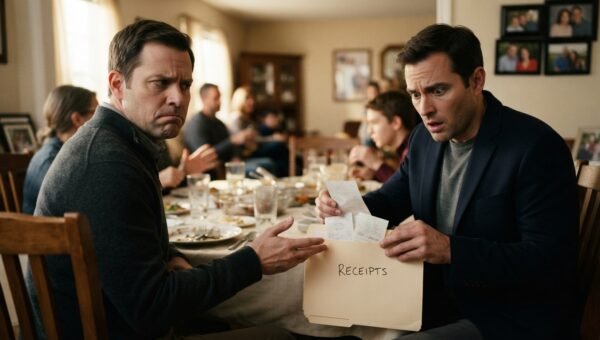
David, Megan, and Brian were all sitting around the kitchen island. A stack of Manila folders and printed divorce forms lay spread across the marble between two empty coffee cups. David was holding a blue pen.
When the front door clicked shut behind Eleanor and me, all three of them froze.
Megan went pale instantly. “Mom? What are you doing here?”
David set the pen down on the counter, his jaw tightening as he slipped back into the calm, distant mask he had worn at the school play. “Sarah, we agreed to handle this privately. I told you I’d have my lawyer deliver the papers tomorrow.”
“You don’t have a lawyer, David,” I said, walking into the kitchen and stopping at the edge of the island. “You printed those forms off the county clerk’s website this morning.”
David blinked, caught completely off balance. “Sarah, please. Go home. We can talk later.”
“I’m not going home,” I said. “And you’re not signing a quitclaim deed to protect me from Brian’s three hundred and fifty thousand dollar default.”
The color drained completely from David’s face. He stood up so fast his chair screeched against the hardwood.
Brian didn’t stand up. He crossed his arms over his chest, his eyes darting toward Eleanor, who had stepped into the kitchen behind me holding a leather briefcase.
“Who is this?” Brian demanded, his voice defensive.
“This is Eleanor Vance,” I said. “She’s my attorney. And she’s here to explain to David why your little plan to dump your commercial loan onto our marriage is over.”
“Mom, stop!” Megan cried out, tears already spilling down her cheeks. “Dad was just trying to help us! We’re going to lose everything if the supplier sues!”
“You’re going to lose your swimming pool, Megan,” I said, looking directly at my daughter. “Your father and I were about to lose the house we built over twenty-nine years because you stood by and let your husband use his father-in-law as collateral.”
David stepped toward me, his hands shaking, the cold mask finally shattering completely. “Sarah, I had to. The bank was going to call the note. If I gave you the house through the divorce, it was supposed to be yours. Brian said if I wasn’t an owner on the deed, they couldn’t touch it.”
“Brian lied to you, David,” Eleanor said from the doorway. Her voice was cool, precise, and carried the weight of four decades in courtroom trenches. “Under state law, a transfer of real property for nominal consideration within one year of insolvency is presumed fraudulent. The lender would have overturned the deed in six weeks. You wouldn’t have saved Sarah. You would have left her with no legal representation and no joint defense when the foreclosure notice arrived.”
David turned slowly to look at Brian. His face had gone from pale to an ashen, sick gray.
“You knew that?” David asked, his voice barely above a whisper. “You knew they could still take the house?”
Brian looked down at the granite island, refusing to meet David’s eyes. “My corporate counsel said it was a gray area. We had to try something.”
“It’s not a gray area,” Eleanor said sharply. “It’s an open-and-shut voidable transfer. And if Sarah files a fraud complaint regarding the execution of that guarantee, your corporate shield won’t protect you from personal discovery.”
ENDING
The silence in that kitchen was absolute. The only sound was Megan softly crying into a paper towel.
David didn’t look at Brian again. He didn’t look at Megan. He looked at me, his shoulders slumping as if all the air had been kicked out of his chest. The man who had walked out of our home twenty-four hours earlier trying to carry the world on his own back looked completely broken.
“Sarah,” he said, tears finally welling in his eyes. “I’m so sorry. I thought I was fixing it. I thought if I took the blame, if you just thought I was a bad husband, you wouldn’t have to suffer for what I did.”
“You don’t get to decide what I suffer for, David,” I said, keeping my voice steady even though my heart was pounding against my ribs. “We’ve been married for twenty-nine years. You don’t hand me a divorce at our granddaughter’s school play and call it protection. That wasn’t courage. That was cowardice.”
He lowered his head and didn’t offer a single word of defense.
We didn’t file the uncontested divorce papers. Eleanor took over immediately.
She contacted the commercial lender before Brian could trigger a disorderly default. Over the next three weeks, she forced a structured liquidation of Brian’s commercial equipment, his inventory, and the warehouse lease. It wasn’t clean, and it wasn’t painless. Brian had to sell his late-model pickup truck, Megan had to sell her luxury SUV, and they were forced to take out a high-interest second mortgage on their own house to cover the remaining balance of the commercial shortfall.
David didn’t escape completely untouched. We had to liquidate forty-eight thousand dollars from our joint savings to settle the personal guarantee release with the lender’s attorneys, ensuring that our house on Maple Street remained unencumbered and fully protected under an ironclad settlement agreement.
The money hurt, but the house was ours.
David moved into the spare bedroom on Maple Street when we got home that evening. He didn’t ask to come back to our bed, and I didn’t invite him. For the first two months, our house felt like a museum where two strangers were afraid to touch the exhibits. We ate our meals in quiet, polite shifts.
Trust isn’t a light switch that flips back on just because the disaster was averted. David had been willing to throw away our entire life together rather than sit down with me, admit he had made a catastrophic financial mistake, and face the consequences as partners. He had treated me like a dependent child who needed to be shielded from the truth, instead of the woman who had stood beside him through thirty years of life.
It took six months of difficult, honest conversations with a family counselor before we could sit in the living room without the ghost of that cafeteria conversation hanging between us. He had to learn how to speak when he was terrified, and I had to learn how to look at him without seeing the man who had abandoned me during a children’s play.
Our relationship with Megan and Brian changed permanently. Brian doesn’t come to our house anymore. When we see Chloe, we pick her up from school ourselves, or Megan brings her over for Sunday afternoons while Brian stays behind. Megan tried to apologize a few months after the settlement, crying at our kitchen table just like she had when she convinced David to sign the loan.
I poured her a cup of tea, handed her a napkin, and told her the truth.
“I forgive you because you’re my daughter,” I told her quietly. “But the bank accounts are closed, the favors are finished, and your father will never sign his name to another piece of paper for you as long as he lives.”
David was standing by the sink when I said it. He didn’t argue. He just nodded and looked out the window at the yard we had worked thirty years to keep.