PART 1
Ruth knocked at eight-ten every morning, give or take thirty seconds. I could set the kitchen clock by the rattle of her knuckles against the screen door.
“Clara? Just heading up to Miller’s. You need butter? That young fella got fresh sweet corn off the truck if you want two ears.”
It was always something small like that. A loaf of rye, a quart of whole milk, or just an extra pair of eyes looking across my porch rail to make sure I was dressed and vertical.
I am fifty-four years old, divorced four years, and I work from home doing medical billing for a regional clinic in Fort Wayne. When I bought the little yellow cottage on Elm Street, the neighbors told me Ruth had lived in the brick ranch next door since 1971. Her husband, Arthur, passed away six years ago. Her son lived two hours south in Bloomington.
At first, I thought she was just an intensely lonely seventy-year-old widow looking for an anchor. Sometimes she stayed on the top step for three minutes, clutching her canvas tote bag, smiling that tight, cautious grandmother smile. If I invited her in, she always declined. She never crossed the sill. She would only hand over whatever small thing she had picked up the day before, take my list if I had one, and walk back across the strip of lawn between our driveways with her small, shuffling gait.
This went on five days a week for six months straight.
Then came a Monday in late September.
At eight-ten, the porch was quiet. At eight-fifteen, the milk truck rattled down the street, but no knuckles hit my screen. By nine o’clock, I caught myself looking out the bay window every time an engine slowed. By ten-thirty, my screen door still had not moved. I told myself she had an early dental appointment or slept in. People Ruth’s age have off mornings.
By noon, the unease got the better of me. The sun was high, beating down on her concrete drive, and her shades were still pulled down tight. Her little silver sedan sat under the carport, completely dry from the morning mist.
I walked across the grass and stepped onto her back patio. I tapped the wooden doorframe first. Nothing. I tried the handle. The latch was unlocked.
“Ruth?” I pushed the door inward an inch. “It’s Clara from next door.”
A weak scrape answered from somewhere near the stove.
I pushed the door open all the way and walked into the kitchen.
Ruth was sitting flat on the yellow linoleum floor between the refrigerator and the counter, her back wedged against the base cabinet. Her left knee was pulled up, and her navy house slippers were kicked off near the trash can. Right beside her right hip, a heavy ceramic coffee mug lay shattered in three large pieces, cold coffee puddled across the tiles.
“Ruth, oh lord,” I gasped, dropping to my knees beside her. “Did you fall? Can you move?”
Her face was chalky, her thin silver hair sticking to her forehead with cold sweat. But the moment my hand touched her shoulder, she pulled back. She did not want me near her.
“I’m fine,” she whispered, her voice rough and dry. “Just slipped on the rag. I didn’t break nothing. Do not call the rescue squad, Clara. Don’t you dare call an ambulance.”
“Ruth, you have been down here since breakfast. You are shaking.”
“I am not hurt,” she insisted, her breath hitching. “Help me get my feet under the cabinet. Just pull on my forearms.”
I took her wrists and helped leverage her up. She was light as paper, but her legs were stiff from hours on the cold linoleum. I guided her toward the sturdy oak chair at the dinette table. She gripped the edge of the vinyl placemat, her knuckles turning white, staring at the floor as if she could not bear to look me in the eye.
“I will get you some water and clean up the mug,” I said, turning to the sink.
That was when I saw the wall beside the refrigerator.
Hanging on a brass hook was a standard bank calendar from the local savings and loan. The big square grid for September was completely filled in with pencil. But it was not doctor appointments or church potlucks.
Every single weekday morning, right in the center of the box, my name was written in small, neat cursive: *Clara.*
Beside every *Clara*, there was a tiny, distinct penciled mark. On the days I had answered the door right away, there was a small circle. On two days in August when I had been away visiting my sister in Michigan, there was a double line. Beneath the names, in microscopic shorthand, she had logged times: *8:11. 8:10. 8:12. Green sweater. Red car left at 10.*
Six months of my life, written down in a dead woman’s hand.
My stomach dropped into my shoes. A cold chill ran right up the back of my neck.
“Ruth,” I said slowly, pointing at the wall. “What on earth is this?”
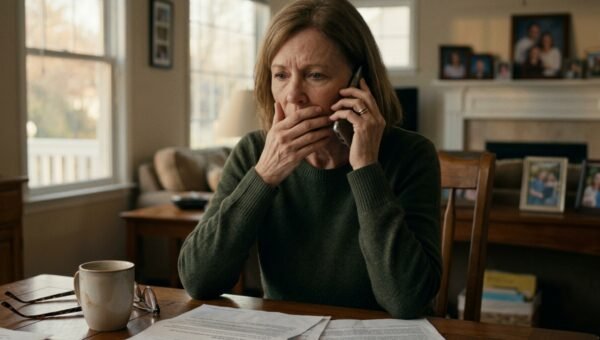
She looked up, saw where my finger was pointed, and her face crumpled completely. She buried her face in her hands and began to sob, her frail shoulders shaking violently against the vinyl seat.
“Call David,” she wept, unable to look at me. “His number is taped to the side of the fridge. Please just call my son.”
PART 2
David arrived just before two-thirty. He was a man in his late forties with tired gray eyes, wearing a rumpled polo shirt and work boots that smelled of machine oil. He had clearly driven straight up from his job without stopping.
I had stayed in the living room while Ruth rested on the sofa under a knitted afghan. She had not said three words to me since her breakdown at the table.
When David walked in, he knelt beside his mother first, checking her pulse and speaking in a low, soothing cadence that told me this was not the first time she had frightened him. Once he saw she was unhurt and had taken a sip of water, he walked back into the kitchen where I was standing by the back door, waiting to give him an accounting of how I found her.
He looked at the broken mug on the counter, then his eyes drifted over to the calendar hanging by the pantry.
His whole body went rigid. He did not blink. He stared at the rows of my name, the little circles, the time stamps written in his mother’s neat hand.
He turned to face me. The expression on his face was not anger or embarrassment. It was pure, hollow exhaustion.
“Has my mother ever told you where she was on October 18, 1984?” he asked.
The room seemed to shrink. The question made no sense at all, but the date hit me like a physical blow against my chest.
“Why would she tell me that?” I asked, my voice barely audible. “That is my birthday.”
David took a deep breath, ran both hands down his face, and pulled out the chair where Ruth had been sitting an hour before. He sat down heavily and rested his elbows on the table.
“My mother was an administrative clerk at St. Jude’s Memorial Hospital in Fort Wayne for thirty-two years,” David said quietly. “From 1974 until she retired in 2006.”
“I was born at St. Jude’s,” I whispered. My throat felt like sand.
“I know,” David replied. “And my father, Arthur, was a line foreman at the auto parts plant down the road. They lived right here. In 1984, they were barely keeping the mortgage paid. Then October came.”
He looked back toward the archway leading to the living room, making sure the afghan on the sofa was still still.
“There was an infant girl born on that shift,” David said, his voice dropping another octave. “A young mother, unmarried, seventeen years old. The girl’s family had money, or at least enough pull in town to hide what happened. They arranged an off-the-books placement through an unlicensed agency out of Indianapolis. No state filings, no proper legal records in the county clerk’s office. Just cash in brown envelopes and signed intake cards that were supposed to vanish from the basement filing room.”
My ears were ringing. My parents, Arthur and Eleanor Bailey, had raised me in a quiet home three miles from this very neighborhood. My father had run a hardware store. My mother had passed away in 2012; my father followed two years later. All my life, I had a birth certificate signed by an attending physician who had died before I entered junior high, but I had never seen an adoption decree. My parents always told me it was a closed arrangement handled through private counsel, sealed and done.
“My mother was the one who pulled the records,” David continued, looking directly into my eyes. “A private lawyer handed her five thousand dollars in cash to walk down to the medical records vault at three in the morning, remove the intake ledger from the October 18 births, and shred the delivery suite log. My dad was laid off that autumn. The bank was threatening foreclosure on this house. She took the envelope.”
“She destroyed my birth record?” I managed to ask.
“She thought she did,” David said. “She shredded the carbon duplicates. But she couldn’t bring herself to destroy the primary intake sheet. It sat in Arthur’s metal strongbox in the attic for forty years. When Arthur died six years ago, I had to clean out the paperwork. That was the first time I ever saw your name.”
PART 3
I could not breathe. The kitchen walls seemed to press inward, suffocating me with the smell of old linoleum and cold coffee.
“If she knew,” I said, my voice shaking with rage and confusion, “why did she spend the last six months standing on my porch with butter and sweet corn?”
David rubbed his temples. “Because she didn’t know where you were until you bought this house in March. When you signed the deed, the title transfer ran in the county weekly paper. *Clara M. Bailey.* She saw the name, checked the strongbox in the attic, and realized that the baby girl whose life she erased for five thousand dollars had just moved in forty feet from her bedroom window.”
I walked over to the living room archway. Ruth was sitting up now, her small frame curled into the corner of the floral sofa, holding her hands tightly in her lap. Her eyes were red-rimmed and filled with a terror so deep she could not look directly at me.
“Ruth,” I said, stepping into the room.
She flinched. “I never meant to hurt you, Clara. I swear to God I didn’t.”
“You watched me,” I said, my voice trembling. “Every single morning. You wrote down the color of my clothes. You marked whether I opened the door.”
“I was checking to see if you were real,” she wept, rocking slightly back and forth. “Every time I looked out my window and saw your kitchen light go on, Arthur’s voice was in my head. He told me before he died that the money was cursed. Every dime of that five thousand dollars went into fixing the roof that year, and the roof leaked anyway. We paid for that sin every day of our lives. When you moved in, I thought God put you here to see what I had done.”
“You weren’t checking on a neighbor,” I said, the realization settling into my gut like lead. “You were checking to see if I was going to figure it out.”
“No,” she sobbed, shaking her head violently. “No, Clara, that wasn’t it. At first, maybe. At first I was terrified you had found the records and come here to confront me. But after two weeks, I saw you were just living. You were alone. I saw you sitting on your back steps after work drinking tea, looking tired. And then I couldn’t stop. I had to know you were alright. If you didn’t answer that door at eight-ten, I thought something had happened to you, and it would be my fault all over again.”
“Where is the sheet?” I asked.
David stood in the doorway behind me. He had a battered blue tin box in his hands. He had gone up to the attic while Ruth was speaking.
He walked over and handed it to me. The latch was loose. Inside, sitting atop old insurance policies from the 1970s, was a single sheet of yellowed bond paper with the St. Jude’s Memorial Hospital seal embossed at the top.
The ink was faded blue ballpoint.
*Infant Female. Mother: Evelyn Vance. Time of Birth: 4:14 AM. October 18, 1984.*
Below it, in heavy pencil, a single sentence had been scrawled across the bottom margin in my father’s unmistakable handwriting: *Paid in full to Vance estate representative, Nov 2, 1984. Child renamed Clara Marie.*
The room went dead silent. The woman who had given birth to me had a name. A real name, written on a real piece of paper that had sat forty feet from my kitchen for four decades while I grew up believing I was simply an abandoned ward placed through a silent court.
“Evelyn Vance died in 2004,” David said quietly from the hallway. “I looked her up six years ago when I found the box. She never had other children. But she left an estate in Noblesville. There is family down there, Clara. Cousins. People who never knew what her father made her do.”
ENDING
I did not call the police. There was no crime left to prosecute; the statutes of limitations on medical records theft had expired decades ago, and the people who paid the bribes and forced the signatures were all buried in county cemeteries.
David stayed with his mother for three weeks. By the middle of October, they had put the brick ranch up for sale. Ruth could no longer live safely on her own, and the weight of the street had become impossible for either of us to bear. A moving van came on a cold Tuesday morning and cleared out forty years of Arthur’s tools, the floral sofa, and the oak dinette table.
Before the car pulled away toward the assisted living facility in Bloomington, David walked over to my porch one last time. He handed me an envelope.
Inside was the original yellowed intake sheet, a copy of Evelyn Vance’s obituary from an old Noblesville paper, and a cashier’s check for five thousand dollars, made out in my name.
“She insisted,” David said, his voice quiet. “She kept that amount in a separate savings account since 1985. She said it never belonged to her family, and it doesn’t belong to me.”
I held the check in my hand, looking across the driveway at the empty brick house with its bare windows and dark carport. For six months, that woman had knocked on my screen door every morning, bringing me bread and corn, trying to buy back forty years of stolen truth with three-minute conversations on my top step.
I did not cash the check. I took it down to the community foundation in town and had them assign the funds to a fund for local foster youth aging out of state care.
Two months later, right after Thanksgiving, I drove south to Noblesville. I met a woman named Sarah at a diner off the state route. She had her mother’s eyes and an old photo album wrapped in a kitchen towel. When she opened the front cover, there was a photograph of a seventeen-year-old girl in a high school track uniform, smiling under a willow tree in the autumn of 1983.
She looked exactly like me.
The brick ranch next door has a young couple living in it now with a golden retriever that barks at the mail truck. Nobody knocks on my screen door at eight-ten in the morning anymore. But every day when the kitchen clock clicks over to that exact minute, I look at the framed photograph sitting on my sideboard, take a sip of coffee, and remember that sometimes the secrets that break your life open are the only things that can finally put the pieces where they belong.