PART 1
Every morning at exactly 8:10, two quick knocks hit my front door.
Not three. Not a heavy pounding. Just two light raps against the screen door frame, followed by the soft scuffle of orthopedic sneakers on the concrete porch.
I work from home doing medical billing, so my coffee was usually still steaming on the kitchen counter when she arrived. I would open the door, and there she would be: Ruth Miller, seventy years old, wrapped in the same faded fleece cardigan regardless of whether it was April drizzle or July heat.
Her silver hair was always pinned back in two metal barrettes, and she always held a green canvas tote bag by the handles.
“Morning, Clara,” she would say, her eyes crinkling behind thick bifocals. “I am heading down to the supermarket on Oak. You need anything? Milk? Butter? A lemon?”
For six months, this was our ritual. I moved into the brick duplex on Maple Street back in November after my divorce went through. It was a quiet neighborhood, mostly retirees and young families who kept to themselves. Ruth lived right next door in the identical half of the property. When she first showed up with that offer during my second week, I figured she was simply an older woman who missed having company. My own mother passed away twelve years ago from breast cancer, and there was something comforting about having an elderly neighbor who checked in.
I almost always said no, thank you, though sometimes I would ask for a loaf of sourdough or a carton of eggs just to give her an errand.
She never accepted the extra five-dollar bills I tried to hand her for gas. She would bring back the exact receipt, down to the penny, neatly folded under a paper clip. We would chat on the porch for three or four minutes about the weather, her potted geraniums, or the road construction down on Main Street, and then she would turn and walk slowly down the gravel driveway back to her door.
It was harmless. It was neighborly. At least, that was what I told myself.
Then came the second Monday in May.
At 8:10, I stood in my kitchen waiting for the familiar tap against the screen. Eight-fifteen came and went. By eight-thirty, the silence in the driveway felt strange. By nine o’clock, I walked over and knocked on her door. No answer. I peered through the front window, but the blinds were drawn. Her ancient blue sedan was still parked under the carport, cold and untouched.
I told myself she might have slept in. People get tired. At seventy, an extra hour of rest is normal. But when eleven o’clock rolled around and her curtains were still drawn, a cold knot formed in my stomach.
By noon, I could not sit at my desk any longer. I walked back over to her porch and tried the brass doorknob. To my surprise, it turned easily. The lock was disengaged.
“Ruth?” I called out, pushing the door open into the entryway. “Ruth, it is Clara. Are you okay?”
The house was completely quiet, smelling faintly of lavender sachet and stale tea. I stepped through the living room toward the back of the house.
When I reached the kitchen, my heart dropped straight to the floor.
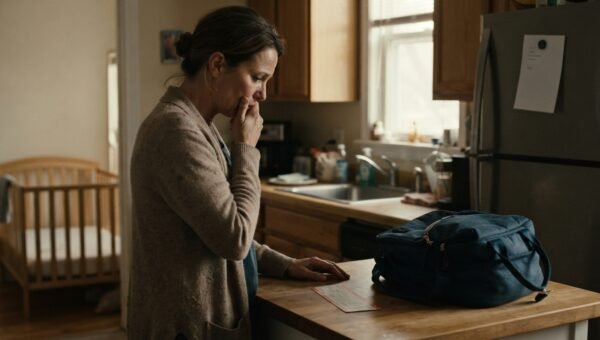
Ruth was sitting flat on the yellow linoleum floor between the stove and the small wooden breakfast table. A heavy ceramic mug lay shattered in three large pieces a few feet away from her, brown coffee dried into a sticky puddle on the tile.
She was leaning back against the bottom cabinet, her legs stretched out in front of her, breathing in short, shallow gasps.
“Ruth!” I dropped to my knees beside her, my hands shaking as I reached for her shoulder. Her skin felt cool and clammy. “What happened? Did you fall? Are you hurt?”
She blinked up at me, disoriented for a second, and then her hand reached out with surprising strength, gripping my wrist. Her fingers were bony and cold.
“No ambulance,” she whispered, her voice rough and dry. “Do not call an ambulance, Clara. I just got dizzy. I slipped. My knee gave out, that is all. I am fine.”
“You are not fine, you have been down here for hours,” I said, panic tightening my throat. “Let me call the paramedics. You could have a concussion or a fracture.”
“No,” she insisted, her voice trembling but firm. “No sirens. No hospital. Just help me into the chair. Please, Clara. Just help me up.”
I hesitated, but seeing the genuine panic in her eyes over the idea of an ambulance made me pause. I checked her limbs gently. She could wiggle her toes, and her arms moved without sharp pain, though her left hip was clearly bruised. Carefully, bracing my feet against the floor and wrapping my arms under her shoulders, I hoisted her up. It took every bit of my strength, but I managed to get her off the linoleum and settled into the sturdy oak armchair by the kitchen table.
She slumped back against the cushions, closing her eyes and pressing a trembling hand to her chest.
“I am going to get you a glass of water,” I said, heading over to the sink.
As I reached into the cupboard for a clean glass, my eyes caught something hanging on the wall directly beside the refrigerator.
It was a standard wall calendar from the local hardware store, the kind with large grid squares for writing down appointments. But there were no dentist visits written there. There were no hair appointments or birthdays marked in the boxes.
Every single day of the past six months was filled with the exact same handwriting.
In every single square, starting from November 12 up to that very morning, my name was written in dark blue ballpoint ink: *Clara.*
Beside each entry, without a single day missed, was a neat, precise check mark.
I stared at the paper. Months of my life, documented day after day on a stranger’s wall. Today’s date, May 11, was the only square that remained blank. There was no check mark beside my name.
My mouth went completely dry. “Ruth,” I asked, turning slowly around to face her, the glass of water still empty in my hand. “What is this?”
PART 2
Ruth’s eyes snapped open at the sound of my voice. She looked at the wall, then at me, and a look of pure, raw terror crossed her face. For a woman who had seemed so gentle and grandfatherly for half a year, the sheer desperation in her posture made me take a half-step backward toward the door.
She did not answer my question. Instead, she pointed a trembling finger toward the rotary phone mounted on the wall near the pantry.
“My purse,” she rasped, her breathing turning ragged again. “The little notebook in the side pocket. Call David. Call my son.”
“Ruth, you need a doctor, not just your son,” I said, my voice shaking as I glanced back at the wall of check marks. Seeing my own name repeated dozens of times felt violating in a way I could not put into words. It felt like living under glass.
“Call David,” she begged. Her voice cracked, tears finally spilling over the rims of her thick glasses. “He lives in Oak Creek. He can be here in forty minutes. Please, Clara. Just call him.”
Oak Creek was the neighboring town, about thirty miles west along the county highway. I found the worn leather purse sitting on the counter by the toaster. Inside the zippered pocket was a small spiral pad with three phone numbers written down. The first one was labeled *David (Cell)*.
I pulled out my mobile phone and dialed the number. A man answered on the second ring, his voice brisk and hurried.
“David Miller speaking.”
“David, my name is Clara Evans,” I said, trying to keep my voice steady while keeping one eye on Ruth, who was sitting with her head bowed, clutching her cardigan tight around her ribs. “I live next door to your mother. She had a fall this morning in the kitchen. She is conscious and refusing an ambulance, but she cannot stand on her own and she asked me to call you immediately.”
There was a sudden, dead silence on the line. I heard papers shuffling, then a heavy scrape of an office chair pushed back across hardwood.
“Is she breathing okay?” he asked, his tone dropping all professional pretense.
“She is breathing, but she is bruised and shaken up. She hit the floor pretty hard.”
“I am leaving right now,” David said. His voice was taut with an anxiety that seemed far heavier than a routine call about an aging parent. “Do not leave her alone, Clara. Please. Just stay with her until I get there.”
The line clicked dead.
The next forty minutes were excruciating. I cleaned up the broken mug and wiped the sticky coffee off the floor, desperate for something ordinary to keep my hands occupied. Ruth refused to speak. Every time I tried to ask about her knee, or ask why she had been tracking my movements on paper, she simply closed her eyes and shook her head, muttering that David would be here soon.
At 1:05, gravel crunched outside. A gray crossover SUV pulled sharply into the driveway.
A tall man in his early forties, wearing dark jeans and a rumpled navy polo shirt, rushed through the front door without knocking. He had Ruth’s sharp blue eyes and high cheekbones, but his jaw was tight with stress.
“Mom,” he said, striding straight into the kitchen and dropping to one knee beside her chair. He checked her pulse, touched her forehead, and gently examined her bruised knee with practiced hands. “You promised me you would use the cane when you felt the spells coming on. You promised.”
“I was just going to the store,” she whispered, looking down at her lap like a scolded child. “Clara needed to see me. I had to go to the door.”
David froze.
He stood up slowly, turning to look at me for the first time. He offered a quick, strained nod of thanks, his eyes scanning my face with an intensity that made the hair on my arms stand up. Then his gaze drifted past my shoulder to the wall by the refrigerator.
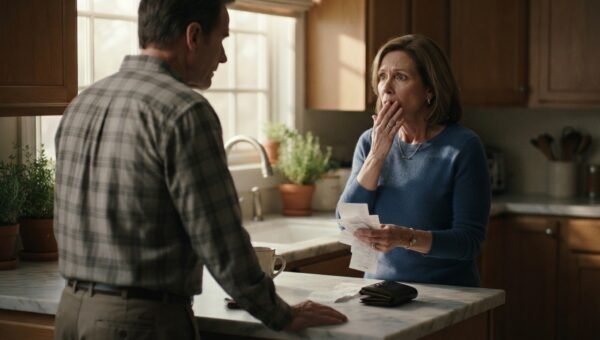
He saw the calendar. He saw the months of my name, the unbroken line of blue check marks, and the empty square beside May 11.
David did not look confused. He did not look surprised. He simply closed his eyes, let out a long, ragged exhale through his nose, and dragged a hand down his face.
“David, what is going on here?” I demanded, crossing my arms. “Your mother has been knocking on my door every single morning since I moved in. I thought she was just being friendly, but she has been keeping a log of me. Every single day. I deserve an explanation.”
David looked at his mother, who had her face buried in her hands, her shoulders shaking with silent sobs. Then he looked back at me, his expression unreadable and profoundly sad.
“Has my mother ever told you where she was on October 18, 1984?” he asked quietly.
I blinked at him, completely thrown off balance by the question. “What? Why on earth would she tell me that?”
“Just answer the question, Clara. Did she ever mention that date to you?”
“No,” I said, a cold chill running straight down my spine. “Never. Why would she? That is my birthday.”
PART 3
The room went completely airless.
Ruth let out a soft, broken wail and pulled her knees up toward her chest as best as her bruised hip would allow. David walked over to the kitchen table, pulled out a second chair, and sat down heavily. He rubbed his eyes, looking older than his years.
“Sit down, Clara,” he said, his voice dropping to a near whisper. “Please. If you stand there, you are going to pass out.”
I didn’t sit. I stayed rooted to the linoleum, my back pressed against the counter, my fingers gripping the edge of the laminate so hard my knuckles turned white.
“Start talking, David,” I said, my voice trembling with an anger born entirely of sudden, suffocating confusion. “Right now.”
David stared at the wood grain of the table for several seconds before looking up at me.
“In October of 1984, my mother was a charge nurse in the maternity ward at St. Jude’s Memorial in Green River,” he said evenly.
St. Jude’s was the regional hospital where I had grown up, forty miles north of here. It was the hospital listed on my birth certificate. My mother, Evelyn, had always told me about the rainy night I was born there, how the power had flickered during her labor, and how the nurses had brought me to her wrapped in a pink flannel blanket.
“Okay,” I said, my heart hammering against my ribs like a trapped bird. “She was a nurse. What does that have to do with me? Thousands of babies were born at St. Jude’s.”
“On the night of October 18, St. Jude’s had seven babies in the nursery,” David continued, ignoring my interruption. “It was an old facility. They didn’t have barcode bracelets or digital security systems back then. They used plastic identity bands with handwritten paper inserts. Around three in the morning, the utility room adjacent to the nursery caught fire from faulty wiring. The alarms went off. Smoke flooded the hallway.”
Beside him, Ruth was rocking back and forth, her eyes squeezed shut, whispering under her breath.
“There were only two nurses on duty in that wing,” David said, his eyes locked on mine. “My mother was one of them. She panicked, Clara. The smoke was so thick she couldn’t see the bassinets. She pulled three infants out of their cribs, carried them through the fire door, and set them down on the triage counter in the recovery room. In the chaos, two of the babies lost their wristbands. They fell off on the floor during the evacuation.”
The air felt heavy, like breathing through wet wool. “A mix-up?” I whispered. “You are telling me they mixed up the babies?”
“No,” David said firmly. “They didn’t mix them up. My mother sorted them out before the mothers woke up. She matched the crib cards, she checked the birth weights from the charts, and she put the right tags back on the right babies. The fire was put out in twenty minutes. No one died. No one was hurt. It was written up as an equipment accident, and life went on.”
“Then why did you ask me about that date?” I demanded, my voice rising. “Why is my name on that wall?”
David looked down at his mother. “Because my mother made a fatal mistake with the medicine that night.”
Ruth’s sobbing cut through the room like glass.
“She was terrified,” David said, his voice tight. “She had inhaled smoke. She was shaking. When she brought the infants back into the nursery after the fire was cleared, she was supposed to administer an injectable antibiotic to a baby girl who had been born with an early amniotic infection. A girl born to a woman named Evelyn Evans.”
Hearing my mother’s name spoken out loud by this strange man made the room tilt sideways.
“The charts were scrambled on the desk,” David said. “My mother drew ten times the prescribed dose of gentamicin. A lethal pediatric dose. She walked over to the bassinet, pulled back the blanket, and injected it straight into the IV line.”
I stopped breathing.
“Ten seconds later, she looked at the chart hanging from the foot of the crib,” David whispered. “It wasn’t Evelyn Evans’s baby. It was an infant named Sarah Hoffman. The doctor had moved the cribs around to check the air filters after the smoke cleared. My mother had given a fatal dose of medication to the wrong newborn child.”
“Oh, God,” I choked out, a wave of nausea hitting me so hard I had to grab the counter with both hands.
“Sarah Hoffman went into respiratory arrest twenty minutes later,” David said, his face pale as chalk. “The attending physician assumed it was complications from smoke inhalation. Everyone did. They worked on that baby for an hour, but she died before sunrise. The parents were devastated. The hospital settled a quiet insurance claim with the Hoffman family over the smoke exposure, and nobody ever looked closer.”
David turned to look at Ruth. Her head was bowed so low her chin rested on her chest.
“Nobody knew,” David said. “Except my mother. She realized what she had done the moment she saw the chart. She went into the charting room, altered the medication log, destroyed the used vial, and kept her mouth shut. She covered it up to save herself from prison. But the guilt ate her alive. Within six months, she quit nursing entirely. She never practiced medicine again.”
I stared at the broken, trembling woman sitting in the chair. “If she killed that other baby… why has she been stalking me?”
“Because of what she wrote in her diary that night,” David answered softly. “She believed that God spared you, Evelyn’s baby, at the cost of an innocent child’s life. She convinced herself that because of her cowardice, your survival was a debt she owed the world. For forty years, she kept tabs on your family from a distance. She knew when your mother died. She knew when you went to college. And when you bought the half of this duplex last year, she couldn’t believe it. She took it as a sign that her time was running out.”
ENDING
“She didn’t move here to stalk you, Clara,” David said, standing up and walking over to the refrigerator. He reached out and touched the calendar on the wall. “She has owned this property for twenty-five years. She rented out your side to college kids and young couples. When her rental agency sent her your application six months ago and she saw the name Clara Evans, born October 18, 1984, at St. Jude’s… she completely unraveled.”
I looked at Ruth. The woman who had brought me sourdough bread. The woman who had asked if I needed a lemon.
“Why the check marks?” I asked, my voice barely audible over the hum of the refrigerator. “Why the knocking?”
Ruth finally lifted her head. Her face was gray, her eyes red-rimmed and hollow with a lifetime of misery that no apology could ever undo.
“I was terrified you were going to die,” Ruth whispered, her voice cracking into a ragged sob. “Every single day since October of 1984, I have had nightmares that the debt would come due. That you would get sick. That you would get hit by a car. That something terrible would happen to you because of what I did to that little Hoffman girl.”
She reached out a trembling hand toward me, but stopped short, letting it fall back to her lap.
“I just needed to see your face,” Ruth said. “Every morning. If I saw you open that door at eight-ten, if I heard your voice and saw you breathing, I knew you were safe for one more day. I put the check mark on the wall so that when I went to sleep at night, I could tell myself that Evelyn’s baby was still alive. That I hadn’t destroyed everything.”
I stood there in the quiet kitchen, the truth hanging between us like a heavy iron weight.
I didn’t yell. I didn’t scream at her. The anger that had flared up twenty minutes ago had curdled into a cold, heavy sadness. I thought about my mother, who had raised me with so much love, completely unaware of the horror that had unfolded three rooms down the hall while she slept off her labor. And I thought about the Hoffman family, people I had never met, who had buried their daughter forty years ago believing a faulty wire had killed their child.
“You need to go to the hospital, Ruth,” I said quietly.
She flinched, looking up at me with dread. “Clara, please—”
“I am not asking,” I told her, my voice completely steady now. “You are seventy years old, you have a severe hip contusion, and you cannot walk. David, call an ambulance right now, or I will.”
David nodded without hesitation. He pulled his phone from his pocket and stepped into the living room to make the call.
While we waited for the sirens, the kitchen remained completely silent. Ruth kept her eyes on the floor, weeping quietly into a paper napkin. I walked over to the wall by the refrigerator. I pulled the hardware store calendar off the small brass nail holding it in place.
I folded it in half, then in half again, and slipped it into the pocket of my jeans.
When the paramedics arrived fifteen minutes later, they wheeled Ruth out on a gurney. As they loaded her into the back of the ambulance, she turned her head toward me one last time, her eyes begging for something I could not give her. Forgiveness is not something you hand out just because someone is old and afraid.
Two days later, David called me. Ruth was stable, but she had a hairline fracture in her pelvis and would be moving directly from the hospital into an assisted living facility near his home in Oak Creek. She would not be returning to Maple Street.
Before he hung up, David cleared his throat. “I found the medical records she kept in her safe,” he said quietly. “The original charts. The Hoffman family… their surviving son still lives two counties over. I am hiring an attorney to turn the documents over to the state medical board and the district attorney’s office. Whatever happens to my mother legally, it is time for the truth to be told.”
“Good,” I said. “That is what should happen.”
I hung up the phone and walked out onto my front porch.
The morning air was cool and clear. At 8:10, the street was completely quiet. There was no knock on the screen door. There was no scuffle of sneakers on the concrete. Just the steady, unbothered rustle of the oak leaves in the yard.
For the first time in six months, I drank my coffee alone.