PART 1
My brother stopped speaking to me the second week of October, three days after the estate movers loaded our mother’s upright Baldwin into the back of a box truck.
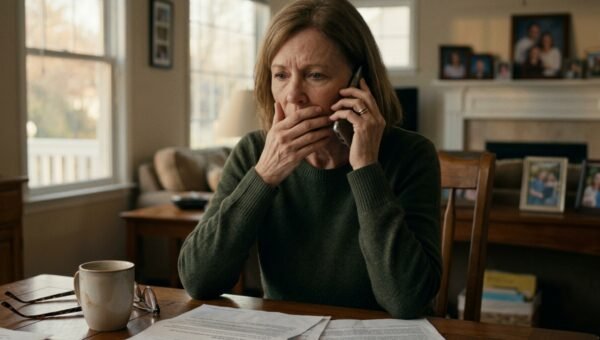
He didn’t call me to ask what happened. He called our cousin Brenda in Ohio, our aunt Clara in Tampa, and two women from Mom’s Sunday school class at First Methodist. By Tuesday evening, Brenda had already phoned my landline to ask why I was so desperate for cash that I had to strip our childhood living room down to the baseboards.
David told everyone I had auctioned off Mom’s favorite possession behind his back out of pure greed.
He left one voicemail on my cell phone that Thursday morning. His voice shook so hard he had to restart his sentence twice. He said, “You took the one thing in that house that actually belonged to our family, Sarah. Don’t ever call my house again.”
The truth was, the piano was never supposed to be sold to a stranger. It had sat in the damp corner of Mom’s formal parlor for thirty years without being tuned, and the soundboard had developed a hairline crack along the bass bridge. I had called an older technician named Arthur Miller, who had worked on instruments in our county since the late nineteen-seventies. I hired him to tighten the pins and clean the felt hammers so we could decide which of us had room for it.
David lived in a split-level outside Canton with three dogs and an open floor plan; he had already told me twice that he had nowhere to put an eight-hundred-pound piece of walnut. But grief does strange things to memory, especially when a parent passes after eight long months in hospice care.
Arthur had taken off the bottom panel and the front kickboard to inspect the pedals. When he reached up behind the cast-iron plate with an inspection light and a long pair of angled brass forceps, he hit an obstruction lodged between the third rib and the soundboard wood.
He thought it was an old mouse nest or a stack of dry sheet music that had slid down behind the keys decades ago. Instead, he pulled out a heavy manila mailing envelope, stiff with age and sealed with yellowed linen tape.
On the front, written in our mother’s exact, upright Catholic-school cursive with a blue ballpoint pen, were two names: Sarah and David.
Underneath our names, she had written a single instruction: “Open this together only when the music stops.”
Arthur had handed it to me right there in the empty living room, surrounded by cardboard boxes of chipped china and mismatched Tupperware. His hands were gray with graphite and felt dust. He didn’t ask a question. He packed his canvas tool roll, took his sixty-dollar service fee in cash from my kitchen counter, and let himself out the side screen door.
I didn’t open it alone. I carried it out to my car, set it on the passenger seat, and drove the twenty-five miles out to David’s subdivision.
His silver truck was parked in the driveway beside his wife’s sedan. When I walked up the three concrete steps and pressed the doorbell, the chimes echoed through the foyer, but nobody answered. I knocked hard on the solid oak door.
“David,” I called out, pressing my forehead against the cool wood. “It’s Sarah.
Turn off the television. I need to show you what was inside Mom’s piano.”
Inside, his heavy footsteps came to a halt right on the other side of the door. The deadbolt didn’t turn.
“Go home, Sarah,” he said, his voice flat and muffled through the wood. “Sell whatever else you stole. I have nothing to say to you.”
“David, please. It’s not about the money. Mom left an envelope wedged behind the soundboard. It has your name on it. Both our names.”
“You expect me to believe that?” he said. “You’ve been making excuses since the funeral. Just leave.”
The manila envelope was too thick to fit through the narrow gap at the bottom of the weather stripping. My fingers trembled as I broke the old yellow tape. Inside were five folded sheets of heavy institutional paper and one handwritten letter from Mom, dated August 14, 1974.
I separated Mom’s handwritten page from the rest. I got down on my knees on his welcome mat, flattened the paper with my palms, and slid the top edge through the small draft crack beneath the brass sill until only the bottom margin remained in my hand.
He pulled it from the inside.
The porch went dead quiet. Ten seconds passed. Then twenty.
The heavy brass deadbolt clicked. The handle turned, and the door swung open three inches. David stood in the entryway under the hall light, his face completely drained of color, his knuckles white around the creased paper. He looked down at the sheet, then up into my eyes, his voice dropping to a harsh whisper.
“Tell me this doesn’t mean the woman who raised us was actually our aunt.”
PART 2
The hallway smelled like pot roast and lemon wood polish. David did not invite me in; he simply backed away from the entryway with his eyes glued to the ink, leaving the front door open behind him.
I stepped inside and pulled the heavy oak door shut until the latch caught.
“Read the rest of it,” I said quietly, holding out the stiff manila envelope.
He didn’t reach for it right away. His thumb kept rubbing over the top line of Mom’s handwriting, the same steady penmanship that had signed our permission slips, our report cards, and our Sunday school envelopes.
The sentence he had read through the crack in the door was the second paragraph. Mom had written: “If you are reading this, the Baldwin has finally left the parlor, and the silence I bought with it has run out. David, you spent fifty-two years believing you were born to Helen and Arthur Vance in the winter of 1972. You were not. You were born in room 214 of St. Jude’s Memorial Hospital in Scranton, Pennsylvania, to my younger sister, Evelyn. Arthur and I took you off the fourth floor because Evelyn could not keep you, and because the family could never know what happened to her in that county.”
David’s hand dropped to his side. The paper made a dry, rustling sound against his corduroy slacks.
“Aunt Evelyn died of pneumonia when we were kids,” David said. His voice was too quiet, like he was trying to convince an empty room. “She was the quiet one who lived in Pennsylvania. We went to her burial in seventy-eight. I remember the red coat Mom wore to the cemetery.”
“Look at the other pages, David,” I said. “I didn’t open them until I was sitting in your driveway. Look at the letterhead.”
He walked toward the dining table, his shoulders stiff, and pulled out a chair. He didn’t ask me to sit, but I sat across from him on the edge of the walnut chair anyway.
Between us lay the yellowed institutional forms Arthur Miller had freed from behind the piano ribs. They were carbon-copy admission records from St. Jude’s County Hospital, an old municipal facility in northeastern Pennsylvania that had closed its doors back in the late eighties.
The top document was a standard intake form dated November 3, 1972. The patient name was Evelyn Marie Vance, age nineteen, unmarried. The secondary form was a release authorization signed by our father, Arthur Vance, listing himself not as an uncle, but as legal guardian of an infant male child registered simply as Baby Boy Vance.
Beneath that was a handwritten receipt for four hundred and eighty dollars, dated November 6, 1972, paid in cash to an attorney named George K. Mercer for “custodial transfer fees and private care expenses.”
David looked at the cash receipt for a long time. His jaw worked back and forth, the muscle jumping beneath his graying stubble.
“Mom told me I was born in general delivery at Fairview Hospital right here in town,” he said. He looked directly at me for the first time since the funeral. “You were seven when I came home. You were there. Did you know?”
“I was seven, David,” I told him, my throat aching. “I remember Dad driving out of the driveway on a Thursday night in the old station wagon. He told me Mom was staying with family for a few days because she had a migraine. When they came back on Sunday afternoon, Mom was carrying you in a yellow knitted blanket. She was wearing her church coat. She told me God had answered her prayers and brought me a brother.”
“She lied to me,” he said. He wasn’t crying; he was furious. The anger that he had aimed at me over the piano was turning inward, finding no clean place to land. “For fifty-two years. She let me carry Dad’s watch. She let me give his name to my own boy. She let Aunt Evelyn sit at Thanksgiving in seventy-six, three chairs down from me, passing the green bean casserole, and nobody said a word.”
“Keep reading,” I whispered. “Mom didn’t leave this behind the soundboard to hurt you. Read why she hid it.”
PART 3
David turned over the second sheet of Mom’s letter.
The ink on the back was slightly heavier, where her hand had pressed harder against the dining table fifty years ago.
“Evelyn did not give you away because she didn’t want you,” the letter continued. “She gave you to Arthur and me because her father had threatened to place her in the state sanitarium at Clarks Summit if she brought a child without a father into our home county. Our father told the neighbors Evelyn was working at a textile mill in Scranton for the season. When her water broke two months early, she called Arthur from a pay phone in the hospital lobby. Arthur left our house in the middle of the night without telling his own parents.”
David stopped. His eyes scanned the middle of the page three times before he could read the rest out loud.
“Arthur gave Mercer the four hundred and eighty dollars to settle the hospital account so they wouldn’t file the birth index with the state clerk before we could bring you across the Ohio line. We bought the Baldwin upright from Evelyn’s landlord for sixty dollars that same weekend. Evelyn had bought it secondhand with her own wages when she lived in Scranton. She told Arthur that if her son couldn’t know her face, she wanted him to grow up hearing the same wood and keys she had touched while she carried him.”
David’s breath hitched in his chest. He looked down at the worn oak floor beneath his socks.
“The piano was Evelyn’s,” David whispered.
“It was Evelyn’s,” I said. “Mom didn’t buy it at the Sears outlet like she always told the church ladies. She put the papers behind the iron frame the week Dad brought it into the house because she was terrified our grandfather would find them if he ever visited.”
“Why didn’t she tell us when Grandpa died?” David asked. His voice cracked completely now, the anger breaking open into something hollow and bruised. “Grandpa died in eighty-two. Mom lived another forty-two years. Why did she leave this for a repairman to dig out of the dust?”
“Because Dad made her promise,” I told him, pointing to the last paragraph on the third sheet.
Mom had written: “Your father carried the shame of that crossing every day of his life. He was a deacon, David. He loved you more than his own skin, but he believed if anyone ever found out we had falsified the baptism record, the town would look at you like an outsider. He told me on the night before his stroke that the truth belonged to you two, but only after both of us were gone and could no longer ask you to forgive our cowardice. I left it in the only thing Evelyn ever owned.”
David sat motionless in the dim dining room for nearly ten minutes. Outside, a neighbor’s lawnmower buzzed along the curb, ordinary and steady, completely indifferent to the fact that the entire foundation of my brother’s life had just shifted beneath his feet.
He reached out slowly, took the hospital admission sheet, and placed it neatly against Mom’s letter. Then he stacked the yellow cash receipt on top. He squared the edges against the table with both thumbs, very carefully, the way Dad used to square his business receipts before filing his taxes every April.
“I called Brenda awful things about you, Sarah,” he said, staring down at his hands. “I told the whole family you were selfish.”
“I don’t care about Brenda, David,” I said. “Brenda didn’t spend three weeks watching Mom try to breathe through an oxygen mask. I know who you were mad at. You weren’t mad at me. You were mad that the house was empty.”
He closed his eyes and let out a long, ragged breath. “Where is the piano now?”
“It’s in Arthur Miller’s workshop off Route 44,” I told him. “He’s replacing the felt pads this week. I haven’t sold it, David. I was never going to sell it. I just paid him three hundred dollars to hold it until we figured out what to do.”
ENDING
David didn’t call Brenda back that afternoon, and he didn’t tell his wife until after dinner.
Two days later, on a cool Saturday morning when the maple trees along Route 44 were dropping wet yellow leaves onto the asphalt, David pulled his silver pickup into the gravel lot behind Arthur Miller’s barn.
The old repair shop smelled of boiled linseed oil, hide glue, and fifty years of seasoned pine. Mom’s Baldwin stood near the back wall beneath an unshaded fluorescent tube, its walnut casing stripped of forty years of nicotine and paste wax, glowing with a soft, pale honey color we hadn’t seen since we were children.
Arthur was working on a pump organ near the front doors. When we walked in, he simply nodded at David, wiped his hands on a blue mechanic’s rag, and went into his small front office to leave us alone.
David walked over to the Baldwin. He didn’t touch the wood at first. He just stood there looking at the small brass pedals, scuffed and tarnished by two generations of shoes.
Then he sat down on the narrow wooden bench Arthur had set in front of the keys.
David hadn’t played since high school, when Mom made him practice hymns for forty minutes every Sunday before we were allowed to watch football. He set his large, rough hands on the keys, his fingers stiff from thirty years of working commercial construction. He played four slow, clumsy chords from the old church hymn Mom used to hum when she folded the laundry in the basement.
The middle notes were clear and round. The crack in the soundboard had been glued with fresh spruce shims, tight and silent.
“We need to go to Pennsylvania,” David said quietly, his eyes fixed on the white key tops. “I want to see where St. Jude’s used to be. And I want to find Evelyn’s marker.”
“We can go next weekend,” I told him, resting my hand on the high top of the walnut case. “I’ll drive.”
He pressed the sustain pedal down, letting the last chord hang in the damp air of the barn until the vibration died away into the rafters. Then he reached into his jacket pocket, took out the manila envelope, and laid it gently on the music rack where the hymnals used to sit.
“Don’t put it back inside the wood,” he said, standing up and sliding the key cover shut. “It stayed in the dark long enough.”