PART 1
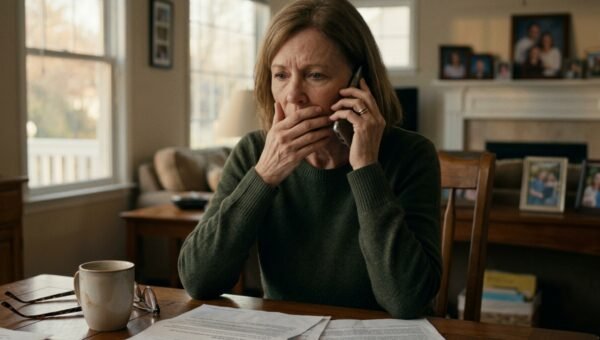
My sister Brenda always had a way of delivering terrible news like she was reading the back of a cereal box. When our mother passed away on a rainy Tuesday morning in October, Brenda called me forty minutes later from the hospice wing.
She did not say she was sorry. She did not ask how I was holding up. She simply took a sharp breath and said, “It is over, Nora.
She went in her sleep. And before you start calling pastors or ordering flower wreaths, you need to know she specifically asked for direct cremation with no memorial service. No viewing, no gathering, nothing.”
I sat on the edge of my unmade bed, gripping the phone until my knuckles burned. “No service? Brenda, Mom went to St. Jude on Elm Street every single Sunday for forty-two years. She baked lemon loaves for every funeral reception the altar guild ever put together. Why would she want to be slipped into an incinerator with nobody praying over her?”
“Because she was tired, Nora,” Brenda snapped, her voice tightening the way it always did whenever I questioned her authority. “She did not want people staring at her body or gossiping over sandwiches in the church basement. She told me weeks ago. She made me promise not to let you turn it into a production.
I signed the paperwork with Miller Brothers Mortuary. They are doing the cremation Thursday at noon. You can meet me there to pick up half the ashes if you want, but that is all there is.”
Grief does something cruel to your common sense. It makes you feel foggy, like you are underwater, and it makes you doubt your own memories. Mom had suffered through six hard months of stomach cancer. Toward the end, she barely weighed eighty pounds, and her voice had faded to a dry whisper. Brenda had stepped in as her medical power of attorney, mostly because Brenda lived four miles down the county road while I was two hours away in Lansing, working full-time at the county clerk’s office and driving down every single Friday night to sit with Mom through Sunday afternoon. Brenda constantly reminded me that she was the one handling the daily grind.
So when she told me Mom wanted no service, I felt an awful, hollow ache, but I believed her. I thought maybe Mom was just so exhausted from the pain that she wanted to slip away quietly without being an inconvenience.
On Thursday morning, I pulled on a plain black wool sweater, pinned Mom’s old silver cross brooch to the collar, and drove the two hours through a spitting grey mist. I got to Miller Brothers Mortuary around quarter to one. I figured the cremation would be finished, or they would have the urn ready for us in the front office.
The mortuary was an old brick building with a gravel parking lot. As I turned into the drive, I noticed two large tour-style vans pulling out, followed by three sedans I recognized immediately. One belonged to Mrs. Gable, Mom’s oldest friend from the altar guild. Another belonged to our cousin Greg.
My stomach dropped into freefall.
I parked my car crooked near the side door and walked inside. The lobby smelled heavily of carnations and warm candle wax. A small brass easel stood near the entrance to Chapel B. The felt board had white plastic letters pushed into the grooves: *In Loving Memory of Evelyn Vance. 11:00 AM Service.*
There had been a service. A full, two-hour church service right here in the mortuary chapel.
Brenda had gathered Mom’s friends, our cousins, our neighbors, and the congregation from St. Jude. She had printed programs. She had ordered white lilies. She had stood at a podium and accepted condolences, hugs, and casseroles. And she had deliberately lied to me so I would not be in the room.
The rage that hit me was so violent I could barely pull air into my lungs. My hands began to shake. I marched down the hallway toward the main office, ready to tear Brenda apart with my bare hands if she was still in the building.
The door to the director’s office was half open. Inside, a tall, grey-haired man named Arthur Miller was sliding manila folders into a file cabinet. He looked up, adjusted his reading glasses, and offered a gentle, practiced smile.
“Can I help you, ma’am?” he asked softly.
“Where is Brenda?” My voice cracked, raw and shaking. “Where is my sister? And why did you hold a service for Evelyn Vance when I was told Mom wanted direct cremation with nobody present?”
Mr. Miller’s expression shifted instantly from polite sympathy to deep, uneasy concern. He stepped out from behind his desk. “You must be Nora.”
“Yes, I am Nora. I am Evelyn’s daughter. Her other daughter.”
“Please, come inside and shut the door,” he said quietly. He waited until I walked in, then closed the heavy wooden door behind me, shutting out the quiet hum of the building. “Take a breath, Mrs. Miller—well, Nora. Sit down, please.”
“I do not want to sit down. My sister locked me out of our mother’s funeral. She told me Mom refused a service!”
“Your sister organized that service two weeks ago,” Mr. Miller said, speaking each word with deliberate care. “She paid for the chapel rental, the organist, and the floral arrangements out of your mother’s checking account. When I asked her why your name was not listed among the surviving family in the printed bulletin, she informed me that you were estranged and living out of state.”
The cruelty of it felt like a physical slap. “We were not estranged. I was here five days ago. I held Mom’s hand on Sunday night. I combed her hair.”
“I know,” Mr. Miller said gently. “Your mother knew, too.”
I stared at him, my chest heaving. “What does that mean?”
Mr. Miller walked back behind his desk, opened the bottom drawer with a small brass key, and lifted out a heavy cream-colored envelope. Paper-clipped to the front was a tarnished brass key with a masking tape tag that read *Room 4*.
“Ten days before she passed,” Mr. Miller said, “your mother had her neighbor, Mr. Henderson, drive her here while your sister was at work. She was very weak, but her mind was completely clear. She sat in that exact chair you are standing next to. She knew Brenda was planning a service behind your back. She knew Brenda was telling people you had abandoned the family.”
“Then why didn’t Mom stop her?” I whispered. “Why let her do it?”
“Because your mother knew Brenda would create an unbearable scene if she was challenged openly while your mother was dying,” Mr. Miller said. “Your mother wanted her final days to be peaceful. But she refused to let Brenda have the last word.”
He held out the envelope and the key.
“Your mother left strict instructions with me. She paid cash in advance for a private second ceremony. She rented the small study room at the old community chapel on 4th Street for three hours this afternoon. The key opens the back entrance. Inside, she left something specifically for you. She made me promise that I would not hand this over until your sister had cleared out of this building.”
I reached out and took the envelope. It was heavy in my palm.
“Go on over there, Nora,” Mr. Miller told me softly. “Your mother is waiting for you.”
PART 2
The old community chapel on 4th Street sat nestled between a dormant auto repair shop and a row of overgrown boxwood hedges. The building had not held regular Sunday services in nearly a decade, but the historical society kept the heat on and rented out the front rooms for small meetings, quiet prayer circles, and grief support groups.
The gravel lot was completely empty when I pulled in. The rain had picked up, drumming steady and dull against the windshield of my sedan. I sat there for five minutes, the cold steering wheel hard beneath my fingers, staring at the envelope Mr. Miller had given me. Written across the front in my mother’s shaky, looping cursive was a single instruction: *Go to Room 4. Lock the door from the inside.*
My knees felt weak as I walked up the side ramp toward the back entrance. The key turned smoothly in the lock with a heavy, satisfying click.
The air inside smelled of cedar oil, old hymnals, and radiator heat. A carpeted hallway led down past a pair of locked supply closets to a door with a tarnished metal plate stamped with the numeral 4.
I unlocked that door, stepped through, and clicked the deadbolt behind me just as Mom had asked.
The room was small, barely ten feet across, illuminated by the grey afternoon light filtering through a frosted window. In the center sat an oak library table flanked by two matching straight-backed chairs. Resting directly in the middle of the table was a portable, battery-powered cassette recorder with a red play button, a fresh plastic pack of four AA batteries, and a thick legal-sized manila folder with my name printed across the tab in dark black marker. Beside the recorder sat a small white card with a single sentence written in Mom’s hand: *Sit in the green chair, Nora. Put the tape in and press play.*
I pulled out the chair with the faded green cushion and sat down. My hands were trembling so badly I could barely peel the plastic wrapping off the batteries. I slotted them into the bottom of the player, lifted the cassette tape resting on the folder, and snapped it into the deck.
I hit the play button.
The machine hummed with mechanical static for three long seconds. Then there was the sound of someone adjusting a microphone, a faint, ragged cough, and the sound of a glass of water setting down on wood.
“Nora, sweetheart,” Mom’s voice filled the quiet room.
A sob ripped out of my throat before I could stop it. Her voice was thin, reedy, and scraped raw by the illness, but the cadence was unmistakably hers. It was the voice that had sung hymns over the sink while washing dishes, the voice that had told me everything would be alright whenever life knocked me flat.
“If you are hearing this,” Mom said, pausing to catch her breath, “then Arthur did his job at the mortuary, and your sister did exactly what I knew she would do. She buried her mother in front of an audience, played the devoted, martyr daughter, and made sure you were not in the room to contradict her.”
Mom let out a bitter, exhausted chuckle that dissolved into another quiet cough.
“I am sorry, Nora. I am so terribly sorry I made you go through this today. When you walked into that empty lobby and saw that service bulletin, I know your heart broke into a hundred pieces. I know you felt discarded. But you have to understand why I let her run her little show.”
I pulled the folder closer to my chest, staring at the tiny black reels turning inside the plastic cassette window.
“For forty years,” Mom continued, her tone shifting from tender to grim, “I kept you and Brenda apart as much as I could. When you were girls, you used to ask me why I never let Brenda babysit you, why I sent you to your Aunt Clara’s house during summer breaks instead of keeping you home together, why I never encouraged you two to share an apartment when you both moved out. You thought I was playing favorites. You thought I loved you more because you were the baby, and Brenda grew up believing the exact same thing.”
Mom stopped. On the tape, you could hear the faint, muffled sound of traffic from the street outside where she had recorded it, probably sitting in the front passenger seat of Mr. Henderson’s car.
“Brenda was not always angry, Nora. But she was born with something broken inside her. When she was sixteen years old, your father and I found out what she was truly capable of. We covered it up because we were terrified of the shame, terrified of what the town would say, and terrified of what it would do to you. We thought we were protecting our family. But all we did was feed a monster, and for the last ten years, that monster has been slowly bleeding me dry. Open the folder, Nora. Look at the first bank statement.”
I opened the manila folder. My eyes fell on a stack of official documents from First Federal Savings, dated between June and August of that year.
Attached to the statements were carbon copies of withdrawal slips. Each one was signed with my mother’s name, but even a casual glance revealed the handwriting was completely wrong. The letters were stiff, sharp, and hurried. Brenda’s handwriting.
“She took forty-eight thousand dollars out of my savings while I was in the hospital having my second surgery,” Mom’s voice explained, steady now, stripped of all hesitation. “She told the bank manager she had my verbal permission under a power of attorney she had me sign while I was coming out of anesthesia. When I found out, she looked me straight in the eye and said it was her ‘caregiver fee.’ She told me if I went to the police, she would walk out and leave me to die alone in my bed, and she would tell you and the rest of the family that I had wasted the money on prescription pills.”
Hot, furious tears tracked down my cheeks. Forty-eight thousand dollars. That was the entirety of Mom’s savings, the money Dad had left her from his union pension, intended to pay for her hospice care and leave a modest inheritance for the two of us.
“That is why she kept you away from the funeral, Nora,” Mom said softly. “She knew that the moment you talked to Mrs. Gable or cousin Greg or the pastor, someone would mention the estate. She needed to establish herself as the sole grieving daughter in front of the whole town before you could ask a single question about the money. She thought that if she humiliated you enough, you would pack your bags, drive back to Lansing, and leave her with the house and whatever was left.”
There was a long silence on the tape, broken only by the faint click of a clock.
“Turn the page in the folder, baby,” Mom said. “Look at the blue paper.”
I flipped the bank statements over. Beneath them lay a bright blue legal document stamped with a notary seal from the county clerk’s office, dated just nine days before Mom passed away.
PART 3
The blue document was an irrevocable deed of transfer and a revised last will and testament.
Across the top, in crisp, legal print, it designated Arthur Miller and a trust attorney named Richard Vance—my father’s younger brother—as the co-executors of Evelyn Vance’s estate. Brenda’s name had been completely removed from any fiduciary role.
Attached to the deed was a title transfer for Mom’s three-bedroom craftsman house on Maple Street—the very house Brenda had already moved her boxes into three weeks ago, claiming she needed to ‘sort through Mom’s things.’
The deed placed the house, the property, and all remaining personal assets entirely into my name.
“Brenda thinks she has won,” Mom’s recorded voice continued, dropping into a tone that was chillingly clear. “She thinks that because she had the old will from five years ago locked in her desk, she is going to inherit that house free and clear. She does not know that while she was at the grocery store last Tuesday, Arthur brought Richard to my bedroom with a traveling notary. I revoked the power of attorney. I documented the forty-eight thousand dollars she stole as an early advancement against any claim she might make on my estate. Legally, Nora, she has already taken more than her share. She has nothing left to inherit.”
I stared at the notary’s signature, my pulse pounding in my ears. Mom had not been weak at the end. She had been trapped in a sickbed, surrounded by a daughter who was actively robbing her, and she had spent her final ounce of strength laying a trap.
“Now listen carefully, Nora,” Mom said. “Inside the envelope Arthur gave you, there is a small brass key. That key opens the side desk drawer in my sewing room at the house. In the false bottom of that drawer is a spiral notebook. In that notebook, your father and I kept the receipts, the police report, and the canceled checks from when Brenda was sixteen. That was the year she set fire to the old parsonage barn behind the church because the youth pastor chose another girl to sing the Christmas solo. Your father paid the church board ten thousand dollars in cash from his retirement to keep them from pressing felony charges against her. We buried it. We kept it from you because you were only eight years old, and we did not want you to look at your sister with terror.”
My breath hitched. I remembered that winter. I remembered the sudden smell of smoke in the neighborhood, the sirens cutting through the night, and how Dad had looked grey and hollow for months afterward. I had always believed it was an accidental electrical fire.
“She has lived her entire life believing she can take whatever she wants, lie about anyone who stands in her way, and leave other people to clean up the ashes,” Mom said. “She expects you to stay quiet. She expects you to slink away in shame because she made you look like a terrible daughter today. Do not do it, Nora. Do not give her an inch. Take the folder. Go to the house. Arthur has already filed the deed with the county register. The house is yours. Walk through that front door, look your sister in the eye, and finish this.”
The tape fell silent for a moment. Then Mom took a deep, shuddering breath.
“I love you, Nora. You were the joy of my life. Every Friday night when I heard your car pull into the driveway, I knew I was safe for two days. I am safe now, sweetheart. Go take care of yourself.”
A soft click sounded as the tape ended. The little red button popped up with a hollow thud.
I sat in the cold study room for a long time, the silence pressing against my ears. Outside, the rain had tapered off into a freezing mist. I closed the folder, slid the cassette into my coat pocket next to the brass key, and stood up.
The grief was still there, heavy and aching in my chest, but the fog was gone. The doubt that had plagued me for forty-eight hours had burned away, leaving behind a cold, sharp resolve.
I got back into my car and drove across town to the house on Maple Street.
When I pulled up to the curb, Brenda’s silver SUV was parked in the center of the driveway. Through the living room window, I could see the glow of the chandelier. Brenda was already inside, bustling between the dining table and the front foyer, carrying cardboard boxes marked *Kitchen*.
I parked behind her car, stepped out into the damp cold, and took the manila folder from the passenger seat. I walked up the front steps, pushed open the screen door, and turned the knob. It was unlocked.
Brenda was standing by Mom’s china cabinet, wrapping our grandmother’s porcelain teacups in sheets of newspaper. She looked up, startled, a sharp scowl immediately settling across her features.
“What are you doing here, Nora?” she demanded, setting a cup down on the table with an aggressive clatter. “I told you to meet me at Miller Brothers at noon. When you did not show up, I assumed you took the highway straight back to Lansing. I had to handle everything by myself. Again.”
“The service was at eleven, Brenda,” I said quietly, closing the heavy oak front door behind me and locking it.
Brenda did not even flinch. Her face hardened, her chin lifting in that defensive, haughty tilt I had seen a thousand times. “Oh. So you went snooping. Well, if you really want to know, people wanted to pay their respects. They loved Mom. I did not invite you because I knew you would make it all about yourself. You would have cried, caused a scene, and made everyone uncomfortable. I spared the family the drama.”
“You stole forty-eight thousand dollars from her while she was in post-op recovery,” I said, my voice level, steady, and loud enough to echo off the hardwood floors.
Brenda’s mouth opened slightly, then snapped shut. A flicker of panic crossed her eyes, replaced almost instantly by venom. “That was for her care! I was the one who drove her to chemo! I was the one who changed her bed sheets! You dropped in for weekend visits like a guest at a hotel! I earned that money!”
“You forged her signature,” I replied, taking two steps toward the dining room table and dropping the blue legal document directly over the box of teacups. “And Mom knew.”
Brenda looked down at the paper. Her eyes scanned the bold lettering across the top, the county clerk’s red stamp, and the clear, unambiguous language revoking her power of attorney and deeded ownership of the property to me.
Her face drained of all color. The haughty arrogance vanished, replaced by an ugly, frantic desperation.
“This is not real,” she stammered, her fingers trembling as she picked up the page. “This is not legal! I have the power of attorney! I am the oldest! She was not in her right mind when she signed this! She had dementia! I will take this to probate court and have it thrown out in five minutes!”
“Call Richard Vance,” I said. “He is the executor. He was in the bedroom when the notary stamped it. He already filed the transfer this morning while you were giving your eulogy at the mortuary.”
Brenda lunged forward, clutching the paper in both hands. “She could not do this to me! I gave up six months of my life for her! This house is mine! Half of everything in this house belongs to me!”
“You already took your inheritance, Brenda. Forty-eight thousand dollars in forged cashier’s checks. Richard has the bank records, and he is preparing to hand them over to the county prosecutor if you contest this deed.” I looked her directly in the eyes. “And if that does not convince you to walk away, I have the key to the sewing room desk. I know about the parsonage barn. I know about the ten thousand dollars Dad had to pay the church board.”
Brenda froze. The color did not just leave her face; it looked as if the very blood in her veins had turned to ice. She dropped the deed onto the table.
“She told you,” Brenda whispered, her voice barely audible.
“She gave me the whole story,” I said. “Every single word. So here is what is going to happen, Brenda. You are going to take your coat, your purse, and your car keys. You are going to leave those boxes of Mom’s things right where they sit. And you are going to get off my property before I dial the sheriff’s office.”
ENDING
Brenda stood in the middle of our mother’s dining room for nearly a full minute, her chest rising and falling in rapid, shallow jerks. She looked around at the walls, at the framed family portraits she had already begun taking down, at the furniture she had assumed would belong to her by nightfall.
For the first time in my life, I saw my sister look truly small. The illusion of total control she had maintained for decades had shattered into dust.
She did not scream. She did not argue. She snatched her leather purse off the sideboard, pulled her heavy coat around her shoulders, and walked out the front door without looking back once. The screen door banged shut behind her. A few seconds later, her SUV engine roared to life, tires crunching furiously over the gravel driveway before fading down the road into the grey mist.
When the sound of her car was completely gone, the silence of the house settled over me like a heavy wool blanket.
I walked into the kitchen, turned on the kettle, and made a cup of black tea in Mom’s favorite chipped yellow mug. Then I carried the mug upstairs to the small sewing room at the back of the house.
The floorboards creaked under my feet, the familiar, comforting sound of my childhood. I knelt by the old wooden roll-top desk, slid the brass key into the side drawer, and turned it. Beneath the velvet-lined tray in the bottom, just as Mom had said, lay a worn black spiral notebook.
I did not read the details of that terrible winter thirty years ago. I did not need to. I simply placed the notebook back in the hidden compartment, locked the drawer, and slid the key onto my own keyring. It was not a weapon I ever wanted to use; it was a shield Mom had left behind to make sure I would never be hurt by Brenda again.
Two days later, on a crisp, sunlit Saturday morning, I held the real service.
It was not in a mortuary chapel, and there were no printed programs with artificial eulogies. I invited Mrs. Gable, cousin Greg, Mr. Henderson, and the half-dozen ladies from the St. Jude altar guild who had truly loved Mom for forty years.
We gathered around the kitchen table in the house on Maple Street. We ate the lemon loaves Mrs. Gable brought in a wicker basket, drank hot coffee, and shared real stories about Evelyn Vance—how she used to laugh so hard during choir practice that she would lose her place in the hymnal, how she spent twenty years quietly paying the electric bills for young mothers in town who were struggling to make ends meet, and how fiercely she had loved her family, even when that love required heartbreaking, impossible choices.
Before everyone left, we walked out into the backyard beneath the giant sugar maple tree Mom had planted with Dad when they bought the house in 1968. Mr. Miller had personally delivered the simple wooden urn to me that morning.
With her true friends standing around me in a quiet circle, we said the Lord’s Prayer together. The autumn wind blew through the red and gold leaves overhead, carrying the scent of woodsmoke and turning earth.
Brenda got the public spectacle she wanted, but she left with empty hands and a closed door. I was left with the house, the memories, and the quiet, unshakable knowledge that my mother had spent her final breaths making sure truth had the final word.