PART 1
The mail carrier didn’t just drop the envelope through the slot by the front door like usual. He rang the bell twice, hard enough that the dog barked from the laundry room, and stood there on the porch holding a yellow electronic pad.
He asked if I was Mrs. Dan Miller. I said I was. He asked for my signature, handed me a thick cream envelope with a lime-green certified label stuck across the top, and tipped his hat before walking down the driveway.
Thirty-one years married, and I had never once opened Dan’s mail. It wasn’t some grand moral rule we had spoken aloud. It was just how we lived. Dan handled his truck insurance, his union paperwork, and whatever came from the hardware yard. I handled the groceries, the utilities, and the property taxes. We had a rhythm, and after three decades, you trust the rhythm.
Then I looked at the return address. It was from a law firm in Columbus representing an entity called Buckeye Lending Services. Stamped across the lower front corner in stark red ink were two words: FINAL NOTICE.
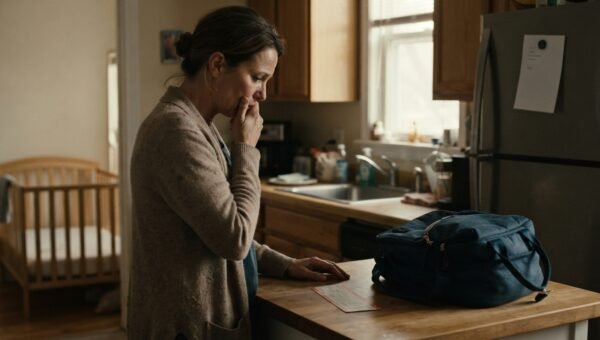
My hands felt cold right then, even though it was eighty degrees outside and the afternoon sun was hitting the kitchen window. I walked back inside and stood over the sink. I did something I had never done in my entire adult life. I turned on the electric kettle, held the sealed flap of that envelope over the thin stream of hot steam until the glue turned gummy, and slid a butter knife under the paper.
The top sheet was a Notice of Default and Intent to Accelerate.
I leaned both hands on the edge of the kitchen counter because my knees went weak. I read the numbers once, then twice, then a third time out loud to make sure my eyes weren’t playing tricks on me. There was a delinquent balance of sixty-one thousand four hundred and twenty dollars on a second mortgage taken out against our home. Our home on Meadow Lane. The brick ranch we built in 1994, the one we held a backyard barbecue to celebrate paying off completely in August of 2019.
I looked at the attached copy of the deed of trust. Sitting right there on the signature line, next to Dan’s heavy, sloping handwriting, was my name.
It wasn’t a forgery. It was my real signature.
My stomach dropped straight through the floor. My mind raced backward through two years of kitchen table paperwork, searching for where I could have put my pen to that document. Then it hit me like a blow to the chest.
Back in the fall of 2024, Dan had laid a stack of documents on the table while I was stirring spaghetti sauce. He told me the township was offering an updated property assessment combined with an municipal rate lock on our county water taxes, and that we both needed to sign to keep our rates from jumping. He had flagged every line with little yellow sticky arrows. “Just sign where the flags are, Martha,” he had said, pouring himself a glass of iced tea. “I’ll run them by the notary at the bank tomorrow during lunch.”
I had signed it. I had signed away the clear deed to our home between stirring garlic and draining pasta, trusting the man who slept beside me.
I pulled out a wooden kitchen chair and sat there for two hours in the quiet house, staring at that paper. The kitchen clock ticked on the wall.
At five-fifteen, Dan’s pickup truck turned into the gravel drive. The driver’s side door slammed. He came through the mudroom whistling an old country tune, wiping his boots on the braided mat. He tossed his keys into the ceramic bowl by the fridge, turned around, and froze.
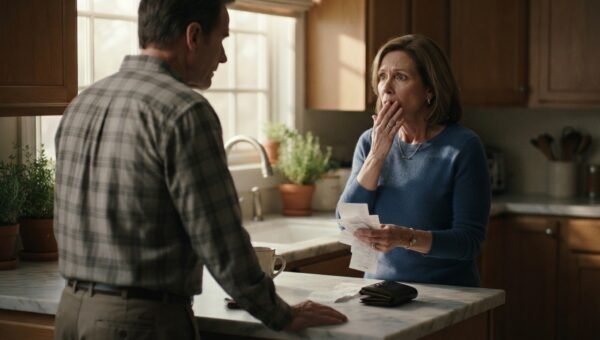
I had smoothed the envelope flat and set it dead center on the table, right between the salt and pepper shakers. The red FINAL NOTICE was facing him.
His whistle died in his throat. The color drained from his weathered face so fast I thought he might pass out right on the linoleum.
“Martha,” he started, his voice cracking like dry wood.
“Where did sixty-one thousand dollars go, Dan?” I asked. My voice was completely flat. There were no tears, no yelling. Just an emptiness so deep it terrified me.
He wouldn’t lift his eyes from the tabletop. His big hands, calloused from forty years of carpentry, hung limp at his sides. He swallowed twice.
“It’s Perry,” he mumbled, barely louder than a whisper. “I couldn’t watch our boy lose the shop. I just couldn’t do it.”
PART 2
The silence that followed was so loud my ears rang.
Perry was our twenty-eight-year-old son. Two years ago, he decided he was going to open a custom auto detailing and vinyl-wrap business in an industrial park out by the highway. He came to us asking for fifty thousand dollars to get it off the ground. I had told him no. I loved Perry with every ounce of my heart, but he had already walked away from community college, an electrical apprenticeship, and a landscape outfit he abandoned after six months. I told Dan at the time that if we handed him our retirement safety net, we would be doing him no favors. Dan had agreed with me at the table. He nodded, looked Perry in the eye, and told him he had to secure a commercial bank loan on his own merit.
Now, sitting three feet away from me, Dan couldn’t even look me in the eye.
“You took out a second mortgage on our home behind my back,” I said, each word feeling like gravel in my mouth. “You lied to me about tax paperwork. You had me sign our house away so you could fund a business we agreed not to touch.”
“He was going to lose the lease, Martha,” Dan pleaded, finally stepping toward the table. His hands reached out, but when he saw the look on my face, he pulled them back against his chest. “The bank turned him down. He came to me in tears at the yard. He told me he was going to be ruined before he even got started. He promised me he would make the monthly payments. He swore on his life he’d pay the note directly to the lender every single month. I never meant for you to be hurt. I thought he was handling it.”
“He hasn’t paid a dime in seven months, Dan,” I said, tapping the letter with my finger. “That’s why this is a final notice. That’s why there is a court date scheduled for foreclosure next month. We have thirty days before they initiate a sheriff’s sale on this property.”
Dan sank down into the opposite chair. He buried his head in his hands, his broad shoulders shaking. For thirty-one years, Dan had been the rock of our family. Seeing him folded over like an empty coat made me feel sick, but the pity didn’t wash away the cold betrayal burning under my ribs.
“Call him,” I said.
“Martha, please—”
“Call him right now, put him on speakerphone, or I am walking out that front door, driving to the police station, and reporting mortgage fraud.”
Dan looked up, his eyes bloodshot and full of genuine shock. “You’d do that to your own family?”
“You did this to me,” I replied. “Dial his number.”
Dan pulled his phone from his pocket with shaking fingers. He hit Perry’s contact and tapped the speaker button. It rang four times before Perry picked up, the background loud with rap music and the hiss of an air compressor.
“Hey, Dad, what’s up? I’m in the middle of a wrap on a Silverado.”
“Perry,” Dan’s voice trembled. “Your mother found the letter.”
The compressor kept running for another three seconds, and then the music abruptly cut out.
“What letter?” Perry asked, though his voice instantly tightened up.
“The certified mail from Buckeye Lending,” I spoke directly toward the phone. “The one showing you stopped paying on the sixty-one thousand dollar loan Dan took against our home. The one that says our house goes to auction in thirty days.”
There was dead air on the line.
“Mom,” Perry stammered, trying to slip into the charming, defensive tone he always used when he was cornered. “Look, things got tight over the winter. Foot traffic died down. I had to upgrade the paint booth to keep up with the competition. I was going to catch up on the payments this summer, I swear. I just needed a little breathing room.”
“Breathing room?” I asked. “You let seven months of default notices go ignored. Where were those notices sent, Perry?”
A pause. “I had the statements routed to my shop address so Dad wouldn’t get stressed out.”
“You rerouted the loan statements so we wouldn’t find out until the sheriff showed up,” I said. “Where is the money, Perry? You didn’t just miss payments. That loan was sixty-one thousand dollars on day one. You should have had enough capital to float the rent for three years.”
Perry didn’t answer right away. When he spoke again, the charm was completely gone, replaced by a defensive snap that made my blood run cold. “Businesses have overhead, Mom. You don’t know what it takes to run a shop today. You think it’s just rent? I had to buy equipment, I had to market, I had to live.”
“You had to live,” I repeated. “On our house.”
“I’ll figure it out, okay?” he said, his voice rising in irritation. “Stop freaking out. I’ll call the lender tomorrow and work out a plan.”
“No,” I told him. “You won’t call anyone. You are going to be at this kitchen table in twenty minutes. If you are not sitting in this room by six o’clock, I will not protect either one of you.”
I pressed the red button and ended the call.
PART 3
Perry walked through the back door twenty-five minutes later. He had a smudge of grease on his cheek and his work boots were untied, but he was wearing a brand-new leather jacket I had never seen before. On his wrist was a heavy silver watch.
He didn’t look like a man whose business was failing. He looked like a man who thought he was untouchable because his father had always stepped in front of the consequences.
He pulled out a chair, spun it around, and straddled it backward, crossing his arms over the backrest. “Alright. I’m here. Can we talk about this like adults?”
“Let’s see the books,” I said.
Perry frowned. “What?”
“You said you’re running a business. Let me see the shop accounts, the merchant processor records, and the bank statements. Right now, on your phone.”
“Mom, that’s proprietary business stuff. You don’t just hand that over—”
“Perry,” Dan snapped suddenly. It was the first time Dan had raised his voice in an hour, and it cracked with a sharp, desperate edge. “Unlock the phone and hand it to your mother. Right now.”
Perry glared at his father, clearly stunned that his safety net was suddenly demanding accountability. But Dan’s face was white with panic, and Perry recognized that the ground had shifted. He unlocked his screen, swiped through a couple of apps, and tossed the phone onto the table in front of me.
I opened his business banking app.
The account balance was four hundred and eighteen dollars.
I scrolled through the transactions for the last six months. There were payments to an auto parts supplier, yes. There were two rent transfers for the garage bay. But mixed right in with the operational expenses were daily charges that took my breath away. Weekend charges at high-end steakhouses in downtown Columbus. Three thousand dollars at a custom motorcycle shop. Recurring payments for a boat slip at the reservoir. Monthly lease payments on a late-model Dodge Charger.
He hadn’t poured that sixty-one thousand dollars into building an auto detailing business. He had treated the equity in our home like an inheritance he didn’t want to wait for us to die to collect.
“A boat slip, Perry?” I looked up, holding the glowing screen in front of his face. “You bought a boat while your father and I were one month away from having a foreclosure notice nailed to our front porch?”
Perry’s face flushed a dark, ugly red. “That boat was for entertaining clients. Networking. You have to project success in this town if you want high-dollar wrap jobs. You guys live like it’s 1980. You don’t understand how modern business works!”
“Don’t you dare,” I said, standing up from the table. “Don’t you dare sit in the house that paid for your braces, your clothes, and your freedom, and lecture me about how business works. You stole from us. You used your father’s guilt and you used my signature to fund your toys.”
Dan was staring at the phone screen now. The realization of what he had facilitated finally broke through his denial. He looked at Perry, not with anger, but with a crushing, hollow grief.
“I gave you my word at the bank, son,” Dan whispered. “I put my name on the line. I put your mother’s home on the line. And you bought a boat?”
“Dad, I can sell the boat!” Perry said, sensing that he had finally lost Dan completely. “I’ll list the boat this weekend. I’ll get forty grand for it, easy. We can pay the arrears and put the loan back in good standing.”
“You won’t get forty thousand for a used boat in September,” I told him coldly. “And even if you did, it doesn’t fix this. You aren’t in good standing with me. Neither of you are.”
I picked up the foreclosure notice, folded it carefully along its original creases, and slid it back into the cream envelope. I gathered my purse and my car keys off the counter.
“Where are you going?” Dan asked, scrambling up from his chair. “Martha, please, we have to handle this together.”
“There is no ‘together’ right now, Dan,” I said, looking at the two men who had shared my life and betrayed my trust. “You two built this trap. You have twenty-four hours to figure out how to pay Buckeye Lending the sixty-one thousand four hundred and twenty dollars in full. Not the arrears. The entire balance. Because tomorrow at five o’clock, I am meeting with an attorney to protect my half of this estate.”
ENDING
I spent that night at my sister Evelyn’s house twelve miles away. I didn’t sleep more than an hour. Every time I closed my eyes, I kept seeing that yellow sticky flag on the table from two years ago, reminding me of how easily blind trust can dismantle thirty-one years of hard labor.
The next morning, I didn’t wait for them to call. I drove to the county recorder’s office myself. I pulled the public records and looked at the deed of trust with my own eyes. Seeing the official stamp made it real in a way the letter hadn’t. The lien was tied directly to the property. If Buckeye Lending foreclosed, my credit, my equity, and the roof over my head would be wiped out along with Dan’s.
At three o’clock that afternoon, Dan called me. His voice sounded like he hadn’t slept either.
“Martha,” he said quietly. “Come home. We have a plan. Just come listen.”
When I walked into the kitchen at four, the atmosphere was completely different. The bravado had been thoroughly scrubbed out of Perry. He sat at the table with bloodshot eyes, a stack of vehicle titles and legal papers laid out in front of him. Dan sat beside him with a notebook filled with his tight pencil calculations.
Dan didn’t make excuses this time. He pushed the notebook toward me.
“Perry signed over the title to his Charger, the title to the boat, and the commercial detailing equipment today,” Dan said. “A liquidator from the industrial park came by at noon. He bought the equipment and the boat for thirty-eight thousand dollars cash. The check is already deposited into an escrow account at First National.”
I looked down at the receipt from the escrow officer. It was legitimate.
“That leaves twenty-three thousand,” I said.
Dan looked down at his own hands. “I went down to the union hall this morning. I pulled my voluntary annuity fund. It wipes out my penalty-free withdrawal for the next five years, and the tax hit is going to be brutal next spring, but the wire transfer cleared twenty-five thousand dollars into the escrow an hour ago. The total payoff wire to Buckeye Lending was submitted at two-thirty. The foreclosure is stopped. The second mortgage will be satisfied and released by the end of next week.”
I stood there looking at the receipts, feeling no rush of relief. The house was saved from the auction block, but the cost was carved directly out of our remaining years. Dan’s retirement buffer was gone. We were sixty-two years old, and the cushion we had spent our entire working lives building had been drained in forty-eight hours to cover our son’s reckless arrogance.
“And Perry?” I asked, looking straight at our son.
Perry wouldn’t meet my gaze. “The shop is closing on Friday, Mom. I turned the keys back over to the landlord. I’m taking a job on a framing crew down in Chillicothe starting Monday morning.”
“Good,” I said. “Because you owe your father twenty-five thousand dollars. And you are going to pay it back on a signed promissory note, drawn up by a lawyer, at eight percent interest, deducted automatically from your paycheck every two weeks.”
Perry flinched, but he nodded. “I know. Dad told me.”
“And if you miss one payment,” I added, “I will take that note to small claims court myself. Do you understand me?”
“Yes, ma’am,” he whispered.
Perry left twenty minutes later. The house went completely quiet again.
Dan stood by the stove, leaning against the counter just like I had the day before. He looked ten years older. “Martha,” he said, his voice cracking. “Can we get past this?”
I looked around the kitchen. The cabinets Dan had built with his own hands, the tile floor we had laid together on a holiday weekend twenty years ago, the table where we had raised our only child. The walls were still standing, and the deed would be in our names again, free and clear.
“The house is safe, Dan,” I told him, picking up my purse from the counter. “Now you have to figure out how to save this marriage. And that’s going to take a whole lot more than a wire transfer.”
I didn’t move back into the master bedroom that night. I made up the bed in the guest room down the hall, turned off the lamp, and lay in the dark, listening to the quiet settling of the house we still owned, but would never look at the same way again.