PART 1
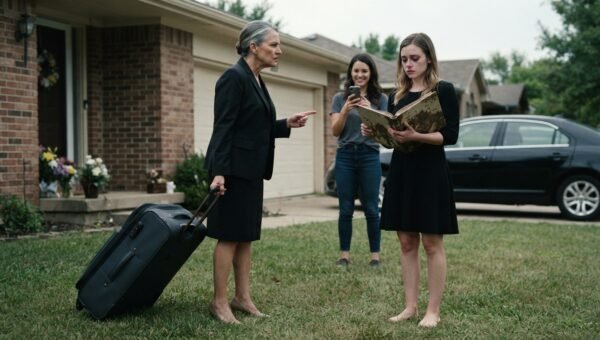
My daughter-in-law, Brenda, asked me to return every key to their house because she said privacy matters now that our routines were changing. I was sixty-two years old, standing on the flagstone porch my husband and I had helped pay to seal three summers before, holding a small brass ring with two silver keys.
She did not smile when she asked. She held out her hand flat, palm up, the way someone takes money from a stranger.
My son, Mark, stood two steps behind her near the screen door, looking down at the laces of his work boots. He did not look up once.
“It is just better for boundaries, Evelyn,” Brenda said. “Every family needs them. You understand.”
I felt hot behind my neck, the kind of embarrassment that makes your mouth go dry. I had never walked into their house unannounced in my life. If I brought over Sunday pot roast or washed school clothes for my nine-year-old grandson, Leo, I texted first from my driveway, then knocked and waited. But I did not argue. I slid the ring off my car key, dropped the brass set into her palm, and said, “Of course.”
Three months went by. The house felt three times farther away than the seven-minute drive it actually was. I stopped offering to pick Leo up from track practice. When Mark called on Tuesdays, the calls lasted four minutes, mostly about the weather, oil changes, or his lawn mower.
I told myself it was normal. Grown boys make their own lives, and wives set the tone for their homes.
Then, on a rainy Tuesday in early October around four in the afternoon, my landline rang.
“Grandma?” The voice was tiny, shaky, and competing with the hiss of rain.
“Leo? Honey, where are you?”
“I’m at Mr. Henderson’s garage. Next door. Grandma, my house door is locked. The garage keypad isn’t working and it’s raining real hard. Mom isn’t home from her appointment.”
“Did you call your dad?”
“His phone went straight to voicemail. Mr. Henderson let me use his phone. Can you come unlock the door?”
My chest tightened. “Honey, I don’t have a key anymore. Remember?”
There was a quiet sniffle on the line. “Oh. Yeah.”
“Stay right on Mr. Henderson’s porch under the awning,” I said, already grabbing my raincoat off the peg by the kitchen door. “I am leaving my driveway right now.
I will sit in the car with you until your mom gets home.”
When I pulled up to their curb, Leo was sitting on Mr. Henderson’s porch steps, hugging his backpack against his chest to keep his homework dry. His sneakers were soaked through. I thanked our old neighbor, tucked Leo under my umbrella, and walked him over to my Buick. I started the engine, turned the heater all the way to high, and pulled a clean fleece throw from the back seat to wrap around his shoulders.
He leaned against the passenger door, shivering. “I’m sorry, Grandma. I’m sorry.”
“For what, sweetheart? You didn’t do anything wrong. Keypads run out of batteries. It happens to everybody.”
“No,” he whispered, staring down at his wet knees. “Mom says I forget things like Grandma. She says I have a bad head like you.”
The words hit me like a slap in the face. I kept my hands steady on the steering wheel. “What do you mean, like Grandma?”
Leo bit his lip. He hesitated, looking out at the rain washing down the windshield, then reached down into the front pocket of his canvas backpack. He pulled out a small, blue-lined spiral notebook, the cheap kind with a bent cardboard cover.
“Mom makes me write down every mistake,” he said, his voice barely audible over the car heater. “Whenever I lose a pencil or leave my lunchbox. She said if I don’t track them, I’ll end up confused and careless like you.”
My stomach turned over. “Did she write in that notebook, Leo?”
He nodded once, opened the cover, and flipped straight to the very back page.
The handwriting was unmistakable. It was Brenda’s tight, slanted cursive in black gel pen. Across the top of the ruled page, she had written a title: Reasons Grandma Can’t Be Trusted.
Beneath it were numbered bullet points.
Number one said: Tried to steal our house by demanding her name stay on the secondary loan papers.
Number two said: Took vintage gold necklace from master bedroom drawer during Thanksgiving dinner.
Number three said: Showing early signs of dementia; lies about conversations when confronted.
I stared at the page until the blue lines blurred. None of it was true. Mark and Brenda had asked me to co-sign when their credit score dipped four years ago, and my bank insisted my name remain on the deed until the secondary balance was cleared. As for jewelry, I hadn’t set foot in their master bedroom since they painted it five years ago.
Before I could speak, headlights swept across my windshield. Brenda’s silver SUV pulled hard into the driveway, splashing muddy water toward the curb.
She climbed out, slammed her door, and marched straight toward my car. She jerked the passenger door open, grabbed Leo by the forearm, and pulled him out into the cold rain without looking at me.
“Get inside right now, Leo,” she snapped. “Go.”
Leo scrambled up the porch steps, head down, leaving the fleece blanket on my seat.
Brenda turned on me, her eyes narrowed, rain dripping off the hood of her jacket. “You had no business being here, Evelyn. We told you what the rules were.”
“His hands were blue from the cold, Brenda,” I said, my voice shaking despite my best efforts. “He was locked out in fifty-degree rain.”
“He has a neighbor. We have a system. You stay away until you’re invited.” She slammed my car door shut before I could say another word.
I drove home with my knuckles white on the wheel, my heart pounding in my throat. I couldn’t stop seeing that blue notebook. I sat in my quiet kitchen for three hours, not even turning on the overhead lights, watching the rain beat against the windowpane.
At eight-thirty, my phone rang on the counter. I picked it up.
It was Mark. He didn’t say hello. He was shouting.
“What is wrong with you, Mom? Why are you collecting evidence against my wife?”
“What are you talking about, Mark?” I asked, bewildered.
“Don’t play dumb! You were digging through things in the car, trying to build a case against Brenda! She told me you were pumping Leo for information!”
“I did not pump him for anything! He showed me that notebook, Mark! The things written in the back about me stealing from you and trying to take your house—”
“How would you even know what’s in that book unless you went looking?” Mark yelled. “Brenda knows what you did! The camera in Mom’s purse showed you!”
The kitchen went dead quiet.
“What did you just say?” I asked, my voice dropping to a whisper.
“The camera,” Mark said, his voice suddenly hitching, stumbling over his own sentence. “The… the camera in your purse.”
I gripped the counter edge until my fingers ached. “Mark. I don’t own a camera. And I didn’t have my purse in the car today. It has been sitting on my kitchen counter since noon.”
On the other end of the line, my son went completely, totally silent.
PART 2
The silence on the line stretched out so long I could hear Mark’s rough, shallow breathing through the receiver.
“Mark?” I said.
He cleared his throat, but the anger was completely gone from his voice. It had collapsed into something hollow and terrified. “Mom… whose purse was it?”
“My purse is sitting right next to the fruit bowl where I left it when I got home from the pharmacy at twelve-fifteen,” I said, staring at the worn black leather bag. “I ran out to get Leo with only my car keys and my umbrella. I didn’t take a purse. But Leo had his backpack.”
“No,” Mark muttered, almost to himself. “No, she said… she said she checked the footage from the bag.”
“Whose bag, Mark?”
He hung up.
I called him back immediately. The call rang once and clicked over to his automated greeting. I tried a second time, and it went straight to voicemail.
I didn’t sleep that night. Every time I shut my eyes, I saw that ruled sheet of paper in the back of the spiral notebook. I kept thinking about the two specific accusations Brenda had written down: the house deed and the gold necklace.
Four years earlier, Mark had come to my kitchen table on a Sunday afternoon, with red-rimmed eyes and a stack of overdue mortgage notices. He and Brenda had refinanced to build an addition on the back of the house, but the contractor had walked off with forty thousand dollars, and their credit was ruined. They faced foreclosure within sixty days.
My husband, Richard, had passed away two years before that, leaving me the modest pension and our paid-off ranch home. I didn’t have forty thousand dollars in cash, but I had spotless credit and equity. I agreed to co-sign a $65,000 secondary equity loan with their credit union to save their home, on one strict condition set by the bank’s loan officer, Mr. Miller: because my name was guaranteeing the primary risk, my name had to be recorded on the deed as a joint tenant until that loan was paid down to zero.
Brenda had smiled at the closing table. She had hugged me in the bank lobby and called me their guardian angel.
Now, according to her notebook, I was trying to steal their home.
At seven in the morning, I didn’t call. I didn’t text. I put on my coat, grabbed my actual purse, and drove to their neighborhood.
Mark’s work truck was still parked in the driveway, which was unusual; he normally left for the supply warehouse by six-thirty. As I stepped onto the front porch, the front door swung open before I could knock.
Mark stood in the hallway. His eyes were bloodshot and his shirt was rumpled, as if he had slept in his clothes. Behind him, sitting on the bottom step of the staircase, was Leo. The boy looked pale, his hands clamped tightly between his knees.
Brenda was standing at the kitchen island, holding a white ceramic mug with both hands. Her face was tight, drawn, and completely pale.
On the kitchen island, sitting between Brenda’s mug and the fruit basket, was Leo’s canvas backpack. The front pocket was unzipped. Resting on the counter beside it was a small black plastic cylinder no bigger than a tube of lip balm, connected to a short charging cord.
A portable pinhole lens.
“Mark,” I said quietly, stepping into the foyer. “What is this?”
Brenda didn’t give Mark a chance to answer. She set her mug down with a sharp clatter against the granite. “You need to leave, Evelyn. This is a private family matter.”
“You put a recording device in a nine-year-old child’s school bag,” I said, looking directly at her. “You sent him out into the world with a surveillance camera so you could watch where he went and what he said.”
“I have a right to protect my family!” Brenda’s voice cracked, rising in pitch. “I have a right to know what you’re saying to my son, and what you’re filling Leo’s head with! You’ve been trying to control us since the day we bought this house!”
“By co-signing your loan when you were thirty days from a sheriff’s sale?” I asked.
“By keeping your name on our deed!” she yelled, pointing a trembling finger toward the floor. “You hold it over our heads! You think you own us! We can’t refinance, we can’t sell, we can’t take out a single dollar of equity without your signature! You’ve trapped us!”
Mark stepped forward, his voice cracking. “Brenda, stop. Just stop.”
“No!” she snapped, turning on him. “Tell her! Tell her what you promised me last year!”
Mark closed his eyes. The room went dead still, save for the hum of the refrigerator.
“What did you promise her, Mark?” I asked.
Mark wouldn’t look at me. He looked at the floorboards between my boots and his. “She wanted me to petition the county to have your name removed from the title. She said… she said if we claimed you were experiencing cognitive decline, the credit union would allow an emergency modification based on financial abandonment.”
A cold weight settled in my chest, heavy and suffocating.
The notebook wasn’t a discipline tool for a nine-year-old boy. It was a fabricated paper trail. She had made Leo write in it, and she had written her own false entries in the back, creating a deliberate record to portray me as erratic, forgetful, and mentally unfit.
“And the jewelry?” I asked, my voice barely above a whisper. “The gold necklace you wrote down that I stole at Thanksgiving?”
Brenda crossed her arms tightly, her lips pressed into a hard, bloodless line. She didn’t blink. “I couldn’t find it after you left. You were the only one who went down the hall to the guest bath.”
“Mark,” I said. “Look at me.”
He slowly raised his head.
“Did you believe that?”
Mark swallowed hard. His throat worked, but no sound came out. The fact that he hesitated told me everything I needed to know. He hadn’t stopped her. He had let her plant the camera. He had let her accuse me on the phone last night. He had stood by while his wife poisoned our grandson’s mind against me, all because he was too weak to tell her that the house wasn’t entirely theirs to risk.
“I need you both to listen to me very carefully,” I said.
PART 3
I walked over to the kitchen island, picked up the small pinhole camera, and set it back down.
“You didn’t lose that gold necklace, Brenda,” I said.
Brenda scoffed, tossing her head. “Oh, really? And how would you know that?”
“Because three weeks after Thanksgiving, Sarah down at Miller’s Consignment in town called me,” I said. “She knows our family. She has known Richard and me for thirty years. She called because a young woman had brought in a 14-karat rope chain with a small sapphire drop to sell for cash, and the original jeweler’s mark was my husband’s initials from 1984. Sarah thought maybe I had given it to you as a gift, but she wanted to make sure before she wrote the payout check, because the person selling it seemed desperate.”
Brenda’s posture stiffened instantly. Her chin dropped an inch.
“I didn’t say a word to Mark,” I continued, watching her eyes dart toward the hallway. “I didn’t say a word because I felt sorry for you. I thought you two were behind on the utility bills again. I paid Sarah two hundred and eighty dollars out of my own checking account to buy Richard’s mother’s chain back, and I put it in my safe deposit box. I never brought it up because I didn’t want to humiliate you.”
Mark turned his head slowly toward his wife. His voice was terrifyingly calm. “You sold my grandmother’s necklace?”
“We were behind on the car note, Mark!” Brenda burst out, her face mottled with red. “You didn’t have the overtime! Somebody had to do something!”
“By telling our son that my mother stole it?” Mark’s voice rose, breaking on the words. “By making Leo write down that his grandmother is losing her mind?”
“I was trying to get the house clear!” she cried. “The bank said if she stayed on the deed, we couldn’t roll the secondary loan into a new mortgage to pay off the cards! She had us backed into a corner! We’ve lived under her thumb for four years!”
“I never asked you for a single dime of interest,” I said, my voice steady and cold. “I co-signed that $65,000 note so my grandson wouldn’t lose his bedroom. I stayed on the deed because the credit union required it to protect my estate. And for four years, while I stayed out of your way and gave you your space, you were coaching this little boy to believe I was sick and dangerous.”
I walked over to the bottom of the stairs where Leo sat. He was crying silently, wiping his nose on the sleeve of his flannel shirt. I knelt down so I was at eye level with him.
“Leo,” I said gently.
He looked up, terrified. “Grandma, I didn’t mean to show you the book. Mom told me never to take it out.”
“You did the right thing, sweetheart,” I told him. “You are not careless. You do not have a bad head. You are smart, and you are kind, and you didn’t do anything wrong.”
I stood up and turned back to Mark and Brenda.
“Here is what is going to happen,” I said. “Mark, you are going to call the credit union this morning. You are going to request the exact remaining payoff balance on that secondary loan. If you cannot refinance it on your own credit by the end of next month, I will exercise my right as a joint tenant on the title to force a partition sale of this property.”
Brenda let out a sharp, ragged gasp. “You can’t do that! This is our home!”
“My name is on the deed, Brenda. The exact thing you tried to claim I was stealing gives me the legal authority to force the sale of this house to clear the debt attached to my credit.” I looked at my son. “And until that debt is settled and this situation is handled, do not call me to ask for help. Do not send Leo to my porch. If you want to see me, Mark, you come alone, and you come with the payoff receipt.”
I walked out the front door into the morning light. Behind me, the house erupted into shouting, but I didn’t turn around. I got into my Buick, locked the doors, and drove straight home.
ENDING
The partition paperwork never had to be filed.
Two weeks after that morning in their kitchen, Mark went to his branch manager alone. To clear my name from the title, he had to take out a high-interest personal loan to cover the remaining $18,400 balance on the secondary note, combined with a strict repayment schedule that took every spare dollar of his overtime. The credit union released my obligation on the second Tuesday of November.
I sat at the mahogany conference table with the loan officer, signed the quitclaim deed, and handed the paperwork across the desk. My credit was free. My name was off their house.
When Mark walked out to the parking lot with me, he looked older. There were deep lines around his mouth, and he couldn’t hold my gaze for more than a few seconds at a time.
“She’s staying with her sister in Altoona for a while,” he said, staring at the gravel between our cars. “We’re… we’re trying to figure out what’s left. Leo is seeing a counselor through the school on Thursdays. The counselor told me to throw the notebook in the fireplace. We did that last weekend. Leo watched it burn.”
“Good,” I said.
Mark reached into his coat pocket. For a second, I thought he was going to pull out an envelope or an apology letter. Instead, he pulled out a small brass ring holding two silver keys.
“I found these in her jewelry dish,” he said, his voice cracking. “I want you to have them back.”
I looked down at the keys resting in his palm. They were the exact same keys Brenda had demanded three months earlier, the ones to their front door and their deadbolt.
I didn’t take them.
“Keep them, Mark,” I said gently. “If Leo ever needs me, he knows where I live. But I don’t need to be able to walk into that house anymore.”
He swallowed hard, nodded slowly, and closed his fingers over the brass ring.
It has been six months now. Mark brings Leo over to my house every other Sunday afternoon. We sit at my kitchen table, eat chicken and dumplings, and do fifth-grade math worksheets together. Brenda hasn’t called, and I haven’t reached out to her. Mark is still working fifty-five hours a week to pay down the bank, and his marriage is still hanging by a thread, but when Leo walks through my front door, he doesn’t apologize for forgetting his jacket anymore.
Yesterday, while we were clearing the plates after lunch, Leo reached into his pocket and handed me a small, folded piece of drawing paper. On it was a sketch of my old blue Buick with two people sitting inside, smiling out through the windshield.
At the top, in his messy nine-year-old pencil print, he had written: Grandma’s car is safe.
I didn’t frame it or show it to his father. I just smoothed the creases with my thumb, walked over to the refrigerator, and stuck it right under the magnet by the calendar, exactly where it belonged.