PART 1
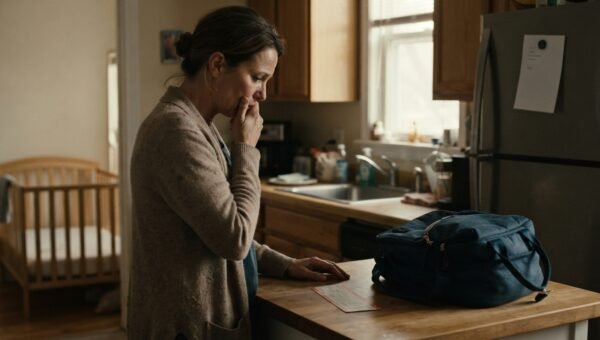
My daughter-in-law, Brenda, asked me to return every key to their house because “privacy matters.” I was sixty-four years old, and sitting at her kitchen table while she held out her open hand felt like being scolded in the principal’s office. My son, Mark, stood by the refrigerator, looking down at his socks. He didn’t say a single word.
I took my brass house key off my ring, along with the silver deadbolt copy Mark had cut for me five years earlier when they bought the place.
I put them on the table. My face burned, but I kept my voice level. I told her I understood, even though I didn’t. I had never walked in without knocking. I only came over when they asked me to watch nine-year-old Toby or when Mark needed someone to sign for a package.
Four months went by. I stayed away unless I was specifically invited. Then, on a Tuesday afternoon around three-thirty, my home phone rang.
“Grandma?”
It was Toby. His voice was thin and shaky. He was calling from Mrs. Gable’s landline next door. The school bus had dropped him off early after a teacher workday schedule change, and his parents were both at work. He was locked out on the back porch with his backpack, and it had started to drizzle.
“Stay right on Mrs. Gable’s porch, sweetheart,” I told him. “I’m coming right now.”
I grabbed my purse, got in my sedan, and drove the ten minutes to their subdivision.
But when I pulled into the driveway, the habit caught me. My hand reached straight for the glove compartment where I used to keep the emergency spare, but it wasn’t there. I had given it back.
Mrs. Gable walked Toby over under a black umbrella. She had a dentist appointment and couldn’t stay, so Toby and I sat on the porch bench under the roof overhang. He was shivering a little in his blue windbreaker. I pulled him close, rubbing his arms.
“I’m sorry, Grandma,” he mumbled. “I forgot my lanyard in my desk.”
“It’s alright, Toby. It happens to everyone.”
He stared at his muddy sneakers. “Mom says I forget things like Grandma. She says you have bad memory and that’s why you can’t be trusted.”
That phrase hit me right in the chest. I don’t have memory problems. I still keep the books for my church circle, I pay my bills on the first of the month, and I drive myself everywhere.
“When did your mom say that, Toby?”
He hesitated, then unzipped the front pocket of his backpack. He pulled out a small black-and-white marbled composition notebook. The edges were bent and dog-eared.
“Mom bought it for me,” he whispered. “She told me whenever I mess up or forget my homework, I have to write it down so I don’t turn into you.”
My stomach tightened. I took the little book from his small hands. The first ten pages were filled with his messy third-grade printing: *Forgot library book. Left water bottle in gym. Spilled juice on counter.*
Then I flipped toward the back.
The handwriting changed. It wasn’t Toby’s clumsy pencil marks anymore. It was sharp, slanted blue ink from a rollerball pen. Brenda’s handwriting.
Across the top of page forty-eight, she had written a title: *Reasons Grandma Can’t Be Trusted.*
Underneath were numbered bullet points.
*1. Tried to take the house out from under Mark when we bought it.*
*2.
Stole mother’s gold pendant and antique diamond earrings from master bedroom.*
*3. Forgetting appointments and covering it up with lies.*
*4. Dangerous around Toby due to mental decline.*
I sat there on that wet porch bench, reading those lines twice.
The first lie was venomous enough. When Mark and Brenda bought this house, I had gifted them $35,000 for the down payment from my late husband’s life insurance. My lawyer had simply drawn up an agreement stating that if they sold the house within three years, the money returned to my retirement fund. Brenda had thrown a fit back then, claiming I was trying to “own” them, so I had torn up the paperwork and let them keep the money as a pure gift just to keep the peace.
But the second lie made my hands shake. Stole jewelry? I had never touched a single piece of jewelry in their home. The only heirloom gold pendant in the family belonged to Mark’s grandmother, and Brenda had worn it to Thanksgiving two years ago.
Before I could speak, headlights swept across the wet driveway. Mark’s silver crossover pulled in. He jumped out through the rain, his tie loosened, looking stressed.
“Mom? What are you doing here?” he asked, hurrying up the porch steps.
Toby shrank back against me. I held the notebook tightly against my coat.
“Toby was locked out,” I said quietly. “His bus came early. He called me from Mrs. Gable’s.”
Mark sighed, running a hand over his face. “Brenda had an emergency at the clinic. She told me to grab him, but my meeting ran over. Thanks, Mom.”
He reached for Toby’s hand. I didn’t hand the notebook back to Toby right then. I couldn’t bear to let that poor child carry that poison in his schoolbag. I slipped it into my deep coat pocket. I told Mark to get Toby inside and dry him off.
I drove home in silence. The rain beat against the windshield, and that list burned in my pocket. I set the notebook on my kitchen counter beside my reading glasses, trying to understand why a daughter-in-law I had given $35,000 to would write down that I was a thief and feed it to my grandson.
At eight-thirty that night, my phone rang.
I picked it up. It was Mark, and he didn’t say hello. His voice was shaking with fury.
“Why are you going through Toby’s things? Why are you collecting evidence against my wife?”
I gripped the edge of the kitchen counter. “What are you talking about, Mark?”
“The camera in Mom’s purse showed you!” Mark shouted. “Brenda saw you take that notebook off the porch!”
The room went dead still. My skin went cold.
“Mark,” I said very slowly. “I don’t own a purse camera. What purse are you talking about?”
On the other end of the line, Mark’s breathing stopped completely. Then came the terrible silence, because neither of us had thought through what he had just admitted.
PART 2
“Mark?” I said.
The line stayed silent for five long seconds. I could hear his shallow breathing and the faint hum of a television in their living room.
“Whose purse had a camera in it?” I asked. My voice didn’t shake this time. The shock had cleared away, leaving something cold and hard in its place.
“Forget it,” Mark muttered. He sounded rattled now, his anger collapsing into panic. “Brenda’s just upset, Mom. She noticed Toby’s notebook was missing from his bag when she checked his homework. She asked him where it was, and he said you took it.”
“You said the camera in my purse showed me. Those were your exact words.”
“I misspoke, alright? I’m exhausted.”
“No, you didn’t misspeak,” I said. “Did Brenda put a camera in my bag?”
“No! Of course not. Mom, just bring the notebook back tomorrow. It’s Toby’s private school stuff. It’s none of your business.”
He hung up.
I stood by the counter, looking at my black leather handbag hanging on the back of the kitchen chair. It was the purse I carried every single day. A sensible shoulder bag with brass buckles that Mark had given me for Christmas two years ago.
I took the purse to the dining room table under the bright overhead chandelier. I emptied everything onto the wood: my wallet, my checkbook, tissue packets, cough drops, a pen, my reading glasses, and a small tube of hand cream.
I checked the lining. I pressed my fingers along the bottom seam. Near the small interior zipper pocket, where the fabric met the stiff leather backing, my thumb hit a hard, square lump the size of a postage stamp.
I turned the bag inside out. A tiny cut had been made along the interior seam, carefully closed with two small safety pins hidden beneath the cloth lining. Inside was a black plastic square no bigger than a car key fob. A pinhole lens poked through a minuscule slit right near the exterior brass grommet where the strap attached.
It was a battery-operated spy tracker with an internal micro-SD card and a cellular SIM slot.
I sat down on the dining chair. My hands were perfectly still now.
Four months ago, Brenda had demanded my keys because of “privacy.” Around that same time, she had offered to “clean and condition” my leather purse for Mother’s Day, saying it looked scuffed. She had kept it for three days.
She hadn’t just banned me from her house. She had planted a camera in my life. And when I had been sitting on her porch with Toby, my purse had been resting on the bench right beside us, with the lens facing directly toward Toby’s open backpack.
I didn’t call Mark back. I didn’t call Brenda.
Instead, I turned on my tablet. I am sixty-four, not senile. I worked twenty-eight years as an administrative clerk for the county district court before I retired. I knew how records worked, and I knew how accusations functioned.
Brenda’s list had four points.
The house down payment.
The missing gold pendant and earrings.
My supposed memory decline.
Being dangerous around Toby.
If Brenda was writing those things down, she wasn’t just venting. She was building a file. And if she was tracking my movements, she wanted proof that I was unfit, unstable, or a criminal.
The next morning, Wednesday, I drove to the county sheriff’s department. I didn’t make a scene. I asked to speak with Deputy Miller, whose mother had worked with me in the clerk’s office years ago.
I laid the black leather purse on his metal desk, along with the device I had carefully extracted using a pair of kitchen tweezers.
“I found this hidden in the lining of my purse,” I told him plainly. “My daughter-in-law had possession of the bag four months ago. Last night, my son told me on a recorded voicemail that Brenda saw me take a notebook because of a camera. I want to know if this is illegal surveillance.”
Deputy Miller examined the tiny lens under his desk lamp. His brow furrowed.
“In this state, Mrs. Vance, planting an electronic recording device on someone’s person or property without their consent is an interception of communications violation. It’s a felony.” He looked up at me. “Do you want to file a formal complaint?”
“Not yet,” I said. “First, I need to know about the jewelry.”
“What jewelry?”
“My daughter-in-law has put in writing that I stole an antique gold pendant and diamond earrings from her house. If she filed a police report claiming I stole them, I need to know.”
Deputy Miller typed my name and their address into his terminal. He clicked through several screens.
“Nothing under your name, Evelyn,” he said. “No reports involving you as a suspect. But there is an incident report filed by a Brenda Vance three months ago. A residential property theft.”
My chest tightened. “What did it say?”
“She reported a nineteenth-century gold filigree pendant and two diamond drop earrings stolen from her master closet. Value estimated at eight thousand dollars. But she didn’t name you.”
“Who did she name?”
Deputy Miller adjusted his glasses. “She reported it as an unknown intruder. She claimed a back door key had gone missing months prior, suggesting someone used a stolen key to enter while the family was away.”
The air left my lungs.
She had taken my keys in February. In March, she had reported the jewelry stolen, claiming an old key had been used. In the notebook, she wrote that I took them.
She was setting me up. If she ever needed to cut me off completely, or if she wanted to justify keeping Toby away from me forever, she had a police report with an unaccounted-for key, a written ledger of my “confession” to Toby, and a hidden camera watching me.
“Deputy,” I said, “how did she value that jewelry at eight thousand dollars?”
“It says here she submitted an appraisal certificate for an insurance payout. The claim was approved by State Farm in April.”
I looked at the counter. A terrible realization clicked into place.
I knew that gold pendant. It had belonged to my mother-in-law, Martha. Martha had given it to Mark before she passed, with the explicit instruction that it stay in the family. It wasn’t worth eight thousand dollars. Martha had it insured for twelve hundred dollars back in 1998. It was fourteen-karat gold with a small seed pearl, not an eight-thousand-dollar antique.
“Can you hold that camera in evidence property, Deputy?” I asked. “Just in case I need the chain of custody.”
“I can log it right now,” he said. He handed me an evidence property receipt: Item #4092, audio-visual recording module.
I took the receipt, put it in my wallet, and walked out to my car.
There was one place Brenda would go if she needed quick money or a fake appraisal. Her brother, Kevin, ran an independent jewelry and pawn shop on the north side of the county.
I started my car and drove across town.
PART 3
Kevin’s shop sat in a strip mall between an auto parts store and a dry cleaner. The neon sign in the window read *Northside Gold & Estate Jewelry.*
I had known Kevin since Mark and Brenda were in college. He was twenty pounds overweight, always smelled of cheap cigars, and had declared bankruptcy twice before opening this shop with money loaned to him by his parents.
The bell above the door chimed as I walked in. Kevin was behind the glass counter, polishing a silver watch with a rag. When he saw me, his smile froze.
“Evelyn,” he said, shifting his weight. “What brings you out this way? Mark isn’t with you?”
“No, Kevin. Mark isn’t here. I came to see Martha’s pendant.”
Kevin didn’t move. The cloth stayed flat against the watch face. “I don’t know what you’re talking about. Martha’s jewelry belongs to Brenda.”
“Brenda filed an insurance claim on it three months ago,” I said calmly, resting both hands on the glass counter. “She told State Farm it was stolen by someone using a missing house key. She got a check for eight thousand dollars based on an appraisal. And she wrote in Toby’s schoolbook that I stole it.”
Kevin’s face turned a dull, blotchy red. “Evelyn, whatever family stuff you got going on with Brenda, leave me out of it.”
“You wrote the appraisal, didn’t you?”
He looked toward the back office door. He didn’t answer.
“I just came from the sheriff’s department, Kevin. Deputy Miller has the spy camera Brenda hid in my purse. Filing a false insurance claim over five thousand dollars is grand theft in this state. Providing a fraudulent appraisal to defraud an insurer makes you an accomplice. If that pendant is sitting in your safe right now, the deputies will find it when they execute the search warrant.”
I didn’t have a search warrant. But Kevin was a coward who had already lost two businesses to sloppy paperwork.
“She told me it was just between family!” Kevin blurted out, his voice cracking. “She said you were trying to take back the down payment money and they were drowning in credit cards! She told me Mark was going to lose the house if they didn’t clear eighteen grand by spring!”
I stood there, letting the words settle.
They weren’t drowning because of me. They were drowning because Brenda had leased a luxury SUV she couldn’t afford and had renovated their kitchen last summer.
“Where is the pendant, Kevin?”
He swallowed hard. He stepped into the back room and returned thirty seconds later holding a small velvet pouch. He dumped it onto the counter.
There was Martha’s filigree pendant, along with the two diamond drop earrings. Beside them was a carbon copy of a store receipt dated March 14th. It showed Brenda had sold the items to the shop for six hundred dollars cash. Kevin had then written an insurance appraisal slip valuing the exact same pieces at $8,200.
She had double-dipped. Six hundred dollars cash from her brother, eighty-two hundred from the insurance company, and a paper trail designed to frame me if anyone asked why the family heirlooms were gone.
“Give me the receipt copy, Kevin,” I said.
He handed it across the glass without a word. His hands were trembling.
“If anyone asks,” I told him, “you bought these over the counter. But if Deputy Miller calls you, you tell the truth. Because if you lie to protect Brenda, you will go to prison for insurance fraud.”
I took the receipt, left the velvet pouch on the counter, and walked out.
I drove straight to Mark and Brenda’s house. It was two in the afternoon. Brenda’s medical clinic shift ended at one on Wednesdays.
Her white SUV was parked in the driveway.
I didn’t have a key anymore. I walked up the porch steps, past the bench where Toby and I had sat in the rain yesterday, and knocked three firm times on the front door.
Brenda opened it. She was wearing her blue nurse scrubs. Her hair was pulled back in a neat clip, and her expression was instantly cold.
“Evelyn,” she said, blocking the doorway with her arm. “Mark told you to return the notebook. We don’t want you coming over unannounced. We’ve talked about boundaries.”
“Step inside, Brenda. Or we can have this conversation right here on the porch where Mrs. Gable can hear every word.”
She glared at me, but she stepped back into the foyer.
Mark came out of the kitchen holding a mug of coffee. When he saw me, his jaw tightened. “Mom, I told you I’d come by your house tonight.”
“Sit down, Mark,” I said.
My voice was quiet, but it had the authority of thirty years of running a household and twenty-eight years of managing court records. Mark looked at my eyes, then set his mug on the hall table and sat down on the edge of the living room sofa. Brenda remained standing, her arms crossed tight against her chest.
I took the evidence property receipt from the sheriff’s office and laid it on their glass coffee table.
Beside it, I placed the carbon copy from Kevin’s shop.
And on top of both, I laid Toby’s composition notebook, opened to page forty-eight: *Reasons Grandma Can’t Be Trusted.*
Brenda looked at the papers. Her arms slowly uncrossed.
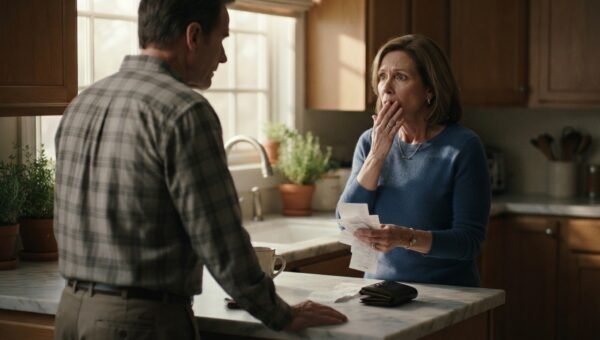
“What is this?” Mark asked, leaning forward. He picked up the shop receipt first. He read the description: *14k antique filigree pendant, seed pearl, family piece.* He read Brenda’s signature at the bottom. Then he saw the six-hundred-dollar payout.
“Brenda?” Mark said, his voice cracking. “This is my grandmother’s necklace. You told me this was stolen in March. You cried on the bedroom floor when you called the insurance company.”
Brenda’s mouth opened, but no sound came out. Her eyes darted from Mark to me.
“She sold it to Kevin for six hundred dollars,” I told Mark. “Then Kevin wrote an appraisal for eighty-two hundred dollars so she could collect an insurance check. And she told Toby, and wrote in his book, that I stole it with the extra key.”
Mark stared at the paper. His face went gray. “You… you told me the police suspected my mother because of the back door key. You told me we had to change the locks.”
“Mark, listen to me,” Brenda began, her voice shrill and fast. “We were five months behind on the second mortgage! The bank was sending cure notices! Your mother had thousands sitting in her certificates of deposit and she wouldn’t help us without holding it over our heads!”
“I gave you thirty-five thousand dollars!” I said, cutting through her panic like a knife. “I gave you the down payment! I tore up the agreement so you wouldn’t feel indebted to me! And you put an illegal recording device inside my purse so you could watch me in my own home.”
Mark looked up from the table. “The camera… you really put it in her bag?”
“She was going to find out!” Brenda screamed, pointing a shaking finger at me. “She’s always checking! She knew how much Martha’s jewelry was worth! I had to know if she was talking to Kevin! I had to know what she was telling Toby!”
“You put a felony wiretap on my mother,” Mark whispered. He looked like he was about to be sick. He covered his face with both hands. “You used our son to track her. You made our nine-year-old boy write down that his grandmother was losing her mind.”
“I did it for this family!” Brenda cried.
“No,” I said, standing up tall. “You did it for yourself. Because you couldn’t stand that I saw right through you. You wanted to make me look crazy and dishonest so that when the jewelry came to light, Mark would believe you instead of me.”
The living room fell completely silent. The only sound was the ticking of the grandfather clock in the corner, a clock that had belonged to my late husband.
Brenda sank onto the arm of the accent chair. She wasn’t yelling anymore. She looked small, ugly, and caught.
“What are you going to do?” she asked in a thin, defeated whisper. “Are you going to have me arrested?”
I looked at Mark, sitting on the sofa with his head in his hands, completely broken. Then I thought of Toby, sitting on that wet porch yesterday, believing he was flawed because his mother told him he was turning into his grandmother.
“Here is what is going to happen,” I said.
ENDING
I didn’t send Brenda to prison. I thought about it on the drive over, but sending Toby’s mother to jail for insurance fraud would have destroyed that little boy’s life, and I refused to let her sins ruin his childhood any further.
Instead, I laid down the terms, and I did not negotiate.
First, Brenda had to call State Farm in my presence and withdraw the claim, citing “misplaced property found in storage,” and repay every cent of the eight-thousand-dollar settlement. She had to take a personal loan from her own retirement account at the clinic to do it.
Second, Kevin handed Martha’s filigree pendant and earrings back to Mark that afternoon. They now sit in my safe deposit box at the bank, where they will remain until Toby turns twenty-five.
Third, Brenda had to sit Toby down at the kitchen table with me present. She had to look her son in the eye and tell him that his grandmother had never stolen anything, that his grandmother’s memory was sharp, and that he was never, ever to write in that notebook again.
I watched Toby’s face as she told him. The relief on that nine-year-old child’s shoulders was visible. He didn’t cry. He just reached across the table and held my fingers.
As for Mark, something broke between him and Brenda that afternoon that will never fully heal. He didn’t divorce her immediately, but he took over every single financial account. He moved into the guest bedroom for five months. He stopped letting Brenda manage the household money, and he hired an accountant to audit their debt.
He came by my house two weeks later with a brand-new set of brass keys on a green plastic ring.
He held them out to me on my front porch, his eyes red and swollen.
“Take them back, Mom,” he pleaded. “Please.”
I looked down at the shiny brass keys in his hand. They caught the afternoon sun.
“No, Mark,” I said gently.
He looked at me like I had slapped him. “Mom, I trust you. I swear to God I trust you.”
“I know you do, son,” I said. “And I love you. But I don’t need a key to your house anymore. When you need me, you call me, and you open the front door yourself.”
I left the keys in his hand and closed my door.
It has been a year since that rainstorm on the porch. Toby comes over to my house every Sunday afternoon. We bake cookies, we work on his fourth-grade science projects, and we sit on the back patio playing gin rummy. He leaves his schoolbag by the coat rack, completely empty of notebooks.
I still have that little marbled composition book in the bottom drawer of my desk. I kept it not out of bitterness, but as a reminder. When someone tries to make you believe you are losing your mind, you don’t argue with their words. You just look at the receipts.