PART 1
My grandmother left her handwritten recipe book to my cousin Sarah, even though I had cooked beside her every Sunday afternoon for twenty-two years.
When the lawyer read that line from Grandma Evelyn’s will in the quiet conference room, my face grew hot. It was embarrassing how deep the sting went. Sarah did not cook. She ordered takeout four nights a week and openly joked about using her oven to store shoe boxes.
Yet when she walked out of that office carrying the thick, oil-stained binder with its cracked leather spine, she held it like a prize she had won at a carnival.
I told myself to let it go. Grandma was eighty-eight when she died in April, tired and thin, and people make strange choices when their minds start to drift. Still, every Sunday after church felt hollow. I missed the smell of cinnamon and roasting flour in her kitchen, and I missed the steady way she used to guide my hands over pie crust.
A month later, a thin manila envelope arrived in my mailbox with Sarah’s scrawled handwriting on the front.
Inside was a single page torn straight out of the binder. There was no card, no note, and no explanation. Sarah had kept the rest of the book and mailed me just the recipe for Grandma’s Dutch apple pie.
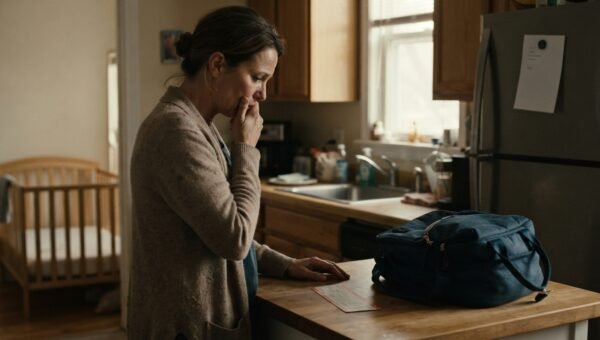
I stood by my kitchen counter, angry enough to throw it straight into the garbage can under the sink. It felt like an insult, a petty scrap tossed my way so Sarah could say she gave me something. But when I smoothed the creased yellow paper against the granite, something looked completely wrong.
Grandma’s real apple pie recipe was engraved in my memory. We used six cups of peeled Granny Smith apples, a pinch of nutmeg, white sugar, and brown sugar. On this page, half the lines were bizarre. It called for sweet cream, dried mint, allspice, and lard, none of which had ever touched her crust.
Then I looked at the left margin. The first letter of every line was capitalized in dark blue ink.
M.
A.
R.
G.
A.
R.
E.
T.
Margaret. My name.
The handwriting was shaky, but the ink had been pressed hard into the paper.
Beside the strange ingredients, Grandma had written numbers instead of usual kitchen measurements. Beside the sweet cream was 04-12-1974. My birth date. Beside the dried mint was 10-03-1982. The exact Tuesday my mother died in the county hospital.
Beside the final line, next to two teaspoons of salt, the date read 10-18-2026. Next month.
At the very bottom of the torn sheet, below where the pie baking instructions should have been, Grandma had written two sentences in a faint pencil stroke:
“Bring this page to the county archive before that date. Ask for sealed ledger 44.”
I didn’t wait. I took off work the next morning and drove thirty miles south to the county records building.
The clerk behind the counter was an older woman named Mrs. Henderson, wearing silver reading glasses on a beaded chain. She took the torn yellow sheet, adjusted her glasses, and walked into the back room without a word.
When she came back ten minutes later, she set a thick manila folder tied with faded red string on the counter. The red seal was cracked.
She looked up at me over her glasses and asked, “Are you here to claim the child record your grandmother hid forty-two years ago?”
PART 2
The counter between Mrs. Henderson and me felt cold under my palms.
“I don’t know what you mean by a child record,” I said. My voice sounded thin in the quiet room. “My grandmother gave me this paper. Her name was Evelyn Miller.”
Mrs. Henderson untied the red string without rushing. “Evelyn worked here in the county clerk’s office for twenty-six years, dear. She knew how files moved, and she knew how they disappeared. In 1982, before she retired, she deposited this under a special administrative hold. It was flagged to be destroyed on October eighteenth, 2026, when the statutory retention period expired.”
She slid the top document across the counter.
It was a certified hospital birth certificate from Mercer County General Hospital, dated April 12, 1974.
My eyes went immediately to the infant line: Baby Girl Miller. Seven pounds, two ounces.
Then my gaze dropped to the mother’s line. It didn’t say Clara Miller, the quiet woman I had grown up calling Mom, who had passed away from pneumonia when I was eight years old.
The mother’s name was Diane Miller. My aunt Diane. Sarah’s mother.
The father’s line was stamped blank.
“Diane was seventeen in the spring of 1974,” Mrs. Henderson said gently, her eyes resting on the file. “Evelyn handled the vital records intake herself that year. There’s a private deposition inside, signed by Evelyn and Clara, witnessed by Judge Thomas Vance.”
My fingers shook as I pulled the yellowed legal paper forward.
The document explained everything in blunt, legal terms. In 1974, seventeen-year-old Diane had become pregnant while still living at home. To protect Diane’s reputation and keep the family from scandal in our small church community, Grandma Evelyn had arranged for Clara, her older, married, childless daughter, to take the baby home straight from the hospital ward.
Clara and her husband raised me on their farm two miles down the road. They never formally filed adoption papers through the state court; Grandma had simply switched the county birth registry ledger to show Clara as the birth mother, keeping the original record locked in the archive vault under her own administrative seal.
Eight years later, when Clara died, Grandma brought me into her home and raised me herself. Aunt Diane had already moved to Chicago, married an insurance adjuster, and had Sarah.
I looked at the date Grandma had written beside the dried mint: 10-03-1982. The day Clara died.
Grandma had buried her oldest daughter, taken custody of me, and come straight to this building to lock the real file under ledger 44. She knew the law. She knew that after fifty-two years, the archive system routinely shredded closed administrative holds that were never contested. If October eighteenth passed, the only paper proving who I actually was would have been turned into grey pulp.
“Why would she give the book to Sarah?” I whispered.
Mrs. Henderson tapped the open file. “Evelyn left a handwritten affidavit in this folder three years ago, Margaret. She updated it right before she stopped driving. She wrote that Diane and Sarah had spent the last five years demanding she sign over the family farm in trade for their silence.”
PART 3
I sat in my car in the gravel lot outside the records building for an hour, the certified copies resting on the passenger seat.
Everything I had lived through since childhood was suddenly turned upside down. Clara had loved me with a fierce, quiet devotion, but she had never been my birth mother. Aunt Diane, the woman who only sent twenty-dollar bills on my birthdays and barely spoke to me at Thanksgiving dinners, was the woman who had carried me.
And Sarah, the cousin I had envied for her confidence, was my half-sister.
I drove straight to Aunt Diane’s brick ranch house on the north side of town. Sarah’s silver sedan was parked in the driveway beside her mother’s Buick.
I didn’t knock softly. I banged on the screen door until Sarah opened it, wearing a pair of sweatpants, holding a mug of tea. When she saw the yellow recipe page clutched in my hand, the color drained out of her face.
“Margaret,” she said, backing up two steps. “What are you doing here?”
“I went to the archive, Sarah,” I said, walking right past her into the living room.
Aunt Diane was sitting on the sofa with a local newspaper open across her lap. She looked older than she had at Grandma’s memorial service, her gray hair pinned back, her reading glasses resting low on her nose. She looked up at me, and when she saw the manila folder under my arm, her mouth tightened into a hard, straight line.
“You had no right to dig into old family business,” Diane said. Her voice wasn’t loud, but it was cold. “Evelyn promised she would let that record expire.”
“She didn’t promise you anything,” I said. I laid the certified birth record directly over her newspaper. “She gave the recipe book to Sarah because she knew Sarah would look through it for whatever she thought was valuable, find this page, and throw it at me to be spiteful.”
Sarah stood in the hallway doorway, her arms crossed over her chest. “Grandma promised Mom the farm acreage,” Sarah said, her voice rising. “Mom sacrificed her entire youth for this family. She had to move away. She had to start over in Illinois while Clara got to play the happy mother.”
“You blackmailed an eighty-five-year-old woman,” I said, looking directly at Diane. “You told her you would tell the entire town Clara was a fraud and drag her name through the dirt if she didn’t leave the forty acres to Sarah.”
Diane didn’t look down at the certificate. She stared straight at the wall behind me. “Clara got eight years with you. She got the baby shower. She got the sympathy when she got sick. I got sent to an aunt’s house in Peoria until my stomach went down.”
“And Grandma protected you,” I said. “She protected you so well that you turned it into a weapon against her when she was too tired to fight you back.”
I pulled Grandma’s final affidavit from the folder.
“Grandma didn’t leave you the land, Diane,” I said quietly. “In this statement, she explicitly deeded the farm to the survivor named in the sealed archive file upon presentation of the birth registry page. She wrote it three years ago, witnessed by her attorney, David Keller. The only way the land went to Sarah was if ledger 44 was destroyed without being claimed.”
Sarah took a step forward, her eyes wide. “That’s not fair. Grandma gave me the book. The book was mine.”
“You didn’t want the book, Sarah,” I said. “You wanted forty acres of timberland you could sell to a developer. You tore out this page because you thought it was a pathetic leftover you could use to make me feel small. Grandma knew you couldn’t resist twisting the knife.”
Neither of them spoke. The house was completely silent except for the hum of the refrigerator in the next room.
Diane looked down at the birth certificate then. Her eyes lingered on the date, April 12, 1974. For five seconds, something soft flickered across her face, an old regret that had turned sour over forty years of bitterness. But she didn’t reach out to touch the paper, and she didn’t look at me.
“Take the copies,” Diane said, her voice barely above a whisper. “Get out of my house.”
ENDING
I walked out to my car and didn’t look back through their front window.
Two weeks later, David Keller finalized the deed transfer at his office on Main Street. The forty acres of farmland and Grandma’s old white-sided house now sat legally in my name. Sarah and Diane did not attend the signing, and neither of them called me.
Sarah kept the leather recipe binder. I never asked for it back.
I didn’t need the binder to remember how Grandma made her beef stew, or how she rolled her egg noodles across the floured kitchen table until they were paper thin. I had twenty-two years of Sundays stored in my own hands, memories that no lawyer’s reading and no torn page could ever take away from me.
On Sunday morning, I drove out to Grandma’s farm. The house was quiet and smelled of old cedar and dry floorboards.
I carried a sack of Granny Smith apples from the market into the kitchen, set them on the yellow laminate counter, and took out my paring knife. I didn’t use the strange ingredients from the archive page. I peeled six apples, cut them into even slices, and tossed them with brown sugar, white sugar, and a pinch of nutmeg.
As the oven heated up, I took the torn yellow page from my purse.
I looked at my name spelled out in Grandma’s firm blue letters down the left margin. She had known me better than anyone else ever had. She knew my patience, she knew my stubbornness, and she knew I would never throw away something she had written for me.
I folded the paper carefully, slid it into an old wooden recipe box Clara had given me when I was six years old, and shut the lid.