PART 1
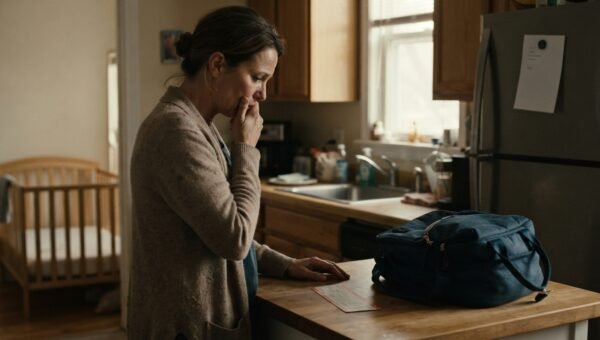
For four years, our joint checking account took the hit. Every single month, $650 went to county property taxes, insurance, and the minimum electric and water bills on an empty two-story colonial twenty minutes across town.
It was his mother’s house. Evelyn had passed away after a long illness, and from the day we buried her, my husband, Greg, dug his heels in. Anytime I brought up listing it or even renting it out so we wouldn’t drain nearly eight thousand dollars a year from our own retirement savings, his jaw would set.
“It’s family, Sarah,” he would tell me, his voice taking on that low, defensive edge that warned me to drop it. “That’s my childhood home. I’m just not ready to hand the keys to strangers. Give me a little time.”
I gave him time. I tried to be the understanding wife. We were both fifty-two, our own daughter was out of college and married, and I told myself grief had no calendar. But eight thousand dollars a year was real money to us. I was working thirty hours a week at an insurance agency, and Greg was an estimator for a commercial roofing company. We weren’t wealthy. We drove cars that had over a hundred thousand miles on them.
Then came a Tuesday morning in October.
I was at my desk cross-referencing policy renewals when my personal cell rang. The caller ID showed our municipal water authority.
“Is this Sarah Miller?” a woman asked.
“Yes, it is.”
“Mrs. Miller, we’re calling regarding the service address on Maple Street. Our automated meter system flagged continuous high usage over the last four days.
It’s reading over three hundred gallons a day. If you don’t have an active tenant, you likely have a burst pipe or a serious leak in the basement.”
A cold knot formed in my stomach. A burst pipe in an older home could ruin the hardwood floors and rot the subflooring in days.
I called Greg’s work cell immediately. It went straight to voicemail. I texted him: “Water company called about Maple Street. Big leak flagged. Going over right now with my key.”
I grabbed my jacket, told my supervisor I had a family property emergency, and got into my Honda.
The drive took eighteen minutes. Pulling into the gravel driveway, I noticed the lawn was neatly cut, though Greg had told me the previous weekend that he hadn’t had time to get over there with the mower.
I unlocked the front door and pushed it open, expecting the musty smell of damp drywall and stagnant air.
Instead, the house smelled of lemon pine cleaner and toasted bread.
I stepped into the foyer, my sneakers squeaking on the entryway tile.
The front hall table, which had been bare and coated in dust six months ago, held a woven wicker basket filled with keys and mail.
I walked into the kitchen. The sink was bone dry. No dripping faucet, no standing water. But the refrigerator hummed steadily. I reached out, pulled the door open, and stared. The shelves were packed with milk, eggs, yogurt tubes, string cheese, and leftover spaghetti in a glass container.
Beside the back door sat two small pairs of rubber boots and a blue pair of child’s sneakers, size eleven, with light-up soles.
Upstairs, the floorboards creaked.
My heart thumped against my ribs. I walked toward the central staircase, looking up. The upstairs hallway walls, which had been a faded, peeling wallpaper when Evelyn died, were freshly painted in a pale, clean gray.
Before I could call out, the back kitchen door swung open.
Greg stepped inside, holding a plastic grocery bag from the corner market.
When his eyes landed on me, he stopped dead. The grocery bag crinkled in his grip. For three seconds, neither of us said a word.
“Sarah,” he said. His voice was completely flat. “What are you doing here?”
“The water company called me,” I said, pointing toward the sink. “They said there was a leak. Greg, why is the fridge full? Who is living here?”
He let out a heavy breath, set the grocery bag on the counter, and walked toward me with his hands out, trying to look reasonable.
“Look, don’t get upset,” he said. “I was going to tell you this weekend. It just happened fast. It’s an old cousin of mine. Brenda. From my dad’s side of the family down in Ohio. She had an eviction notice and two kids, and she had nowhere to go. I couldn’t let them sleep in a shelter when Mom’s house was just sitting here.”
I looked at him, trying to fit his words together. “A cousin? You have paid property taxes out of our joint savings for four years, told me we couldn’t sell because you were mourning your mother, and now you moved people in without mentioning it?”
“She fell on hard times, Sarah! It’s family. You would have wanted to debate it for weeks, and she needed a roof over her head on Monday.”
“Mommy?” a small voice piped up from the top of the stairs.
I turned.
A little boy, maybe four years old, with dark messy curls and a yellow dinosaur shirt, was holding onto the oak banister. He took two careful steps down, looked straight past me at Greg, and smiled.
“Dad!” he shouted. “Did you get the juice boxes?”
PART 2
The room felt entirely without air.
“Dad!” the boy said again, taking the steps faster.
Greg didn’t look at the child. He looked at the floorboards between our feet. “Liam, buddy, go back upstairs for a minute,” he said, his voice trembling in a way I had never heard in twenty-eight years of marriage.
Footsteps hurried across the second floor, and a young woman came rushing down the staircase. She was in her early thirties, wearing yoga pants and an oversized knit sweater, her brown hair pulled into a messy knot. She scooped the boy up into her arms before he reached the bottom landing.
She saw me, and her face tightened. She looked at Greg, then back at me.
“He calls every man Dad right now,” she said quickly, her voice pitched high and nervous. “He sees it on cartoons. Greg’s just helping us out because of the family connection. He’s an uncle to him, basically. Don’t read into it.”
She was talking too fast. Her shoulder was angled away from me, protectively shielding the boy, but in her left hand she was carrying a small, silver-framed five-by-seven photograph that she must have picked up off a dresser when she heard voices.
“What is that?” I asked.
“Nothing,” she said, trying to tuck it behind her hip. “Just unpacking our things.”
“Let me see it,” I said.
Greg stepped between us. “Sarah, stop it. You’re scaring the kid. Brenda, take Liam upstairs and close the door.”
“I am not moving from this foyer,” I said, looking right into my husband’s eyes. My voice didn’t shake. The panic had burned off, replaced by something cold and steady. “Brenda, show me the picture, or I will call the police and report a trespass right this second. This house is in my mother-in-law’s estate, and our joint money has paid every bill on it.”
Brenda looked at Greg. Greg didn’t back her up; he just rubbed his forehead, his shoulders slumped.
Slowly, Brenda turned the frame around.
It was a hospital photo. Greg was sitting in a vinyl hospital armchair, wearing the blue windbreaker he always wore in the spring, looking down at a newborn wrapped in a standard hospital flannel blanket with pink and blue stripes. His eyes were red-rimmed, and he was smiling with a tenderness I hadn’t seen since our daughter Chloe was born twenty-four years ago.
I reached out and took the frame from her fingers. She didn’t fight me for it.
I flipped the frame over. Written on the cardboard backing in blue ballpoint ink was a short inscription:
*April 14, 2022. First time you met your daddy. We love you so much.*
The date was four years ago. April 2022 was the exact month Evelyn had passed away. That was the month Greg had insisted we could not sell the house.
I looked up at Greg. “April 2022.”
He couldn’t look at me. “Sarah. Let’s go outside. Let’s talk by the car.”
“Is he your son?” I asked.
The silence in that kitchen was absolute. The boy, resting his chin on his mother’s shoulder, watched me with large, dark eyes that had the exact shape and arch as my husband’s.
“Yes,” Greg whispered.
“And Brenda isn’t your cousin.”
“No,” Greg said.
Brenda shifted the boy’s weight. “Look, Mrs. Miller, I didn’t want to live here. I wanted him to tell you four years ago. But he kept promising he was sorting things out. He said he was going to sell this place and set up a trust for Liam, but then he just kept paying the utilities and letting it sit empty because he couldn’t figure out how to explain where the money was going.”
“He was paying for an apartment for you,” I said, the math clicking into place without effort. “All those extra site visits he took for work. The cash withdrawals he said were for subcontractors on weekend side jobs.”
“Sixteen hundred a month,” Brenda said plainly, looking weary. “For a two-bedroom on the north side. Until two weeks ago, when he told me his company cut overtime and he couldn’t carry my rent and this mortgage and your house anymore. He told me to move in here because nobody ever came here.”
Every argument we had had over the last four years flashed through my head. Every time I had suggested selling the house to pay off our car loans, he had made me feel heartless. He had called me cold. He had told me I didn’t understand what family meant.
“You used our retirement savings to keep this place empty as a backup plan,” I said to him.
“I panicked,” Greg said, stepping closer, reaching for my arm. I stepped back, and his hand dropped. “When Mom died, Brenda told me she was pregnant. I was terrified. I thought if I sold the house, I’d have to account for the half of the estate proceeds to you, and I wouldn’t have any leverage to take care of Liam without you finding out. I thought I could keep them separate until I figured out what to do.”
“Four years,” I said. “You had four years.”
“Mommy, I want my juice,” Liam whimpered.
I looked at the little boy. He didn’t know what his father had done. He was just a four-year-old child who wanted apple juice.
I handed the silver frame back to Brenda.
“Pack your bags,” I told her quietly. “You have until Friday. Because on Monday morning, this house is going on the market, and the locks are being changed.”
“Sarah, please,” Greg pleaded, following me as I walked out the back door. “We can fix this. We can sit down with a counselor. I made a terrible mistake, but you can’t just throw them on the street.”
I stopped beside my car, unlocked the driver’s door, and looked at the man I had shared a bed with since 1998.
“I didn’t put them on the street, Greg. You did. Four years ago.”
PART 3
I drove straight to our bank downtown.
Sitting in my car in the parking lot, I logged into our online banking app from my phone. I transferred half of our joint liquid savings, exactly $18,450, into a personal checking account I had opened in my name only two years ago for my freelance bookkeeping work. I left the other half in the joint account. I didn’t take a dime more than my legal half, but I wasn’t going to let him drain our remaining cash to put Brenda up in another rental.
Then I called our family attorney, Tom Patterson, who had handled Evelyn’s probate.
I was in his office by two that afternoon.
Tom was sixty, a pragmatic man who had known Greg’s parents for thirty years. When I laid out what I had discovered, along with the photo of the inscription I had snapped on my phone before handing the frame back, he closed his notebook and took off his reading glasses.
“Evelyn’s will left the Maple Street property solely to Greg,” Tom explained, his voice measured. “Because it was an inheritance, it started as his separate property. But you told me you’ve been paying the property taxes, insurance, and upkeep out of your joint marital earnings for the last forty-eight months.”
“Every single cent,” I said. “Nearly thirty-two thousand dollars over four years. I have every bank statement downloaded.”
“That gives the marital estate a strong commingling claim,” Tom said. “He cannot unilaterally dispose of the property without accounting for that equity. More importantly, Sarah, child support for a four-year-old is going to be calculated against his income, not yours, but if you file for legal separation, we freeze the assets immediately.”
“File it,” I said.
When I got home to our four-bedroom house in the suburbs, Greg’s truck was already in the driveway.
I walked inside. He was sitting at the kitchen table with a legal pad and three file folders. His eyes were bloodshot, and an untouched cup of black coffee sat beside him.
“Brenda’s staying at a motel for a few days,” he said the moment I walked in. “I paid for three nights on my personal credit card. Sarah, listen to me. I know what this looks like.”
“It doesn’t look like anything, Greg. It is what it is.”
“I never loved her,” he said desperately, standing up. “It happened when I was supervising that commercial job in Canton. It was stupid. It was six months of weakness when Mom was in hospice and everything was falling apart. When she told me she was pregnant, I thought my life was over. I wanted to protect you.”
“You didn’t protect me,” I said, setting my purse on the counter. “You protected your comfort. You let me scrimp on groceries. You let me drive a car with a grinding transmission because you said we needed to build back our reserves. While you were paying sixteen hundred a month for an apartment across town and keeping your mother’s house empty so nobody would look too closely at the estate.”
“I’ll sell the house,” he offered, his voice cracking. “We’ll list Maple Street tomorrow. Every penny of the sale will go to our accounts. I’ll sign whatever you want.”
“The house is going to be sold,” I said, “because Tom Patterson is filing the paperwork tomorrow morning. But that money isn’t going into our account, Greg. Half of it is going to reimburse our marital account, and the rest is going to be split when we divide our assets.”
He stared at me, his mouth slightly open. “You’re divorcing me?”
“Did you think we were going to have dinner and watch television tonight?”
“We’ve been together twenty-eight years!” he yelled, the first flash of anger breaking through his shame. “One mistake shouldn’t wipe out twenty-eight years! People get through this!”
“A one-night stand is a mistake, Greg. A four-year-old child with an apartment, a four-year lie, and thirty-two thousand dollars stolen from our future is a second life. You didn’t make a mistake. You built an entire secret household while I was folding your laundry.”
I turned and walked down the hallway to our guest room. I locked the door, sat on the edge of the mattress, and didn’t cry until two in the morning.
ENDING
We sold the Maple Street house in December of that year.
Because the real estate market in our county was still tight, it went for $245,000. Under the settlement agreement Tom negotiated, $31,200 was taken off the top and paid directly to me to reimburse the marital funds used for the property’s upkeep during the four years Greg kept it off the market. The remaining net proceeds were split equally between us as part of our divorce settlement.
The divorce was finalized nine months later, on an overcast Tuesday in September.
There were no screaming matches in the courthouse. We sat at separate tables with our respective lawyers, signed thirteen pages of stipulations, and walked out through different sets of glass doors.
Greg bought a small, two-bedroom townhouse near the highway. He pays court-ordered child support for Liam every month. Brenda didn’t stay with him; she took the child and moved closer to her own family in Columbus, though Greg drives down every other weekend to take Liam to the zoo or the park. He is trying to be a father now, out in the open, with no secret apartments and no hidden bills.
Our daughter Chloe took it hard at first. She was twenty-four, and learning that her father had a four-year-old child felt like an earthquake under her childhood memories. But she is mature, and she loves her father while refusing to make excuses for him. Last month, she told me she agreed to meet Liam at a diner halfway between here and Columbus. She didn’t do it for Greg; she did it because the boy didn’t choose how he came into the world.
I kept our suburban house. I refinanced the remaining mortgage in my own name, using my share of the Maple Street proceeds to pay down the principal so my monthly payment dropped to something I can easily manage on my salary.
Last Saturday, I finally had the old transmission on my Honda replaced. When I drove it home from the mechanic, the grinding noise that had irritated me for three years was completely gone. The car ran smooth and quiet.
I pulled into my driveway, turned off the engine, and sat there for a minute in the quiet afternoon.
In my glove compartment, I still carry the original water bill that came in the mail two weeks after that terrible Tuesday, showing the final meter read on Maple Street before the service was transferred. I don’t keep it out of anger. I keep it as a reminder of the day I stopped carrying someone else’s lie.
I stepped out of the car, locked the doors with the remote, and walked inside my quiet, clean home to start dinner.