PART 1
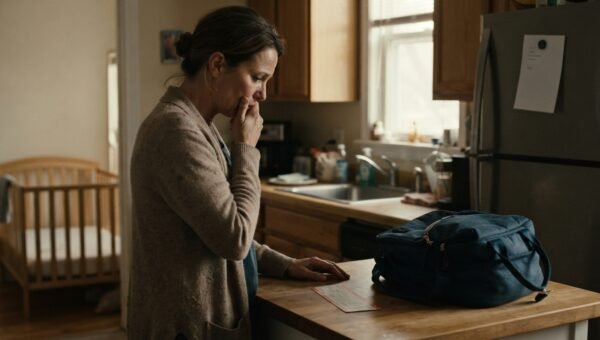
I found the slip of paper on a Thursday morning while shaking the rain off Paul’s heavy wool overcoat. We had just celebrated our fortieth wedding anniversary three weeks earlier at the small Italian place down on 4th Street, where our daughter Sarah brought our two grandsons and we all took pictures by the brick fireplace.
The paper was folded into a tight square, jammed deep into the silk lining near the inside breast pocket.
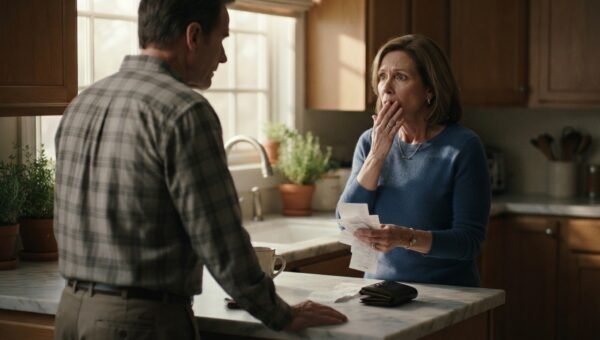
When I smoothed it flat against the kitchen counter, it turned out to be an electronic transfer receipt from First Community Bank. It showed an automatic payment of $1,675 sent on the first of each month to an address on Maple Street over in North Bend, about twenty miles past the county line. The payee was listed under an account number ending in 4108.
We had shared one joint checking account and one money market fund at Valley National since 1984. I managed every utility, our property taxes, and the grocery budget. I had never heard of First Community Bank, and I had never seen that account number in my life.
I stood there by the sink with the cold tap dripping, my hand shaking so hard the paper rattled. At sixty-seven, your mind runs to the worst possible place in a matter of seconds. Forty years of marriage, two grown children, a quiet house with paid-off siding, and suddenly there was an apartment receipt and a secret account taking nearly two thousand dollars a month right under my nose.
I did not scream. I did not march into the garage where Paul was sharpening his lawnmower blades. Once words come out of your mouth, you can never pull them back, and I wanted to know the truth before I let anger take the wheel.
I folded the paper, slipped it into my purse, and waited until the following Tuesday. Paul went to his weekly bowling league at nine in the morning. By noon, I was in my ten-year-old station wagon, driving across the river into North Bend.
The address led to a two-story brick garden complex built back in the late seventies. Unit 4B was at the end of an open breezeway. When I knocked, the door pulled open almost immediately.
A young woman stood in the entryway. She looked no older than twenty-four or twenty-five, wearing gray sweatpants and holding an infant asleep against her shoulder. She looked down at my face, then glanced past my shoulder at the dented blue station wagon parked by the curb.
“Are you Paul’s wife?” she asked.
The air went clean out of my lungs. “Yes,” I said. “I am.”
Her face crumbled right in front of me. She stepped back into the hallway, leaving the door wide open, and began to cry without making a sound.
I stepped over the threshold into a small, sparsely furnished living room. On the wooden coffee table sat a gold-framed photograph of my husband from around 1979, back when he had dark curly hair and wore his olive-green work jacket. Right next to the frame, resting on a clean white saucer, was a plastic hospital bracelet bearing our last name: Vance.
My heart hardened instantly. I thought I was looking at proof of a double life. I thought this girl was a secret child, or worse, someone he had taken up with.
Then she wiped her face on the sleeve of her shirt and looked me dead in the eye.
“He isn’t my father,” she whispered, her voice trembling as she cradled the baby. “He’s the reason my father is alive.”
PART 2
I stayed standing in the middle of the small living room, my purse clutched tight against my ribs.
The girl’s words hung between us, but forty years of practical life do not let you drop your guard just because a stranger offers a dramatic sentence.
“Sit down, Mrs. Vance,” she said softly, walking over to lay the baby in a portable bassinet near the window. “My name is Clara. Clara Diaz. I knew this day was coming, but Paul promised he would tell you himself before the lease renewed in December.”
“Paul doesn’t keep secrets from me,” I said, though hearing my own voice say it felt hollow. “Or at least, that’s what I thought until five days ago.”
Clara walked to the small kitchenette, poured a glass of tap water, and set it on the coffee table beside the frame. She gestured to the worn corduroy sofa. I sat on the very edge, keeping my coat on.
“Thirty-one years ago, my father, Hector Diaz, worked on the framing crew with your husband at Miller Construction,” Clara began, sitting in an armchair opposite me. “In August of 1993, they were working on the grain elevator expansion down in Pomeroy. A support beam shifted while they were hoisting it. My dad was directly underneath. Your husband saw the cable snapping and tackled him off the platform.”
My stomach lurched. I remembered August of 1993 clearly. Paul had come home with four broken ribs, a fractured collarbone, and a deep concussion. He spent nine days in Pomeroy General. The plastic hospital bracelet on the saucer was from that stay. Paul had told me he tripped on an unsecured scaffold during a routine inspection. The company paid his medical bills and gave him a modest settlement, which we used to pay off the second mortgage on our house.
“Paul didn’t trip,” Clara said. “He pushed my dad out of the crush zone. The beam took Paul across the chest, but the trailing iron rig caught my dad’s lower spine and crushed both of his legs. Hector spent two years in rehabilitation. He never walked without forearm crutches again.”
“If it was an accident at work, there was worker’s compensation,” I said, my voice tight. “The union handled settlements back then.”
“The company went under eight months later,” Clara replied quietly. “The owners declared bankruptcy, the insurance carrier contested the coverage limits, and the legal fight dragged out until there was nothing left to recover. My dad had three young kids and medical debt that never stopped compounding. When the union fund dried up, Paul came to our house in Pomeroy. He told my dad that as long as he was drawing a breath, Hector wouldn’t end up on the street.”
She stood up and walked to a low bookshelf in the corner, bringing back a metal accordion file. She opened it on the table between us. Inside were neatly filed carbon copies of cashier’s checks, utility slips, and lease agreements dating back nearly three decades.
Every single check was made out from an account under Paul’s name at First Community Bank. It had started in 1995 at four hundred dollars a month. Over thirty years, as rents rose and Hector’s health deteriorated, the payment had steadily climbed to sixteen hundred and seventy-five dollars.
“Where did the money come from?” I asked. My hands were completely numb. “We didn’t have that kind of extra cash. In the nineties, we were clipping coupons to buy school shoes for Sarah and Mark.”
Clara looked down at the file. “Paul took the overnight maintenance shifts at the regional freight depot three nights a week for fourteen years. He told my dad he told you it was weekend overtime at the yard that dried up.”
The room spun. I remembered those years. Paul coming home at dawn smelling of diesel and grease, his hands permanently stained with industrial black grime, claiming he was putting money away for the kids’ college funds. We had managed to pay for Sarah’s state college and Mark’s trade school without taking on major loans. I had always credited Paul’s union wages and our strict grocery budget. Now I was looking at paper records proving he had spent half his physical life carrying a second family’s roof on his back.
PART 3
“Where is your father now?” I asked, looking around the quiet apartment.
Clara’s eyes welled up again, but this time she held back the tears. “He passed away six months ago, Mrs. Vance. Complications from kidney failure and long-term immobility. He was sixty-one.”
“Then why are you still receiving payments?” The question came out harder than I intended, but the receipt in my purse was dated just three weeks ago. Hector Diaz was gone, yet the money was still leaving that account on the first of the month.
Clara swallowed hard. She didn’t look offended. She reached into the file and pulled out a handwritten letter on lined notebook paper, dated four months earlier. I recognized Paul’s blocky carpenter handwriting instantly.
“When Dad died, I called Paul to tell him to close the account,” Clara explained. “I’m twenty-four. I work as an ultrasound technician at the valley clinic. I have an associate degree that Paul helped pay for with small monthly stipends while I was in school. But my fiancé walked out when I was seven months pregnant with Leo. I couldn’t cover the deposit and first month’s rent on a safe place near the hospital daycare by myself.”
She handed me the letter.
*Clara,* it read. *Your father was the best man I ever swung a hammer with. When that beam came down, he tried to shove me back, too. He took the worst of it because he hesitated to save my neck. I promised him you kids would finish your schooling and have a roof over your heads. I am covering this apartment through December so you can finish your probation period at the clinic. After that, you take the lease in your own name. Don’t thank me. Just raise the boy right.*
I read the words three times until they blurred together.
“He told me last month that he was going to show you the whole ledger before Thanksgiving,” Clara said softly. “He said he was getting too old to keep secrets, and that his conscience was chewing him up because you were the most honest person he ever knew. He said he kept it from you all those years because when it started in 1995, you were worrying yourself sick over Mark’s asthma treatments, and he couldn’t bear to ask you to sacrifice our family’s peace of mind for his guilt.”
I looked at the baby asleep in the bassinet, breathing softly under a yellow knitted blanket. Then I looked at the photograph on the table. Paul at twenty-five, young and strong, with no lines around his eyes and no hitch in his right hip.
I stood up, folded the letter carefully, and laid it back in the accordion folder.
“Did he come here often?” I asked.
“Never alone,” Clara answered immediately. “He visited Dad at the assisted care facility in Pomeroy on Sunday afternoons after church, maybe once a month. When I moved here, he came by once with his toolbox to install the deadbolt on that front door and repair the safety latch on the baby’s window. He was here for forty-five minutes. He wouldn’t even stay for coffee.”
I walked over to the door and rested my hand on the brass lock. It was a heavy-duty Schlage deadbolt, installed with the exact same neat, square wood shims Paul always used on our doors at home.
“Thank you for the water, Clara,” I said.
“Mrs. Vance,” she called out as I turned the handle. “Please don’t hate him. If anyone is to blame, it’s my family for leaning on him for so long.”
“I don’t hate anyone, dear,” I said, and for the first time that day, it was the absolute truth. “I just need to go home and talk to my husband.”
ENDING
The drive home across the river was the quietest forty minutes of my life. The rain started up again around three o’clock, heavy gray sheets sweeping across the highway.
When I pulled into our driveway, Paul’s pickup was parked near the shed. Through the kitchen window, I could see him setting two coffee mugs on the table, just like he did every afternoon before dinner.
I walked into the house, hung my wet coat in the hall closet, and set my purse on the counter. Paul turned around from the stove with the kettle in his hand. He looked tired. His shoulders had started to curve inward over the last five years, and his right knee popped when he shifted his weight.
I took the transfer receipt out of my pocket, along with the First Community Bank card I had found tucked into his spare wallet in the dresser drawer that morning, and laid them flat on the kitchen table between the two mugs.
Paul froze. He looked down at the paper, then up at my face. The color drained from his cheeks until he looked like he was about to collapse.
“Martha,” he whispered. His hands began to shake, and he had to set the kettle down on the unlit burner. “Let me explain. Please.”
“I went to North Bend today, Paul,” I said calmly. “I met Clara. And I saw little Leo.”
He dropped into the nearest chair as if all the bones had gone out of his legs. He put his face into his calloused hands and began to sob. It wasn’t an excuse, and it wasn’t a defense. It was thirty-one years of carrying an unbearable weight alone in the dark.
“I didn’t steal from our household,” he choked out between breaths. “I swear to God, Martha. I worked those nights at the rail depot. Every dime I sent to Hector came from my own back. I never touched our savings. I never touched the house.”
“I know,” I said, pulling out the chair across from him and sitting down. “I saw the receipts. I know exactly what you did.”
“I was terrified,” he said, looking at me with red, ruined eyes. “Back in ninety-three, we barely had two thousand dollars in emergency cash. Mark needed an inhaler every three weeks. If I had told you I felt responsible for Hector losing his legs, you would have told me we couldn’t afford to save him. And you would have been right. We couldn’t afford it. So I took the extra shifts. But the longer it went on, the deeper the lie got. Every anniversary, every Christmas, I felt like a fraud sitting across from you.”
“You weren’t a fraud, Paul,” I said, reaching across the table and covering his cold, rough fingers with mine. “You were just arrogant enough to think you had to carry the whole world on your own shoulders without your partner.”
He stared at me, completely unprepared for my lack of fury.
“We are married forty years,” I continued, keeping my voice steady. “Marriage means we carry the debts together, whether they’re financial or moral. You stole thirty years of rest from yourself, and you stole thirty years of truth from me. That’s what I’m angry about. Not the money. The fact that you thought I was too small of a person to understand why you couldn’t let Hector Diaz starve.”
We sat in the kitchen until the sun went down and the room went dark. We didn’t turn on the overhead light. We talked through every year, every shift at the rail depot, and every payment.
The next morning, we drove together to First Community Bank. We didn’t close the account. We transferred the remaining funds into our joint ledger, set up the final three lease payments for Clara through December just as Paul had promised, and added my name to the signature card.
When December came, Clara sent a holiday card with a picture of Leo sitting upright on a rug. Enclosed was a copy of her new lease contract, signed in her name alone, along with a note thanking us both.
Paul still has a limp, and on cold mornings his ribs ache where the iron beam hit him thirty-one years ago. But he sleeps eight hours a night now, and for the first time since we were twenty-seven years old, there isn’t a single closed door between us.