PART 1
When our daughter Sarah died in a car accident eighteen months ago, she took the air right out of our home. Ellie was only eleven then, and for nearly a year after the funeral, that poor child barely spoke above a whisper. She stopped playing soccer, stopped sketching in the notebooks Sarah used to buy her, and spent most weekends curled up on our living room rug with her mother’s old college sweatshirt pulled over her knees.
My husband Ray was the one who finally broke through the fog. Ray is sixty-eight, a retired supervisor from the county road department, a man who communicates mostly in nodded greetings and grease-stained work gloves. Last spring, he dug his old fiberglass tackle boxes out of the shed, oiled three reels, and asked Ellie if she wanted to learn how to cast from the shore down at Lake Cherokee.
The first time she agreed to go, I stood by the kitchen sink crying into a dish towel just watching her climb into the passenger side of Ray’s silver Silverado. When they came back four hours later, Ellie smelled like bug spray and wet lake dirt, but she was smiling. Ray had bought her a strawberry shake from the drive-in on Route 9.
From that Saturday on, it became their ritual. Every single Saturday morning around six-thirty, Ray would fill his silver thermos with black coffee, pack a cooler with sliced ham sandwiches and ginger ale, and Ellie would be waiting on the front porch with her sneakers tied tight.
It gave me four quiet hours to do laundry, tend to the hydrangeas Sarah had planted along our walkway, and slowly pick up the pieces of my own life. I felt a deep, swelling gratitude toward my husband. In forty-three years of marriage, Ray had never been an emotional man, but the way he stepped up for our orphaned granddaughter proved to me what kind of foundation we stood on.
Then came the second Saturday of September.
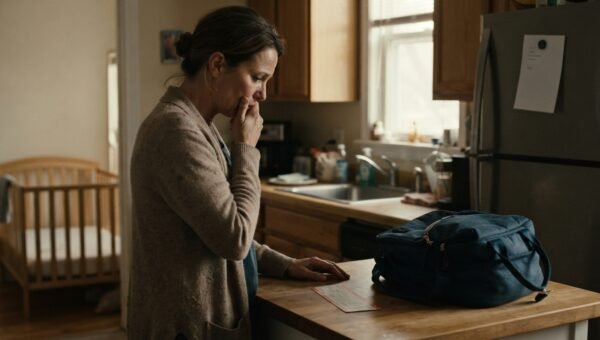
They usually pulled into the driveway by eleven in the morning so Ellie could shower and do her homework. That day, Ray’s truck did not roll up until nearly one in the afternoon. When the front door opened, Ellie walked into the kitchen alone, her shoulders slumped. Her pink plastic tackle box, the one Ray had bought her for her twelfth birthday back in July, was missing from her hands.
I wiped flour from my fingers onto my apron and turned around from the kitchen island. “Hey, sweet girl.
Where’s your tackle box? Did you leave it in the bed of the truck?”
Ellie leaned against the refrigerator door, looking down at the worn toe of her sneaker. “Grandpa carried it inside.”
“Inside where? The garage?”
She shook her head. “No. At the other house.”
The kitchen clock ticked loudly on the wall above the stove. I stopped wiping the counter. “What other house, Ellie?”
“The little blue one,” she said, her voice dropping into that small, hesitant tone she used whenever she thought she might be in trouble. “Near the marina turnoff on Blackwood Road. We stop there every Saturday before we come home.”
My stomach gave a queer, hollow flutter. Ray and I had bought our brick ranch on Maple Street in 1983. We raised Sarah there. We had paid off the thirty-year mortgage six years ago with a small celebration over cheap champagne in the backyard.
As far as I knew, Ray owned our home, two acres of scrub timber his uncle left him in another county, and that pickup truck.
“How long have you been stopping there, Ellie?” I asked, trying to keep my voice flat and casual so she wouldn’t clam up.
“Since June,” she whispered. “Grandpa always tells me to wait in the truck with the air conditioner on and listen to the radio. He said he has to drop off supplies for a friend from work. But today he took my tackle box inside because he said the kid there needed some extra hooks and sinkers. Grandma, why does Grandpa have another house?”
Before I could answer, the front door rattled open and Ray walked in. He had his cap pulled low and his keys jingling in his hand. He looked tired, the skin beneath his gray eyes sagging into deep creases, but he offered his usual faint grin.
“She catch anything today, Martha?” he asked, kicking his boots off onto the rubber mat by the door.
I looked at my husband of four decades. His gray hair was thinning at the crown. His knuckles were permanently swollen from years of wrenching heavy machinery. He looked like the steady, ordinary man I had slept beside nearly every night of my adult life.
“She was just telling me about the blue house on Blackwood Road,” I said.
Ray froze for a split second, his hand resting on the wooden coat rack. The relaxed lines of his mouth tightened, just enough that someone who hadn’t lived with him for forty-three years would have missed it completely. Then he gave a dry, dismissive snort and walked toward the hallway bathroom.
“Old Pete Higgins,” Ray said over his shoulder, water already running in the basin. “Worked the road crew with me twenty years back. His knees went out and his daughter moved to Ohio. I drop off his heart medicine from the pharmacy and some groceries every couple weeks so the poor guy doesn’t starve. Ellie must’ve gotten turned around about the tackle box. Left it in the toolbox in the truck bed. I’ll grab it after lunch.”
He came back out drying his hands on a paper towel, looking directly into my eyes without a single blink. It was a neat, reasonable story. Pete Higgins was a real person; I remembered his name from county picnic rosters a decade ago.
Except Pete Higgins died in 2021.
I remembered his funeral distinctly because Sarah had still been alive then, and she had helped me bake two pans of lemon bars for the church reception hall. Ray had attended that service with me. He had stood right beside me in the third pew while the preacher talked about Pete’s thirty years of county service.
I did not say a word. I dished up turkey sandwiches, poured three glasses of sweet tea, and watched Ray eat every bite of his crust without his hands shaking once.
The following Saturday, Ray woke up at five-thirty as usual. He made his thermos, kissed the top of my head while I pretended to be half-asleep under the quilt, and left the house with Ellie at six-fifteen.
Ten minutes after their taillights disappeared down Maple Street, I took the keys to our ten-year-old Buick sedan, slipped my handbag onto the passenger seat, and drove toward Lake Cherokee.
Blackwood Road is a winding two-lane strip paved with coarse gravel and patch asphalt that branches off the state highway a mile before the public boat ramps. It is lined with summer shacks, aluminum-sided trailers, and overgrown pine woods. I parked the Buick behind an abandoned bait shop three hundred yards up the road, tucked behind a stand of thick scrub oak where the car was invisible from the main lane.
At eleven-fifteen, the silver Silverado turned onto Blackwood.
I watched through my windshield as Ray pulled the truck up the narrow gravel driveway of a small, faded blue cottage with white trim and a rusted tin roof. The mailbox at the road was painted gray, but the numbers were missing.
Ray cut the engine. The passenger door remained closed. Through the tinted rear glass of the truck cab, I could see Ellie sitting upright in the front seat, her ballcap visible, waiting just like she had been told to do.
Ray stepped out of the driver’s side. He walked around to the truck bed, reached under the tonneau cover, and lifted out two plastic grocery sacks full of milk jugs, bread, and cereal boxes. He walked up the three wooden steps to the front porch with the familiar, heavy gait he had used on our own porch every evening of our married life.
I gripped the steering wheel, my chest burning, preparing to step out of the car and walk up that gravel driveway to confront him.
Then the front door of the blue cottage flew wide open.
A boy burst through the screen door onto the porch. He was tall, gangly, maybe thirteen or fourteen years old, wearing faded jeans and a dark green hooded sweatshirt. His dark hair fell across his forehead in messy waves, and his face was split in an enormous, excited grin.
“Grandpa!” the boy yelled.
Ray set the grocery bags down on the wooden floorboards, opened his arms, and pulled the boy into a fierce, tight hug, patting the boy’s back in a steady, practiced rhythm like he had done it a hundred times before.
PART 2
I sat frozen behind the steering wheel of the Buick, unable to draw a full breath. The world outside the glass seemed terribly bright, almost bleached, while my chest felt like an anvil had landed on it.
Through the trees, I watched the boy pick up the grocery bags while Ray rested an easy hand on his shoulder. Then the screen door opened again. A woman stepped onto the porch. She looked to be in her late thirties, wearing an oversized gray cardigan, her hair pulled back into a clip. She didn’t look like an old lover or a glamorous secret; she looked worn out, the deep shadows under her eyes reminding me painfully of Sarah during the final exhausting year before her accident.
She smiled at Ray, took one of the bags from the boy, and said something I couldn’t hear. Ray reached into his jeans pocket, pulled out a white envelope, and handed it to her. She didn’t open it. She just nodded, her head bowing slightly, and touched Ray’s forearm in genuine gratitude. Ray checked his watch, ruffled the boy’s hair, and turned back down the steps toward the truck. The entire exchange took less than seven minutes.
By the time the Silverado backed out onto Blackwood Road, I had already ducked low in my seat. I waited until the rumble of his exhaust died away completely before I started the Buick’s engine.
My hands were shaking so hard I could barely steer. A second family. A secret grandson. A woman young enough to be our daughter. For forty-three years, I had believed Ray was an open book, maybe a little blunt and stubborn, but solid as concrete. Now every memory of our marriage felt hollowed out, like dry wood infested with carpenter ants.
Instead of following him home, I drove straight into town to the county records office on Court Street. It was closed on Saturday, which meant I had to endure forty-eight agonizing hours under the same roof with him.
That weekend was a waking nightmare. Ray watched football on the sofa. He helped Ellie finish a science project on rock formations, patiently gluing pieces of shale to a cardboard trifold. He ate my pot roast, cleared the plates, and kissed my cheek before bed, completely unaware that every time he touched me, my skin went cold. I lay awake staring at the ceiling until four in the morning, listening to his familiar, rhythmic snoring, wondering how a human being could split his life down the middle and sleep like an innocent babe.
First thing Monday morning, right after dropping Ellie at the middle school, I went to the county courthouse.
The clerk at the property deeds counter was a woman named Brenda whose mother had sung in the church choir with me years ago. I gave her the parcel location on Blackwood Road. Within ten minutes, she brought up the digital deed on her monitor.
The small blue house sat on a three-quarter-acre lot. It had been purchased four years earlier, in August 2022.
The owner of record was not Ray. The deed was registered under the name of an LLC called Ridge View Properties. But attached to the file was the original mortgage satisfaction and tax assessment. The property taxes were billed to a local bank branch, paid out of an escrow account. When I asked Brenda who had signed the transfer paperwork as the managing agent for the LLC, she turned the screen toward me.
Raymond J. Miller. My husband.
The purchase price had been $112,000 in cash.
I felt a cold rush of nausea. Four years ago, our daughter Sarah had been going through a brutal divorce from Ellie’s father, a deadbeat named Marcus who had emptied their joint savings and vanished to Texas. During that exact time, Ray had told me that our mutual funds had taken a heavy hit during the market downturn and that we needed to tighten our belts. We had postponed replacing our fifteen-year-old roof. We had canceled our anniversary trip to the Smokies. And all along, he had moved over a hundred thousand dollars out of our accounts to buy a home for another woman and her son.
I left the courthouse, drove to our local credit union, and asked the branch manager for the past three years of statements from our joint money market account. Because my name was on the account, she printed them without hesitation.
I sat in my car in the bank parking lot, flipping through the pages. Every month, like clockwork on the first and the fifteenth, a cash withdrawal of seven hundred and fifty dollars was made at the drive-up ATM on Route 9. Fifteen hundred dollars a month. Eighteen thousand dollars a year. Vanishing into thin air.
I drove home, parked the car in the garage, and walked into our master bedroom. I went straight to Ray’s closet.
On the top shelf, behind a row of dusty shoe boxes containing old fishing reels and work boot laces, sat a locked gray metal tackle box. I had seen it there for years; Ray always said it held his grandfather’s collectible brass lures from the 1940s. I walked out to the garage, fetched a small flathead screwdriver from his workbench, came back inside, and forced the latch open.
There were no lures inside.
Inside were neat folders. The deed to the Blackwood Road property. Bank receipts showing the monthly cash deposits into a separate account. A copy of a health insurance policy covering the boy.
And at the bottom of the box, clipped to a birth certificate, was a photograph.
The boy in the picture was about six years old, wearing a little red t-shirt, grinning directly at the camera. He had dark, wavy hair and wide, bright brown eyes.
I picked up the birth certificate.
The child’s name was Tyler James Miller. He was born fourteen years ago at St. Joseph’s Hospital.
My eyes dropped to the parentage lines, braced for the blow that would officially end my marriage.
Father: Deceased / Not Listed.
Mother: Claire Miller.
I stared at the name. Claire. Ray had no sister named Claire. His only sibling was an older brother who lived in Arizona. I searched my mind, trying to place the name among our cousins, our neighbors, the women Ray had worked with at the county garage. Nothing fit.
Then I looked at the boy’s photograph again, pulling it closer to the bedroom window light.
It wasn’t Ray’s jawline the boy had. It was Sarah’s.
Tyler had the exact slight arch in his left eyebrow that Sarah had possessed since childhood. He had the same crooked upper canine tooth that we had paid three thousand dollars in braces to straighten on our daughter when she was fourteen.
My breath caught in my throat so sharply it hurt my ribs. This was not Ray’s secret son.
This was Sarah’s boy.
PART 3
I sat on the edge of our unmade bed for an hour, holding that faded photograph against my chest.
Sarah had never mentioned a baby. Fourteen years ago, she had been twenty-two, living two hours away in an apartment near the state university, finishing her degree in business administration. She had taken a semester off that winter, claiming she had landed an intense internship with an accounting firm that required long hours and remote travel. Ray had visited her twice during that period, telling me she was overwhelmed with coursework and needed him to haul some spare furniture up to her apartment.
I had believed every word. I had stayed home, working my shift at the medical billing office, mailing her packages of homemade chocolate chip cookies and clean towels.
All of it had been a lie. Ray had known. Sarah had known. I was the only one who had been kept in the dark for nearly a decade and a half.
When Ellie got off the school bus at three-thirty, I fed her an apple, helped her start her spelling words, and told her that Aunt Brenda was coming over to watch her for a few hours. I called Brenda, told her there was a family emergency I couldn’t explain yet, and asked her to sit with Ellie until dinner.
Ray came home at five o’clock sharp. I heard his truck tires crunching on the gravel drive, heard the heavy thud of the truck door closing, and then the scrape of his work boots on the front porch mat.
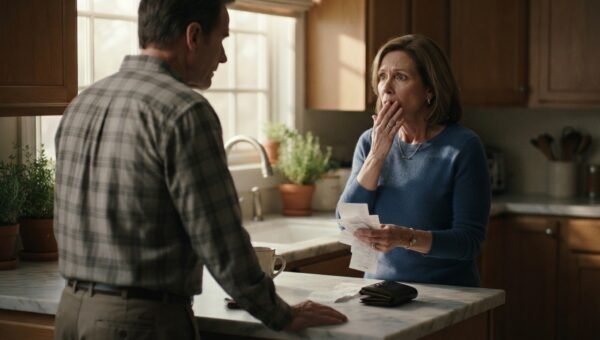
When he stepped into the kitchen, the gray metal tackle box was sitting right in the center of the kitchen table. The files were fanned out beside it. Tyler’s birth certificate and photograph were laid on top.
Ray stopped dead in the kitchen doorway. His lunch cooler swung slightly in his left hand before his grip slackened and it hit the linoleum floor with a dull plastic clatter.
“Martha,” he said. His voice was completely devoid of its usual gravelly confidence.
“Sit down, Ray,” I said. My voice was low, steady, and terrifyingly calm. “Sit down and tell me why our daughter had a child fourteen years ago that I never held, and why you’ve been hiding him in a shack on Blackwood Road.”
Ray’s shoulders seemed to collapse inward. The man who had always seemed six feet tall and indestructible suddenly looked every bit of his sixty-eight years. He pulled out a wooden kitchen chair, his joints cracking, and sat down heavily, resting his forearms on the table without looking at the papers.
He didn’t make excuses. He didn’t yell. For a long time, the only sound in the kitchen was the hum of the refrigerator.
“Sarah begged me,” Ray whispered, his eyes fixed on the salt shaker. “She made me swear on my own soul, Martha. On my soul.”
“Swear what, Ray? To keep her mother out of her life? To let a child grow up ten miles from here without knowing who he belongs to?”
“She was terrified of you,” Ray said, his voice cracking. He looked up then, and there were tears pooling in the red rims of his eyes. “You remember how hard you were on her back then? She was twenty-two. She got pregnant by a married adjunct professor who threatened to ruin her academic standing if she named him. She came to you first, Martha. Don’t you remember that Thanksgiving?”
The room went completely still.
“What Thanksgiving?” I asked, my voice barely audible.
“She tried to bring it up,” Ray said. “She started talking about a girl in her dorm who got pregnant out of wedlock, testing the waters. And you went on a twenty-minute tear about how shameful it was, how girls who throw their futures away for some careless fling have no self-respect, how if a daughter of yours ever brought that kind of disgrace home, you wouldn’t know how to look the neighbors in the eye.”
A cold, sickening weight dropped straight through my stomach. The memory hit me with the force of a physical blow. I remembered that kitchen conversation. I had been rolling out pie crust, self-righteous and sharp-tongued, parroting the rigid, judgmental standards my own mother had drilled into my head in church pews forty years earlier. I remembered Sarah’s face going pale, her quiet retreat to the guest bedroom, her announcement the next morning that she had to leave early for her internship.
“She called me from a payphone two weeks later, crying so hard she couldn’t breathe,” Ray said, wiping his nose with the back of his rough hand. “She was five months along. She wanted to give the baby up for closed adoption through an agency in Tennessee. She said she couldn’t face you, that she’d rather die than have you look at her like she was trash.”
“Ray…” The word came out of me like a wounded gasp.
“I drove down there,” Ray continued, his voice trembling. “I couldn’t let our flesh and blood vanish into an adoption registry where we’d never see him again. But Sarah wouldn’t budge. She said if I told you, she would get on a bus to California and change her name. So I made a deal with her. A private placement. My second cousin Claire in Missouri had been trying to have a baby for ten years. Claire took him at birth. Sarah signed temporary guardianship papers, and Claire raised him as her own.”
“Then why is he on Blackwood Road?” I demanded, tears finally spilling over my lashes. “Why is he here?”
“Because Claire’s husband walked out on her three years ago, and then Claire lost her job at the assembly plant,” Ray said. “She was facing eviction. She had nowhere to go. Sarah was already married to Marcus by then, dealing with Ellie, drowning in that nightmare marriage. Sarah called me in a panic. She said, ‘Dad, Tyler has no place to live. He’s my baby, and he’s going to end up in a shelter.’ So I took the emergency fund we set aside for retirement. I bought that cottage under an LLC. I moved Claire and Tyler here so I could look after them, buy their groceries, pay the utilities, and make sure that boy had a roof over his head.”
“And Sarah?” I asked, my heart breaking into pieces. “Did Sarah see him?”
“Every Saturday,” Ray wept, putting his face into his rough hands. “Before the accident, Sarah would meet me out there. She couldn’t tell Marcus, because Marcus was an abusive leech who would have used Tyler to blackmail her for custody of Ellie. So Sarah and I met at the lake. She got to hug her son once a week for two years. And then the truck hit her car.”
Ray looked up at me, his face wet and crumpled. “When Sarah died, I couldn’t just abandon that boy, Martha. He lost his real mother before he ever had the chance to call her Mom in public. He’s fourteen years old. He loves fishing because his mama loved fishing. When I started taking Ellie out, I started stopping by to drop off groceries. Last week, Tyler saw Ellie’s pink tackle box in the truck bed and asked if he could borrow some hooks. Ellie didn’t even know who he was. I was trying to figure out how to tell you, Martha. I swear I was. But I was so damn scared you’d hate me for lying to you for fourteen years.”
ENDING
We sat in that kitchen until long after dark. Brenda had taken Ellie out for pizza, leaving Ray and me alone with forty-three years of truth laid out between us.
I didn’t scream at him. The anger that had fueled my drive to the courthouse had evaporated, replaced by a deep, hollow grief that was heavier than anything I had felt since the cemetery dirt had settled on Sarah’s grave. Ray had lied to me, yes. He had hidden money, forged a secret life, and kept me at arm’s length for fourteen long years.
But as I looked across the table at his bowed head, I had to face the mirror. Ray hadn’t built that wall out of malice. He had built it out of fear of my own self-righteous tongue. My daughter had spent her final decade carrying a secret that must have eaten her alive, all because she thought her mother’s love was conditional on a spotless reputation.
The next morning, Sunday, I woke up at five o’clock.
Ray was already awake, sitting on the edge of the bed in the gray dawn light, his shoulders slumped as if waiting for me to tell him to pack his bags.
“Get dressed, Ray,” I said quietly, pulling my cardigan off the closet hanger.
He looked up, wary and bloodshot. “Where are we going?”
“Blackwood Road,” I said. “And wake up Ellie. She needs to put her shoes on.”
The drive out to the lake was dead silent. Ellie sat in the backseat of the truck, sensing the heavy tension between her grandparents, clutching her small pink notebook in her lap. Ray kept both hands glued to the ten and two positions on the steering wheel, his jaw set hard.
When the truck turned into the gravel driveway on Blackwood Road, the morning sun was just beginning to burn through the lake mist. The blue cottage looked small and tired, but the porch was swept clean, and a plastic bird feeder hung from the rusted tin roof.
We stepped out of the truck. Ray walked beside me, his steps hesitant, like a man walking toward a firing squad. Ellie followed close behind, holding my sweater hem.
Before Ray could lift his hand to knock, the screen door clicked open.
Claire stood there. In the daylight, she looked even more fragile than she had through my car windshield, her hands wrapped around a faded mug of coffee. When her eyes traveled from Ray to me, the color drained from her face. She stepped back, her hand moving instinctively toward the door frame to steady herself.
“Martha,” Claire whispered, her voice trembling. “Oh, Lord. Martha.”
“Claire,” I said. My voice was steady, though my knees felt like water. “May we come in?”
The inside of the cottage was sparse but immaculately clean. On the small laminate dining table sat a bowl of cheap fruit and Tyler’s middle school textbooks. And on the small upright piano in the corner sat a framed five-by-seven photograph of our daughter Sarah, smiling in the sunlight with her hair tied back in a green bandana.
Tyler walked out of the short hallway a moment later, rubbing sleep from his eyes, wearing gray sweatpants and bare feet. He stopped when he saw three strangers standing in his living room.
His gaze locked onto mine.
Up close, without a car windshield or a camera lens between us, the resemblance was undeniable. He had Sarah’s exact hazel eyes, with the little flecks of amber near the pupil that I had spent eighteen years watching across our own breakfast table.
“Tyler,” Ray said, clearing his throat hard to keep his voice from breaking. “This is your Grandma Martha. And this is your sister, Ellie.”
Tyler’s eyes widened. He looked from Ray to me, his chest rising and falling quickly under his t-shirt. For a terrible, breathless ten seconds, nobody moved.
Then Ellie let go of my sweater hem. She stepped forward, looked at the boy, and then looked down at his bare feet.
“You have my tackle box,” Ellie said simply, her twelve-year-old voice cutting straight through the heavy adult misery in the room.
Tyler blinked, a slow, nervous smile breaking across his mouth, revealing that crooked canine tooth. “Yeah,” he said softly. “I didn’t take your favorite lures, though. Just the catfish hooks.”
The dam broke.
I walked across that faded linoleum floor, reached out my trembling hands, and pulled Sarah’s son into my arms. He stiffened for half a second, then he leaned into me, his tall, awkward frame resting against my shoulder. He smelled like cheap soap, clean pine, and lake water.
I buried my face in his dark, wavy hair and let fourteen years of pride, anger, and hidden grief wash out of me in silent, hot tears.
“I’m sorry it took me so long to find you, Tyler,” I whispered against his temple. “I’m so sorry.”
We did not fix forty-three years of secrets in an afternoon. Trust, once broken down to the studs, takes a long time to rebuild. Ray and I had long, painful conversations at our kitchen table in the months that followed, working through the deceit, the finances, and the bitter sorrow of what had been kept from me. I had to forgive him for his silence, and I had to forgive myself for creating the coldness that made that silence necessary in the first place.
We sold the blue cottage on Blackwood Road that November.
With the proceeds from the sale and the retirement funds Ray had managed to save, we helped Claire put a down payment on a modest duplex three streets over from our house on Maple Street, where she could have independence and steady work at the local medical clinic.
And Tyler moved into the large upstairs bedroom of our brick ranch, the one right next to Ellie’s, with Sarah’s old college desk set under the window.
Now, every Saturday morning when the sun comes up over the pines, the kitchen smells like black coffee and bacon grease. Ray still fills his silver thermos, but he doesn’t pack sandwiches for two anymore. He packs them for four. And when the silver Silverado pulls out of the driveway toward Lake Cherokee, Ellie and Tyler sit shoulder-to-shoulder in the backseat, arguing about whose turn it is to cast first, while Sarah’s eyes look back at me from both of their faces.