PART 1
My husband, Greg, bought a brand-new silver Silverado last fall, but two weeks ago he started driving our beat-up 2011 Outback to work instead. When I asked him why, he said he didn’t want the truck getting dinged in the gravel lot near his job site. It sounded reasonable enough at the time. Greg had worked as a commercial site supervisor for twenty-six years, and he was always fussy about his tools and vehicles.
Then on a Tuesday evening, I went out to the driveway to grab my garden clippers from the cargo area. I opened the back door of the wagon, and there was a high-back child’s booster seat tightly strapped into the rear passenger side. The shoulder harness was adjusted for a small child, maybe four or five years old.
Our daughter, Chloe, is twenty-seven and lives four states away in Denver. Our son, Mark, is twenty-four and still sharing a rental house with two college buddies across town. Neither of them has children.
I stood by the open door with my hand resting on the warm metal frame, staring at the black and gray plastic seat. When Greg came out to take the trash bins to the curb, I pointed directly at it.
He didn’t skip a beat. He gave a short, easy laugh, shook his head, and reached past me to grab a stray plastic bottle off the floorboard.
He told me one of his younger framing subcontractors, a kid named Tyler whose truck was in the transmission shop, had borrowed the wagon for two days over the weekend to take his daughter to daycare. Greg said Tyler must have forgotten to pull the booster seat out before handing the keys back on Monday morning.
I wanted to believe him. When you have been married for thirty-one years, your first instinct is to accept the simplest explanation because the alternative makes your stomach knot up. I nodded, went inside, and let it go.
Two days later, on Thursday afternoon, I dropped my house keys between the passenger seat and the center console while getting ready to run to the grocery store. I had to get down on my knees in the driveway, reaching under the front seat to feel along the carpet. My fingers brushed against a cold metal coin, some dried leaves, and then something soft tucked deep against the plastic track.
I pulled it out. It was a single pink fleece mitten with white trim. Stitched across the cuff in small, neat lavender embroidery were three script letters: *M.E.H.*
My fingers tightened around the fabric. Those were not commercial factory initials. Thirty years ago, my grandmother taught me how to do cross-stitch and monogramming on an old wooden hoop. When Chloe and Mark were babies, I hand-stitched those exact same loop-tail initials on all their flannel swaddles, stroller blankets, and winter caps. The letters stood for the family names on my side, Miller and Evans, combined with Hayes.
Tyler the subcontractor did not have our family initials stitched onto a pink mitten with the exact lavender thread I still kept in a sewing tin in our spare bedroom.
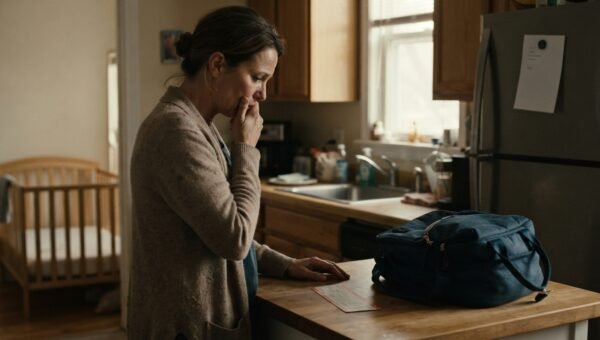
I took the mitten into the house, sat at the kitchen table, and stared at it for twenty minutes. My hands were shaking.
I didn’t call Greg. I didn’t send a text. I knew that if I asked him, he would have another quick, sensible answer ready before I could even finish the sentence.
The next day, Friday, I left the house at 11:30 in the morning. I drove my sedan downtown to the four-story medical building project Greg had been managing since January. I found a parking spot across the street behind a row of delivery vans, parked facing the main job trailer, and cut the engine.
The digital clock on my dashboard flipped to 12:18.
The heavy metal door of the field office swung open. Greg stepped out into the bright noon sunlight. He had taken off his hard hat, wearing his faded flannel shirt and dusty work jeans. Walking beside him, holding his left hand with both of hers, was a little girl in a navy blue puffer jacket with dark curly hair. She had the other pink mitten on her right hand.
Greg leaned down, said something that made her laugh, and lifted her easily into his arms. As he turned toward the gravel parking lot where our old station wagon was parked, the little girl looked straight across the street at my car. She smiled, pointed her small mitten at Greg’s cheek, and called him Daddy.
PART 2
The sound of her voice came through my cracked window clear as a bell. I sat behind the wheel of my car, unable to move my feet or hands. Greg didn’t look my way. He was completely focused on the little girl, carrying her toward the back door of our old wagon, opening it, and lifting her up into the very booster seat he had sworn belonged to a subcontractor.
He buckled her in with practiced, easy motions. He didn’t struggle with the chest clip. He knew exactly how tight the straps needed to be. He reached into his jacket pocket, handed her a small juice box, closed the door gently, and walked around to the driver’s side.
I watched our station wagon pull out of the job site and turn left toward the county bypass.
My mind was racing with ugly, predictable thoughts. A second family. A secret affair that had been going on for years. A child he had kept hidden while we sat across from each other at dinner every night, talking about his 401(k) and our plans to repaint the back porch. But the mitten kept nagging at me. The embroidery had been done by hand with thread that lived in my craft room. A secret mistress didn’t steal thirty-year-old embroidery thread from my sewing basket to monogram her daughter’s winter gear.
Instead of following the wagon, I turned my car around and drove straight to my son Mark’s apartment.
Mark worked second shift at an auto parts warehouse, so he was usually home around one in the afternoon. When I knocked on the front door, it took him a couple of minutes to answer. He opened it wearing sweatpants and an old high school t-shirt, his hair sticking up on one side.
“Mom?” he asked, rubbing his eyes. “What’s wrong? Is Dad okay?”
I didn’t answer right away. I stepped past him into the small living room, reached into my coat pocket, and set the pink fleece mitten on his coffee table.
Mark stared at the mitten. The color drained from his face so fast that he actually reached out a hand to steady himself against the back of the sofa.
“Where did you find that?” he whispered.
“Under the passenger seat of the wagon,” I said. My voice was steady, but it sounded completely foreign to my own ears. “Your father was driving it today. At twelve-eighteen, he walked out of his job trailer holding the hand of a four-year-old girl who called him Daddy. Now you are going to tell me what is happening, Mark, or I am calling the police to report that your father has an unidentified child in the car.”
“No, Mom, don’t do that. Please,” Mark said, his voice cracking. He sat down heavily on the edge of the sofa and buried his face in his hands. “It’s not what you think. Dad isn’t having an affair. I swear to God he isn’t.”
“Then whose child is that?”
Mark took a ragged breath. “Her name is Maya. She’s four.” He looked up at me with red-rimmed eyes. “She’s mine, Mom.”
PART 3
I stood in the center of Mark’s cluttered living room, the room completely silent except for the low hum of his refrigerator.
“Yours?” I repeated.
“Four years ago, right after I dropped out of state college,” Mark said quietly. “I was seeing a girl named Sarah. We were together for maybe five or six months. It was bad, Mom. We were both drinking too much, working dead-end jobs, fighting all the time. When she told me she was pregnant, I panicked. I gave her what little savings I had and told her I couldn’t do it.”
He stared down at the floor, his shoulders hunched.
“Two years ago, Sarah tracked me down. She had gotten clean, she had a steady job at a dental clinic up in Canton, but she was struggling with daycare costs. She brought Maya to meet me at a diner off Route 9. The second I saw that little girl, I knew. She looked just like Chloe did at that age.”
“And you never told me?” The words felt thick in my throat. “You had a daughter for two years and you never said a single word to your own mother?”
“I wanted to,” Mark choked out. “I was terrified. You had worked two jobs to put me through school, and I had dropped out and made a complete mess of everything. I was so ashamed of walking away from Sarah when she was pregnant. I didn’t think you would ever look at me the same way. So I went to Dad first.”
The pieces began to lock together with brutal clarity.
“Eighteen months ago,” Mark continued, “I broke down in Dad’s garage and told him everything. Dad was furious with me at first. He chewed me out worse than he ever had in my life. But then he said, ‘A child is not a mistake, Mark. If she’s here, she’s family, and we don’t abandon family.’ Dad met Sarah. He helped me set up a legal paternity agreement through a family lawyer so I could have visitation. He’s been paying $600 a month toward Maya’s daycare out of his personal allowance so Sarah could keep her job.”
“And the mitten?” I asked, pointing a shaking finger at the coffee table.
“Last winter, Sarah needed baby clothes and warm things,” Mark said, a tear finally spilling over his cheek. “Dad came over to the house while you were at your weekend scrapbooking retreat in Columbus. He took two boxes of Chloe’s old toddler clothes and your old monogrammed blankets from the attic storage. He gave them to Sarah. He told her they were family heirlooms, that they belonged to Maya.”
The anger in my chest didn’t disappear, but the shape of it shifted violently. It wasn’t betrayal from another woman. It was a wall of silence built right down the middle of my family, built by the two men I had loved and cared for their entire lives, deciding between themselves that I was too fragile, or too judgmental, to handle the truth.
“Why was she with your father today?” I demanded.
“Sarah had an emergency root canal procedure scheduled for noon,” Mark said. “I had a mandatory inventory shift starting at one that I couldn’t miss without getting fired. Dad took his lunch hour to pick Maya up from preschool and bring her over to my place so I could watch her for forty-five minutes before I had to leave for work. Maya was supposed to stay with Dad at his job trailer this afternoon while she took a nap, until Sarah finished at the dentist.”
“Where is she right now?”
“In Dad’s truck,” Mark said. “They’re on their way here right now to drop her off with me before I clock in.”
Two minutes later, gravel crunched in the driveway outside. A car door slammed.
Greg walked through the front door carrying Maya on his hip. When he saw me standing in the living room next to Mark, he stopped dead in his tracks. The keys in his hand rattled against his belt buckle.
For the first time in thirty-one years of marriage, I saw raw guilt in my husband’s eyes.
“Helen,” Greg said, his voice dropping to a low murmur.
Maya looked between us, sensing the tension immediately. She wrapped her small arms around Greg’s neck and buried her face against his collar.
“Set her down, Greg,” I said. My voice was very quiet, but neither man moved for three full seconds. “Set our granddaughter down.”
ENDING
Greg gently lowered Maya to her feet on the worn carpet. She stayed glued to his denim pant leg, her big brown eyes wide and cautious, looking up at me. She had Mark’s cowlick at the crown of her head and Chloe’s small, rounded chin. There was no question whose blood ran in her veins.
I walked across the room, stopped two feet in front of Greg, and looked him straight in the eyes.
“You lied to my face,” I said. “You told me Tyler the framer borrowed our car. You sneaked into our attic to take my daughter’s baby clothes. You spent eighteen months helping our son raise his child, and you treated me like an outsider in my own home.”
“I was trying to protect you, Helen,” Greg whispered, his voice cracking. “Mark was terrified you would disown him. And then the longer I kept the secret, the bigger the lie got. I didn’t know how to tell you without breaking your heart.”
“You didn’t protect me from anything,” I said. “You just robbed me of two years of being her grandmother.”
The silence in that room was heavy and painful. Neither Greg nor Mark had an answer for that, because there was no defense for it. They had made a cowardly choice under the guise of being noble, and they both knew it.
I didn’t yell. I didn’t throw anything. I took off my coat and draped it over the arm of the chair. Then I knelt down on the carpet so I was eye level with the little girl.
She looked at me nervously, clutching the edge of Greg’s jeans.
I reached into my pocket, pulled out the little pink fleece mitten, and held it out on the open palm of my hand.
“I think you dropped this in Grandpop’s car,” I said softly.
Maya let go of Greg’s leg. She took two hesitant steps forward, took the mitten from my hand, and turned it over to look at the lavender letters on the cuff.
“M-E-H,” she said, sounding out the letters slowly like a four-year-old learning her alphabet. “Daddy said that means me.”
“It means you,” I said, swallowing the lump in my throat. “And it means me, too.”
That was six months ago.
Things are not back to normal between Greg and me. Trust that took three decades to build does not snap back into place just because the intentions were good. We sleep on opposite sides of our king-sized bed, and we have spent long, exhausting evenings in a marriage counselor’s office working through the anger I still carry about being shut out. I made Greg give me full access to the banking records, and Mark now pays his own share of child support directly from a new job he found with regular daytime hours.
We also met Sarah. She is a quiet, hardworking young woman who was just as nervous to meet me as Mark had been. She didn’t want any drama; she just wanted her daughter to be loved and taken care of.
Every Tuesday and Thursday afternoon now, our old Outback is parked in my driveway, not Greg’s job site. Maya sits at my kitchen table with a glass of apple juice while I pull out my old wooden embroidery hoop and teach her how to guide the needle through the cloth. She is still learning to hold the thread steady, but she knows exactly whose house she is in.