PART 1
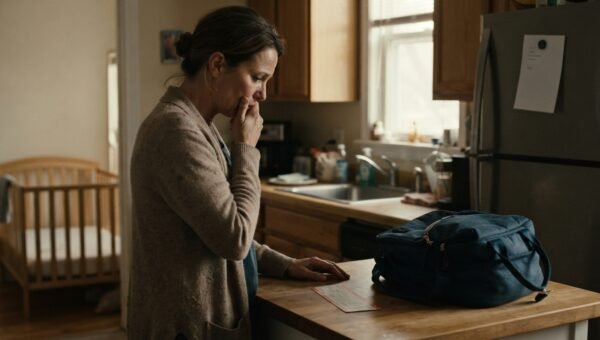
My mother called me on a rainy Tuesday afternoon in late October, her voice barely louder than the hum of my refrigerator. She told me she had to tell me something, but I had to promise not to breathe a word of it to my sister, Clara.
When Mom asked for secrecy, it usually meant she was trying to hide a problem she thought she could handle alone.
At seventy-three, she lived on a modest widow’s pension and Social Security, keeping the heat set low and clipping coupons she barely needed. I sat down at my kitchen table with my pen and notebook, ready to write down whatever utility bill had spiked.
Instead, she told me she had taken her wedding ring down to Miller & Sons Jewelers on Oak Street to sell it.
I dropped the pen. That ring was an antique platinum band set with an Old European cut diamond that my father had saved sixteen months of machinist wages to buy back in 1968. It was the only piece of real value she owned, but more than that, it was the only thing she wore every single day of her life. Even after Dad passed six years ago, she never took it off. She would turn it around on her finger when she prayed or when she was worried about something.
I asked her why on earth she would sell it. She hesitated, then admitted her lower molars had deteriorated. The dentist told her she needed two crowns and an extraction, and the estimate came out to just under thirty-four hundred dollars. Her Medicare supplement didn’t touch major dental. She said she felt humiliated having bad teeth, but she refused to sit across from Clara and hear a lecture about managing a budget, and she did not want anyone feeling sorry for her.
I immediately offered to write a check for the entire dental bill that afternoon. I told her my husband and I had an emergency fund, and family was what that money was for.
She would not hear of it. She grew firm, the way mothers do when their pride is the only thing they have left to protect. She told me she had lived her whole adult life without borrowing money from her children, and she was not about to start now.
She said she had made her peace with letting the ring go. It was just metal and carbon, she insisted, and a mouth full of infections was real. She made me swear on my father’s memory that I would keep quiet and let her handle it her own way.
I hated it, but I respected her. I drove her to the oral surgeon three weeks later. I waited in the small waiting room, bought her soft soups at the grocery store on the way home, and tucked her into bed with ice packs. The ring was gone from her finger. Her knuckle looked bare and pale where the band had shielded her skin from the sun for over fifty years. My chest ached every time I looked at her hand, but she smiled through her swollen jaw and told me she felt a tremendous relief.
Then, at Thanksgiving dinner at my house, Clara walked through the front door.
She took off her wool coat, hung it on the hall tree, and pushed back her hair.
The late afternoon light caught the flash of a heavy diamond ring on her right hand.
I froze with a bowl of mashed potatoes in my hands. It was unmistakable. The distinct floral filigree around the head, the slightly warm hue of the vintage stone, the small nick on the south prong where Dad had caught it on a lathe decades ago. It was Mom’s ring.
Clara saw me looking and lifted her hand, turning her wrist under the chandelier so the facets caught the light. She smiled with that small, satisfied smirk she always got when she felt she had won something. She told everyone at the table that Mom had finally decided who should inherit the family heirloom. She said Mom called her over the previous weekend, handed her the velvet box, and told her that someone with a professional career ought to carry the family legacy forward.
I looked across the table at Mom. Mom was cutting her turkey into tiny bites, her eyes fixed firmly on her plate. She didn’t say a single word. She didn’t confirm it, and she didn’t deny it.
I felt a cold wave of betrayal wash over me. Mom had lied to my face. She had refused my help, claimed she was selling the ring for dental surgery, and then turned around and quietly handed it over to Clara behind my back.
PART 2
The rest of Thanksgiving dinner felt like chewing on sawdust.
Clara spent the entire meal holding her water glass with her right hand, making sure the diamond caught the light every time she took a sip. She talked about having an appraiser look at it for insurance purposes, guessing it was worth at least six or seven thousand dollars in today’s estate market. She wondered out loud if she should reset the center diamond into a modern halo pendant so it didn’t look so old-fashioned.
Every word felt like a slap. Mom sat quietly beside my husband, chewing her soft rolls, nodding politely whenever Clara asked if she remembered how much Dad had paid for it. Not once did Mom look me in the eye.
When dinner ended and Clara left to drive back to her subdivision across town, I helped Mom put on her winter coat in the entryway. I wanted to ask her why. I wanted to ask why she made me swear secrecy about an imaginary sale at a jewelry store, why she let me sit in an oral surgeon’s waiting room thinking she had sacrificed her most precious possession, only to give it away to Clara a month later. But looking at her frail shoulders and the tired lines around her mouth, I couldn’t bring myself to start a fight on a holiday. If she favored Clara, that was her right. She was my mother, and I loved her, but a wall went up between us that night.
For the next three weeks, I kept my distance. I still called her every Tuesday to check if she needed groceries or prescriptions picked up, but our conversations were brief and polite. I stopped lingering on the phone. I stopped dropping by with homemade soup. The hurt ran too deep. I didn’t care about the monetary value of the ring, but the deceit made me feel foolish for caring so deeply about her feelings.
Then, on a gray Monday morning in the middle of December, my cell phone rang with an unfamiliar local number.
“Is this Evelyn?” a man asked. His voice was gravelly and slow, carrying the measured cadence of someone who had done business behind a counter for half a century.
I told him it was.
“This is Arthur Miller over at Miller & Sons Jewelers on Oak Street,” he said. “I’m calling because I have a claim check and a repair ticket here with your name and cell number written across the back. It belongs to Ruth Campbell. Is she your mother?”
My breath hitched. “Yes, she is. Did she leave something there?”
“She certainly did,” Mr. Miller said, the sound of paper rustling over the line. “She was in here back in late October. We finished the work weeks ago, but she left strict instructions that if nobody came to pick it up by the fifteenth of December, I was to call the number on the ticket. That’s today. You need to come down to the shop.”
“Mr. Miller, did she sell you a ring?” I asked, unable to stop myself.
There was a brief pause on the line. “Young lady, I’ve run this bench for forty-two years. I don’t discuss customer transactions over the telephone. If you want to know what your mother did here, you come into the shop and show me your driver’s license.”
I grabbed my keys and my purse, left the laundry half-folded in the basket, and drove straight down to Oak Street.
PART 3
Miller & Sons was an old-fashioned shop with green carpet, velvet display pads inside dark wood cases, and the steady, quiet ticking of wall clocks.
An older man with thick silver hair and wire-rimmed spectacles pushed his magnifying visor up onto his forehead as I walked through the door. I introduced myself and slid my driver’s license onto the glass counter.
Mr. Miller looked at my license, looked at the carbon slip on his desk, and nodded. He reached into a small drawer beneath the register and pulled out a worn manila envelope and a heavy velvet jeweler’s pouch.
“Your mother is a very deliberate woman, Evelyn,” he said, setting both items between us on the glass. “When she came in here six weeks ago, she told me she had a dilemma. She needed three thousand dollars for some urgent medical work, and she had two daughters who looked at her life through very different lenses.”
I stared at him, confused. “She told me she was selling her wedding ring. But my sister is wearing it right now. Clara has it.”
Mr. Miller let out a soft, dry chuckle that held no humor at all.
“Your sister is wearing a four-hundred-dollar replica,” he said plainly.
I blinked, trying to process his words. “What?”
“Your mother brought her ring to me on the twentieth of October,” Mr. Miller explained, resting his hands flat on the counter. “She didn’t come to sell it. She came to ask if I could duplicate it. I took high-resolution molds of the platinum mounting, matched the floral engraving using a modern casting method, and set it with a precision-cut cubic zirconia that carries the same dimensions as her vintage diamond. To anyone glancing across a dinner table or holding a cocktail glass, it looks identical. To a trained eye with a ten-power loupe, it’s worth the price of the silver and the synthetic stone.”
“Why would she do that?” My voice was barely a whisper.
“Because your mother knew your sister would ask for it,” Mr. Miller said. “She told me Clara had visited her apartment the week prior, noticed she was looking frail, and started talking about dividing household items before things got complicated. Clara specifically asked about the ring, asking how much it would appraise for and reminding your mother that jewelry left behind in estates often gets lost or taxed.”
He pushed the velvet pouch toward me.
“Your mother didn’t sell her ring to me, Evelyn. She took a short-term collateral loan against it. I gave her thirty-five hundred dollars in cash against the intrinsic value of the piece so she could pay her oral surgeon without taking handouts. Then, three weeks later, she came back in and paid the loan off in full.”
“Where did she get thirty-five hundred dollars to pay you back?” I asked, my head spinning.
“She sold her late husband’s vintage woodworking tools and his old metal lathe from the garage,” Mr. Miller said gently. “A machine collector from Columbus came down and bought the lot. She paid off the loan, left the genuine ring locked in my fireproof safe, and paid me an extra fifty dollars to hold it until today, along with this envelope.”
He tapped the manila envelope. On the front, my name was written in my mother’s delicate, shaky cursive.
My fingers trembled as I opened the clasp. Inside was a thick, folded piece of stationery and my father’s original handwritten receipt from 1968.
I opened the letter.
ENDING
The letter was written in blue ballpoint ink on the pale yellow stationery Dad used to buy her for their anniversaries.
“My dearest Evelyn,” it read.
“If you are reading this in Mr. Miller’s shop, it means you loved me enough to let me have my dignity, even when you thought I had lost my mind.
When my teeth went bad, the shame nearly choked me. You were the only one who saw my pain and asked how to take it away. You offered your own hard-earned money without asking what you would get in return, and when I told you no, you respected my pride and held my hand in the doctor’s office anyway.
Clara came over two days before I went to the dentist. She didn’t notice I was living on soup. She didn’t ask why I looked so thin. She noticed my hand was swollen from an infection, and she asked if I had ever thought about having my ring appraised so it wouldn’t cause an argument between you two later on. She asked me what it was worth three times in one afternoon.
I realized then that if I gave her the truth, she would turn my home into a marketplace before I was even in the ground. And if I gave you the ring openly, she would make your life miserable with envy.
So I let her have exactly what she wanted. The copy is for the daughter who asks what things are worth. The real one is for the daughter who asks if I am okay.
Take Dad’s ring home with you. Do not wear it to family dinners. Do not wave it in Clara’s face. Keep it in your drawer until you are an old woman, and remember that your father and I built our lives on kindness, not on appraisal slips.
I love you,
Mom.”
I stood in the quiet jewelry shop, tears rolling silently down my cheeks, splashing onto the glass counter.
Mr. Miller reached over and loosened the drawstring of the velvet pouch. He tipped it gently into his palm. The original platinum band rolled out. In the quiet morning light of the shop, the old European cut diamond had a soft, deep fire that no modern synthetic stone could ever copy. It looked heavy, worn smooth on the inside from half a century against my mother’s skin, carrying the faint microscopic marks of my father’s life.
I slipped it onto my finger. It fit perfectly, cold against my skin for only a second before warming to my blood.
I thanked Mr. Miller, tucked the note and the receipt into my purse, and walked out into the crisp December air. I got into my car and sat in the quiet for a long time.
Two days later, Clara called me. She was furious. She told me she had taken the ring to a high-end estate jeweler at the mall to have it insured for eight thousand dollars, only for the man behind the counter to tell her the stone was glass and the setting was silver-plated brass. She demanded to know if I had known Mom had pawned the real diamond years ago and replaced it with junk. She called Mom manipulative and said the family had been cheated.
I listened to her rant for five full minutes without interrupting. I didn’t raise my voice. I didn’t tell her about the trip to Miller & Sons. I didn’t mention the velvet pouch, the machine lathe in the garage, or the note folded safely in my jewelry box at home.
“Mom gave you what she had to give, Clara,” I said quietly. “Have you called her this week to ask how she’s feeling?”
Clara made a frustrated noise and hung up on me.
That evening, I drove over to Mom’s small apartment. I brought a tub of fresh potato leek soup and a loaf of soft bread. When she opened the door, her face lit up with a hesitant, hopeful smile, as if she had been waiting weeks to see if I would ever come back.
I walked in, set the groceries on the counter, and wrapped my arms around her narrow shoulders. I didn’t mention the ring on my hand, which was tucked safely inside my coat pocket, and neither did she. We just sat at her small formica table, eating hot soup together in the warm kitchen, exactly where we were supposed to be.