PART 1
The air in Mark’s office still smelled like his heavy cedar shaving soap and stale black coffee, even though he had been gone for three weeks. My sister, Brenda, sat in his leather desk chair with her shoulders curved inward like a broken wing, clutching a bundle of soft tissues she had already shredded into bits. It was a Tuesday afternoon, gray and wet against the windowpanes, and our job was to clear out the small spare room he used for his tax consulting files before the building lease reverted back to the management company at the end of the month.
I had come over to help because Brenda could not bear to touch his papers. She would pick up a receipt, stare at it as if it were written in ancient Latin, and then set it back down in the exact same spot. My role was to sort things into three distinct cardboard boxes: shred, keep, or trash. It was tedious, heavy work that required very little thought, which was perhaps why my mind kept wandering back to the funeral service and the quiet shock of how empty a life can become in a matter of seconds. Mark had collapsed right beside the kitchen island while reaching for a carton of milk, a sudden aortic dissection that left no time for goodbyes or final words.
At the bottom of the lowest filing drawer, tucked behind a stack of outdated tax code manuals and old receipts from nineteen ninety-eight, I found a heavy, square tin box with a brass latch.
It was green, painted with faded gold trim around the edges, the kind of box people used to keep recipe cards or loose photographs in before everything migrated to digital folders. It did not rattle when I lifted it out, but it had a distinct, heavy weight that told me it was full.
“Brenda,” I said, holding the tin up so she could see it through the gloom of the room. “Did Mark keep his coin collection down here? Or maybe old stamps?”
She looked up, her eyes red-rimmed and hollow from weeks of sleepless nights. She shook her head slowly, her hair falling across her cheek in damp strands. “No. Mark didn’t collect coins. He didn’t have any hobbies to speak of, besides his ledger books and his garden.”
I sat back on my heels against the worn office carpet and flipped the brass latch. It gave a soft, dry click that sounded unnaturally loud in the silent room.
Inside were not coins or stamps, but stacks of heavy cream-colored envelopes, bound neatly together with pale green ribbon that matched the tin. Each envelope had a name and a year written across the front in Mark’s sharp, precise accounting hand: Lucas, followed by a sequence of numbers starting from eighteen and moving up year by year.
My heart did a strange, heavy stutter against my ribs. Lucas was my twenty-six-year-old son, currently living two hours away in the city where he worked as an assistant manager at an industrial supply warehouse. Mark had barely known Lucas. They had met perhaps six or seven times in total, usually at large family barbecues or brief holiday dinners where Mark would ask polite questions about college classes and then retreat to the porch with a cigar. There was no bond between them. No mentorship, no secret friendship, no reason on earth why Mark should have owned a single birthday card intended for him, let alone a continuous, chronological stack spanning every single year of my son’s adult life.
“Look at this,” I whispered, pulling the top envelope free from the green ribbon. The date on the front was from eight years ago, when Lucas turned eighteen. “Mark had birthday cards for Lucas. Every year since he turned eighteen.”
Brenda frowned, leaning forward over the desk with a look of profound confusion settling into the lines around her mouth. “That doesn’t make any sense. Mark never bought cards for anyone except me on our anniversary, and even then he usually forgot until the day before. Why would he have cards for your boy?”
I turned the first envelope over in my hands. The flap was unsealed, clean and sharp-edged. I pulled out the card inside, a simple card with a picture of a vintage truck on the front, and opened it. Inside, written in that same meticulous, upright handwriting, Mark had penned a short, formal birthday wish, followed by a cash amount that made my stomach drop: five hundred dollars in crisp, untraceable bills.
I looked down at the empty slot in the tin box, then back at Brenda, whose face had gone completely, bloodless white.
PART 2
Brenda stood up so fast her chair screeched loudly against the hardwood floor. She crossed the small room in two strides, her hand reaching out not to grab the card, but to touch the edge of the metal tin as if it were something venomous.
“Give me that,” she said, her voice dropping into a dry, breathless whisper.
“Brenda, what is this?” I asked, holding the card away instinctively. “Why would Mark be sending money to Lucas behind my back? Lucas never mentioned receiving any checks from Mark. He told me he saved up for his first car entirely on his own through his warehouse job.”
Brenda did not answer right away. She walked over to the small window that looked out onto the gray street and pressed her forehead against the cool glass. Her shoulders were shaking, not with the soft, weeping grief she had shown all morning, but with a hard, tense tremor that looked like fear.
“Before I met Mark,” she said, her voice barely carrying over the hum of the refrigerator in the break room down the hall, “before any of us settled down in this town, I spent one summer working at that resort up in the mountains. The Lakeview Lodge. You remember. You came up to visit me for two weeks in July.”
The memory hit me with the force of a physical blow. Twenty-seven years ago. That long, sun-bleached summer when the world felt wide open and uncertain. I had worked the front desk, and Mark had been the night auditor, a quiet, serious young man who wore ironed shirts even when he was off duty and kept his hair parted with military precision. I remembered him, of course. Everyone remembered Mark because he never raised his voice and never made a mistake. But nothing had happened between us. I had spent my fortnight helping Brenda in the cabins, swimming in the cold lake water, and going home before August arrived.
“I remember Mark being there,” I said slowly, trying to piece together the jagged edges of a timeline that suddenly felt completely untrustworthy. “He was quiet. But we didn’t have anything to do with each other. You were the one who—”
“I didn’t stay with him that summer,” Brenda interrupted, turning around to face me, her eyes wide and dark with a terror I had never seen in her before. “You did. After I left to go back home to take care of Mama’s hip, you stayed on for another month. You told everyone you wanted to save up money for your apartment lease in the city.”
The room seemed to tilt slightly on its axis. My breath caught in my throat. I stared at my sister, wanting to scream at her that she was losing her mind, that grief had scrambled her brain into a knot of impossible fiction. But as I opened my mouth to deny it, a dark, heavy door in the back of my memory swung open. That extra month at the lake. The hazy, confusing weeks after I broke things off with a local boy whose name I could barely recall anymore. The sudden, unexplained physical changes I had dismissed as stress or bad water, right up until the morning I realized I was pregnant, months before I met the man I eventually married.
“Brenda,” I breathed, my fingers tightening around the edges of the green tin. “What are you saying?”
“I’m saying Mark didn’t just notice you that summer,” she said, her voice cracking into a sob. “He watched everything. And when Lucas was born, he looked at the dates. He knew the math before anyone else did.”
PART 3
The silence in the office grew so heavy I could hear the faint ticking of my own watch against my wrist. I looked down at the stack of envelopes, twenty-six in all, representing every year of my son’s life. Twenty-six years of hidden observations, of secret money orders, of a man who lived under the same roof as my sister while quietly financing the life of a boy he believed was his own flesh and blood.
“He never told me,” Brenda whispered, sliding down the side of the filing cabinet until she was sitting on the carpet with her knees pulled up to her chest. “He swore to me after we got married that he loved me, that the past didn’t matter. But every year on Lucas’s birthday, he would go down to the bank. He said he was paying off an old debt from his college days. I believed him. I believed every single word because Mark never lied about money.”
I dropped to my knees beside her, the tin box resting between us like an unexploded shell. My mind raced through two decades of family holidays, of casual conversations across Thanksgiving tables, of Mark handing Lucas a twenty-dollar bill for graduation with a dry, quiet smile. All those years, I had thought Mark was just being politely distant. I had pitied him for his coldness, thinking he simply lacked the capacity to care deeply about anyone outside his immediate routines.
Instead, he had been caring in the dark, performing a bizarre, solitary ritual of fatherhood from the cheap seats of an uncle’s role.
“Did Lucas know?” I asked, my voice shaking so badly the words barely formed. “Did he ever figure it out?”
“Look at the bottom of the tin,” Brenda said, pointing a trembling finger toward the very last envelope, the one addressed for the birthday that had passed just two months ago, right before Mark died. “There’s a letter. Not a card. A letter.”
I reached inside the green box and pulled out a plain white envelope that hadn’t been sealed. Inside was a single sheet of paper, covered in that familiar, neat handwriting. I unfolded it, my eyes scanning the lines under the harsh fluorescent light of the office ceiling.
*Lucas,*
*If you are reading this, it means I am gone and your mother has finally found this box. I do not ask for your forgiveness, nor do I expect you to call me father. But you have my blood running through your veins, and for twenty-six years I have watched you grow from a distance because I made a promise to keep the peace. The money in these envelopes was never charity. It was my share. Take care of your mother, and remember that someone was always keeping count.*
I let the paper fall from my fingers onto the carpet. It landed face up, the final sentence staring up at us like a quiet verdict from the grave.
ENDING
The drive home that evening felt surreal, as if the landscape outside my car window had been painted on cardboard and propped up against the sky. The rain had stopped, leaving the asphalt dark and gleaming under the amber streetlights, reflecting a world that looked completely normal on the surface while everything beneath it had turned to ash.
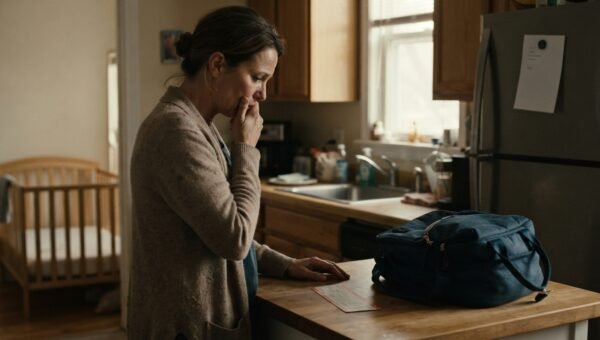
I parked in the driveway of my small house, turned off the engine, and sat in the quiet dark for a long time. The green tin box rested on the passenger seat beside my bag, heavy and silent, containing a truth that had no place to go. I could not call Lucas and tell him. Telling him would destroy the memory of the man he had known as his father—a hard-working, flawed man who had raised him, paid for his braces, and taught him how to throw a baseball, even if he had been a stern and distant figure at times. To rip that away now, to hand him a stack of secret letters from a dead accountant who claimed ownership of his blood, would be an act of cruelty with no healing at the end of it.
And I could not look at Brenda the same way again, either. My sister had lived beside a ghost for decades, sharing a bed with a man who was quietly obsessed with a summer we had both tried to bury in the dust of our youth.
I picked up the tin box, carried it inside the house, and set it down on the kitchen table. Then I went to the phone and dialed Lucas’s number. It rang three times before he answered, his voice sounding tired from a long shift at the warehouse, asking me how I was holding up after helping clean out uncle Mark’s office.
“I’m fine, honey,” I said, my hand resting gently on the cold metal lid of the box. “Just… thinking about the past. Are you eating well?”
“Yeah, Mom. Everything’s good,” he said, the ordinary warmth of his voice washing over the terrible silence in the room. “I’ll come down this weekend and help you around the yard, okay?”
“I’d like that,” I whispered, looking out the kitchen window toward the dark, empty street where the world kept turning, indifferent to the secrets buried just beneath the floorboards.