PART 1
My husband, David, did not speak to his older sister for thirty years. Whenever her name came up, he shut down the conversation with the same four words: we have different values.
He never yelled about it. He never told me some wild story about a fight over money or an insult at a holiday dinner. He just carried a flat, cold wall between them. When Martha sent a Christmas card the first winter after we got married in 1988, David walked it directly from the mailbox to the kitchen trash can without opening the envelope.
Over the decades, I learned to leave it alone. We had two daughters, paid off our home in Fort Wayne, worked our jobs, and grew gray together. I accepted that Martha was simply a closed door in his past.
Then, on a rainy Tuesday this past October, an estate lawyer named Robert Vance called our house from Pennsylvania. Martha had died in a hospice facility outside Harrisburg after a short bout with cancer. She had never married, and she had no children.
David held the landline receiver against his ear, his jaw set hard.
“I don’t need anything from her estate,” David told the lawyer. “Donate whatever she left to a shelter.”
Mr. Vance cleared his throat over the line. “Mr. Miller, there are no liquid assets or property to divide. She had some small medical debts that will consume the remaining bank balance. However, your sister left specific instructions regarding one personal item.
She requested that it be delivered into your hands, or destroyed if you refused it.”
David was quiet for a long moment. “What item?”
“A sealed glass jar,” the lawyer said. “She marked it specifically for you.”
Three days later, a heavy cardboard box arrived by certified courier. David left it sitting on the entryway table all afternoon. He walked around it like it was a trap. Around dinner time, he picked up the box, carried it into the garage, and set it next to the metal trash bin.
“David, don’t,” I said, following him out into the cold garage. “She passed away alone. Whatever happened between you two thirty years ago, she thought of you at the end. At least see what it is.”
He stood there in his work flannel, his shoulders tight. “It’s just another way to get under my skin, Sarah. That’s who she was.”
“Let me open it, then,” I said. “If it’s garbage, I will throw it out myself.”
He didn’t answer. He turned his back and walked inside to the living room.
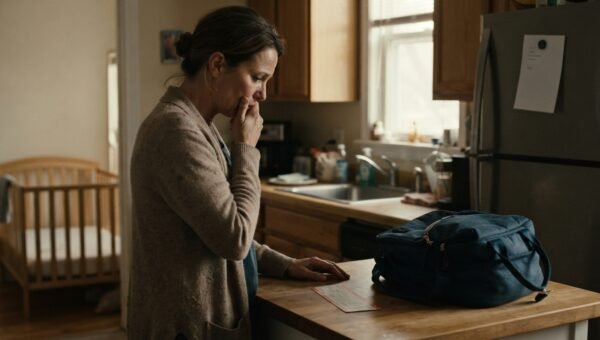
I brought the box to the kitchen island, cut the heavy tape with a paring knife, and pulled away layers of crumpled brown packing paper. Inside was a large, heavy canning jar with a zinc screw-top lid. Through the clear glass, I could see copper coins.
It was full of pennies.
I unscrewed the rusted lid. The faint, sour smell of old metal drifted out. When I tilted the jar onto a dish towel, thirty pennies spilled out across the cotton cloth. That was all. Not a full jar of loose change, just thirty individual coins, plus one tiny brass key taped to the bottom of the glass.
I picked up the coins one by one. The oldest was minted in 1994. The next was 1995. Then 1996, 1997, all the way in an unbroken sequence up to 2024. Thirty pennies. Exactly one for every year David had refused to speak to her.
Underneath the tape holding the small key, there was a small slip of index card written in a woman’s shaky, cramped handwriting:
Locker 14. Old Union Depot, Altoona. You were sixteen. You know where to look.
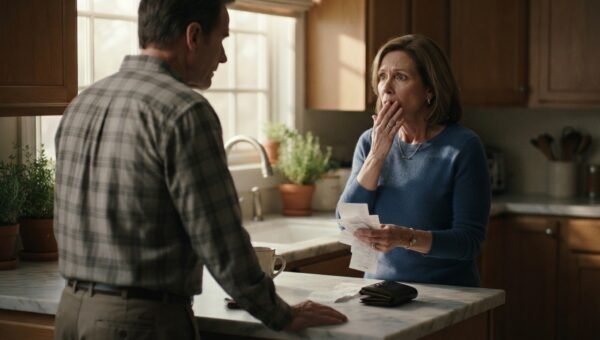
David came into the kitchen to pour a cup of water. He glanced at the counter, saw the coins lined up in a neat row, and stopped moving. His gaze dropped to the slip of card and the brass key.
“What is this?” I asked him quietly. “David, what happened in Altoona?”
His face went completely blank. He looked at the key, then at the floor. For thirty years, my husband had been a steady, predictable man who rarely raised his voice and never showed weakness. But right then, his breathing came shallow and ragged.
“We are not going down there,” he whispered.
“David, she kept thirty years of pennies,” I said, stepping closer to him. “She kept track of every single year you stayed away. You can’t just leave a locked door between you and your sister forever, especially not now.”
He didn’t speak for the rest of the evening. But at six o’clock the next morning, he came downstairs dressed in his heavy coat, his car keys already jingling in his hand. He looked at me across the kitchen and said, “Get your boots on, Sarah.”
PART 2
The drive from our home to Altoona took nearly six hours. David barely said ten words the entire way across Ohio and into the hills of central Pennsylvania. His hands stayed locked at ten and two on the steering wheel, his knuckles pale against the dark plastic.
I kept the brass key in my coat pocket, rolling it between my thumb and forefinger.
I had known David since our early twenties. I knew his parents had died before I ever met him. His mother had passed from pneumonia when he was barely nine, and his father, Arthur Miller, had died of a sudden coronary in 1982 when David was twenty-three. David had always spoken of his father with a strange, careful distance. He told me Arthur was a quiet rail mechanic who kept to himself and worked long shifts in the freight yards. Whenever I asked about his childhood, David would shrug and say there was nothing much to tell, that it was just him, his sister Martha, and their dad living in a small company house near the tracks.
The old Altoona station had long ceased being a major passenger hub. Most of the original brick structure had been repurposed into local offices and a small regional transit concourse, but the rear baggage corridors still smelled of damp concrete and coal dust from fifty years ago.
We found the bank of vintage metal lockers set into a back hallway near the side exit. Most of the doors were scratched, painted over in dull industrial gray, and fitted with modern padlocks or left open and empty. Locker 14, however, still had its original recessed cylinder lock.
David stood three feet back from the metal door. He wouldn’t touch it.
“Go ahead,” he said, his voice raspy.
I took the tiny brass key from my pocket, slid it into the lock, and turned it. The mechanism gave a dry, stiff click. The metal door groaned as I pulled it outward.
Inside, resting on the bottom shelf of the locker, was a faded cardboard shoe box and a small, heavy bundle wrapped in an old wool blanket.
I reached in and lifted the blanket first. As the folds fell away, I realized it was a child’s winter coat. It was a dark blue wool pea coat, sized for a boy no older than six or seven, with brown bone buttons. One of the cuff buttons was cracked in half. The wool smelled strongly of cedar and decades of trapped air.
Under the coat in the shoebox lay an old black-and-white photograph and a yellowed newspaper clipping.
I picked up the photograph first. It showed a teenage boy standing on a gravel path near a riverbank. The boy was skinny, wearing a faded high school track jacket, his dark hair falling across his forehead. It was David at sixteen. He was holding the small hand of a little boy who couldn’t have been more than six years old. The little boy was wearing the exact same dark blue pea coat with the bone buttons, grinning up at the camera with a missing front tooth.
Beside the photo lay a clipping from the Altoona Mirror, dated November 14, 1975.
The headline read: SEARCH CONTINUES FOR MISSING BOY AFTER FAMILY PICNIC.
The short article stated that six-year-old Leo Miller had disappeared on a Sunday afternoon near the Juniata River during a family outing. Search and rescue crews, along with local volunteer firefighters, had dragged the river for two weeks but found no trace of the child. The article noted that the boy’s father, Arthur Miller, told investigators his youngest son must have slipped down the steep embankment into the swollen rapids while the family was packing up the truck.
My hands began to shake as I read the names.
“David,” I whispered, turning toward him. “Who is this child? Who is Leo?”
David looked at the clipping, then looked at the small wool coat in my hands. Suddenly, his knees gave out. My husband, who had never let anyone see him break, sank down onto the dirty concrete floor of the train station, pulled his knees to his chest, and began to weep with heavy, choked sobs that echoed down the empty corridor.
“He was our brother,” David choked out, pressing his palms against his face. “He was our little brother.”
I knelt beside him on the cold floor, completely stunned. “Your brother? David, you told me your whole life that it was just you and Martha. You told me you only had one sister.”
He shook his head violently. He kept his eyes squeezed shut, as if opening them would force him to look at the coat again.
“The newspaper says he disappeared at a picnic,” I said gently, trying to piece the impossible together. “They thought he drowned in the river.”
David looked up at me then, his eyes red and swollen, his mouth trembling.
“He didn’t disappear, Sarah,” David whispered. “He didn’t drown. Martha and I watched Dad…”
PART 3
David could not finish the sentence on the floor of the station. His chest was heaving so hard he could barely draw air. I helped him up, gathered the box, the coat, and the clipping, and led him out to our car. We sat in the front seats with the engine idling and the heater blowing warm air over our frozen hands.
It took him twenty minutes to find his voice.
“It was November of seventy-five,” David said, staring straight ahead through the windshield at the gray station wall. “I was sixteen. Martha was nineteen. Our mother had died seven years earlier, and Dad had turned mean. Not the kind of mean that yells all the time. The quiet kind. The kind where you never knew what would set him off.”
He paused, swallowing hard.
“Leo was only six. He was our baby brother. Our mother had him right before she got sick. After Mom died, Martha practically raised him. She cooked his meals, washed his clothes, walked him to school. Dad couldn’t stand the sight of the boy because Leo looked just like Mom. Every time Leo laughed or made noise in the house, Dad acted like it was an insult.”
David reached out with a trembling hand and touched the edge of the blue coat on my lap.
“We didn’t go to the river for a picnic that day,” David said. “Dad came home on a Sunday afternoon smelling of whiskey. Leo had accidentally knocked over Dad’s tackle box in the hallway, spilling hooks and sinkers across the floorboards. Dad lost his mind. He dragged Leo into the back utility room. Martha and I tried to pull Dad off him, but Dad shoved Martha into the radiator and knocked me flat against the doorframe. By the time Dad stopped hitting him… Leo wasn’t breathing.”
A terrible chill went through me. “Oh, God, David.”
“Martha was screaming,” David whispered, tears streaming down his cheeks. “Dad grabbed us both by our collars. He told us that if we ever spoke a single word to anyone, he would tell the police that I did it. He said a sixteen-year-old boy would spend the rest of his life in prison, and that nobody would ever believe two scared kids over a respected rail worker. He put Leo into the trunk of his car, made Martha and me get in the front seat, and drove us up into the state forest land by the old quarry.”
David wiped his face with the sleeve of his coat. “Dad made me help him dig the hole. In the dark. In the freezing dirt. Martha stood by the truck, holding Leo’s coat. She had pulled it off him before Dad took him away. Dad told her to throw it in the fire pit, but she hid it under the spare tire.”
“The next morning,” David continued, “Dad went down to the police station and reported that Leo had wandered off near the river while we were having lunch. The police searched the water for weeks. Everyone in town brought casseroles to our porch and patted Dad on the back, telling him how sorry they were for his terrible loss.”
“Why did you stop speaking to Martha?” I asked, my heart aching for the terrified teenager he had been. “She didn’t do this. She was a victim too.”
David turned his head to look at me, his expression raw with decades of unresolved bitterness and shame.
“Because in 1994, nineteen years after it happened, Martha called me,” he said. “Dad had been dead for twelve years by then. Martha called me and said she couldn’t carry the weight anymore. She wanted us to go to the state police together and confess what Dad had done so they could dig up Leo and give him a proper burial. And I told her no.”
He looked down at his lap.
“I was married to you, Sarah. We had our girls. I was terrified of what it would do to our family. I was scared people would think I helped murder my little brother. I was scared of the shame, the police, the questions, the newspapers. I told Martha that Dad was dead, Leo was at peace, and digging it up would only destroy the living. I told her if she went to the police, she would be ruining my life. I told her she had to choose between letting the past stay buried or keeping me as her brother.”
“And what did Martha say?” I asked.
“She told me that protecting a monster’s lie wasn’t family loyalty,” David said quietly. “She said that by keeping quiet, we were helping Dad kill Leo all over again every day. I told her our values were completely different. I told her never to call my house again. And she never did.”
He picked up one of the pennies that I had brought in my purse.
“Every year on the anniversary of that phone call, she put a penny in that jar,” David said, his voice breaking entirely. “One year for every year I chose my own comfort over the truth. She didn’t leave me money. She left me a debt I never paid.”
ENDING
We did not drive back to Indiana that night.
Instead, David took the shoe box, the photograph, the small blue pea coat, and the 1975 newspaper clipping, and we walked into the Pennsylvania State Police barracks on North Juniata Street.
It was late, nearly nine o’clock, and the desk sergeant looked surprised to see an older couple walking in carrying an armful of decades-old items. But when David sat down across from an investigator in a small interview room, he did not hesitate. For three hours, my husband laid out the entire truth. He gave names, dates, the exact location of the old logging road off Route 865, and the clearing near the abandoned limestone quarry where his father had forced him to dig fifty-one years earlier.
The investigator was patient, professional, and thorough. Because Arthur Miller had died in 1982, there was no suspect left to prosecute. But the case of missing six-year-old Leo Miller was still an open, unresolved file in the state records.
Two weeks later, the state police forensics unit contacted us. Guided by the detailed landmarks David provided from that terrible night in 1975, investigators found small skeletal remains buried beneath three feet of shale and pine roots near the old quarry edge.
David and I traveled back to Pennsylvania in the spring.
We purchased a small plot in the quiet church cemetery where Martha had been laid to rest six months earlier. The state coroner released Leo’s remains to David as his next of kin. We held a private service on a crisp Tuesday morning with just the two of us, the minister, and our two grown daughters, whom David had finally told the whole truth.
We buried Leo right beside his big sister.
On the small granite marker we ordered for him, David chose not to put the date the newspaper claimed he vanished. He put the day Leo was born, and the true date in November of 1975 when his life was stolen. Below his name, David had the stonecutter carve three simple words: *Home With Martha.*
Before we left the cemetery for the long drive back to Indiana, David walked over to Martha’s headstone.
He stood there for several minutes, the cool mountain breeze rustling the new grass around the stones. From his pocket, he pulled out the zinc lid from the canning jar, holding the thirty copper pennies he had carried with him all this time.
Slowly, carefully, David set the pennies across the top of Martha’s granite headstone, lining them up one beside the other in a straight, gleaming row under the midday sun.
“I’m sorry it took me thirty years to understand,” David whispered against the stone.
Then he took my hand, turned his back on the past, and we walked toward the car.