PART 1
For over a year, Sunday dinner at our house was a sacred rule. Our daughter, Chloe, brings our fourteen-year-old granddaughter, Maya, over every single week without fail. Maya plays the flute, and she loves showing us her sheet music over roast chicken and potatoes. But lately, Mark had started finding excuses to miss them. At first it was just a headache or fatigue from his arthritis medication. Then, starting around early spring, he settled on a specific excuse: his night vision.
He told me that streetlights glare too harshly against his windshield after dusk, making the three-mile drive back from the community center or wherever he claimed to be feel unsafe. I felt bad for him. I even offered to drive him places myself, but he always waved me off, saying he did not want to be a bother or disrupt my routine with Chloe and Maya.
I tried to be understanding, because aging brings quiet indignities that men of Mark’s generation hate admitting to. He spent forty-two years working as an estimator for a commercial plumbing supply company, a job that required sharp eyes and relentless precision. Admitting that his eyes were failing at night felt like the first step toward losing his independence entirely. Yet, as the weeks rolled on, his excuses grew oddly rigid. He did not just miss Sunday dinners; he started disappearing on Tuesday and Thursday evenings too, always returning around eight o’clock smelling faintly of old paper and peppermint lozenges, the kind they keep in bowls at bank tellers and parish halls.
When I asked him where he had been, he would say he went for a long walk to stretch his legs or stopped by the hardware store to browse clearance bins for screws and washers he did not actually need.
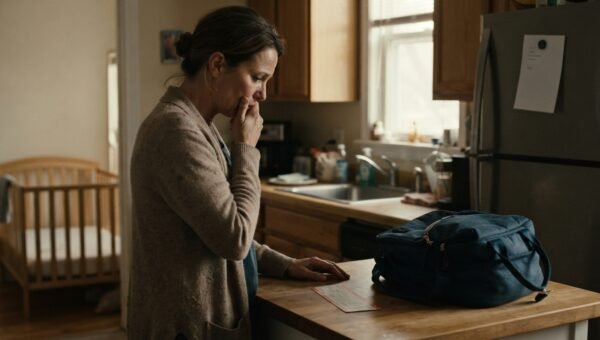
The turning point happened on a clear Thursday evening in late August. Chloe had called earlier to say she was bringing home-baked peach cobbler over on Sunday, and Mark had given a tight, strained smile, muttering that he hoped his eyes would cooperate this weekend. After he left the house around five o’clock for one of his mysterious walks, a restless feeling settled in my chest. It was not jealousy, exactly, and it was certainly not suspicion of another woman. Mark and I have been married for thirty-eight quiet years; we share a joint checking account, a sagging plaid sofa, and a comfortable, predictable silence. But the rigidity of his schedule did not match a man just wandering aimlessly through the neighborhood.
I sat at the kitchen counter and stared at my phone. Months ago, after Mark misplaced his keys twice in one week, I insisted we share our locations through our cellular provider “just in case he gets turned around.” He had grumbled about privacy, but he gave in. I tapped the map icon. For a moment, the blue dot flickered, loading the neighborhood grid. It showed his phone stationary, about four blocks away, parked right beside St. Jude’s Episcopal Church on Maple Street.
St. Jude’s is a small brick parish with a sloping slate roof and a overgrown boxwood hedge out front. It is tucked into a quiet residential corner where very little foot traffic goes after five o’clock. Frowning, I slipped my cardigan over my shoulders, grabbed my car keys, and backed our sedan out of the driveway. I did not plan on confronting him. I just wanted to drive past, see what hardware store or bench he was sitting on, and put my silly anxiety to rest so I could sleep peacefully.
PART 2
I drove slowly down Maple Street with my headlights on low beam, my hands gripping the steering wheel until my knuckles turned white. As I rounded the corner past the elm trees, I spotted Mark’s grey sedan parked directly against the curb across from the side entrance of St. Jude’s. The engine was off, but the interior dome light was not on; the cabin was dark and shadowed. I pulled my car into the empty gravel driveway of a dental office two doors down, cutting my lights immediately so I would not cast a beam across his windshield.
For ten minutes, nothing happened. I sat in the quiet heat of my car, watching the rear silhouette of his head through his back window. He sat completely still, staring straight ahead at the heavy oak doors of the church. I was just reaching for my gear shift to drive over and tap on his window when a movement on the sidewalk caught my eye.
A woman about our age, wearing a dark canvas jacket and carrying a heavy, bulging manila folder under one arm, walked out from the shadowed side portico of the church. She had short, steel-grey hair pulled back behind her ears and walked with a slight, deliberate limp. She crossed the quiet street directly toward Mark’s driver-side door. Mark pushed his door open halfway. She did not get into the car. Instead, she leaned down, handed the thick manila folder through the gap, and spoke a few brief words. Mark nodded once, his face illuminated faintly by the dashboard clock. The woman turned and walked away down the sidewalk toward the bus stop without looking back.
Mark pulled the heavy folder into his lap, clicked his dome light on, and sat there. I watched through my windshield as he opened the cover. Within seconds, his shoulders began to hitch. He dropped his forehead against the top of the steering wheel, his hands clutching the edges of the folder so tightly that the white cardboard bent. Even from fifty feet away, I could see the violent shudder of his back. My husband of nearly four decades, a man who had not shed a single tear when his own father passed away from a stroke, was sitting alone in a parked car outside a shuttered church, weeping with a desperation that cut straight through my ribs.
I did not drive over to him. Instead, I backed out of the dental office driveway, drove home by the long way around, and sat at our kitchen table in the dark with my cardigan still on, waiting for the front door to open.
PART 3
When Mark walked through the back door at seven-forty-five, he looked ten years older. His skin had a grey, washed-out tone, and his eyes were pink-rimmed behind his wire-framed glasses. He set his car keys on the ceramic dish by the door with a soft clink, took off his jacket, and hung it neatly in the hall closet. He walked into the kitchen, expecting me to be watching the evening news in the living room, and stopped dead when he saw me sitting at the table under the single overhead light.
“Helen,” he said, his voice raspy and thin. “You’re still up. Is everything all right?”
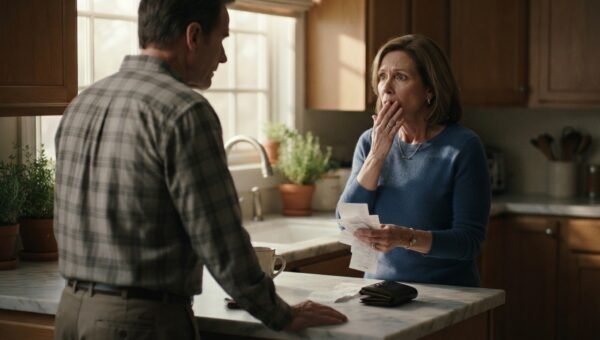
I did not raise my voice. I did not yell or wave my arms. I looked straight at him, feeling a cold, heavy calm settle over me. “I checked the location app, Mark. I drove down to St. Jude’s. I saw the woman give you the folder. And I saw you crying in the car.”
Mark froze. He gripped the back of the kitchen chair across from me, his knuckles bulging. For a long, agonizing moment, the only sound in the house was the low hum of the refrigerator. He did not deny it. He did not invent another excuse about hardware stores or failing night vision. He simply closed his eyes, let out a long, ragged breath that sounded like a sigh of defeat, and walked over to the sideboard where he had laid the manila folder down upon walking in.
He brought it to the table, sat down heavily in the chair opposite me, and pushed the folder across the laminate surface.
“I wasn’t trying to lie to you about the dinners, Helen,” he whispered, his hands trembling as he touched the corner of the cardboard. “Every time I tried to tell you, my throat just closed up. I was terrified of what you would think of me. But I couldn’t carry it another day.”
I reached out, my fingers brushing the edge of the folder. I pulled it toward me and untied the faded red string. Inside were several loose sheets of yellowed legal paper, a receipt from a county courthouse dated in the autumn of 1974, and a stiff, cream-colored birth registration certificate with the edges curled from age.
I looked down at the top document. The ink was faded typewriter ribbon, neat and precise. The baby’s original birth name was typed out in capital letters: ARTHUR DANIEL. The mother’s line was left blank with a notation of confidentiality, but the father’s line bore a signature in looping, youthful script that I recognized instantly from old tax returns in our basement safe. It was signed by Mark’s older brother, Thomas, who had died in a motorcycle accident thirty years ago. But right beside it, scrawled in the margin by a social worker’s hand, was a handwritten notation regarding the relinquishment details and a family name that stopped my breath entirely.
ENDING
My eyes raced across the faded ink on the adoption record, tracing the cursive letters of the original surname listed for the infant born in November 1974. It was the exact, unusual surname my mother had planned to give me before my father legally changed our family name at the hospital following a bitter estrangement from her side of the family.
I looked up at Mark, my heart hammering against my ribs like a trapped bird. “This family name,” I breathed, my voice barely audible in the quiet kitchen. “This is my mother’s maiden name. The family she broke all ties with before I was even born.”
Mark lowered his head, pressing his palms against his face. “Thomas didn’t know when he signed those papers in seventy-four,” he choked out, his voice cracking. “He was twenty-one, working construction in Ohio, and the girl disappeared right after the birth. He thought the baby went to a closed agency in Pittsburgh and was gone forever. But two years ago, a DNA registry match popped up on my phone under a cousin’s profile. A woman was looking for her biological father’s side of the family. She tracked Thomas, found out he passed away, and then found me as the next closest kin.”
He reached across the table and gently touched the corner of the adoption certificate. “She’s our age, Helen. Her adoptive parents named her Claire. She grew up twenty miles from here, and she’s spent ten years trying to piece together why her birth mother vanished. The woman who handed me that folder today was Claire’s daughter—our granddaughter.”
The kitchen grew entirely silent. The heavy knot of anger and suspicion that had built up in my chest over months of missed dinners and secret meetings suddenly dissolved, replaced by a staggering, hollow shock. All this time, while I imagined the worst, my husband had been sitting in a quiet church parking lot, weeping over the puzzle pieces of a family history we never knew existed, trying to shield me from a secret that was too big for either of us to hold alone. I reached across the laminate table, placed my hand over his trembling fingers, and whispered for us both to open the rest of the folder.