PART 1
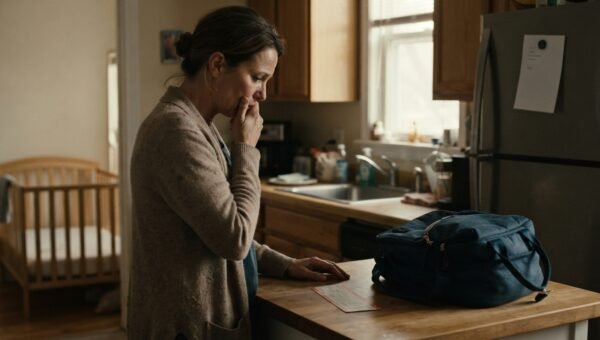
The Sunday my sister Lori disappeared from our lives started over an envelope of cash sitting on the kitchen table.
It was the summer of 2014. My mother had just withdrawn $6,000 from our local credit union in fifty and one-hundred-dollar bills. My dad had a bypass surgery scheduled for that Thursday in Omaha, three hours north of our small Iowa town, and Mom kept repeating that she needed cash on hand for hotel rooms, parking garages, and whatever Medicare might refuse to cover.
Dad was already upstairs resting, weak and grey in the face, while Lori and I helped pack overnight bags.
Mom set the money down right beside her metal recipe box, walked out to the sunporch to water her geraniums, and came back three minutes later screaming that the envelope was gone.
Lori was twenty-two then. She was working twenty hours a week at a dry cleaner and taking community college classes at night. Mom pointed a shaking finger right at Lori’s chest. She did not ask questions. She did not check under the tablecloth or search the trash can. She shouted that Lori had always been reckless, that Lori had sticky fingers, and that she was robbing her own father while he lay sick upstairs.
“I didn’t touch your money, Mom,” Lori said. Her voice was completely steady, which somehow made Mom even madder.
“Give it back right now or don’t ever set foot in this house again,” Mom yelled.
Her face was bright red, her jaw clenched tight enough to crack teeth. “Your father cannot know about this. His heart cannot take knowing what you are.”
Lori looked at me. I was twenty-six, married to my husband Greg, and terrified of upsetting Mom while Dad’s surgery hung over our heads. I stood by the sink holding a dishtowel and said nothing. That silence has haunted me every single day since. Lori waited three seconds for me to speak up, turned on her heel, walked out the front door, and drove away in her beat-up Chevy Cavalier.
By Monday morning, Lori’s bedroom in her rented duplex was cleared out. Her landlord told me she broke her lease, paid a small penalty with her final paycheck, and left no forwarding address.
For twelve years, Lori became a ghost to our family. She missed Thanksgiving dinners. She missed Christmas mornings. When Dad passed away in the winter of 2019, Lori did not come to the funeral home, though I paid forty dollars to run his obituary in three different county papers hoping she would see it.
When my daughter Chloe was born, Lori was not there to hold her. Mom forbade anyone from mentioning Lori’s name in the house. Whenever a neighbor asked how Lori was doing, Mom would press her lips together and say, “We don’t speak about people who steal from their family.”
Mom died in May. After the burial, Greg and I began the miserable job of clearing out the house.
Mom had kept every receipt, coupon, and scrap of fabric from forty years of living on Maple Street. In the back corner of her spare bedroom sat her Singer sewing cabinet, heavy oak with brass pulls. I sat on the carpet to sort through the lower drawers. Tucked between yellowed Butterick dress patterns from 1982 was a thick, green cardboard pattern sleeve for a winter coat Mom had never made.
Inside that sleeve were six white bank envelopes.
I opened the first one. It contained ten crisp one-hundred-dollar bills. I opened the second, the third, the fourth, the fifth, and the sixth.
Every single envelope held exactly $1,000 in fifties and hundreds. Exactly $6,000. It had never been stolen. It had been tucked inside that pattern book the entire time.
Mom had hidden it herself.
My hands began to shake so hard I dropped the envelopes across the braided rug. Why would a mother falsely accuse her own daughter of theft over money that never left the house? Why let her own child walk out into the dark over a lie?
I reached all the way to the back of the bottom drawer to see if there was another pattern book. My fingers brushed against a small plastic case.
It was an old micro-cassette tape. Across the white adhesive label, written in Mom’s tight, slanted cursive, was one word: Lori.
PART 2
I did not own a cassette player anymore. Greg had to drive over to his uncle’s workshop in town to borrow an old Sony handheld dictation recorder with a fresh nine-volt battery.
I sat alone at the kitchen table where the fight had happened twelve years earlier. The late afternoon sun came through the window, hitting the exact spot where Mom had placed that cash back in 2014. My heart was pounding in my throat as I pressed down on the plastic play button.
The tape hissed with loud background static. Then my mother’s voice filled the quiet kitchen. It was raspy, strained, and breathless, the way she spoke during the weeks leading up to Dad’s bypass surgery.
“Lori,” Mom said. She stopped to clear her throat, the microphone clicking against a hard surface. “If you are listening to this, it means I am gone, or it means your sister found what I tucked away. I told them you took the $6,000 because I needed you to leave before your father found out who you were seeing. You wouldn’t listen to reason. You told me you loved him. You told me nothing I said mattered. If your father saw his face, if he found out who was picking you up down by the river road, it would have killed him right then and there. I couldn’t let you destroy this family. I had to make the break so clean and so ugly that you would run as far as you could get.”
The recording stopped with a loud click.
I rewound the tape and listened again. Then a third time.
Mom had framed her own twenty-two-year-old daughter on purpose. She had invented a crime, disgraced Lori in front of me, and banished her from our home just to break up a relationship. But who on earth could Lori have been dating in a town of four thousand people that would justify wrecking a family?
I went through Mom’s address book on the desk. In the very back, on the blank notes page, Mom had jotted down a Colorado phone number in faint pencil beneath Lori’s middle name, Ann. The note was dated three years ago. Mom had known how to reach her all along.
I picked up my cell phone and dialed the number.
The line rang four times. When the call connected, there was only breathing on the other end. No greeting. No hello.
“Lori?” I said. My voice cracked. “Lori, please don’t hang up. It’s Nora.”
The silence stretched for ten seconds. Then I heard a woman take a ragged breath.
“Why are you calling me, Nora?” she asked. Her voice sounded older, deeper, and completely exhausted.
“Mom died two weeks ago,” I said, tears burning my eyes. “And I’m sitting in her sewing room. Lori, I found the pattern book. I found all six envelopes. Exactly $6,000. It was all there. She never lost it. She hid it.”
I waited for Lori to cry, or scream, or say I told you so.
Instead, Lori gave a dry, bitter laugh that cut straight through the phone.
“I know she didn’t lose it,” Lori said quietly. “That’s not why I left.”
PART 3
“What do you mean that’s not why you left?” I asked, gripping the phone against my ear. “Mom left a tape in the drawer, Lori. She said she drove you away to stop you from seeing someone. Who were you seeing? Why was she terrified Dad would find out?”
Lori was quiet for a long time. In the background, I could hear wind chime noises, like she was standing on an open porch somewhere high up.
“Do you remember the young mechanic who started working at Miller’s Auto Body the spring before Dad got sick?” Lori asked. “His name was David. He had just moved to town from Council Bluffs.”
I frowned, trying to pull up a face from twelve years ago. “I remember the shop hired someone new. Tall guy. Kept to himself.”
“David was twenty-four,” Lori said, her voice dropping lower. “We met at the laundromat on Second Street. We started talking, then we started having coffee, and by May we were seeing each other every weekend. We kept it quiet because David was private, and I didn’t want Mom meddling like she always did. But one afternoon in June, David dropped me off at the end of our driveway. Mom was outside clipping the hedges. She saw his truck. But more than that, she saw his face.”
“What about his face?” I asked.
“Mom dropped her garden shears right into the dirt,” Lori said. “She marched down to the street and stared at David through the open window like she had seen a ghost. She asked him his mother’s name. David looked confused, but he answered her. He said his mother was Evelyn Vance.”
The name hit my ears, and an icy chill went straight down my neck.
Evelyn Vance was Dad’s high school sweetheart. Dad had mentioned her maybe twice in our entire childhood, always casually, as a girl who moved away to California back in the late 1970s before he ever met our mother.
“David’s mother died of cancer when he was nineteen,” Lori continued, each word measured and heavy. “She never put a father’s name on his birth certificate. She only told David that his father was an honest man named Thomas who worked at the grain elevator in our county back in 1989. David didn’t move to our town for a job, Nora. He moved there looking for his father. He didn’t know Thomas was my dad. And I had no idea David was Dad’s son.”
I had to put my hand against the table to steady myself. “David was our half-brother.”
“He was our brother,” Lori whispered. “And Mom knew it the second she saw his jawline and heard his mother’s name. That night, Mom cornered me in my bedroom. She was shaking. She told me Dad had an affair with Evelyn when they were already engaged, right before they got married. If Dad found out David existed, and if he found out what Lori and David had started without knowing, Mom believed Dad’s guilt and shock would kill him on the operating table. But Mom was also terrified of the town knowing Dad had fathered a boy out of wedlock.”
“Why didn’t you just tell David the truth?” I asked.
“Mom threatened me,” Lori said, her voice finally breaking with twelve years of held-back pain. “She told me if I said a single word to David, she would tell Dad that David came to town to blackmail him for money. She said she would ruin David’s reputation and make sure he got run out of the county. Then, that Sunday, she staged the missing $6,000. She looked me in the eye and gave me an ultimatum in whispers while you were upstairs getting Dad’s shoes: take the blame, pack my car, and leave the state, or watch our family rip apart right in front of Dad while he was fighting for his life.”
Lori stopped to swallow hard.
“Mom bought my silence with a lie that turned my own sister against me. She made sure you would hate me so you wouldn’t come looking for me.”
ENDING
I sat in the quiet kitchen for an hour after Lori finished talking. The late afternoon shadows stretched across the linoleum floor. All those years, I had judged Lori. I had let myself believe she was selfish and cold, while she had been carrying a burden designed to protect everyone else from our parents’ secrets.
“Where is David now?” I asked when I finally found my voice.
“He lives outside Fort Collins,” Lori said softly. “After I left Iowa, I broke it off with him over a payphone. I couldn’t tell him why back then. Two years later, after Dad passed away, I tracked David down and sat him down in a diner. I told him the truth. We took a DNA test. We matched as half-siblings.”
Lori paused, her breathing steadying. “It was awkward and painful for a long time. But David is family. He helped me put a down payment on my trailer here in Greeley. He’s the only one who came to my nursing school graduation.”
The guilt pressed on my chest like an iron weight. I looked down at the six envelopes lying on the table.
“The $6,000 belongs to you, Lori,” I said. “Every cent of it. Plus whatever interest Mom’s estate owes you.”
“I don’t care about the cash, Nora,” she said. “I cared about my sister.”
“I am so sorry,” I told her, the tears finally running freely down my face. “I should have stood up for you that Sunday. I should have asked questions instead of believing the worst. I am so sorry I stayed quiet.”
There was a long silence on the line. Then Lori let out a slow breath.
“I still have the kitchen table from our first apartment,” Lori said quietly. “If you want to bring the money out here yourself, David and I usually eat Sunday dinner together at five.”
Two weeks later, Greg took time off work to watch Chloe, and I drove nine hours west on Interstate 80 with the pattern book and an old cassette tape sitting in my passenger seat.
When I pulled up to the gravel drive in Greeley, Lori was standing on the front porch in jeans and an oversized grey sweater. She looked older, with fine lines around her eyes, but when she walked down the wooden steps, she walked with the same steady grace she had the day she left Maple Street. A tall man with our father’s dark eyes and wide shoulders stepped out onto the porch behind her.
I stepped out of the car, closed the door, and walked across the gravel to meet my sister.