PART 1
My husband, David, gave our daughter a locked leather diary on her eighteenth birthday and told her not to open it until after he died. I told him right at the dinner table that it was dramatic and unnecessary. He only smiled, patted her hand, and said some things were easier to read than to hear.
Our daughter, Chloe, respected him too much to pry. She put the small brass key inside an old jewelry box in her dresser, tucked the diary on her top bookshelf, and left it there through college, her first apartment, and her wedding.
David passed away eleven years later from heart failure. He was sixty-three. We spent the first month in that heavy, gray fog every widow recognizes, sorting through suits that smelled like his cedar closet and canceling magazine subscriptions. It took six weeks before Chloe remembered the book.
She brought it over to my house on a Tuesday morning. We sat together at my yellow Formica kitchen table, the same table where David used to do the Sunday crosswords with his morning coffee. Chloe set the diary between our mugs and slipped the brass key into the tiny lock. It turned with a dry click.
I expected pages of fatherly advice, maybe stories from his twenties, or thoughts on marriage he had been too reserved to say out loud. But as Chloe turned the heavy cream paper, page after page was completely blank.
Only seven pages in the entire book had writing on them.
David had written a date at the top of each one, followed by a short, neat paragraph in his familiar blue ballpoint pen.
Every single entry described an afternoon when Chloe had almost learned what he called “the truth.”
The first entry was from October 1997, when Chloe was six. She had fallen off the swing set behind our house and needed stitches on her chin. David wrote: “The ER nurse asked for her blood type. I gave an excuse and stepped outside to call the records clerk before you came in from the parking lot. You never noticed.”
The second entry was from May 2007. Chloe had signed up for the high school blood drive in the gymnasium. David wrote: “I called the principal’s office from my work truck and told them you had an undiagnosed iron issue so they would take you off the donor list. You were mad at me for three days. You thought I was being overprotective.”
The third was from July 2009, when we applied for her first passport to visit Montreal.
David wrote that he had intercepted the mail carrier on our porch on a Thursday afternoon to swap out the certified county birth certificate before I saw the state filing stamp.
Chloe read the entries out loud, her voice getting thinner with every page. My stomach felt hollow. I remembered every single one of those days, but I had lived them completely differently. I had thought David was just an anxious, hovering father who worried too much about his only child.
On the seventh page, at the very back of the book, there was no long explanation. There was only an Ohio phone number with a 419 area code and a single line written underneath: “She deserves to decide whether to call him.”
Chloe looked up at me. Her eyes were red around the rims. “Mom, who is him?”
“I don’t know,” I said. “I swear to you, Chloe, I have no idea.”
I reached across the table and touched the page. The handwriting was David’s.
The pen was the same blue ink he bought in bulk for his insurance agency desk. There was no doubt he wrote it.
“Call it,” Chloe said. She laid her cell phone flat between our coffee cups and tapped in the ten digits. She pressed the speaker button.
It rang three times. A man answered on the fourth ring. His voice sounded older, slightly hoarse, with the rough edge of someone who had smoked for forty years.
Before Chloe or I could speak, the man said, “David?”
Chloe glanced at me. I shook my head, my throat too tight to make a sound.
“David, is that you?” the man asked again. Then he let out a short breath and said, “Is this about the girl we switched at St. Mary’s in 1991?”
Chloe stared at the phone. My hand reached out and gripped the edge of the kitchen table so hard my knuckles hurt.
“Switched?” I said into the speaker.
The man went dead quiet on the other end. For five long seconds, there was only the hum of the line.
Then he spoke, much slower this time. “Who is this?”
PART 2
“I’m David’s wife, Martha,” I told the speaker. “And his daughter Chloe is sitting right here with me. David died six weeks ago.”
A heavy sigh came through the phone, followed by the sound of a chair scraping against floorboards.
“I’m sorry for your loss, Martha,” the man said. “My name is Arthur Miller. I worked facilities maintenance at St. Mary’s Hospital in Lima for thirty-two years. I retired back in 2008.”
“What did you mean about switching a baby?” Chloe asked. Her voice cracked on the word baby. “I was born at St. Mary’s in November of 1991.”
“You need to hear me out before you get the wrong idea,” Arthur said quietly. “Nobody stole anyone. It was a terrible mistake that happened on the night shift, and by the time we figured it out, your husband made a choice.”
“Explain it,” I said. “Right now.”
Arthur told us that on the night of November 14, 1991, St. Mary’s had an electrical fire in the east basement utility room. The emergency generators kicked in, but the third-floor nursery lost primary power for nearly forty minutes. The staff had to move twelve newborns down the west fire stairwell to an auxiliary recovery ward. In the rush and smoke, identification bands on two infants had come loose and were taped back on based on handwritten bassinet cards.
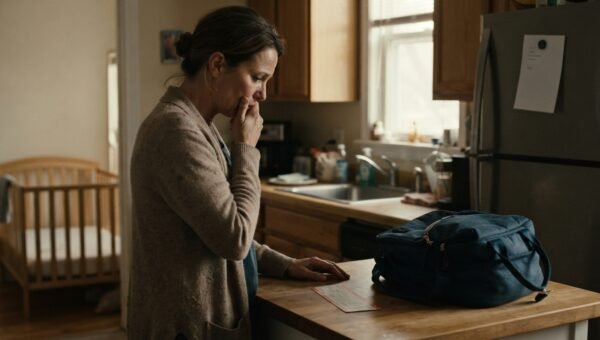
Three days after I was discharged with Chloe, David had returned to St. Mary’s to pick up our forgotten diaper bag and my discharge paperwork.
Arthur had been in the hallway outside the head nurse’s office when the supervising pediatrician was quietly confronting the charge nurse. The hospital lab had run routine follow-up metabolic panels. The infant David and I took home had blood type O-positive.
My blood type is AB-negative.
Biologically, an AB mother cannot give birth to an O child.
David had been standing near the open door. He heard the doctor tell the nurse that the Clark family, a young couple from two counties over who had taken their baby home five hours before us, had likely gone home with our biological daughter. The hospital administration was preparing to contact the county risk board before calling both families.
“Your husband didn’t wait for them to call,” Arthur said. “He cornered the shift supervisor and then he found me in the basement hallway. He was shaking. He told me his wife had just spent four years going through miscarriages, fertility treatments, and bed rest. He said finding out her baby wasn’t hers would destroy her mind.”
I sat frozen at the table. That part was true. Before Chloe was born, I had lost two pregnancies in the second trimester. When Chloe finally came, I spent the first two months checking her breathing every twenty minutes because I was convinced she would slip away like the others.
“David paid me eight hundred dollars to pull the paper maintenance log from that stairwell,” Arthur said. “He wanted to see which staff member handled the transfer. Then he went back to the charge nurse. I don’t know what he said to her, but St. Mary’s was already terrified of a malpractice suit. The hospital quietly sealed the nursery log, and David agreed in writing that he would never file a claim if they let the matter drop.”
“And the other family?” Chloe whispered. “The Clarks?”
“They never knew,” Arthur said. “As far as they were concerned, they took their baby girl home and raised her. But David tracked them. For thirty years, he sent me a hundred-dollar money order every Christmas just to keep my landline active in case he ever decided to tell you. Two years ago, he called me and said he was sick. He asked me for their address.”
Arthur paused. I could hear papers rustling on his end of the line.
“David told me he was going to leave it to his daughter to decide,” Arthur said. “He told me he didn’t have the right to take the truth to his grave, but he was too much of a coward to watch your faces when you found out.”
PART 3
Arthur gave us the address. It was in Defiance, Ohio, an hour and fifteen minutes northwest of our house.
The couple was Thomas and Evelyn Clark. Thomas had passed away from cancer in 2018, but Evelyn was still living in the same white aluminum-sided ranch house where they had raised their children. And their daughter, a woman named Megan, lived four miles down the road with her husband and two boys.
Chloe didn’t cry after we hung up the phone. She went into my bathroom, washed her face with cold water, and came back out with her car keys in her hand.
“I have to go see,” she said.
“We go together,” I told her.
We drove in silence across Route 65. The cornfields on both sides of the two-lane highway were gray and cut down for the winter. Chloe kept both hands locked at ten and two on the steering wheel, staring straight at the white dashed lines.
I kept looking at her hands. She had long, narrow fingers with small half-moons at the base of her nails. My mother had hands like that. David had wide, square carpenter hands. For thirty years I had told people Chloe got her artistic fingers from my side of the family. The thought made my chest ache with a sudden, sharp nausea.
We found the house in Defiance around two in the afternoon. It had an American flag on the porch post and a plastic basketball hoop in the driveway.
I made Chloe wait in the car while I walked up the three wooden steps to the front porch. My knees felt weak, but I forced myself to ring the bell.
A woman in her early seventies opened the door. She had short gray hair, wire-rimmed glasses, and was wearing a fleece cardigan.
When she looked at me, she smiled politely, the way women our age do when someone knocks during the day. “Can I help you?”
I stood there for three seconds, trying to find words that wouldn’t sound insane. “Are you Evelyn Clark?”
“Yes,” she said, her smile fading just enough to show caution.
“My name is Martha Hayes,” I said. “In November of 1991, I had a baby girl at St. Mary’s Hospital in Lima. You were on the third floor that same night.”
Evelyn’s face changed instantly. The polite neighborliness dropped away. She stepped back from the storm door, her fingers tightening around the door frame.
“My husband David died six weeks ago,” I continued, keeping my voice as steady as I could. “He left our daughter a diary. We talked to Arthur Miller this morning.”
Evelyn didn’t ask who Arthur was. She didn’t call for help. She closed her eyes, lowered her head, and let out a long, ragged breath.
“Come inside, Martha,” she whispered.
We sat in Evelyn’s front living room, Chloe sitting stiffly beside me on the sofa. Evelyn brought out a photo album without saying a word and set it on the coffee table.
She opened it to a picture of a girl at sixteen, standing next to a yellow high school locker.
The girl had my widow’s peak. She had David’s wide, square jaw and the slight tilt of his left eyebrow when he smiled. Looking at that photograph was like seeing David’s features copied onto a woman I had never met in my life.
“Tom and I found out when Megan was nine,” Evelyn told us. Her hands were shaking as she smoothed the plastic page of the album. “Megan had an appendectomy. The surgeon told us her blood type was A-positive. Neither Tom nor I carried an A marker. Tom wanted to track you down immediately. He went to St. Mary’s with an attorney.”
“What happened?” Chloe asked softly.
“The hospital had a signed non-disclosure agreement in David’s file,” Evelyn said, looking straight at Chloe. “Our lawyer told us that reopening the records would mean a protracted custody battle that would tear both girls apart. Megan was nine. She loved us. She was doing well in school. Tom and I sat in our car in the hospital parking lot and decided that our daughter was our daughter, no matter whose blood she had.”
Evelyn looked at Chloe then, really looked at her. Her eyes took in Chloe’s brown eyes, her soft chin, the small dimple on her right cheek.
“You look just like my sister Clara,” Evelyn whispered. Tears spilled over her wire frames. “Exactly like her when she was young.”
ENDING
Megan arrived twenty minutes later. Evelyn had called her and only said that family friends were visiting.
When Megan walked through the front door, carrying her youngest son’s soccer jacket over her arm, the room went completely quiet. She stopped in the foyer and looked at me, then at Chloe.
Nobody screamed. Nobody made a theatrical scene. What happened was much quieter, and much harder to bear.
Megan sat down in an armchair across from Chloe. For two hours, the four of us talked about ordinary things. We talked about school sports, about braces, about the year Chloe had chickenpox, and about the college degree Megan had earned in accounting. We compared childhood illnesses and family habits, two mothers and two daughters trying to piece together thirty years of history that had been swapped in a smoky stairwell.
David had thought he was protecting me from heartbreak. He had carried that secret alone through every birthday party, every Christmas morning, and every milestone, watching our daughter grow up while knowing another woman was raising his biological child down the road. He thought silence was mercy.
He was wrong. Silence was just fear wearing an honorable face. He had left the burden to Chloe because he couldn’t face the consequences while he was alive to see them.
Chloe and Megan did a commercial DNA test two weeks later to make the paperwork official for medical histories. The results came back at 99.8 percent match for biological parentage to our respective lines. We used a family law attorney in Toledo to update emergency medical proxies and family health registries, but neither girl changed her legal name or birth certificate. At thirty-one, lives are already built.
Chloe still calls me Mom every single morning at eight o’clock when she drives to work. I still set her favorite cinnamon tea out on the counter when she comes over on weekends. She is the child I nursed through ear infections, the girl whose prom dress I hemmed, and the person who held my hand at David’s graveside. Biology did not undo that.
Megan and her boys came to my house for Thanksgiving dinner that November. We had turkey, green bean casserole, and my homemade dinner rolls. When Megan laughed at something her son said, the tilt of her head was so completely David that I had to look down at my plate for a long second to keep my composure.
The small leather diary is still on Chloe’s top bookshelf. The seven written pages are still there, along with the blank ones David never had the courage to fill.
Chloe didn’t throw it away, but she took the small brass key off her keyring. She dropped it into the bottom of an old chipped tea mug on her desk and left it there, where nobody has to turn it again.