PART 1
My husband, Greg, moved that cream-colored Panasonic answering machine through four houses over twenty years. He wrapped it in bubble wrap every time we packed, right alongside my grandmother’s china and the family Bible. When I asked him why we were hauling an obsolete plastic brick with a microcassette slot into a house with fiber-optic internet, he gave me the same half-smile. He said it was the machine we had when our son, David, was born, and he was just sentimental about that year.
Greg died of a sudden stroke six months ago, three weeks before his sixty-first birthday.
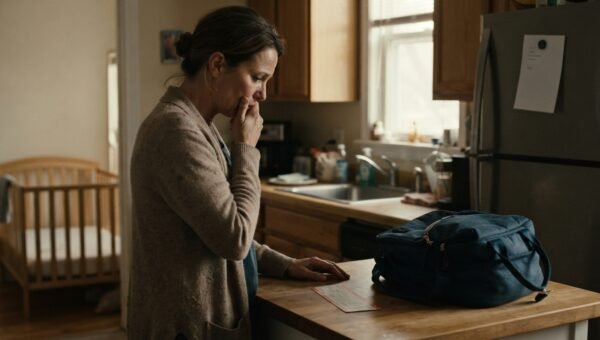
Last Tuesday, I finally started going through the boxes in the spare bedroom closet. I found the machine nested in the bottom of a banker’s box under old tax returns. It smelled like dust and warm copper. I didn’t want to dig through bank statements or look at his handwriting on old receipts, but I wanted to hear his voice. I remembered how he used to record the outgoing greetings, clearing his throat and doing a silly radio announcer voice before giving our home number.
I carried it to the kitchen counter, plugged the black power brick into the outlet behind the toaster, and waited. A small red digit flickered to life on the display: a digital 3.
There were three saved messages.
I hit the play button. The machine whirred, the little tape wheels clicked, and a mechanical beep sounded.
The first message was a carpet cleaner from May of 1998 confirming an estimate. The second was a dial tone cut off after five seconds.
The third message began with a woman’s breath close to the microphone.
“Greg,” she said. Her voice was quiet, trembling, but steady enough to mean every word. “I won’t call again. The baby is healthy. I kept my promise.”
A cold drop hit my stomach. I stood over the counter, my fingers hovering over the stop button. For a split second, I thought of an affair. Every woman who loses a husband probably has that ugly fear buried deep down, wondering if there was another life he kept hidden behind his steady routines.
Then the woman spoke again.
“Tell your wife the hospital bracelet mix-up was not her fault.”
The line clicked dead. The machine beeped twice and rewound the tape with a high-pitched whine.
The timestamp announced by the robotic voice was October 24, 1997, at 9:14 p.m.
October 1997 was the month David was born at Saint Jude Memorial in Oak Ridge.
I stood in my quiet kitchen with my hand flat against the countertop, listening to the hum of the refrigerator. I pressed the play button again. And again. I listened to that woman’s voice five times until the words burned into my head.
My mind went straight back twenty-six years to that linoleum room on the third floor of Saint Jude. David had arrived three weeks early, small and jaundiced. The pediatric team took him down to the neonatal care nursery within hours because his bilirubin numbers were climbing fast. He spent forty-eight hours under the blue phototherapy lamps with tiny foam goggles taped over his eyes.
On the second afternoon, an older nurse had wheeled a clear plastic bassinet into my room so I could try nursing.
I reached down to pick up the swaddled bundle, and my thumb caught on the plastic hospital band around his tiny wrist.
The name on the band wasn’t Miller. It was typed in smudged blue ink: Vance.
I called out to the nurse before she reached the doorway. She hurried back, looked at the band, gasped, and snatched the baby right out of my arms. She apologized three times in ten seconds. She told me she had simply grabbed the wrong bassinet from the nursery row because the shift change was chaotic. Two minutes later, she brought back another bassinet. The band on that baby’s wrist read Miller, Baby Boy.
Greg had been down at the cafeteria getting coffee. When he came back up with two styrofoam cups, I told him what happened. I was crying, exhausted, and running on thirty hours without sleep. Greg had hugged me tight, kissed my forehead, and told me it was just a tired nurse making a paperwork slip. He said our boy was safe in our arms and that I shouldn’t let my postpartum worry turn a silly clerical mistake into a nightmare.
I believed him. I spent twenty-six years believing him.
On Wednesday morning at eight o’clock, I called Saint Jude Memorial. The receptionist transferred me to medical records, and medical records transferred me to hospital administration archives. I told the clerk I was settling family estate matters and needed the administrative incident log from October 1997 involving my discharge.
“Ma’am, incident logs from that era are archived on microfiche at the county annex,” the records manager told me. “Unless there was an official review, they usually don’t stay in active files.”
“There was an incident on October twenty-second,” I said, keeping my voice as firm as I could manage. “An infant identification tag discrepancy in the nursery. Please look.”
It took two hours. I sat on my sofa with a notebook on my lap, staring at the muted morning news. When my phone rang, the woman’s tone had changed from polite boredom to stiff professional caution.
“Mrs. Miller? I found the log entry for October 22, 1997. A formal inquiry was filed by the charge nurse that evening regarding two bassinets swapped during shift transition. Two infant ID numbers were flagged for administrative audit.”
“Give me the numbers,” I whispered.
“The first is your son’s record, ID 4409. The second is ID 4412.”
“What was the name on the second band?”
The clerk hesitated. “I can’t release another patient’s full medical history, ma’am, but the parent cross-reference on the incident report lists the mother as Clara Vance.”
My pencil broke against the notebook page.
“And the baby boy?” I asked. “Is there a current name?”
The clerk paused again, then sighed softly. “The father listed on the intake form was Arthur Vance. But according to the county birth registry note attached to the audit file, the boy was legally registered three weeks later as Thomas Vance.”
I thanked her, hung up, and looked at the name written in jagged graphite on my pad: Thomas Vance.
PART 2
I spent the next three hours at the kitchen table with my laptop.
Living in a mid-sized county has its drawbacks, but people leave deep paper trails. Arthur Vance had owned a small auto salvage yard on the north edge of town until he died in 2014. His obituary listed a surviving son, Thomas Vance, who was currently twenty-six years old, living just forty miles away in Clarksville, and working as an ultrasound technician at an outpatient imaging clinic.
Thomas Vance was born on October 22, 1997. The exact same afternoon I delivered David.
I looked at a recent photograph of Thomas on his employer’s professional directory page. He had a broad, square jaw, thick dark eyebrows, and ears with detached lobes that curled slightly at the top.
My husband Greg had those exact same ears. Greg’s father had them. Greg’s grandfather had them in the sepia-toned portraits hanging in our hallway.
My son David, the boy I had raised, potty-trained, driven to soccer practice, helped through college, and loved with every breath in my body, had a soft, narrow face, fair skin, and blue eyes that we always assumed came from my Scottish grandmother.
I sat there shivering in a warm kitchen.
The woman on the answering machine had said: “I won’t call again. The baby is healthy. I kept my promise. Tell your wife the hospital bracelet mix-up was not her fault.”
Why had she called Greg? Why had she made a promise to my husband?
I got in my car and drove to Clarksville. I didn’t have a plan. I didn’t know what I was going to say to a twenty-six-year-old stranger who looked like my dead husband. When I parked across the street from the brick medical plaza where Thomas worked, I couldn’t get out. I watched young mothers pushing strollers through the automatic glass doors and technicians in blue scrubs walking out to their cars for lunch.
I couldn’t just walk in there and wreck that young man’s life with an old cassette tape and an incident report.
Instead, I drove to the public library in downtown Clarksville and pulled the phone directories from 1997 and 1998. Clara Vance was listed at an address on Sycamore Creek Road. County property records showed the home had been sold three years ago, but the transfer deed gave an updated mailing address for Clara Vance at an assisted living apartment complex in nearby Hendersonville.
I drove south down the two-lane highway, my hands locked at ten and two on the steering wheel.
The facility in Hendersonville was quiet and clean, with potted ferns in the foyer and old gospel hymns playing faintly through ceiling speakers. I walked up to the front desk and asked for Clara Vance. The receptionist checked a binder and directed me to apartment 114 at the end of the north wing.
I knocked on the white wood door.
It opened after a moment, and an older woman looked out at me. She leaned on a silver four-pronged cane. Her hair was cut short and dyed a soft chestnut, and her face was lined with deep wrinkles around the eyes and mouth. She wore a purple knit cardigan over a floral blouse.
“Yes?” she asked.
“Clara?” I said.
“Yes. Can I help you?”
“My name is Martha Miller. Greg Miller was my husband.”
Clara’s face did not pale or look surprised. Instead, something heavy seemed to drain right out of her posture. Her shoulders dropped two inches. She leaned harder on her cane, looked down at my shoes, and then pushed the door open.
“Come inside, Martha,” she said quietly. “I’ve wondered for twenty-six years if you’d ever show up.”
PART 3
Her living room was small, smelling faintly of peppermint and menthol rub. On the sideboard sat two framed photographs: one of a rough-looking man leaning against a tow truck, and one of Thomas in a high school graduation gown. Seeing the graduation picture up close made the air catch in my throat. He looked so much like Greg at eighteen that it felt like looking at a ghost.
I sat on the edge of a floral armchair. I didn’t waste time. I reached into my purse, pulled out the cassette tape I had extracted from the Panasonic machine that morning, and set it on the glass coffee table between us.
“I found the answering machine in Greg’s closet,” I told her. “I heard your voice.”
Clara looked at the small plastic cassette. She didn’t touch it. She sat down on the sofa across from me, folding her hands in her lap.
“Arthur was drinking back then,” Clara said, her voice flat and completely stripped of defense. “He was working eighty hours a week at the yard, and when he drank, he was mean. When the hospital called us on October twenty-second to say my labor was starting, I was terrified. We didn’t have health insurance. Arthur told me if the baby had medical problems, he didn’t know how we’d eat.”
She took a slow breath.
“My boy was born with a severe respiratory struggle. The doctors said his lungs hadn’t fully inflated. They rushed him straight into the nursery. Arthur came up to the hospital around four in the afternoon smelling like bourbon. He threw a fit in the hallway about the cost of the oxygen and the incubator. Then he left.”
“What does that have to do with Greg?” I asked. My voice sounded harsh, scraping my throat.
“Your husband was sitting in the corner of that nursery waiting room when Arthur made that scene,” Clara said, looking straight into my eyes. “Greg had heard the whole thing. A few hours later, around seven that night, the nurse made the mistake. She mixed up the bassinets because the shift was changing and both boys were in phototherapy units side by side. She brought my sick baby to your room. You saw the tag and called her back.”
“Yes,” I said. “I remember.”
“The nurse realized her error, took the baby back to the nursery, and corrected the tags,” Clara continued. “She put your healthy boy back in your bassinet, and put my boy back in mine. But when she put them back, she told the floor supervisor what happened to cover herself. Your husband happened to be standing right outside the nurses’ station when they logged the incident.”
“And?”
“Greg came into my room that night,” Clara whispered. “I didn’t even know who he was. He looked at me sitting alone in that bed, crying over the bills and the sick baby, and he made a mistake that ruined him for the rest of his life.”
I shook my head. “What are you talking about? What mistake?”
“Greg thought the nurse had actually switched them permanently,” Clara said. “He thought the sick boy in the incubator was his, and that the healthy baby in your room was mine. He thought the nurse had panicked, covered up her mistake, and left you with my baby. He was so terrified of having you find out that our child was struggling, and so paranoid about the hospital lying to protect themselves, that he confronted me right there in the ward.”
The room seemed to spin slightly. “He thought David was yours?”
“Yes,” Clara said. “He offered me five thousand dollars in cash from his business account right then and there. He told me to take the sick baby home, let the hospital take care of the bills, and never, ever tell you that the swap in the nursery was real. He thought he was buying my silence so you would never find out you were raising another woman’s child.”
I stared at her, the pieces crashing together into something sickening and tragic.
“The nurse didn’t switch them,” I whispered, the realization hitting me like a physical blow. “The nurse corrected the mistake.”
“Exactly,” Clara said, tears finally welling in her tired eyes. “The nurse had made a simple clerical error and fixed it immediately. David was your biological son. Thomas was mine. But your husband had worked himself into such a terrified frenzy that he convinced himself the cover-up was real. When I was discharged two days later, I took my baby home. My boy got better. His lungs cleared up within a week.”
“Then why did you leave that message on the machine?” I demanded.
“Because a year later, I felt so guilty about taking Greg’s five thousand dollars,” Clara said, wiping her cheek with the sleeve of her cardigan. “Arthur had spent the money on parts for the salvage yard. I couldn’t live with the lie anymore. I called your house when I knew Greg would be at work, planning to tell him that I was going to bring the cash back. But the machine picked up. I was scared to death you were standing right there in the room, so I just blurted out that the baby was healthy, that I kept my promise, and that you shouldn’t blame yourself for the hospital mix-up.”
She looked down at the cassette.
“Greg must have intercepted that tape before you heard it. He kept it because it was his proof that I wouldn’t come after you. He lived twenty-six years believing he was harboring a stolen life, protecting you from a heartbreak that never actually existed.”
ENDING
I drove home in the late afternoon light, the hum of the tires loud against the asphalt.
When I got back to the house, I walked straight into the kitchen. The cream-colored answering machine was still plugged in, its tiny red digit glowing steadily against the tile backsplash.
I stood there looking at it.
Greg had carried that machine through four moves. He had carried it through twenty-six years of family dinners, little league games, high school graduations, and backyard barbecues. He had looked at David every single day of his life, loving him, coaching him, paying for his braces, and hugging him on the morning he left for college, all while bearing the agonizing, solitary guilt of believing David was not his flesh and blood.
He had carried that crushing secret all by himself to protect me from a lie that his own fear had built.
I picked up my cell phone. I scrolled through my contacts until I reached David’s name.
He answered on the third ring. “Hey, Mom. Everything okay?”
His voice was clear, cheerful, and full of the easy confidence that Greg had spent a lifetime building in him. In the background, I could hear the sound of his wife chopping vegetables and their two-year-old daughter laughing in her high chair.
“Everything is fine, honey,” I said, my voice shaking only slightly before I pulled it steady. “I was just cleaning out the closet and found some old things of your dad’s. I just wanted to hear your voice.”
“I miss him too, Mom,” David said softly. “Come over for dinner on Sunday? Sarah’s making pot roast.”
“I’d love that,” I told him.
After we hung up, I walked over to the outlet behind the toaster. I pulled the black power brick from the wall. The red light vanished.
I didn’t call Thomas Vance. He had a good life, a mother who loved him, and a memory of a father that belonged to him. And I had David, the boy who had always been mine, born from my body on a Tuesday afternoon in October, untouched by the tangled ghosts of our fear.
I carried the plastic machine out to the garage, set it gently inside the black trash bin beside the workbench, and closed the lid.