PART 1
When people talk about sacrifice, they usually picture cold kitchens, frayed coat sleeves, and women who never bought themselves a winter coat so their little sister could have new school shoes. That was the picture Clara painted for as long as I could remember. She was fourteen when our parents died in that icy pileup on Route 9, and thirty when she finally stopped walking around our small town like a martyr carrying a heavy cross.
I was only a toddler when the accident happened, so my memories of our parents were just sepia-toned photographs in a cracked dime-store frame on the mantel. Clara took me in without hesitation. She dropped out of community college, took a double shift folding sweaters at the dry goods store, and later worked her fingers to the bone managing the front desk at the county courthouse. She never let me forget what she gave up. Every time I asked for a slightly nicer notebook for school or a ticket to the class skating party, I got the sigh. It was a soft, trembling breath that said she was drowning while I was splashing around in the shallow end.
By the time I reached my twenties, I felt like a walking debt. I went straight into nursing, working the overnight floor at the regional hospital, and every month I handed over a hefty chunk of my earnings for rent and household upkeep.
Clara still owned the modest brick bungalow our parents had left behind, though the mortgage had long since burned. When her husband walked out on her for a teller from the credit union, the house suddenly felt too large and too full of ghosts for her.
She called me over one rainy Tuesday evening, her eyes red-rimmed and her voice shaking with that familiar, fragile exhaustion. She told me she was lonely, that the rooms echoed with memories of a man who didn’t deserve her, and that she wanted us to truly build a life together as a family. She asked me to sell my little two-room cottage across town, the one I had saved my own down payment for, and move back into our childhood home permanently so we could split the upkeep and grow old side by side.
I did it without a second thought. I sold my cottage, poured my thirty thousand dollars of equity into upgrading her outdated kitchen and putting a new roof over our heads, and moved my few boxes back into the second bedroom.
For six months, things felt somewhat settled, even if the old household hierarchy remained firmly in place. I paid the grocery bills, handled the lawn care, and worked my shifts, while Clara drank chamomile tea at the kitchen table and complained about her joints.
Then came the afternoon that blew the foundation right out from under my entire existence.
Clara called me at work, her voice sharp and brittle, telling me she had accepted an offer on the house. She said the memories were suffocating her after all, and she had decided to pack up and move to Arizona to live near her college roommate. She said she had already booked the moving van for the following week and that my share of the sale proceeds would be enough to secure a small studio apartment across town.
I left the hospital at seven in the morning, my head pounding from a twelve-hour shift, and drove straight to the house.
The hallways were already stacked with brown cardboard boxes taped shut with yellowing packing tape. Clara was out running errands, leaving the house quiet and smelling faintly of packing paper and dust. I decided to start clearing out the damp, cramped utility closet behind the water heater in the basement, a space we rarely used because the door stuck tight on its rusted hinges.
I wedged my shoulder against the door and gave it a hard shove. It popped open with a loud splintering sound, revealing a dark, forgotten cavity filled with old paint cans and discarded winter gear. Reaching back into the furthest, dustiest corner to pull out an old bin of holiday decorations, my hand brushed against something wedged flat between the concrete wall and the back of the wooden shelving unit.
It was a thick, heavy manila folder, curled at the edges from decades of damp air. I pulled it out, blew a thick layer of grey lint off the cover, and sat down on an overturned bucket under the lone overhead bulb.
PART 2
The string tie on the folder was brittle, snapping off in my fingers as I tugged at it. Inside lay a neat, chronological stack of papers that spanned twenty-five years. At first, I thought it was just old household clutter. The top pages were faded grocery receipts from the local market, utility bills from the late nineteen-eighties, and payment slips for my childhood dental visits.
As I flipped deeper into the stack, the nature of the documents changed. There were carbon copies of money orders and cashier checks drawn from a bank in a city two states over, all made out to Clara. Attached to each one was a small, neat bank slip bearing the name Arthur Vance.
Arthur Vance was a name I recognized only from whispered village rumors when I was a teenager. He was a wealthy, reclusive timber merchant who owned tracts of land near the state line, a man our local community treated with quiet suspicion and polite avoidance. According to the town gossip, he was a lonely bachelor who kept to himself in a sprawling stone lodge, having cut ties with most of his extended family after a bitter inheritance dispute.
Yet here were hundreds of canceled checks, signed in a sharp, sloping hand, totaling tens of thousands of dollars sent steadily to Clara month after month, year after year. The amounts started right after our parents died, ballooned during my middle school years, and continued straight through my nursing school tuition payments.
I stared at the figures, my chest tightening. Clara hadn’t worked herself to the bone folding sweaters to keep us afloat. She hadn’t sacrificed her youth entirely through sheer willpower and courthouse wages. For my entire life, an invisible hand had been sliding financial support across state lines to keep a roof over our heads.
My fingers trembled as I turned the pages, looking for a letter, a note, anything that explained who Arthur Vance was to us and why he had poured a small fortune into our household without ever stepping foot in our town. The early checks listed simple maintenance memos like “house repairs” and “clothing fund.” But as the years rolled on, the notes grew more specific, referencing my braces, my piano lessons, and finally, my college enrollment fees.
Clara had kept every single receipt, neatly filed away like an accountant tracking inventory. Every time she had sighed over the grocery bill, every time she had made me feel guilty for wanting a new pair of shoes, she had already pocketed a check from Arthur Vance that covered the expense tenfold. The heavy burden of debt she had forced me to carry emotionally was a complete fabrication, a psychological anchor she used to keep me small, compliant, and permanently tied to her apron strings.
I reached the very bottom of the folder. There was a single, heavier piece of cream-colored stationery, folded in half and yellowed at the creases. It was dated just three weeks before my eighteenth birthday.
PART 3
I unfolded the heavy paper under the weak basement bulb. The handwriting was the same sharp, sloping script as the checks, but the tone was different. It wasn’t an accounting record. It was a letter.
“Clara,” it began, the ink slightly blurred by what looked like an old water drop. “I cannot continue to send these funds under the table if you refuse to let her know the truth. She is nearly a woman now, and she deserves to look her father in the eye. I provided for you both because society would have torn our family apart if the scandal had broken when you were carrying her at seventeen. Everyone in town thought you were the good, dutiful older sister raising an orphan. No one ever suspected that the baby you claimed your parents adopted just before the crash was your own flesh and blood. But the deception has gone on long enough. Tell her the truth before she leaves for college, or I will come down there myself and tell her.”
The words blurred together as the concrete basement floor seemed to tilt beneath my feet. I read the lines three times, my lips moving silently in the cold air, trying to force my brain to process a reality that completely demolished every single memory I had ever built.
I wasn’t Clara’s little sister. I was her daughter.
The parents I mourned every year at the cemetery, the couple whose framed photograph sat on the mantelpiece, weren’t my mother and father at all. They were my grandparents. They had taken me in the moment I was born, legally adopting me to save their family from local scandal when Clara was a terrified, pregnant seventeen-year-old high school student. And when they died tragically in that icy crash on Route 9, Clara hadn’t stepped up as an orphaned adolescent taking on a selfless burden out of sisterly love. She had inherited a ready-made sister, collecting monthly hush money and financial support from a wealthy biological father who wanted to be part of my life, while treating me like an ungrateful charity case under her own roof.
For twenty-five years, she had weaponized my existence. Every scolding, every sigh of exhaustion, every dollar of rent I had handed over to her after working exhausting hospital shifts was part of a grotesque psychological play. She hadn’t just lied to me; she had rented me my own life, using me as a living shield to maintain a lie that protected her reputation and lined her pockets.
Upstairs, the front door clicked open. Footsteps tapped lightly against the hardwood floor of the kitchen.
“Grace?” Clara’s voice called out, sharp and impatient from the top of the basement stairs. “Are you down there digging through that junk? The moving truck is arriving early on Thursday, and I need you to clear out those old boxes so the buyers can do their final walkthrough.”
ENDING
I stood up slowly from the overturned bucket, the heavy manila folder clutched tightly against my chest like a shield. My legs felt hollow, but my mind was clearer than it had ever been in my entire life. All the guilt, all the lingering debt, all the quiet apologies I had offered for simply taking up space in the world evaporated in the cold basement air.
I walked up the wooden stairs one by one, each step feeling heavier and more deliberate than the last. Clara was standing by the kitchen counter, holding a stack of bubble wrap and looking annoyed as she waited for my answer.
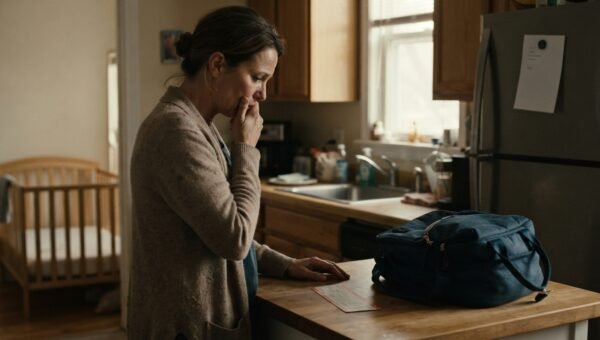
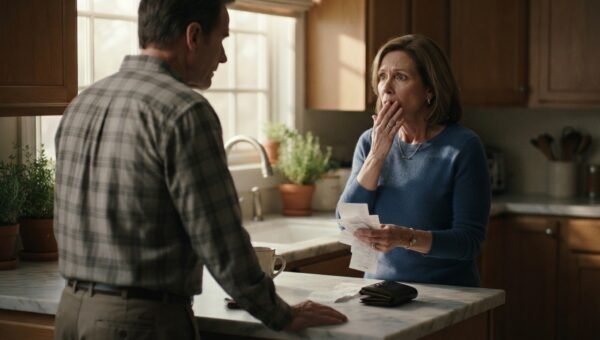
When I stepped into the kitchen and laid the thick, dust-covered folder right in the center of the butcher-block island, the color instantly drained from her face. She didn’t reach for the papers. She just stared at them, her hands freezing mid-motion over the bubble wrap, her lips parting in a silent, panicked gasp.
“You’re moving to Arizona alone, Clara,” I said, my voice steady, quiet, and entirely devoid of the trembling hesitation she had trained me to feel for decades. “And you’re going to pack every single box yourself. Because I’m not going with you, and I’m certainly not giving you another dime of my hard-earned money.”
She opened her mouth to speak, to start the old routine of sighing, of playing the victim, of manufacturing a crisis to pull me back under her thumb. But for the first time in my life, I didn’t wait to hear it. I turned my back on her, walked out the front door into the bright afternoon sunlight, and locked the door behind me with a clean, satisfying click.