PART 1
When Karen and I were twenty-two, sitting in the cab of my beat-up Ford on the gravel turnaround behind the grain elevator, she looked me straight in the eye and told me she was never having children. She did not say maybe someday. She did not say when we have money or when the house is bought. She said her body was hers, her life was hers, and if I needed a nursery down the hall, I needed to let her go right then.
I was twenty-two and so in love with her that the room tilted whenever she walked in. I told her I chose her. I meant it.
Over the next twenty-three years, we built a quiet, comfortable life in eastern Iowa. We had our routines, our garden, two lab mixes that aged and passed away, and a house paid down to the final five years of the note. Did it pinch sometimes? Yes. In my early thirties, every baby shower felt like someone tapping on a bruised rib. When my younger brother had his girls, I held them until their heads grew heavy against my shoulder, and then I went home to Karen and we had supper in our quiet kitchen. I never threw it in her face. I made my peace with it because I thought we were sharing the exact same reality.
Then last October, Karen started volunteering at the Northside Community Youth Center in Cedar Rapids.
She was fifty-two. She had spent thirty years working as an accountant for a regional farm supply outfit, staring at ledgers and spreadsheets.
The volunteer work seemed out of nowhere, but people hit fifty and look around for meaning. I set up her direct deposit mileage tracking and kissed her cheek when she left on Tuesday and Thursday afternoons.
Within three weeks, every conversation in our house had one name running through it: Caleb.
Caleb was quiet. Caleb was working two jobs while trying to get an associate degree in diesel mechanics. Caleb had an old Buick with a cracked radiator hose, and Karen actually asked me if I had spare hose clamps in the pole barn.
“He just needs someone in his corner, David,” she told me over pot roast one Tuesday. Her eyes were bright in a way I had not seen in ten years. “He grew up in state care, mostly. Group homes around Waterloo. He doesn’t trust easily, but he talked to me today for almost an hour about his night shift.”
“That’s good,” I said, cutting my meat. “It’s good you’re helping him.”
By Christmas, it was not just Tuesdays and Thursdays. She was packing extra lunches in plastic containers. She was buying warm wool work socks at the farm store and leaving them on the entryway bench. When I asked her why she was spending eighty dollars on winter boots from Fleet Farm, she snapped that a boy without decent boots could lose his toes in this frost.
The snap in her voice caught me off guard. Karen was always measured, always calm.
In late January, our hot water heater gave out on a Saturday morning. I spent four hours in the crawl space sweating and swearing, hauled the old tank out to the gravel, and came into the kitchen expecting a cup of coffee. Karen was sitting at the island, typing on her phone, smiling at the screen.
“Could use a hand with the dry mop,” I said, wiping rust off my forearm.
She did not look up. “Caleb passed his electrical diagnostics exam. He sent me a picture of the certificate.”
Something ugly twisted in my chest. It was small, petty, and hot. I am not proud of it. I had spent twenty-three years swallowing the quiet house, swallowing the empty bedrooms, convincing myself that neither of us had a maternal or paternal bone in our bodies. Yet here she was, glowing over a stranger’s twenty-year-old kid like he had hung the moon.
“That’s nice,” I said, my voice flatter than I intended. “Glad he knows how to wire an alternator. I’m going to take a shower.”
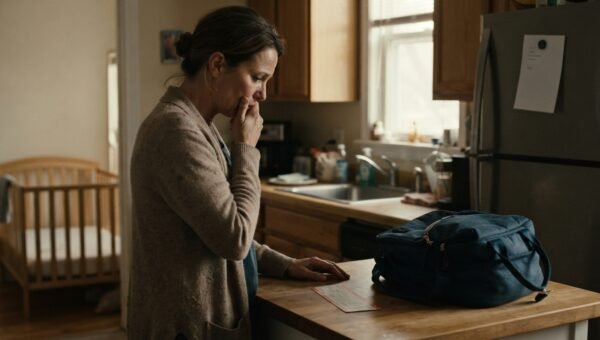
The breaking point came two weeks ago, on a Thursday night. Karen came home almost two hours late. Supper had gone cold in the oven. When she walked through the side door, she had grease on the cuff of her cream-colored wool sweater.
“His water pump failed in the grocery store parking lot,” she said, breath coming fast as she kicked off her snow boots. “I sat with him until the tow truck arrived. He didn’t have enough on his debit card to cover the hookup fee, David. I had to put it on our card.”
I stood by the kitchen sink. The house was dead quiet except for the hum of the refrigerator.
“How much?” I asked.
“A hundred and forty dollars. I wasn’t going to leave him on the curb in five-degree weather.”
“You bought him boots. You buy his lunches. Now you’re paying his tow bills,” I said, my voice rising before I could catch it. “You’re treating him like the son you never wanted with me.”
The kitchen went dead still.
I expected her to yell. I expected her to tell me I was being ridiculous, or selfish, or cold.
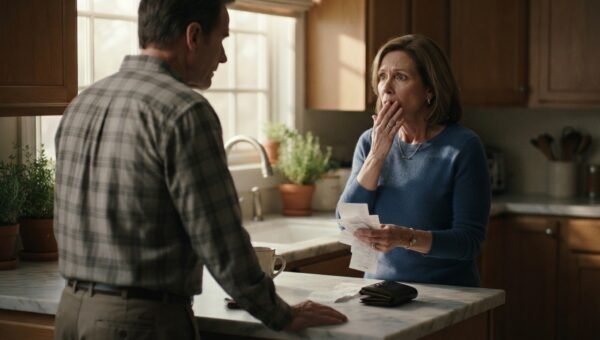
Instead, Karen’s face collapsed. The color washed completely out of her skin, leaving her gray around the lips. She pulled her hands up to her mouth, let out a sharp, choked gasp, and turned on her heel. She ran down the hallway into our bedroom, and the latch clicked shut.
I stood there in the kitchen, feeling like the biggest bastard on earth. I had crossed a line we had drawn in 2001. I slept on the living room recliner with an old wool throw pulled over my chest, listening to the wind rattle the storm windows, waiting for morning so I could apologize.
PART 2
At six in the morning, the light was just creeping over the snowdrifts outside the kitchen window. I smelled coffee brewing.
I got up, stiff-backed from the recliner, and walked into the kitchen ready to tell Karen I was sorry. I had planned the words: I was tired, I was insecure, I had no right to begrudge a kid getting help.
Karen was sitting at the kitchen table. She was dressed in her dark slacks and a navy cardigan, sitting straight as an arrow, hands folded in her lap. Her eyes were swollen, red-rimmed, and dry.
In front of her, precisely centered on the oak tabletop, sat a sealed manila envelope.
“Sit down, David,” she said. Her voice was completely steady, which terrified me far more than if she had been crying.
I pulled out the ladder-back chair across from her and sat. “Karen, listen to me. What I said last night about you treating that boy like a son, it was ugly. I was angry about the tow truck and I took a cheap shot. I’m sorry.”
She did not blink. She slid the envelope three inches across the table toward my fingers.
“Open it,” she said.
The clasp was bent open already. Inside was a single piece of heavy paper, folded once. It was an official state record from the Iowa Department of Public Health, bearing an embossed seal from nineteen ninety-eight.
Mother’s Name: Karen Marie Jensen. Age: 17.
Father’s Name: Blank.
Child’s Name: Caleb James Jensen.
Date of Birth: October 14, 1998.
I stared at the name. My brain refused to assemble the letters into meaning. I looked at the date. Nineteen ninety-eight. We met in the fall of two thousand. When I took her to that gravel turnaround behind the grain elevator and she told me she never wanted children, this child had already been alive in the world for two years.
“He’s twenty-six,” I whispered, the arithmetic failing in my throat before I caught it. “He’s not a teenager.”
“He was born when I was a senior in high school,” Karen said. She was looking at the salt shaker, not at me. “My parents sent me to an aunt in Mason City for six months. They told everyone at church I had mono. When he was born, my father told the agency it was a closed surrender. They took him straight from the delivery room. I never held him. I never even saw his face.”
The grandfather clock in the dining room ticked three times. The sound felt deafening.
“You told me you didn’t want kids,” I said. My hands were shaking so hard the state seal rattled against the table. “You looked me in the eyes, Karen. For twenty-three years.”
“I couldn’t,” she whispered. Her voice cracked, the first break in her composure. “If I told you I wanted a family, I would have had to tell you I gave one away. My father made me swear on the family Bible that it was buried. He said no decent man would ever marry a girl who threw her baby to the state. And then Caleb got bounced around. The couple that took him gave him back after two years when their own biological child was born. He fell into the system. I didn’t know that until last fall.”
“How did you find him?”
“I didn’t find him,” she said, looking up at me now, tears finally spilling down her hollow cheeks. “The state opened the adoption registry records two years ago. He found me. He hired an intermediary through the youth center. When he tracked down where I lived, he started showing up at Northside just to look at me. Two months ago, he finally cornered me in the supply pantry and asked me why I left him.”
PART 3
The air left my lungs. The entire foundation of my marriage had just cracked open, revealing a cellar full of ghosts I knew nothing about.
“Why didn’t you tell me?” I demanded, the shock turning into a cold, sick burn. “You let me sit here and act jealous. You let me bring him socks and talk about his alternator. You lied to me every single day for twenty-three years, Karen.”
“Because I was ashamed!” she cried out, slamming both palms down on the table. The coffee cups rattled. “Every time you looked at your nieces with that quiet ache on your face, I died inside. You think I didn’t see you holding my brother’s babies? You wanted a child so badly, David, and I was so terrified that if you knew I had borne a son and left him in an institution, you would look at me like the monster my father told me I was!”
We sat in that kitchen for four hours while the sun climbed and melted the frost on the glass.
There were no easy words. I walked out to the pole barn twice just to stand in the cold and breathe diesel fumes until my heart stopped hammering. Every memory we had together felt stained. Our trips to the Ozarks, the quiet evenings reading by the woodstove, the silent agreement that it was just the two of us against the world. It hadn’t been just the two of us. There was a boy sleeping on thin mattresses in Waterloo group homes while I was buying Karen silver earrings for our tenth anniversary.
When I came back inside the second time, she was packing an overnight bag.
“What are you doing?” I asked.
“He asked me to meet him for breakfast at the diner off Highway 30,” she said quietly. Her bag was small, zipped shut on the bed. “He wants to know who his father was. And then I think I should stay at a motel in town for a few days to give you room to call a lawyer.”
I looked at the small suitcase. Then I looked at the framed picture on our dresser from our wedding day in June of two thousand one. Karen looked so young, smiling with her veil blowing across her cheek, holding my arm like I was the only solid thing on the planet.
“His father,” I said. “Who was he?”
“A boy from the vocational track who dropped out and moved to Texas before I even knew I was pregnant,” she said, looking down. “He’s dead. Car wreck in two thousand eight. There’s nobody else, David. There’s just Caleb. And he has nobody.”
I stood in the bedroom doorway for a full minute.
My marriage was built on a lie of omission that had hollowed out a piece of my own life. That was a fact. I could call an attorney, split the equity in the house, divide the retirement accounts, and spend my sixties being bitter and right. I had every legal and moral justification to walk away.
Or I could look at the woman I had promised to protect when we were kids ourselves, who had been carrying a stone in her chest since she was seventeen years old.
“Unpack the bag,” I told her.
She looked up, startled. “David, you don’t have to pretend—”
“I’m not pretending anything,” I said, my voice thick. “I’m furious with you. I don’t know when I won’t be furious with you. But you’re not going to a motel, and you’re not driving out to Highway 30 alone.”
ENDING
The Parkway Diner smelled of burnt toast and old frying oil.
We sat in a booth near the emergency exit. Karen sat next to me, her hands tucked underneath her thighs to keep them from shaking. Across from us sat Caleb.
Up close, without the grease on his face, the Jensen blood was unmistakable. He had her exact mouth, narrow and slightly crooked at the left corner, and the same dark, deep-set eyes that had caught me twenty-five years ago. His knuckles were raw from turning wrenches in an unheated shop. He wore a faded Carhartt jacket with the collar frayed down to the white batting.
He didn’t look at Karen. He looked at me.
“Are you the husband?” he asked. His voice was deeper than mine, rough around the edges.
“I’m David,” I said.
“She tell you I was a mistake?” he asked, blunt as a sledgehammer.
Karen let out a soft, wounded noise, but I put my hand flat over her wrist.
“She told me her father made her give you up,” I said, keeping my eyes locked on his. “And she told me she was terrified to tell me because she thought I would leave her.”
Caleb shifted in the vinyl booth. His eyes darted to Karen’s face, seeing her red eyes, seeing the way she leaned toward him like a plant toward a lamp. The anger in his jaw didn’t disappear, but the tension slackened by a fraction of an inch.
“I didn’t come to break up your house,” Caleb said, looking down at his paper place mat. “I just wanted to know if she remembered my birthday. That was it. In the homes, nobody remembers unless you write it on the chore board yourself.”
Karen broke then. She reached across the table, not asking for permission, and laid her palm over his scarred, grease-stained knuckles.
“Every October fourteenth,” she wept, her forehead almost touching the formica table. “Every single October fourteenth of my life, Caleb. I sat in my car and I said your name.”
He didn’t pull his hand away. He didn’t squeeze back, but he didn’t pull away.
That was six months ago.
We have not fixed everything. Some evenings, I walk down the hall past the spare bedroom we used for storage for two decades, and a wave of grief hits me so hard I have to sit down on the laundry hamper. The lie still sits between Karen and me, a hairline fracture in the bone that aches when the weather turns cold. Trust does not snap back into place just because you understand why someone was afraid.
Last Sunday, an old blue Buick pulled into our gravel turnaround.
Caleb got out, carrying a metal toolbox. He didn’t knock; he just walked around to the pole barn where my tractor was idling rough on two cylinders. He stood in the barn doorway with the morning sun at his back, wiped his hands on an old red shop rag, and asked if I had a three-quarter-inch socket he could borrow.
I handed him the tool. We didn’t talk about the past twenty-six years. We bent over the engine block together, shoulder to shoulder in the dust and cold iron, and we went to work.