PART 1
When my husband cracked my ribs and walked out the door, my five-year-old son did not cry first. He listened.
He listened to the truck tires spit gravel down the driveway of our rental on the outskirts of Tyler, Texas. He listened to the front door spring groan after the slam that made the kitchen ceiling light flicker. Most of all, he listened to the wet, shallow sound of my breathing against the linoleum, where the cold floor pressed against my bruised cheek and the taste of copper sat heavy on my tongue.
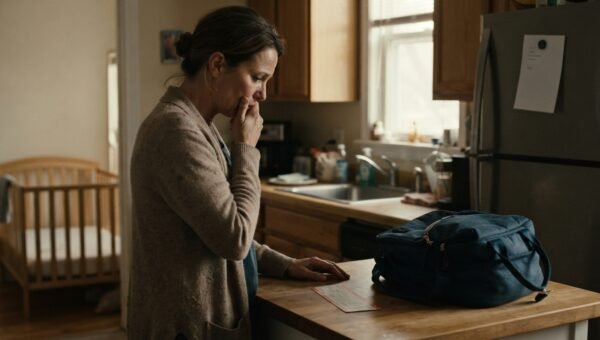
Mark had lost his temper over a stack of unpaid electric bills sitting by the toaster. When I told him the joint checking account had sixty-eight dollars left until Friday, his hand went straight across the counter. The shove sent me over a wooden chair, and the corner of the rung caught my rib cage on the way down.
I could not draw enough air to yell. Every half-inch of breath felt like a dull nail dragging across my chest.
Then Noah crawled across the kitchen floor. He was small for five, dressed in his dinosaur pajamas with the faded knees. He did not ask if I was okay. He simply reached under the fallen kitchen chair, dragged my cracked phone across the floor, and held it with both small hands like it was something sharper than a knife.
“This is what Grandpa is for,” Noah whispered.
His thumb found the green call icon and pressed the name at the top of the contact list: Daddy.
My father, Arthur Vance, was seventy-one years old and lived forty minutes west in Van Zandt County.
He was a retired heavy-equipment mechanic who still smelled like diesel, WD-40, and black coffee. Arthur spoke maybe twenty words on a loud day. When Mark and I got married six years earlier, my father had stood by the buffet table, looked at Mark’s shiny leased pickup and pressed western shirts, and told me quietly, “A man who spends that much time proving he is big usually hides how small he is.” I had rolled my eyes back then. I thought Arthur was just being stubborn.
Noah pressed the speaker button with his thumb.
The line rang twice.
“Yeah, Claire,” my father answered. His voice came through the tiny speaker, dry and steady, competing with the hum of the country radio station he kept on in his barn workshop.
Noah leaned close to the microphone. “Grandpa. Daddy pushed Mama over the chair. She cannot breathe right and she cannot get up off the floor.”
The line went completely dead for three seconds. The background radio cut off sharply, like Arthur had reached out and turned the dial with one hard flick of his wrist.
“Noah,” my father said. His tone did not jump an octave. It did not sound frantic. It got lower and thicker, dropping down into the register he used when a tractor winch slipped. “Is Mark in that house right now?”
“No,” Noah said. “He got in the truck. He kicked the screen door open and went down the road real fast.”
“Put the phone next to your mama’s ear,” Arthur told him.
Noah placed the plastic casing against my temple. The vibration of my father’s breath sounded right inside my skull.
“Claire.”
“Daddy,” I managed to whisper. The air barely made the word work. “It hurts to breathe. Left side.”
“I hear you, baby,” Arthur said. “Do not try to stand up. Just stay flat. Noah, you hear me?”
“Yes, Grandpa.”
“Go to the bathroom, pull the clean yellow towel off the rack, and fold it under your mama’s head. Then you sit on the floor where she can see your eyes. Do not unlock that front door for anybody until you see my white dually pull up. I am leaving the shop right now. I have the county sheriff on my landline while we are talking.”
“Okay,” Noah said.
“Twenty-five minutes,” Arthur told us. “Keep the phone on.”
The line stayed open. As Noah ran on his bare feet to fetch the towel, all I could hear over the speaker was the heavy slam of my father’s shop door, the jingling of heavy keys, and the deep, uneven rattle of his old diesel engine turning over in the yard.
PART 2
The twenty minutes before my father arrived stretched out like hours. Noah brought the towel, tucked it under my head with careful, trembling fingers, and sat cross-legged next to my shoulder. He did not say another word. He just held the hem of my shirt.
When the headlights swept across our living room curtains, it was not one vehicle. It was two. Arthur’s white dually swung into the rutted driveway, followed immediately by a white-and-gold county sheriff cruiser.
Arthur walked through the front door first. He had his heavy grease-stained denim jacket on, and his work boots sounded solid on the floorboards. Deputy Miller, a younger man from the precinct Arthur had known since childhood, stepped in behind him with a first-aid kit and a radio on his shoulder.
Arthur did not start yelling. He did not ask me foolish questions. He knelt down beside Noah, put one wide, calloused hand flat on my forehead, and checked my face.
“Ribs are cracked, Miller,” Arthur said without looking back. “Call the EMT rig up from the county line. Tell them to take her into Mother Frances in Tyler.”
Deputy Miller nodded and stepped back out onto the porch to talk into his shoulder mic.
“Daddy,” I whispered, tears finally leaking out of the corners of my eyes from the raw relief of seeing him. “He took the truck. He said he was going to empty the bank.”
“Let him take the truck,” Arthur said quietly, pulling his jacket off and folding it over my chest to keep the chill away. “He does not own that truck. The bank owns that truck. And the sixty-eight dollars in that account will not buy him what he thinks it will.”
He looked at Noah. “Pack your backpack, buddy. Clothes for three days, your school shoes, and that red fire truck. Put it on the porch.”
Noah stood up instantly and ran down the short hall. When a child sees an adult in complete control, the terror stops spreading.
The paramedics arrived twelve minutes later. They loaded me onto a backboard, slid me into the ambulance, and confirmed on the portable monitor that two of my lower left ribs were fractured. Deputy Miller took my official statement right there in the driveway while the EMTs secured the straps. I gave him every detail: the argument over the bills, the shove, the exact words Mark yelled before he slammed out.
“We have an active domestic battery report now, Claire,” Miller said, jotting notes on his carbon pad. “The magistrate will issue a temporary protection order the minute the hospital report files. If he shows up at your house or Arthur’s, he goes straight to county lockup.”
Arthur rode in the front seat of his truck with Noah right behind the ambulance. At the hospital in Tyler, the doctors strapped my ribs, ran scans to ensure my left lung was not punctured, and kept me overnight for observation. Arthur stayed in the hard plastic chair next to my bed until sunrise. He never once said, “I told you so.” He just handed me sips of water through a bendable straw and kept Noah asleep under an extra hospital blanket on the corner sofa.
At eight in the morning, the hospital room phone rang. It was the landline hooked to the wall by the bed. I could not reach it, so Arthur picked it up.
He held the receiver to his ear. The voice on the other end was loud enough for me to hear from the bed.
It was Mark. He sounded frantic, with highway wind blowing hard in the background.
“Claire? Tell your old man to stay out of my business. I came back by the rental to get my clothes and there’s a sheriff’s deputy parked at the end of the gravel. What kind of lie did you tell them?”
Arthur did not raise his voice. He did not curse.
“Mark,” my father said into the plastic receiver. “You are not talking to Claire. You are talking to Arthur. You listen to me very carefully, because this is the only time I will explain this to you.”
PART 3
There was a short silence on the line. Mark tried to cut in with his usual bluster. “Arthur, you do not know what happened. She came at me over the checkbook, I barely touched her, and she tripped over that damned chair—”
“Deputy Miller took the photographs of the kitchen,” Arthur said, cutting him off cold. “The chair rung has your boot print where you kicked it into her side. Claire has two broken ribs in a county hospital bed. The emergency protective order was signed by Judge Henderson at seven-thirty this morning.”
“You cannot kick me out of my own home!” Mark shouted.
“It is not your home,” Arthur said. “The lease on that house is in my name. I co-signed it when you two moved back from Longview because your credit score was under five hundred. The rent check comes from my farm account on the first of every month. I gave the landlord thirty days’ written notice forty-five minutes ago, and Deputy Miller has the keys to change the deadbolts.”
Mark’s voice cracked over the speaker. “What about my truck? All my tools are in the back!”
“Your truck was repossessed three hours ago,” Arthur told him plainly. “The bank has been looking for that Ford since November. When I called the sheriff’s dispatch last night to report the assault, I gave them your license plate and the lienholder’s address. The bank had a tow truck waiting at the diner where you stopped for breakfast.”
I watched my father’s face as he spoke. There was no anger on it. It was the same look he had when he took a ruined diesel engine apart piece by piece to see which piston had burned through the block. He was simply laying out the reality Mark had spent five years running away from.
“You ruined me, Arthur!” Mark screamed. “I have nowhere to go!”
“You made your own choices, son,” Arthur said. “You walked out of that house leaving a woman broken on the floor while your five-year-old child watched her bleed from the mouth. If you come within five hundred yards of Claire, Noah, or my property line, Deputy Miller will not be writing a ticket. He will be putting you in a cell. Do you understand me?”
Mark did not answer. He hung up the phone with a sharp click.
Arthur slowly set the receiver back in the plastic cradle. He turned around, walked over to the bed, and checked the IV drip hanging above my shoulder.
“He is done, Claire,” Arthur said. “You do not have to look over your shoulder anymore.”
“Daddy,” I said, my voice shaking as the reality began to sink in. “I do not have anything left. The bank account had sixty-eight dollars in it. The house is gone. What am I going to do with Noah?”
Arthur pulled his wallet out of his back pocket, took out a folded piece of white notebook paper, and set it on my bedside table.
“Look at that,” he said.
I picked it up with my right hand, being careful not to twist my ribs. It was a printed statement from the First State Bank in Canton. It was an escrow savings account opened four years ago, carrying my name and Noah’s name. The balance at the bottom was fourteen thousand two hundred dollars.
“Every month you gave Mark cash for your half of the truck payment,” Arthur said, “he brought me an excuse about why he was short on the rent. I paid the landlord directly out of my pocket, but I took every dollar of the rent reimbursement you handed me and put it in this account. I knew the day would come when you would need to walk away clean. That money is yours. It was always yours.”
ENDING
Two days later, the hospital discharged me with a rib brace and a prescription for pain management.
We did not go back to the rental house. Deputy Miller and two of my cousins went over on Saturday morning, packed every piece of clothing belonging to me and Noah, boxed up the kitchenware, and loaded Noah’s bed into a trailer. Mark’s belongings were placed in a secure storage unit in town, and the key was mailed directly to his sister’s address in Louisiana along with a copy of the restraining order.
Arthur drove Noah and me out to his place in Van Zandt County.
He had already cleared out the large spare bedroom on the east side of the farmhouse. The window looked out over the back pasture where the coastal hay was just starting to green up after the winter rain. Noah’s red fire truck was sitting on the wooden dresser, and Arthur had put new blue flannel sheets on the twin beds.
Mark tried to send messages through mutual acquaintances twice over the next month, begging to talk, claiming he had changed and that stress had made him snap. Deputy Miller visited him at his workplace once, showed him the violation paperwork, and the messages stopped permanently. The divorce went through the county court six months later. Because of the police report, the hospital documentation, and the emergency protective order, the judge granted me full custody with supervised visitation that Mark never bothered to claim.
Noah will be seven this coming spring.
Yesterday afternoon, I sat on the back porch steps watching him help my father grease the fittings on the bush hog. Noah had grease smeared across his forehead and a small adjustable wrench tucked into his back pocket, mimicking every move Arthur made.
When Arthur finished tightening the bolt, he patted Noah on the back and pointed toward the barn. “Go wash up with the pumice soap, buddy. Your mama has chicken on the stove.”
Noah ran toward the washbasin by the pump house, his boots kicking up dust in the late sun.
My ribs still ache sometimes when a hard cold front blows down from Oklahoma. But every time I feel that slight stiffness in my left side, I do not think about the linoleum floor or the sound of truck tires on gravel.
I think about a five-year-old boy crawling through the dark with a cracked phone in his hands, knowing exactly who to call, and the seventy-one-year-old man who made sure that boy would never have to be afraid in his own home again.