PART 1
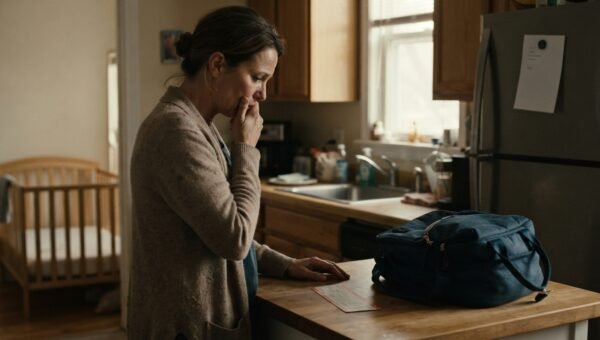
For three years, I carried the weight of being the family villain. My younger brother, Kevin, had spent months building up a mid-sized Italian bistro in town, pouring every bit of savings and borrowed capital into it. When he came to my kitchen table asking me to co-sign a commercial equipment loan for forty thousand dollars, my heart sank. I loved Kevin, but I had worked twenty-eight years as an administrative assistant at the county hospital, saving every spare dollar into a modest pension and a safety net for my own retirement.
I knew what financial ruin looked like. I told him no, gently but firmly, explaining that I could not risk the roof over my head.
Kevin did not just accept the refusal. He detonated our relationship. He slammed his coffee mug down so hard it cracked against the laminate, stood up, and called me cold, unsupportive, and bitter. Within forty-eight hours, the narrative across our entire extended family was set in stone. According to Kevin, I had actively rooted against his success from day one. My phone stopped ringing. My cousins uninvited me from holiday dinners. Even my mother looked at me with a quiet, disappointed pity at family gatherings, as if my caution had personally sabotaged her son’s American dream.
A year later, the restaurant collapsed under a mountain of debt and unpaid vendor bills. The foreclosure notice was pasted to the front glass of the bistro on a rainy Tuesday.
Instead of looking inward, Kevin and his supporters treated the closure as a tragedy I could have prevented. If I had just co-signed that loan, they whispered, the cash flow would have saved him. I absorbed the glares at grocery stores, the chilly silence at family functions, and the heavy, isolating loneliness of being universally misjudged. I kept my head down, continued working my hospital shifts, and tried to find peace in the quiet of my small home.
Then our father passed away. Dad had always been a quiet, steady man who kept his emotions locked behind thick glasses and a newspaper. He supported Kevin’s entrepreneurial spirit with words, but managed his own affairs with absolute privacy. When he suffered a sudden stroke on a Thursday morning, the hospital visits were a blur of sterile hallways, quiet tears, and final goodbyes. Kevin was front and center at the hospice bedside, red-eyed and loud in his grief, positioning himself as the grieving patriarch’s primary protector.
The funeral was exhausting. Relatives flew in, condolences were muttered, and the heavy fog of mourning settled over us all. But the moment the final shovel of dirt hit the ground at the cemetery, Kevin dropped all pretense of mourning and shifted straight into aggressive logistics. He cornered me near the back of the SUV before we even left the parking lot. He demanded that I hand over Dad’s old leather briefcase, the heavy one Dad kept locked in the bottom drawer of his home office desk. Kevin insisted, with a desperate edge to his voice, that Dad had promised him his important personal papers and business files years ago. His demand was so immediate, so frantic, and so entirely inappropriate for a burial afternoon that it sent a sharp jolt of suspicion straight through me.
PART 2
I did not give Kevin the briefcase. I looked him dead in the eye, told him we were burying our father and that his paperwork could wait until the weekend, and loaded the heavy leather case into the trunk of my own car.
Kevin practically vibrated with rage, threatening to call our aunt and uncles to force the issue, but I locked the doors and drove straight to my own house. I placed the briefcase on my dining room table, making sure the curtains were drawn tight against the late afternoon light.
The lock was an old-fashioned brass combination. I tried Dad’s birthday, my own birthday, and our mother’s anniversary, all without success. Then I remembered an old joke Dad used to tell about the year he bought his first pickup truck. I spun the brass dials to nineteen seventy-eight, and with a heavy, satisfying click, the brass latch sprung open.
Inside, the briefcase smelled of aged paper, old leather, and peppermint candies. The top layer held standard documents: his cemetery plot deed, his will leaving everything split evenly between Kevin and me, and a few faded photographs. But underneath a false cardboard bottom liner sat a thick manila folder labeled simply with my father’s neat, cursive handwriting: Kevin – Financial Records.
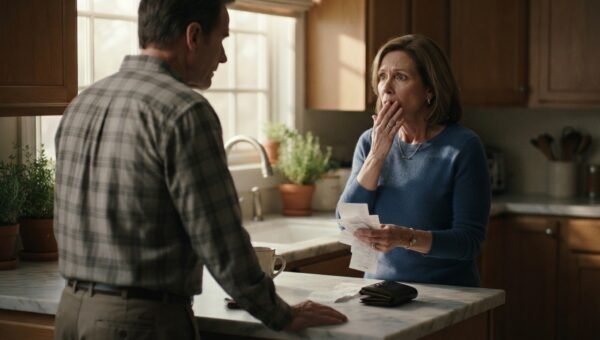
My fingers trembled as I pulled the papers out. The first item was a stack of bank statements from a credit union downtown where Dad held a secondary account. Leafing through them, my breath caught in my throat. Six months before Kevin ever walked into my kitchen asking me to co-sign a commercial equipment loan, a cashier’s check stub for eighty-five thousand dollars had been issued from Dad’s account, made out directly to Kevin.
I sat back in my chair, staring at the numbers in absolute disbelief. Eighty-five thousand dollars. That was more than double the amount Kevin had begged me to risk my credit for. It was nearly all of Dad’s remaining liquid savings, money he had set aside for his own twilight years. I flipped through the rest of the file, finding deposit slips bearing Kevin’s signature, loan payoff notices for sports cars and credit card debt, and frantic letters from Kevin begging Dad to bail him out of high-interest private loans he had taken out to fund the initial build-out of the bistro. Dad had covered for him entirely in secret, draining his own cushion while Kevin played the part of the struggling, self-made entrepreneur who had no one in his corner.
PART 3
The realization settled over me like a sheet of ice, shifting every memory of the past three years into a stark, painful focus. Kevin had never needed my signature to secure a loan because he had already burned through an enormous cash inheritance from our father behind closed doors. When Dad finally drew a hard line and refused to hand over another dime, Kevin had manufactured a crisis, turning to me not out of genuine need, but to create a convenient scapegoat. If I said yes, he got more money. If I said no, which he knew I likely would given my cautious nature, he weaponized my refusal against me. He used my caution as the villain origin story for his failure, ensuring the family would blame me while he hid the fact that he had already squandered eighty-five thousand dollars of our father’s hard-earned money.
I kept reading through the file, looking for the very bottom of the deception, until my eyes landed on a sheet of heavy white stationery clipped directly to the back of the bank statements. It was a handwritten note from Dad, dated just three months before his stroke. His handwriting was shaky, different from his usual sharp cursive, reflecting a man who was deeply tired and carrying a heavy burden of regret.
“If anyone is reading this,” Dad wrote, his words cutting straight through the silence of my dining room, “it means I am gone and the truth has finally come out of the dark. If Kevin tells you I refused to help him, ask him where the first eighty-five thousand dollars went. I kept his secret because I thought it would protect our family peace. I was wrong. I only enabled his destruction and broke your heart in the process. I am so sorry.”
I sat at that table for hours as the sun dipped below the horizon, the paper clutched in my hand. The weight of being the family villain did not vanish all at once, but the suffocating isolation of it fractured completely. The guilt I had carried for refusing to co-sign a loan evaporated, replaced by a cold, clear clarity. Kevin had not just lied to our extended family; he had manipulated our father in his final years, bled his accounts dry, and then built a public campaign of resentment against me to cover his own tracks. The briefcase had finally opened, and there was nowhere left for his lies to hide.
ENDING
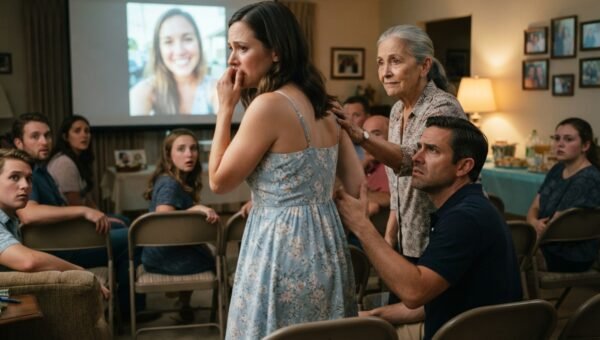
The family memorial dinner was scheduled for the following Sunday at our aunt’s house, a traditional gathering where everyone usually exchanged soft condolences and cast sideways glances in my direction. This time, I decided to attend. I did not go quietly, and I did not go to fight. I placed a single manila folder inside my tote bag, walked into my aunt’s crowded dining room, and found Kevin standing by the kitchen island accepting sympathy from our cousins about how hard it was to settle Dad’s estate without proper cooperation.
When Kevin saw me walk through the door, his expression hardened instantly, his eyes darting immediately to the leather briefcase sitting safely locked back in my trunk. He tried to steer me toward the front door, muttering about how family matters should be handled privately, but I raised my voice just enough to carry across the room. I pulled Dad’s final handwritten note and the bank statements from my bag, laying them flat on the kitchen island right beside the potato salad and ham.
“Before we talk about what Dad left behind,” I said, my voice steady and clear in the sudden, ringing silence of the room, “we need to talk about the eighty-five thousand dollars Dad already gave you before you ever asked me for a dime.”
The color drained from Kevin’s face so fast he looked like a ghost, his mouth opening and closing without sound as our cousins crowded in close to read the copies I had laid out. No one yelled. No one made excuses. The heavy, suffocating silence of absolute shock settled over the room as the truth finally laid itself bare. I did not need to defend myself anymore; the paper spoke every word that needed to be said. I turned around, walked out of the front door into the warm Sunday air, and for the first time in three years, I breathed easily.