PART 1
The phone call came on a Tuesday evening while I was folding laundry in the quiet of my living room. My daughter, Chloe, sounded small and rushed, her voice tight like she was trying to speak through a door while someone stood right behind her. She told me that Thanksgiving at their house was going to be a quiet, scaled-back affair this year. Her husband, Marcus, felt that things had gotten too loud and crowded in past years, and he wanted it kept strictly to immediate family.
I stopped folding a dish towel, holding it against my chest as a cold weight settled in my stomach. Immediate family. For thirty years, Thanksgiving had meant a crowded table at my house, and for the last five years since Chloe married Marcus and bought that big colonial across town, I had baked three different kinds of pies and brought half the dinner. I asked her if she was sure. She gave a little dry, nervous laugh that didn’t reach her eyes, though I could only hear it in her voice. She said Marcus had already planned the menu and they just wanted a low-key day to decompress from work. She told me not to worry about baking anything, and that she would call me on Friday to catch up.
I said I understood. I hung up the phone and sat on the edge of the sofa for a long time, watching the dust motes drift in the late autumn sunlight through the window.
It hurt in a deep, heavy way that felt physical, but I told myself to let it go. Marriages require compromise, and maybe Marcus was stressed about his job at the regional bank or feeling overwhelmed by family obligations. I told myself I was being overly sensitive, an interfering mother reading too much into a simple holiday schedule.
By Wednesday afternoon, however, the silence in my house felt unbearable. I had already bought the tart apples and the fresh pecans, and the ingredients were sitting on my counter waiting to be used. I couldn’t just let them go to waste, and more than that, I wanted my daughter and my grandson to have a taste of home, even if I wasn’t allowed to sit at their table. Early Thursday morning, before the sun had fully cleared the frost off my windshield, I baked two pies: a deep-dish apple with a lattice crust and a rich pecan with toasted nuts.
I packed them carefully into cardboard bakery boxes, tied a red ribbon around each one, and drove the quiet suburban streets over to Chloe and Marcus’s neighborhood.
The morning air was sharp and biting. Frost laced the edges of the manicured lawns. When I pulled my old sedan up to the curb of their house, their driveway was already crowded with Marcus’s shiny black SUV and his brother’s pickup truck. The house looked warm, light spilling from the living room windows, and the rich, buttery scent of roasting turkey drifted faintly on the morning breeze even out by the driveway. I carried the pie boxes up the wide brick steps, feeling a tight knot of longing in my throat. I didn’t want to intrude or cause a scene, so I decided to simply set the boxes on the porch table, ring the bell once, and slip away before anyone opened the door.
I set the boxes down, tucked a small handwritten note under the ribbon wishing them a wonderful day, and pressed the brass doorbell button. As I stepped back toward the top of the steps, the heavy oak front door swung inward an inch or two, caught on the security chain.
Inside, the hallway was loud with the cheerful clatter of silverware and adult laughter. Then came the sound that froze my feet to the cold concrete. It was the sharp, jagged crying of my six-year-old grandson, Leo, muffled by what sounded like a hand or a pillow, followed by Marcus’s voice cutting through the noise with a cold, sharp edge.
“Stop that howling right now, Leo,” Marcus snapped, his tone devoid of any parental warmth. “Grandma isn’t family here, and she’s not coming in. Eat your breakfast and be quiet.”
A chill raced down my spine, sharper than the November wind. Grandma isn’t family here. The words hung in the crisp air, echoing in my ears as the heavy door clicked shut from the inside. I stood frozen on that porch for three agonizing seconds, my chest burning, before I turned around, walked down the steps without knocking, and got back into my car. I drove the entire way home in absolute silence, my hands gripping the steering wheel so tightly my knuckles turned white, tears streaming down my face without a sound.
PART 2
For the next three days, the house felt tomb-like. I didn’t call Chloe, and she didn’t call me. Every time my phone buzzed with a notification, a foolish part of me hoped it would be her apologizing, explaining away Marcus’s cruel words as a moment of stress or misunderstanding. But nothing came. I replayed the phrase over and over in my head. Grandma isn’t family here. How could a man who ate my food, borrowed my lawnmower, and watched me bounce his stepson on my knee decide with such casual venom that I didn’t belong?
The answer eluded me, slipping away every time I tried to grasp it, leaving me with a hollow ache in my chest. I spent Saturday staring out the kitchen window at the bare maples, wondering if I had somehow crossed a line months ago that I didn’t remember. I had always been careful not to overstep, biting my tongue when Marcus made condescending remarks about my cooking or how I managed my retirement savings. I gave them space. I gave them money for Leo’s preschool fund when things were tight two years ago. And this was how I was erased.
Sunday afternoon brought a sharp knock at my front door. It wasn’t the polite, hesitant rap of a visitor unsure of a welcome. It was heavy, hurried, and persistent.
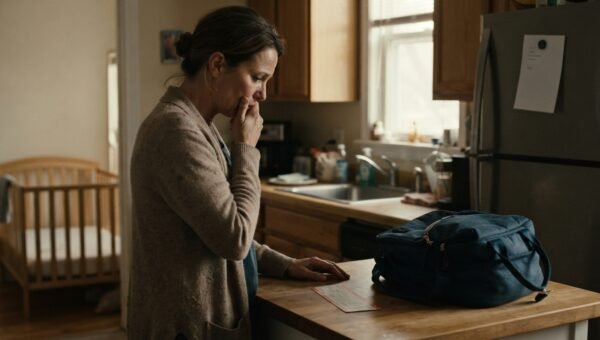
I wiped my hands on a dish towel and walked down the hallway, turning the deadbolt and pulling the door open. Standing on the porch was Chloe. But she looked entirely unraveled. Her hair was pulled back in a messy, loose knot with strands falling across her face, her coat was half-zipped over a wrinkled sweater, and her eyes were red-rimmed and swollen from crying. In her arms, she clutched a heavy, bulging plastic grocery bag by its handles, the plastic stretching and rustling with every shiver of her hands.
“Mom,” she whispered, her voice cracking as she stared up at me. Before I could invite her in or ask what was wrong, she pushed past me into the warmth of the hallway, her shoulders shaking. “Mom, look at what he cut out.”
I closed the front door slowly, my heart hammering against my ribs. Chloe walked into the kitchen and dropped the heavy plastic bag onto the dining room table. She reached inside with trembling fingers and began pulling out thick stacks of old photographs, dropping them onto the polished wood surface in a disorganized, chaotic heap.
PART 3
I stepped closer, looking down at the table. At first, the images didn’t make sense. They were fragments of our family history, printed out over decades. There were glossy 4×6 prints from Christmasses past, faded polaroids from my fiftieth birthday party, and formal studio portraits taken when Chloe was just a teenager.
Then the horrifying pattern came into focus.
Every single picture had a figure cleanly, methodically cut out with sharp scissors or a utility knife. It wasn’t just random damage. The cuts were precise, slicing through faces, bodies, and backgrounds with clinical coldness.
Chloe pulled out a large, framed 8×10 from my wedding day, the glass cracked across the corner. In the photo, my late husband, Arthur, stood proudly beside me, his arm around my waist, while a younger Chloe smiled brightly in a pastel dress standing right in front of us. But Arthur’s face and entire body had been excised from the picture. A ragged, jagged hole shaped like a silhouette gaped in the center of the photo, revealing the floral wallpaper of my dining room table underneath.
“He did this while I was at the grocery store this morning,” Chloe choked out, her hands flying to her mouth as fresh tears spilled over her cheeks. “I found them hidden in the back of his home office closet in a locked metal tin. Every single picture of Dad. Every picture of Uncle David. Every time you and Dad stood together at a milestone. He cut them all out and threw the pieces into the trash bin in the garage.”
I picked up a snapshot from my sixtieth birthday. My brother David, who had passed away three years ago, was completely sliced out of the frame, leaving only empty space between me and my friends.
“Why, Chloe?” I asked, my voice barely a whisper, the shock paralyzing my limbs. “Why would Marcus do something like this? What does he have against your father and David?”
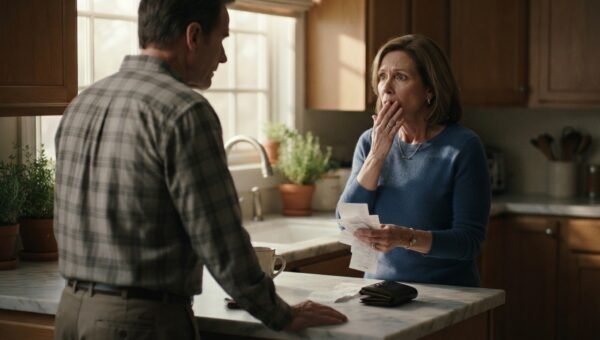
Chloe looked up at me, terror and realization warring in her wide eyes. She reached into the bottom of the grocery bag and pulled out a single, folded piece of heavy parchment paper. It yellowed slightly at the folds, an official-looking document with a raised municipal seal in the corner.
“Because of who David really was, Mom,” Chloe said, her voice dropping to a trembling shudder. “And because of what Marcus found out about our family tree three weeks ago.”
ENDING
I took the document from her shaking hands, my eyes scanning the faded ink of a birth certificate amendment from thirty-five years ago. It was a legal record of adoption and name changes, filed in a county three states away. The names swam before my eyes for a second before the truth landed like a physical blow to my chest.
Arthur wasn’t Chloe’s biological father. Before I met Arthur, I had been married briefly to a man named Richard Vance, a man whose violent past and criminal record I had fled from when Chloe was just a baby, legally changing our names and burying the past where nobody could ever find us. Arthur had stepped in, adopted Chloe as his own, and given us a safe, loving home until the day he died.
“Marcus didn’t just stumble on this,” Chloe whispered, wrapping her arms around herself as if she were freezing. “He’s been doing background checks on families in our social circle for his bank’s wealth-management division. He ran my maiden name through a restricted archival database. He found the old records. And when he found out that my real biological grandfather was Richard Vance—the man who embezzled millions from Marcus’s own grandfather’s firm back in the seventies—he went insane.”
The room went deathly quiet, save for the hum of the refrigerator in the corner. All the pieces snapped into a terrifying, jagged alignment. Marcus hadn’t just banned me from Thanksgiving because he wanted a quiet holiday. He had discovered a generational vendetta, unearthing a decades-old ghost that neither Chloe nor I had ever known existed. To Marcus, I wasn’t just an inconvenient mother-in-law. I was the living link to a family name he had been taught to hate his entire life.
I looked down at the torn photographs scattered across the table, then up at my daughter, whose face was so much like mine and entirely innocent of the sins of the past. The fear in her eyes was palpable, but beneath it, I saw something else hardening into place—the same quiet, stubborn survival instinct that had carried me away from a nightmare thirty-five years ago.
“Pack your bags, Chloe,” I said, my voice steadying as I reached out and gently covered her trembling hand with my own. “You and Leo are not going back to that house tonight. We are going to sit right here, and we are going to figure out how to take your life back from a man who thinks he owns your history.”